 17 minutes
Search engine optimization can feel frightening for many, but it doesn’t have to be. With the right tools, strategies, and implementation, your website can achieve the visibility you want, all without much hassle.
But, ranking a website online starts with two simple questions: ‘What is SEO? and ‘How to do SEO?’
Getting answers to these questions helps you rank your content and reach the right audience at the right time.
In this guide, we will walk you through what SEO is, how search engines like Google work, and how to build a practical SEO strategy from scratch.
By the end, you should understand the search engine basics well enough to start improving your search rankings.
Table of contents
- What is SEO: understanding the fundamentals
- How search engines work: the three core stages
- The four types of SEO: on-page, off-page, technical, and local
- Your step-by-step SEO workflow in 2026
- How SEO is evolving in 2026
- Why SEO matters for your business
- How Contentpen can help you write SEO-optimized content
- Summing it up
What is SEO: understanding the fundamentals
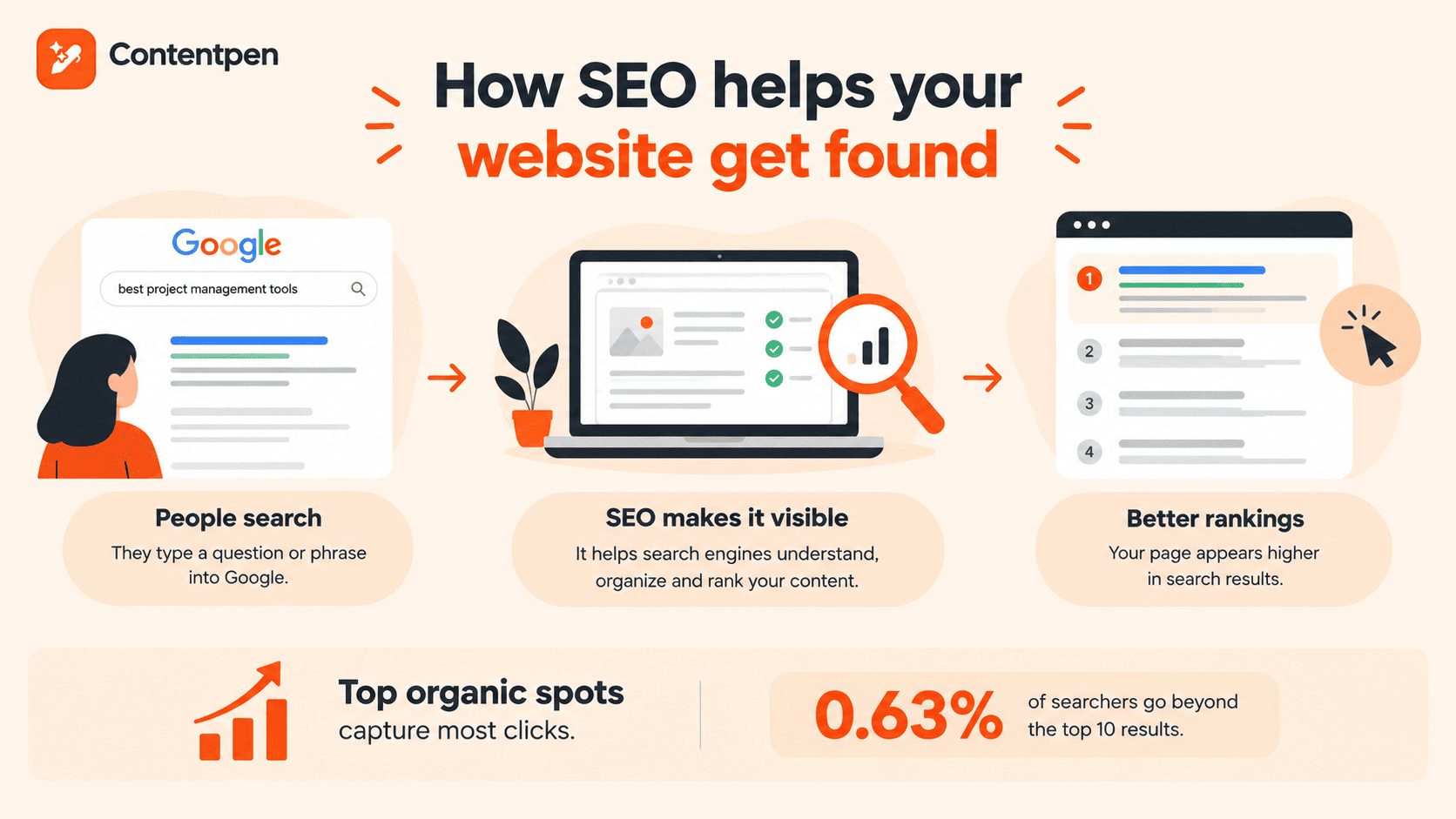
At its core, search engine optimization (SEO) is the practice of improving a website so that search engines can place it well for people.
So when people ask what SEO is, the short answer is that it is how a website earns visibility instead of staying hidden.
When someone types a question or phrase into Google, SEO helps decide whether a page appears near the top, somewhere on page five, or not at all.
The purpose of SEO
Good SEO optimization is less about tricks and more about making helpful content, organizing pages, and fixing technical issues that block search engines.
The main goal is to appear as high as possible in search rankings for important keywords. The top organic spots capture most clicks, with only 0.63% of searchers going beyond the top 10 results.
This shows why SEO in digital marketing is such a high priority for brands and agencies, especially those with tighter budgets for paid ads or PPCs.
Difference Between SEO, SEM, and PPC
SEO sits inside a bigger bucket called search engine marketing (SEM), which covers every way a business can gain traffic from search engines, both paid and unpaid.
Search engine optimization focuses on earning visibility in regular, non-ad results, while PPC (pay-per-click) focuses on paying for ad placements in search results.
Here is a simple comparison:
| Aspect | SEO | PPC |
| Payment | No fee per click; investment is time, content, and tools | Pay every time someone clicks an ad |
| Speed | Slower to see results, but more durable | Very fast visibility, but it stops when the budget stops |
| Perception | Often seen as more trustworthy because it is organic | Seen as advertising, clearly labeled |
| Control | Less control over the exact position | More control through bids, budget, and targeting |
For most brands, the smartest approach is not SEO versus PPC, but combining them. PPC can bring in fast traffic and test which keywords convert, while SEO builds long-term visibility and reduces reliance on ads over time.
How search engines work: the three core stages
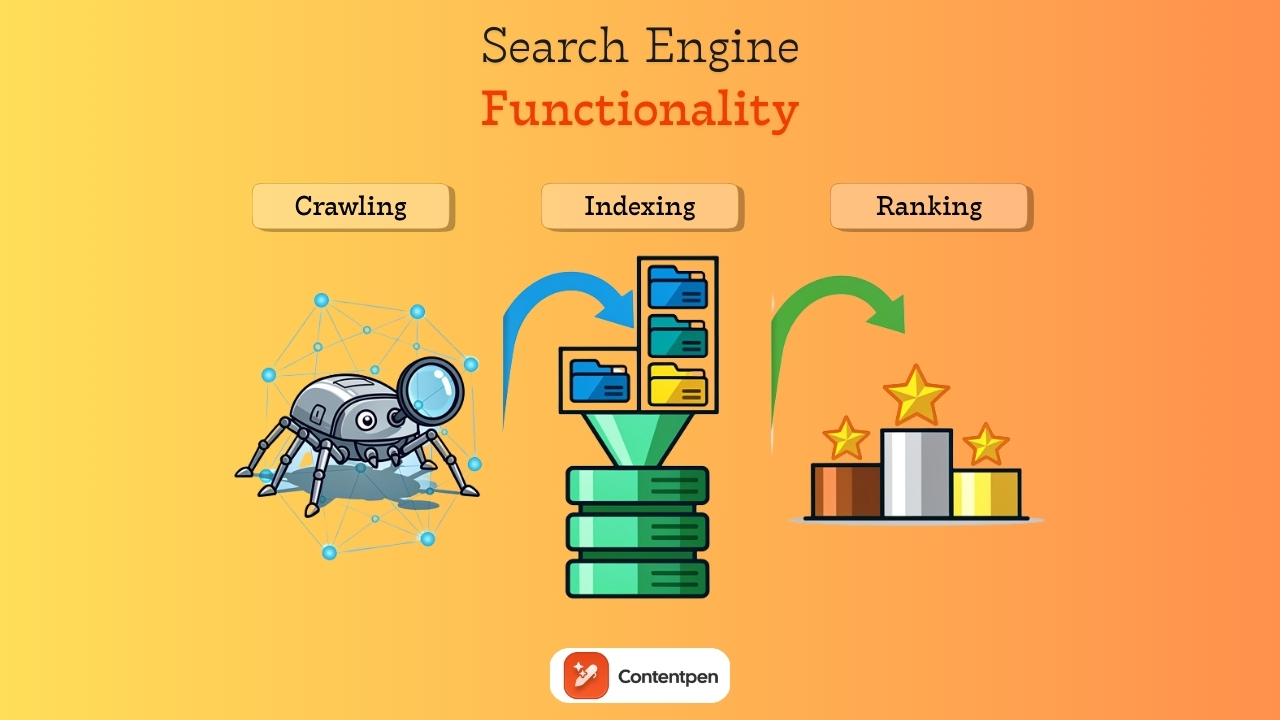
To understand what SEO is in practice, it helps to look at how search engines like Google work behind the scenes. The details are complex, but the basic flow comes down to three steps:
- Crawling – discovering pages
- Indexing – analyzing and storing pages
- Ranking – ordering results for each search
SEO is about making each of these stages as smooth and efficient as possible for both robots and readers.
Crawling: How search engines discover your content
Crawling is the discovery step.
Search engines send automated programs (often called crawlers, spiders, or bots) to move from page to page across the web.
Each link is a path, so when a crawler finds a link, it can follow that link to discover a new page. If those paths are broken or confusing, crawlers may miss important pages.
A site with clear internal links, simple navigation, and logical structure can make a lot of difference for the discoverability of your site.
Indexing: How search engines analyze and store your content
Once a crawler reaches a page, the next step is indexing. During indexing, the search engine reads the page, looks at body content, anchor texts, images, videos, and code, and then stores this information in a massive database called the index.
Pages with clear titles, meta descriptions, headings, and alt text for images are easier for search engines to understand and match to the right searches.
Ranking: How search engines determine the order of results
When someone types a query, Google scans its index for relevant pages and uses many SEO ranking factors to decide which ones appear first.
While there are hundreds of signals in play, focusing on quality content, solid UX, and meaningful SEO backlinks covers the main areas that affect rankings.
Besides this, you should aim to cover LSI terms for better semantic coverage. This practice allows you to rank for more keywords, gaining more traction online.
The four types of SEO: on-page, off-page, technical, and local
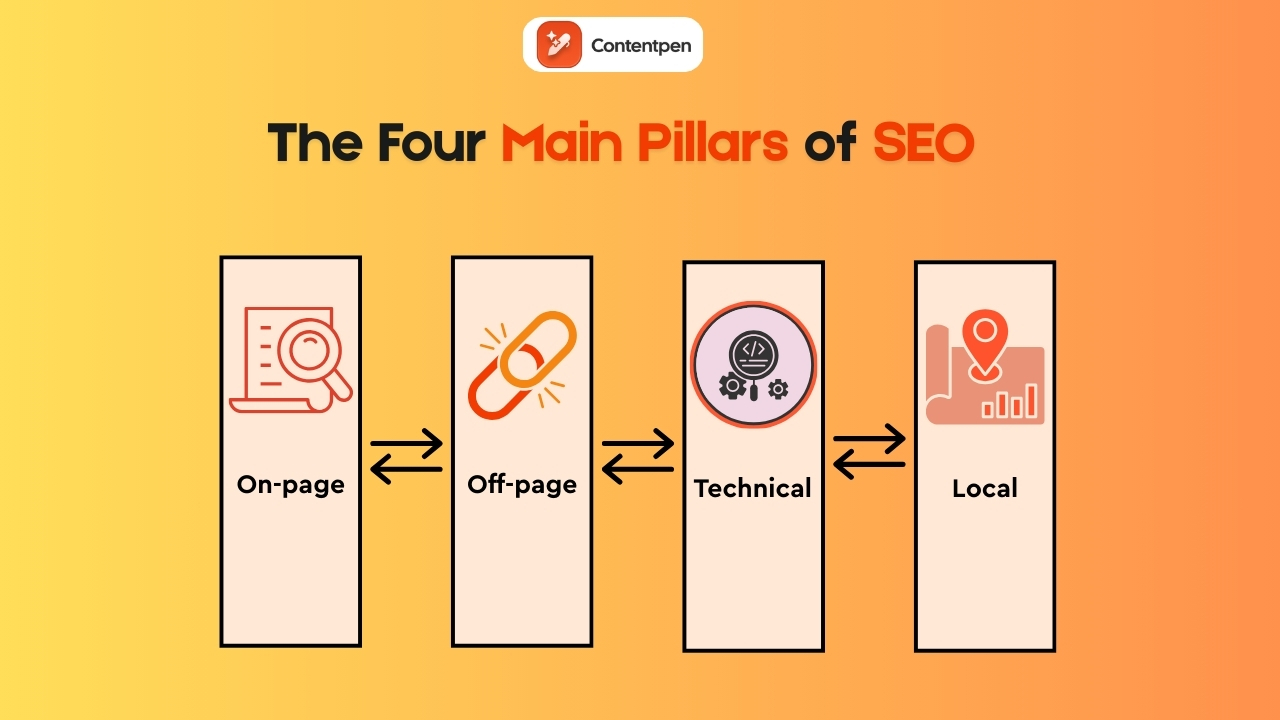
There are four main types of search engine optimization (SEO), often called the SEO pillars:
- On-page SEO – content and HTML on each page
- Off-page SEO – external links and mentions
- Technical SEO – the site’s structure and performance
- Local SEO – the site’s visibility in location-based search results
These define a brand’s presence on the Internet and support each other in one way or another.
For instance, fixing a technical issue can help existing pages rank better. Similarly, publishing better content makes link building easier, and strong backlinks help pages hold their positions during algorithm updates.
On-page SEO: optimizing your content and HTML
On-page SEO covers everything the visitor sees and the HTML that describes it. This is where writers, editors, and content strategists have the most direct control.
Key elements of on-page SEO include:
- Writing content that answers real questions in depth
- Using keyword research to guide topics and wording (without stuffing)
- Structuring content with clear H1, H2, and H3 headings
- Writing descriptive title tags and meta descriptions
- Adding alt text to images for accessibility and image search
- Creating clean, descriptive URLs
- Adding internal links to relevant pages
Many teams now use SEO tools to track an SEO score for each page and catch missing meta tags or weak headings. Platforms like Contentpen help you incorporate this guidance into the writing flow, so on-page optimization happens as content is created.
Off-page SEO: building authority and reputation
Off-page SEO is about how the rest of the web responds to a website. While on-page work explains what a page is about, off-page signals help show how important or trusted that page is.
The biggest off-page factor is SEO backlinks. When another site links to a page, it acts like a recommendation. A link from a respected, relevant site carries far more weight than many links from low-quality sites.
Proper off-page signals include:
- Natural SEO backlinks from blogs, news sites, and partners
- Reddit SEO links from threads and subreddits
- Brand mentions, even when they are not linked
- Positive reviews and ratings on third-party platforms
- Consistent, genuine activity on social channels that encourages sharing
Over time, when your off-page signals grow stronger, you gain topical authority and improve your share of voice in the niche.
Technical SEO: optimizing your site’s foundation
Technical SEO deals with the structure and performance of a site. It addresses how easily search engines can crawl and index pages and how well those pages perform on different devices.
Core areas of technical SEO include:
- Crawlability and indexability
- XML sitemaps
- Robots.txt File Configuration
- Canonical tags
- Stable layouts (good Core Web Vitals)
- Responsive design
- Structured data (schema markup) for products, FAQs, events, etc.
For many marketers, technical SEO can feel intimidating. The good news is that modern website builders, plugins, and tools do much of the hard work, or at least flag problems that you can later fix with ease.
Local SEO: optimizing visibility in location-based searches
Local SEO focuses on helping businesses appear in location-based searches and map results. When someone searches for “coffee shop near me” or “dentist in Austin,” Google prioritizes businesses that are physically close and relevant to that query.
Key elements of local SEO include:
- Google My Business (GMB) profile optimization
- Local citations and consistency in name, address, and phone number
- Location-specific content and keyword usage in content
- Reviews and reputation management
- Earning backlinks from local vendors, news outlets, or organizations
Local SEO works best when combined with the other pillars.
A fast, mobile-friendly site with helpful content and strong backlinks will rank better locally than a poorly built site with just a Google Business Profile.
As search engines evolve, optimization is no longer limited to ranking pages alone. AI-driven systems are now reshaping how information is discovered and presented.
Your step-by-step SEO workflow in 2026
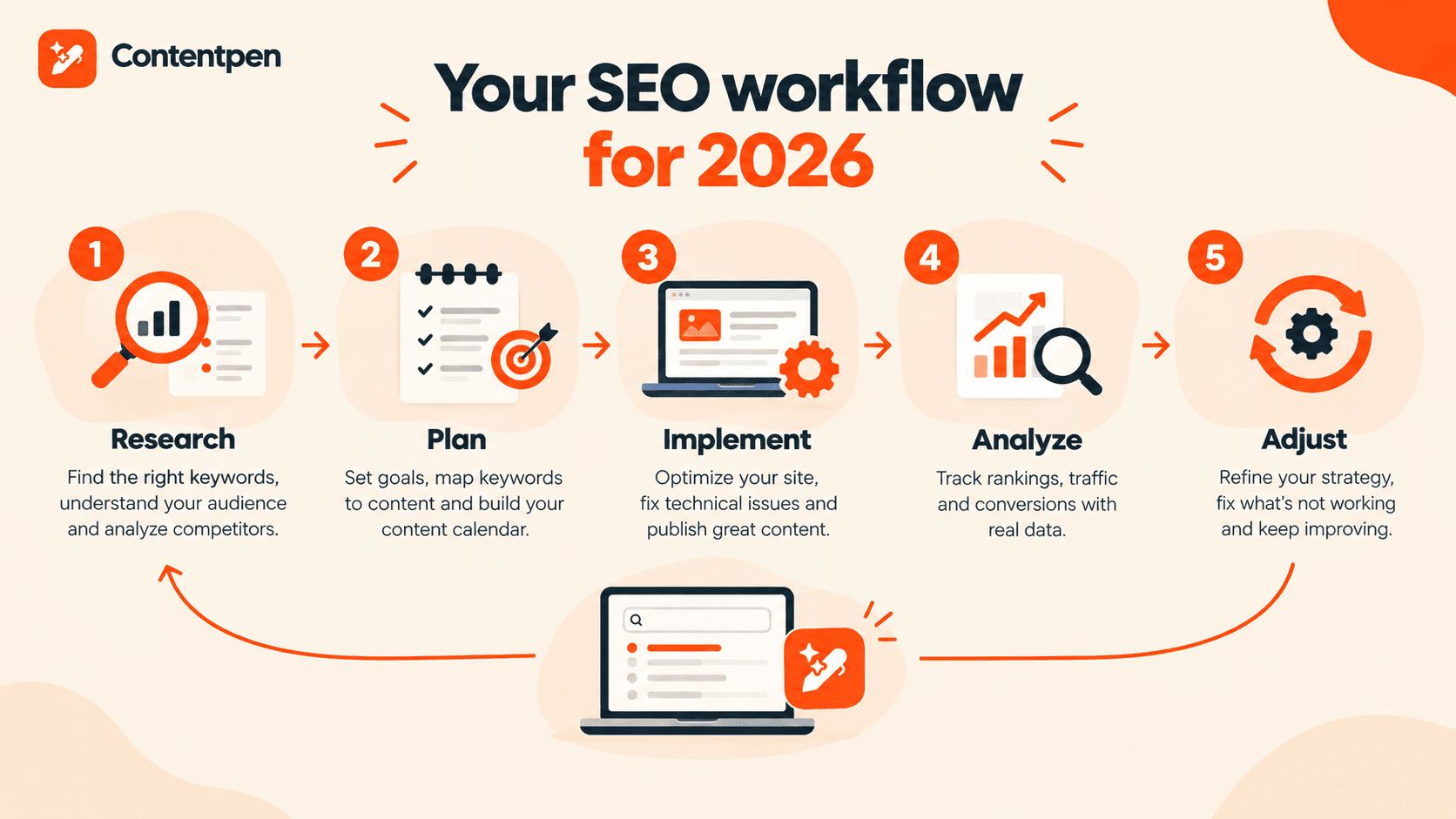
Knowing the fundamentals of SEO is helpful, but results come from following a repeatable process.
SEO is not a one-time checklist – it is an ongoing cycle, one that is built upon the following steps: Research, strategy, implementation, analysis, and adjustments.
A solo writer can use this loop for a single blog post, while a large agency can apply it across hundreds of pages. Tools and platforms like Contentpen fit into this process by reducing work during manual research and content creation while also enabling batch processing.
Step #1: Conducting comprehensive research
A good search engine optimization starts with conducting solid research and an SEO audit. This includes the following elements:
- Audience research – roles, pain points, common questions, and the language people use
- Keyword research – search volume, difficulty, and intent
- Competitor and SERP analysis – who already ranks, what they cover, and where they fall short
- Site audit – current rankings, thin content, broken links, and technical issues
Conducting research is a good starting point, but it will lead you to nothing when you can’t plan and implement a proper strategy.
Step #2: Planning your SEO strategy
Once keyword research is completed, the next step is to plan an SEO strategy that is aligned with your business goals.
A simple plan might look like this:
- Choose priority keywords – aim for terms with solid search volume, reasonable difficulty, and strong relevance to what your site offers.
- Set measurable goals – for example, increase organic traffic by 25% in six months, or move three key phrases from page two to page one within 90 days.
- Map keywords to content – decide which existing pages to improve and which new pages to create.
- Build a content calendar – plan when to publish new pieces and when to refresh older content.
Make sure to document the planning process so others can repeat it without any hiccups.
Step #3: Implementing the SEO strategy
After you are done with the planning of your SEO strategy, it is now time to implement it for your website.
You can do the following to put your strategies into motion:
- Schedule technical and off-page tasks – group fixes like site speed improvements and mobile issues into sprints.
- Set up monitoring and analytics – use SEO analytics tools to track traffic, rankings, click-through rates, bounce rates, and conversions. Set up dashboards or regular reports to spot trends early and see which efforts are working.
- Commit to Ongoing SEO – Schedule regular content audits, keep refreshing outdated pages, and stay informed about algorithm updates and industry best practices.
Also read: How to calculate CTR?
Review this plan regularly (quarterly works well for bulk content creation) and adjust based on new data. Repeat your set processes to reap significant rewards in the long run.
How SEO is evolving in 2026
Search is no longer limited to a list of blue links. In recent years, search engines and AI-driven tools have started answering questions directly. The tools summarize information and highlight sources without requiring users to click through multiple pages.
Understanding generative engine optimization (GEO)
In simpler words, GEO is the type of search engine optimization that builds on the foundations of traditional SEO. The only change is in how content is surfaced and used.
However, let’s clarify one thing here: GEO is not replacing SEO in any way possible.
In fact, properly SEO optimized content facilitates generative engine optimization, enabling even more discoverability for your platforms.
Answer engine optimization (AEO) and how it works
Similar to generative search optimization is answer engine optimization (AEO). This means modifying your content so that AI search, voice assistants (like Siri or Alexa), and chatbots (like ChatGPT) can identify and present relevant answers to the public based on the query.
Instead of only ranking pages, generative systems may pull short explanations, definitions, or steps from multiple sources and combine them into a single answer.
This means that optimizing content for GEO and AEO requires:
- Helpful, well-structured content
- Clear explanations and intent-driven pages
- Solid technical foundations
- Genuine authority and expertise in responses
As search continues to evolve, SEO is becoming less about optimizing for a single format and more about making information easy to find, understand, and trust.
Although understanding how SEO, GEO, and AEO work is essential, real progress comes from applying these principles through a clear, repeatable process.
Why SEO matters for your business
SEO is not just a technical topic for specialists. It is a business decision that affects how many people discover a brand, how they feel about it, and how often they become leads or customers.
Paid ads stop the moment a budget is paused. SEO work, on the other hand, can keep paying off for months or years as content continues to rank. That is why many teams see SEO in digital marketing as an investment rather than a cost.
SEO also supports other channels:
- Strong blog posts and guides can feed email campaigns
- Helpful articles give sales teams resources to share
- Well-structured content shared on social media
For smaller businesses and solo creators, SEO is often the most realistic way to compete with bigger brands that dominate paid ads.
Driving high-quality, targeted traffic
One of the biggest strengths of SEO is the type of traffic it brings. SEO is an inbound channel. People come to a site because they are already searching for an answer, product, or service.
Studies from BrightEdge have reported that organic search can drive more than 50% of all website traffic.
If you want to see what that looks like in practice, these SEO case studies break down how real brands turned search into a growth engine.
Even more important than volume is intent. Someone searching “best project management software for agencies” clearly has a specific need and may be close to buying. While searches like “Most common SEO mistakes” clearly indicate an informational intent. This B2B SEO case study shows how that high-intent traffic was scaled in practice.
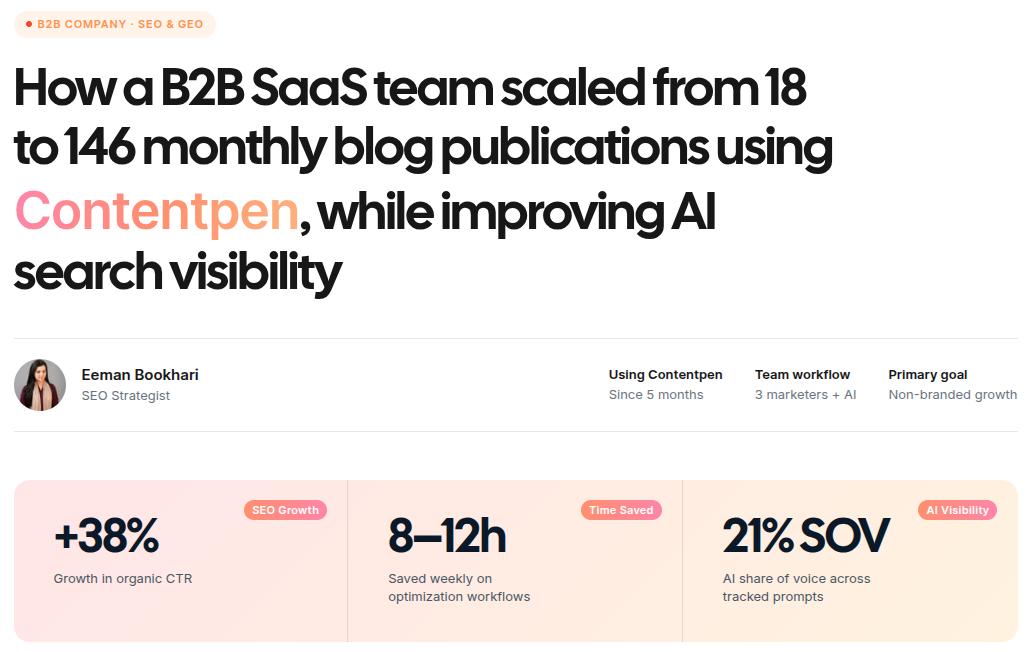
Compared with many social feeds, where most users browse casually, search traffic usually arrives with a clear goal. That tends to lead to higher-quality leads and more efficient conversions.
Building trust and authority
Appearing near the top of organic results carries strong psychological weight. When people see a brand show up again and again for important queries, they start to assume that the brand knows what it is talking about.
Pair that with a clean design and straightforward navigation, and visitors are far more likely to stay, return, and eventually buy.
Over time, returning visitors, positive behavior signals, and brand searches all feed back into how search engines view your site.
Gaining visibility in different SERP features
Modern search results contain much more than a simple list of links. For many queries, you will see:
- Featured snippets – short answer boxes pulled from a page
- People Also Ask boxes – related questions users often click
- Local packs – map results for nearby businesses
- Image and video carousels – visual results for media-friendly topics
- AI Overviews and summaries – AI-generated answers that cite web pages
Each of these is another chance for a brand to appear. Thus, choosing a clear structure, good headings, and concise answers in your content will increase the odds that your content will be selected for these spots.
How Contentpen can help you write SEO-optimized content
Contentpen features help you write search-engine-optimized content in no time. The SEO platform automates many tedious tasks associated with hunting for keywords, fixing vital SEO elements, and more.
Keyword research using Contentpen
Our AI blog writer helps uncover the most relevant and suitable keywords for your niche and search intent. It comes with all the up-to-date data scraped directly from the search engines, helping you implement your SEO strategies with confidence.
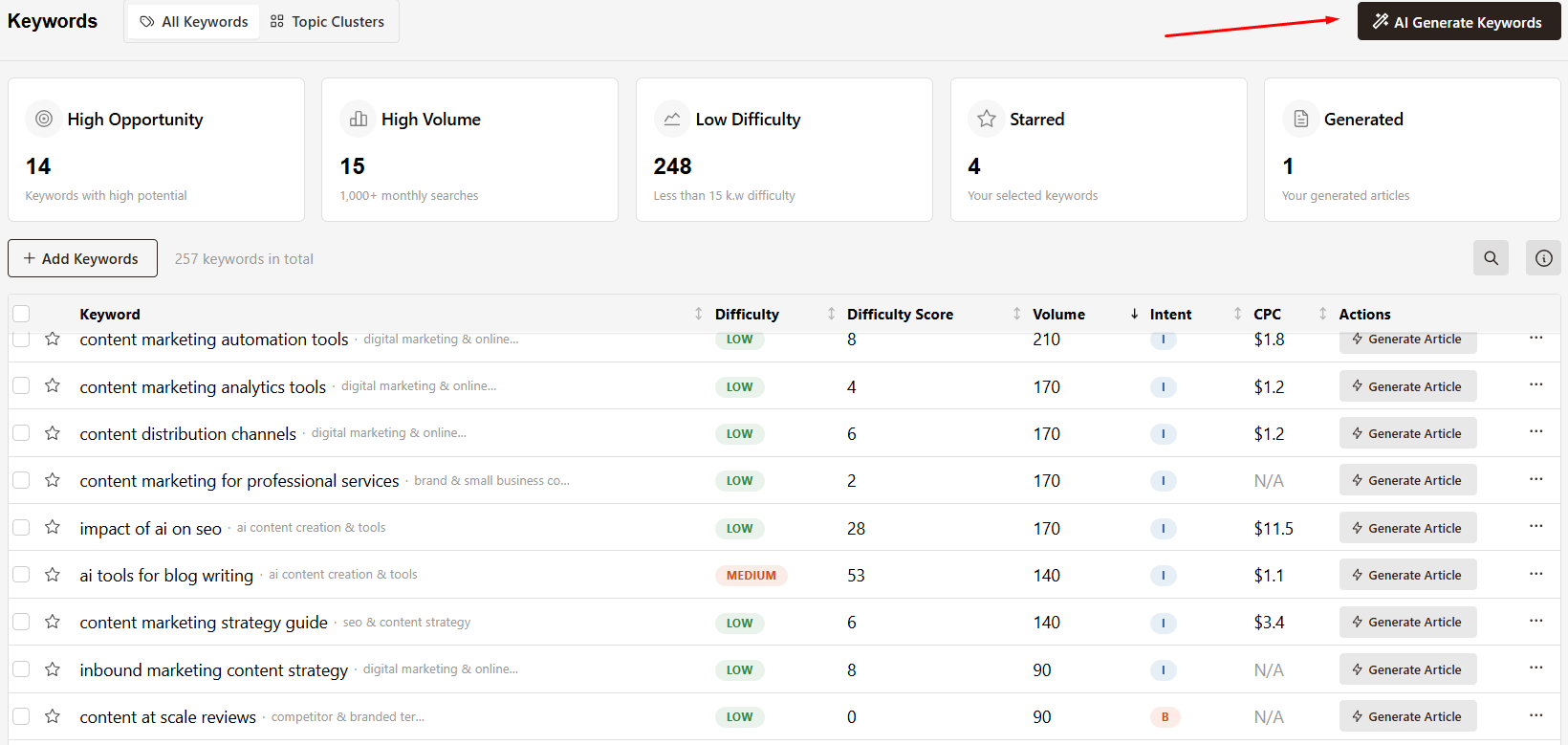
The tool also comes with the ‘AI Generate Keywords’ feature that allows you to get the best keywords for your type of content with one click.
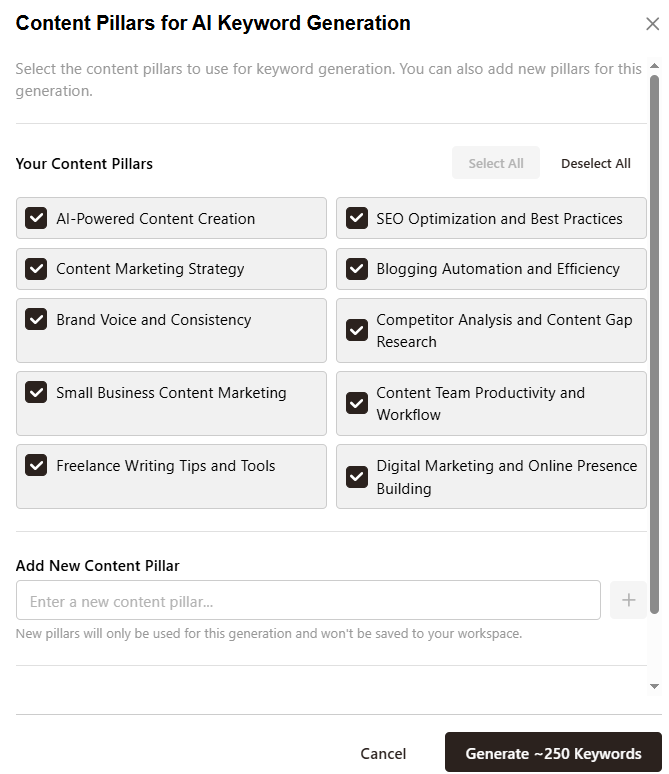
You may also create content pillars and topic clusters to organize your SEO efforts for better outreach and visibility in user searches.
SEO Score for quick content polishing
Besides keyword research, Contentpen may also assist you in quickly refining your content for a better SEO score. It functions as your SEO checklist, allowing you to ramp up the production workflows and bypass any hurdles in the process.
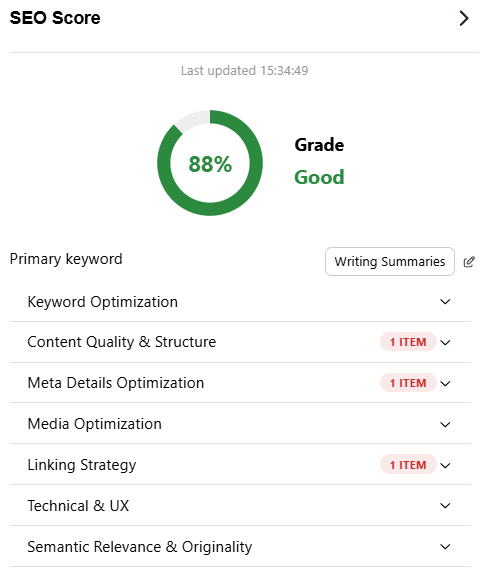
Understanding and fixing the highlighted issues by the system can help you publish content that is ready to rule the SERP results. You might still need a bit of manual tweaking, but not so much that you’d do otherwise.
Metadata settings for more discoverability
Finally, our tool also helps writers, bloggers, content marketers, and businesses come up with compelling Meta titles and descriptions for their pages.
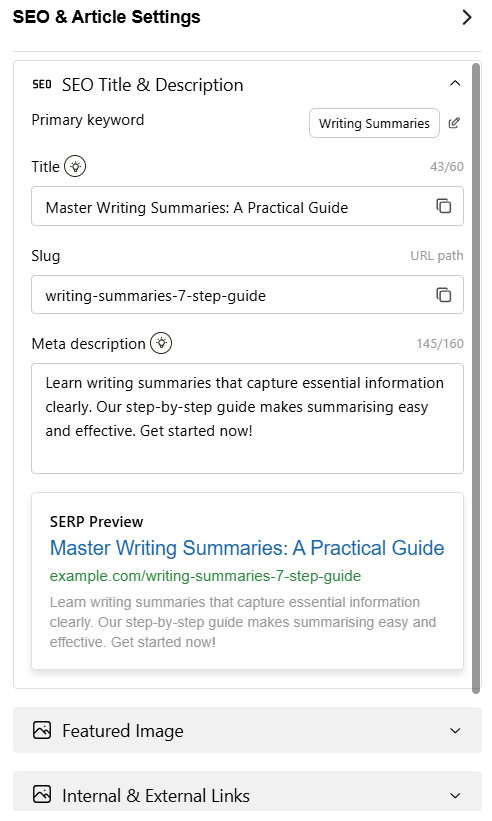
In this example, the metadata for the blog ‘How to write a summary’ is automatically generated for the user. You can edit the information as per your convenience and use the SERP preview to visualize the data before finalization.
Summing it up
Answering the question ‘What is the SEO of a website?’ starts with understanding the basics. SEO turns a website from a quiet brochure into a working asset that brings in visitors, leads, and customers around the clock.
Instead of relying only on ads or word of mouth, a brand with strong SEO basics can show up at the exact moment someone is looking for answers.
SEO can feel like a lot at first, especially with new terms and tools in the market. The important thing is to start small with the simple steps so that your site doesn’t end up lost in the abyss of the World Wide Web.