SEO Checker

Know your blog’s exact SEO score before you hit publish
Most blogs don't rank because small SEO gaps go unnoticed until it's too late. Contentpen's SEO checker catches those gaps in real time, so every blog you publish is already optimized before it goes live.





80K+ blogs generated
The only SEO checker that works while you write
Real-time SEO grade
Specific fixes, not just warnings
From keywords to technical SEO
How Contentpen checks your SEO in real time
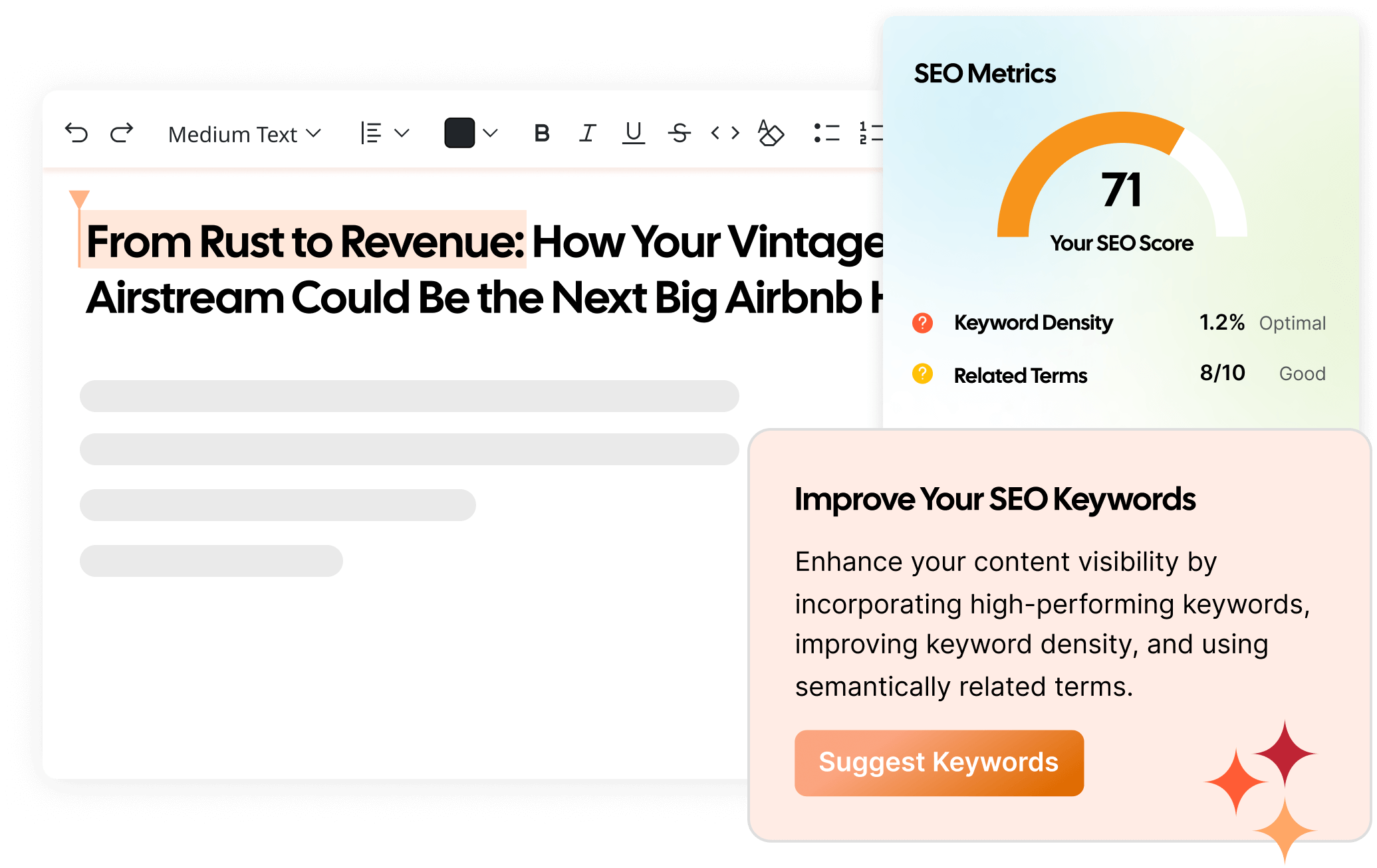
As you write, Contentpen checks your keyword placement, heading structure, meta details, internal and external links, media usage, and semantic relevance. No manual audits, no switching tabs, no waiting until after you publish.
1. Write your blog
Open Contentpen's editor and start writing. The SEO checker runs automatically in the background, no setup, no extra steps, just instant analysis from the moment you begin.
2. Read your score
A live SEO grade sits right alongside your content as you write. See which areas are passing and which ones need work, broken down clearly so nothing gets missed.
3. Fix and publish with confidence
Each flagged issue tells you exactly what to do, not just what's wrong. Make the changes, watch your score improve, and publish knowing your blog is already optimized.
Are your keywords placed where they actually matter?
Contentpen checks whether your primary keyword appears in your meta title, meta description, URL, and within the first 100 words of your content. These are the exact spots search engines look at first, and getting them right is the difference between ranking and being invisible.
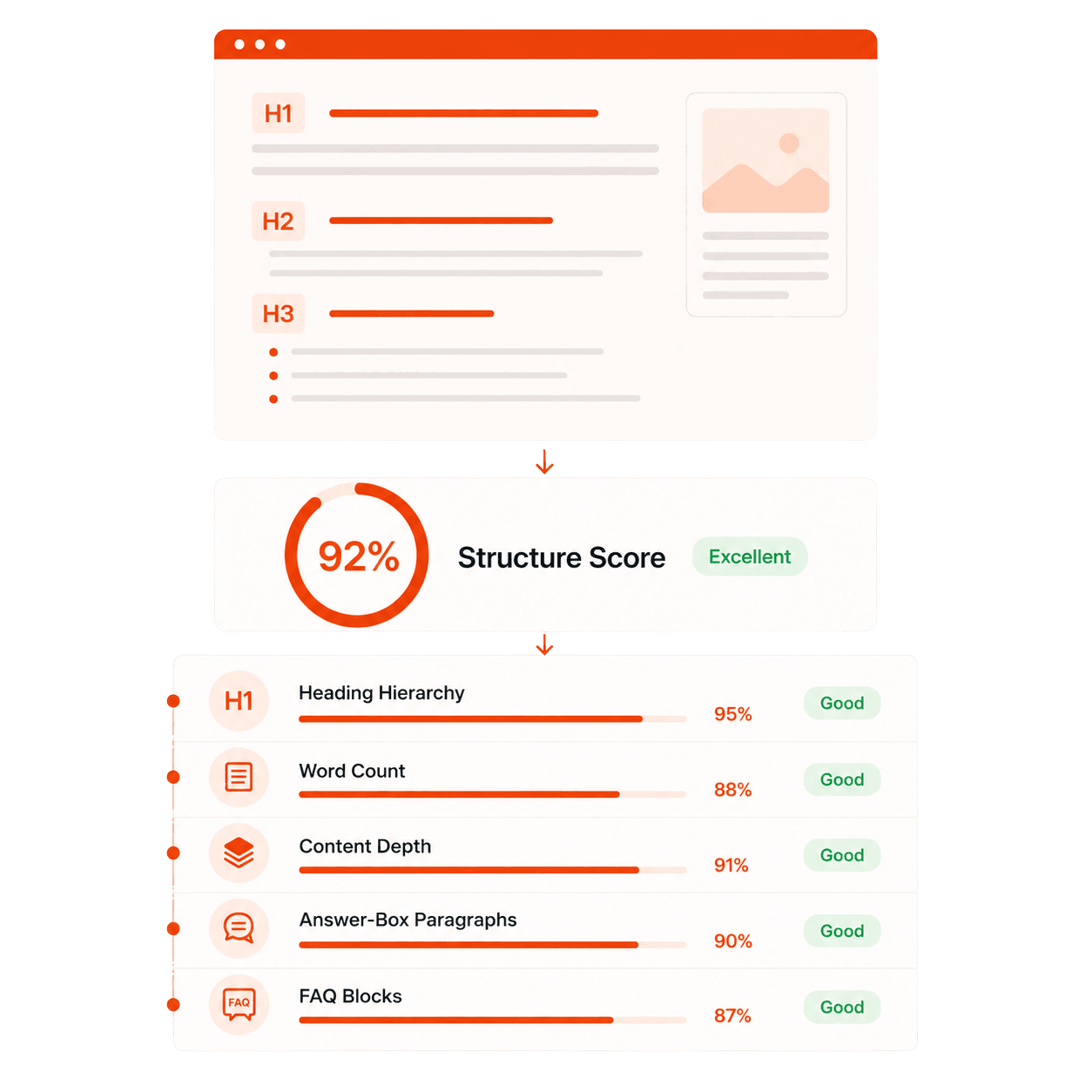
Good content isn't just well-written, it's well-structured
A well-written blog that's poorly structured rarely ranks. Heading hierarchy, word count, content depth, answer-box paragraphs, and FAQ blocks all play a role in how search engines evaluate your content. Each one is scored automatically, so you never have to wonder whether your blog is comprehensive enough to compete.
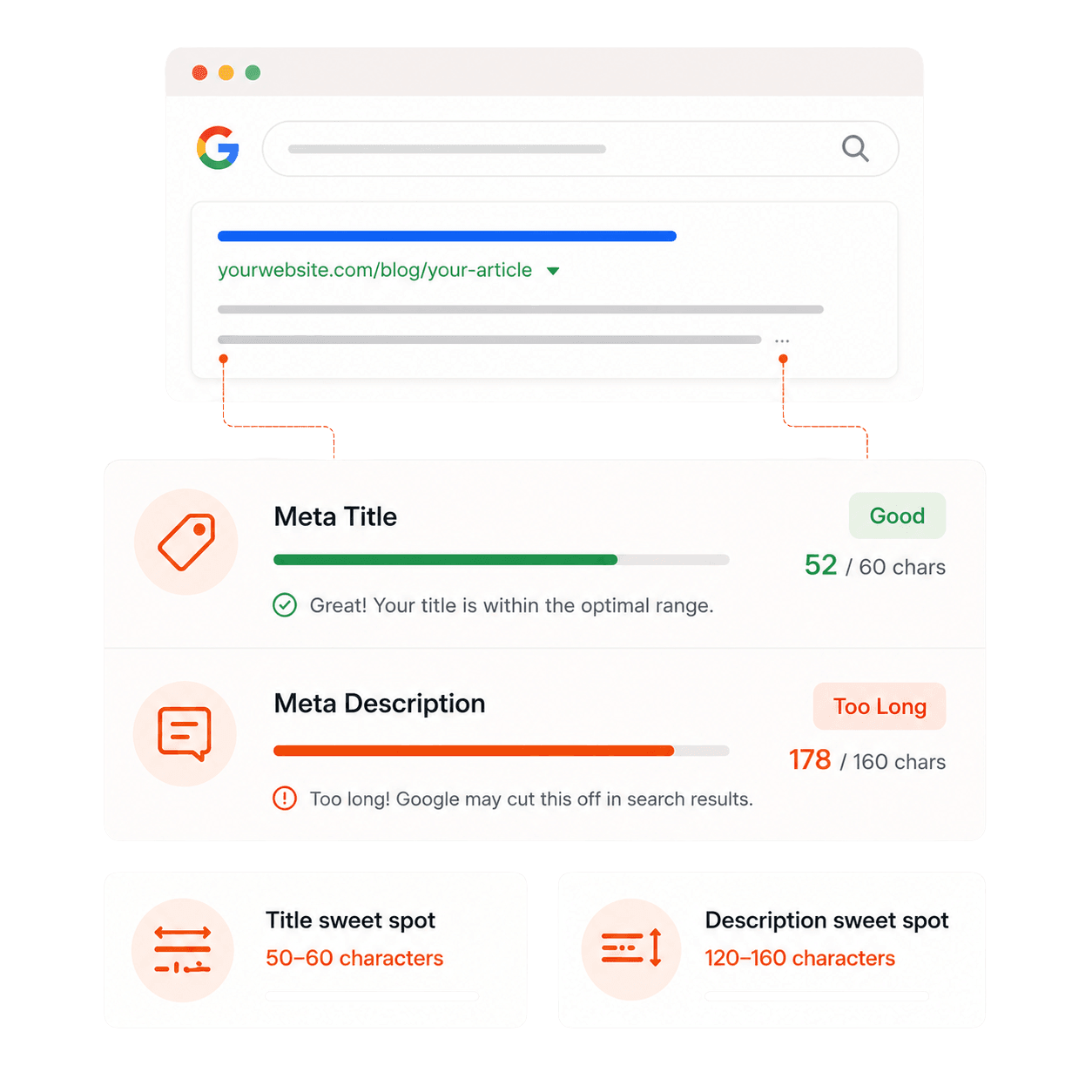
Your meta title and description are your first impression on Google
Most people write meta details last and never check their length. Too long and Google cuts them off. Too short and you're wasting prime SERP real estate. With Contentpen’s SEO scoring, you get flagged the moment either falls outside the optimal range.
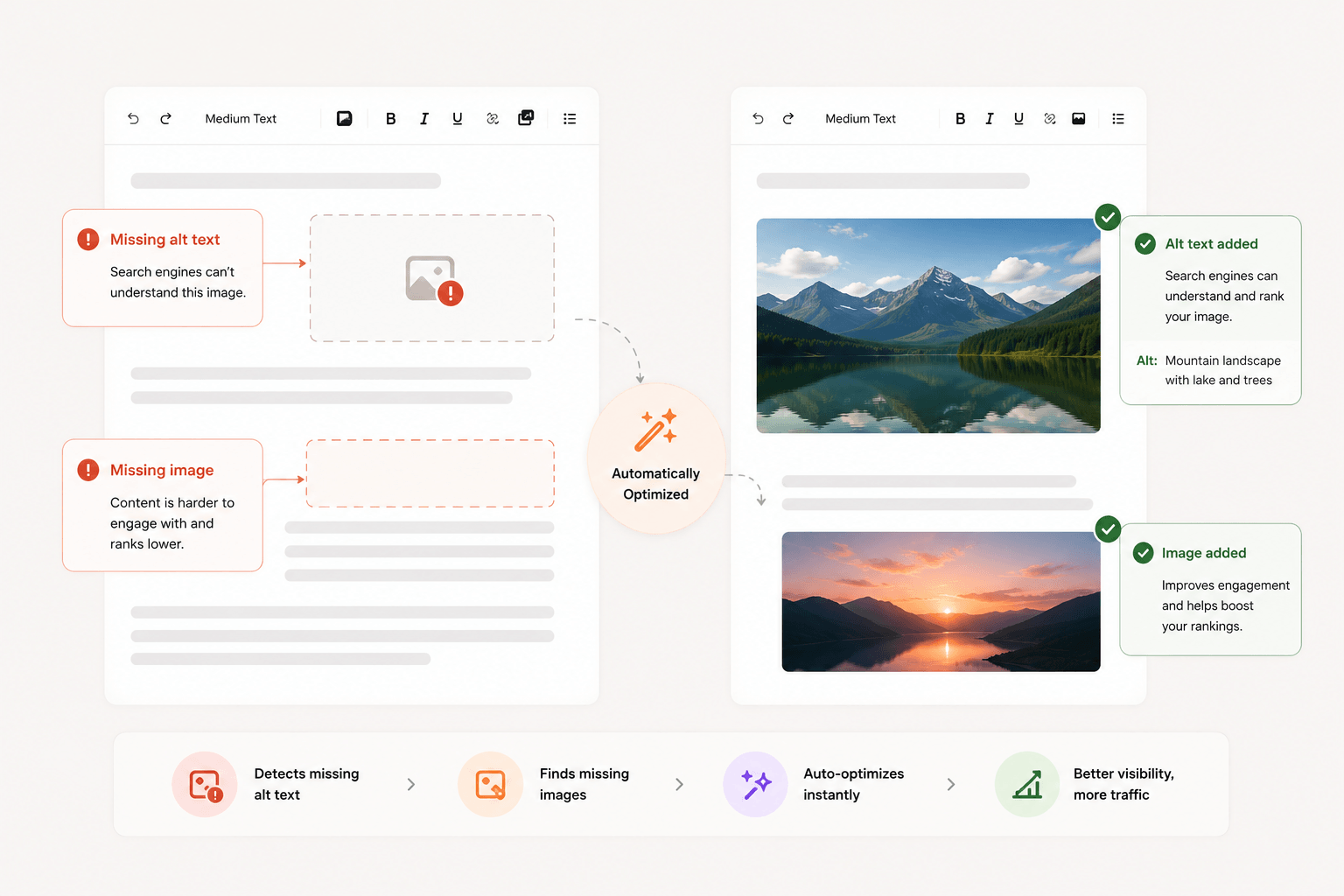
Images that are optimized, not just uploaded
An image without an alt tag is invisible to search engines. Missing media altogether hurts your engagement and your rankings. These are two of the most common and easily fixable gaps in most blogs, and both get caught automatically so nothing slips through before you hit publish.
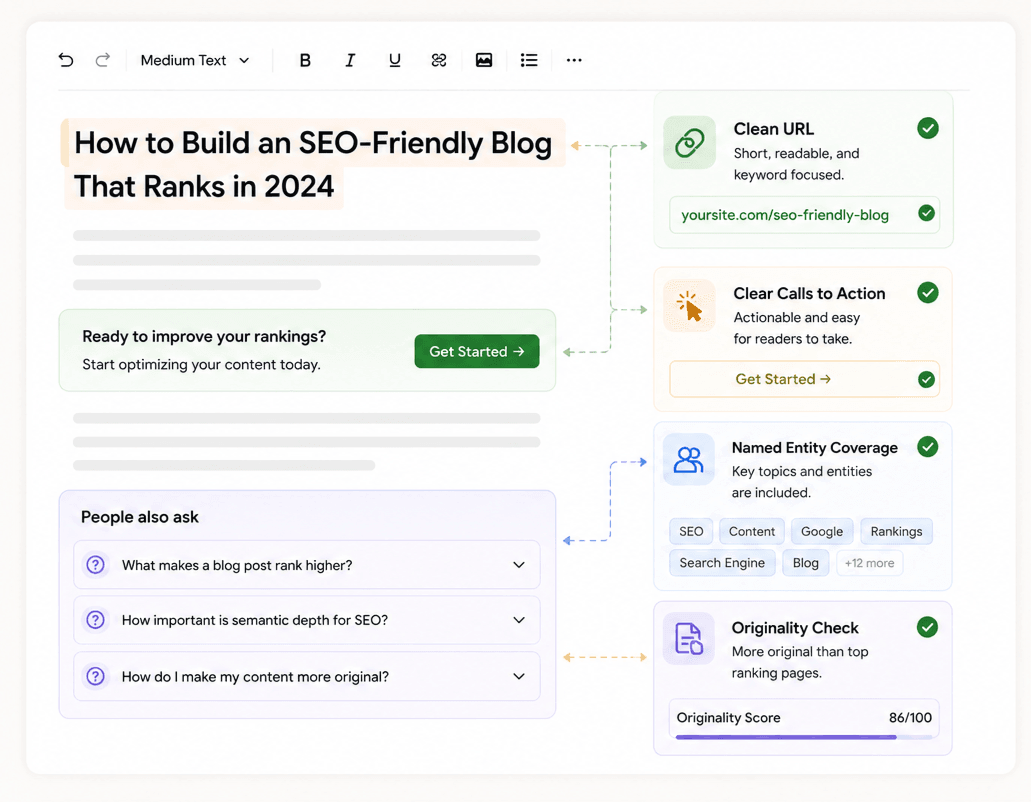
Technical SEO and semantic depth, checked automatically
A clean URL, clear calls to action, named entity coverage, and originality versus what's already ranking. These are the details most writers overlook, and exactly what separates blogs that rank from ones that don't. All scored automatically.
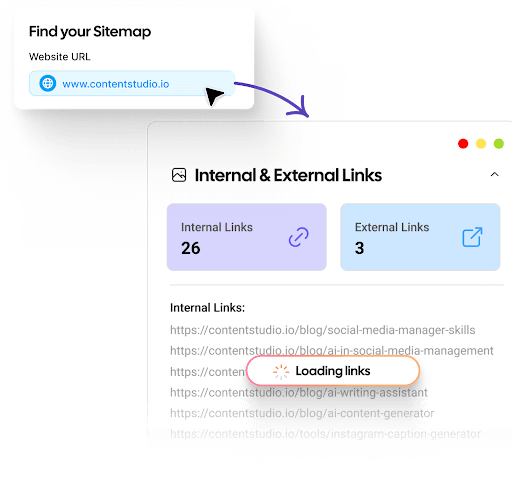
Internal and external links that actually strengthen your SEO
Links tell search engines how your content connects to the rest of your site and whether you're citing credible sources. Quantity, anchor text diversity, and external authority are all scored together so you know if your linking strategy is actually working.
Make your content SEO ready in minutes
Let Contentpen analyze every blog and provide actionable SEO scores. Improve content quality, keyword usage, and technical elements automatically to drive better traffic.
Stories from content teams
Insights from users who rely on Contentpen to streamline content creation, improve SEO, and scale their output efficiently.
“I wrote a blog post for one of my hospital clients using Contentpen. Once it got indexed, it started ranking at position 4 on the first page of Google. What's interesting is that I didn't build a single backlink.”
#4position0backlinks Ankit PrajapatiCEO at Consultant Ankit
“Contentpen helped us establish our presence both on SEO and AI search. Top-Quality content at the speed of thought.”
 Alban TaraireGeneral Manager at NETK5 Technology Group
“Contentpen delivers amazing quality blog posts and saves hours of research. It's fast, reliable, and perfect for efficient content creation.”
 Raj KandelMortgage Broker at Everest Home Loans
“I spend my time saved from blog writing and SEO tasks on building relationships with my clients, which actually benefits my business.”
$1000saved3-8h/weeksaved Keith HillPresident at Go Smart Mortgage
 AlaminMarketing content creator
“After publishing our first 23 blogs through Contentpen, we noticed steady keyword growth in Google Search Console within three weeks. Impressions and clicks doubled, and a few articles started ranking on page one without paid promotion.”
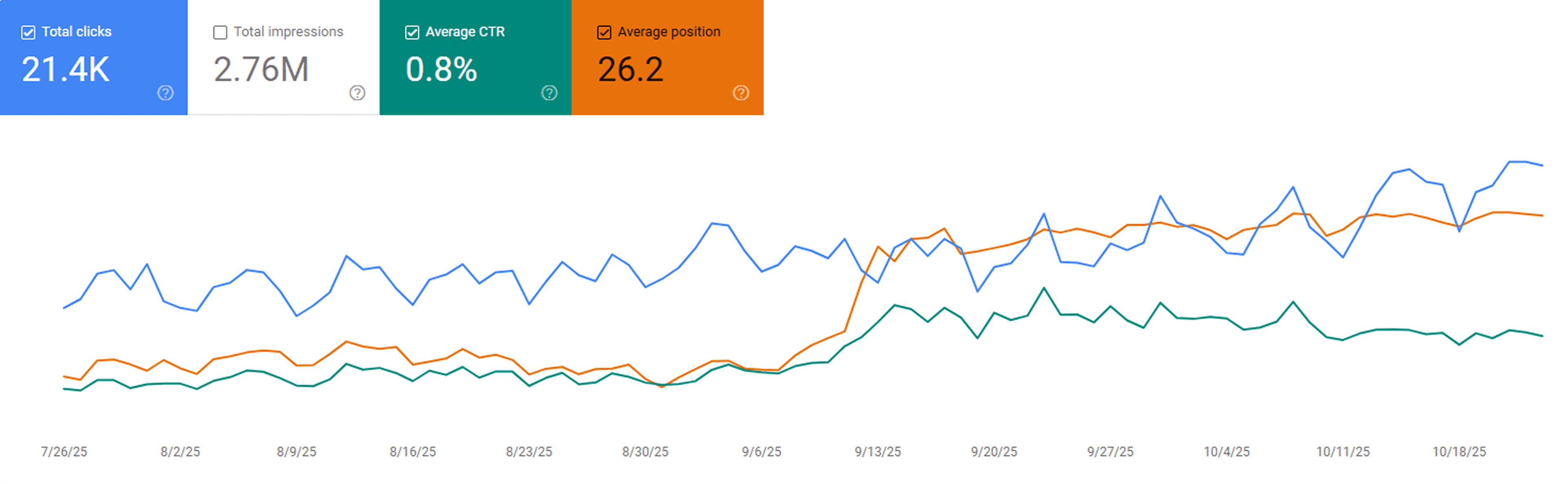
 Sarah MalikSEO manager at GrowthHive
“We analyzed our new posts in Ahrefs and saw a clear lift in organic keywords and referring domains. The internal link suggestions from Contentpen helped us strengthen our site structure, which improved our overall domain visibility.”
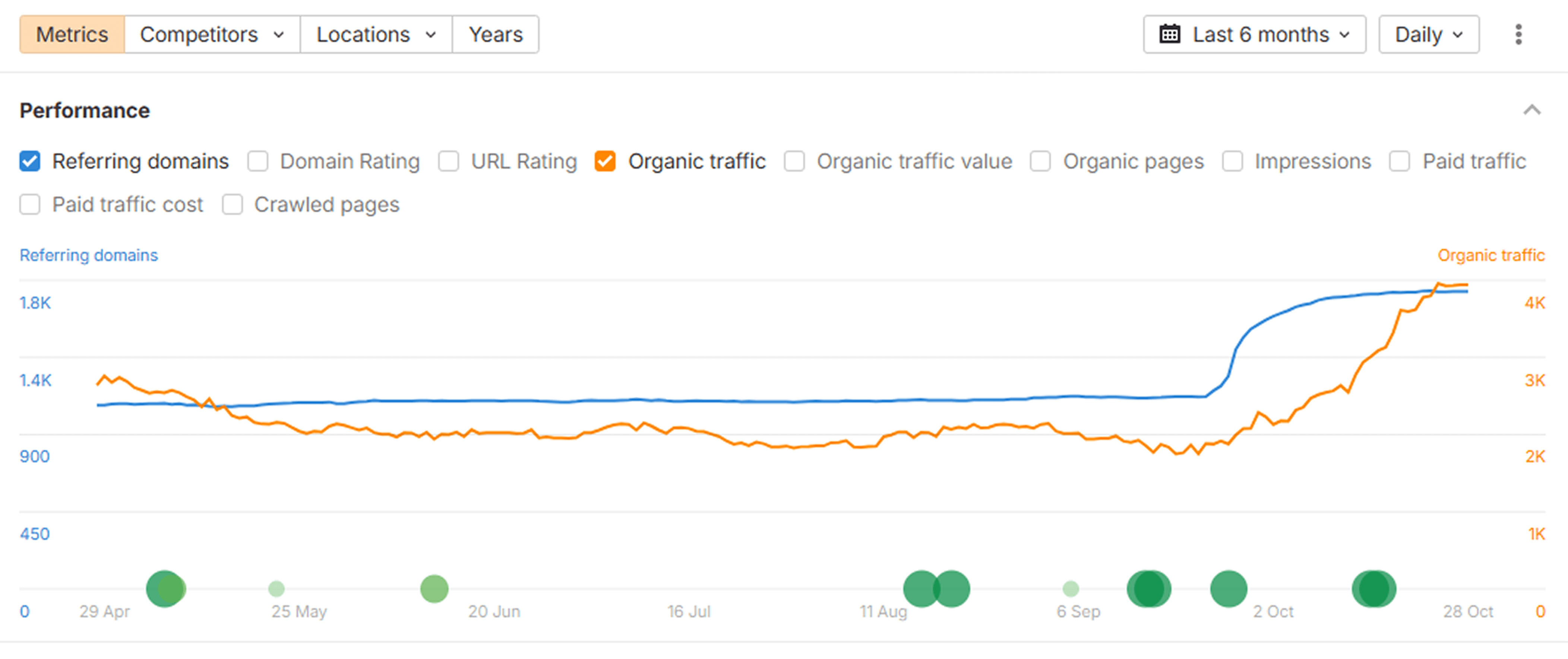
 Daniel LeeContent strategist at BrightScale Media
“Before Contentpen, writing and publishing a blog took us a full day. Now we handle topic research, writing, and publishing in under an hour. Our organic traffic has grown 40% since streamlining our content process.”
 Ayesha KhanMarketing lead at CloudNest Solutions
“Tried Contentpen’s SERP and gap analysis before our next content sprint and found topics we’d completely missed. Rankings started moving within weeks.”
 Priya MalhotraSEO manager, CloudStack
“Contentpen spotted 7 keyword gaps our client’s top competitor was owning. Instant clarity on what to create next.”
 @JeremyHillsFounder, Rankline Agency
Measure SEO success at a glance
See how using Contentpen’s SEO scoring feature drives measurable improvements in traffic, engagement, and overall content performance.
Higher organic traffic
Better keyword rankings
Higher ranking accuracy
More keyword coverage
Who is Contentpen's SEO checker for?
Whether you are a solo blogger or an agency handling multiple clients, this SEO checker helps ensure your blogs are rank-worthy before you hit publish.
Solo bloggers and content creators
Get a clear SEO score on every post before it goes live. No SEO expertise needed, just follow what's flagged and fix it.
SEO managers and marketers
Validate your optimization efforts, catch gaps you might have missed, and keep every piece of content up to your standards without manual audits.
Freelancers
Deliver content that comes with a proven SEO grade. Show clients their blogs are optimized, not just well-written.
Agencies
Run consistent SEO checks across all client content from one place. Every blog gets the same standard of review, regardless of who wrote it.
SaaS founders and small business owners
You don't need a dedicated SEO team. Contentpen checks everything automatically so your content stays optimized as you grow.
Content teams scaling output
More blogs shouldn't mean lower quality. Contentpen's SEO checker keeps your standards consistent no matter how much you're publishing.
Common questions about contentpen
Find answers to frequently asked questions from users about how Contentpen helps improve content performance, streamline workflows, and optimize results.
Generally, a score of 80% or above is considered good. It means your content covers the key ranking factors well. That said, a good score is relative to what's already ranking for your target keyword, so use it as a guide, not a guarantee.
It means roughly 80% of your results come from 20% of your efforts. In practice, fixing your highest-impact SEO issues first, like keyword placement, meta details, and content structure, will move the needle more than perfecting every small detail.
Yes. Contentpen recalculates the score in real time as you edit content, so you always have an up-to-date view of SEO performance.
Yes. Most SEO audit tools check a published URL after the fact. Contentpen scores your blog in real time while you write it, so you optimize before publishing, not after.
Yes. Teams can view scores and recommendations in their workspaces, making collaboration and review smooth.
No. Contentpen provides all necessary analysis and recommendations within the platform, removing the need for separate tools.
Yes. Alongside the SEO score, Contentpen also provides a GEO score that evaluates how well your content is optimized for AI search platforms like ChatGPT and Perplexity.
Everything you should know about SEO scoring
What is an SEO checker?
An SEO checker is a tool that evaluates your content or website against established search engine ranking factors and tells you how well optimized it is. It looks at things like keyword placement, content structure, meta details, links, and technical elements, then gives you a score or grade along with specific recommendations to improve.
Traditionally, SEO checkers worked by analyzing a published URL after the fact. You'd paste a link, run a check, get a report, and then go back into your content to make fixes.
Contentpen works differently.
The SEO checker runs in real time as you write, so optimizations happen during the drafting process rather than after publishing.
Why your content's SEO score is worth paying attention to
Publishing content without checking its SEO is like submitting work without proofreading it. You might get lucky, but more often than not, small fixable gaps are the reason a well-written blog never ranks.
SEO scoring removes the guesswork.
Instead of wondering why a piece of content isn't performing, you get a clear picture of exactly what's working and what isn't before the content goes live. Over time, consistently publishing content with strong SEO scores builds the kind of compounding organic traffic that doesn't disappear when ad budgets get cut.
Comparing on-page and technical SEO scores
SEO broadly splits into two categories, and a good SEO checker covers both.
On-page SEO refers to everything within the content itself. This includes your keyword placement, heading structure, content depth, meta title and description, internal links, external links, image alt tags, and how well your content matches the search intent behind your target keyword. These are factors you control directly as a writer or editor.
Technical SEO refers to the structural and backend elements that affect how search engines crawl and index your content. This includes URL structure, page speed, mobile usability, and how accessible your content is to search engine bots. While some technical factors sit outside the content itself, many, like URL cleanliness and calls to action, can be checked and improved at the content level.
Contentpen's SEO checker covers both. On-page factors like keyword optimization, content quality, and linking are checked alongside technical elements like URL structure and CTA presence, so nothing gets overlooked.
How does an SEO score actually get calculated in Contentpen?
SEO scores are calculated by checking your content against a set of weighted ranking factors. Each factor contributes to an overall score, and most checkers break this down into categories so you can see exactly where you're strong and where you need work.
In Contentpen, the score is broken across eight categories: keyword optimization, content quality and structure, meta details, media optimization, linking strategy, technical and UX, and semantic relevance and originality.
Each category is scored individually and feeds into your overall grade, so you always know which area to prioritize first.
Getting a score is step one. Here's what comes next.
A score on its own is only useful if you act on it. Here's a practical approach:
- Start with the lowest scoring categories since these represent the biggest gaps and the quickest wins.
- Work through the flagged issues in order of impact, prioritizing keyword placement and meta details first. This is because these have the most direct effect on how search engines read and rank your content.
- Once your highest priority fixes are made, work through the remaining categories systematically.
You don't need a perfect score to rank well, but consistently hitting 80% and above across your content gives you a strong foundation.
If you're using Contentpen, your score updates in real time as you make changes, so you can see the impact of each fix immediately rather than waiting to re-run an audit.
SEO scoring is only half the picture now
Traditional SEO scoring focuses on Google and other conventional search engines. But with AI platforms like ChatGPT, Perplexity, and Gemini now answering questions directly, optimizing only for traditional search means missing a growing share of how people find information online.
Contentpen addresses this with a separate GEO score that evaluates how well your content is optimized for AI search. It covers both, so your content is built to show up wherever your audience is searching.
So, sign up to check your score with our SEO platform now before publishing a blog that is never going to rank!
Build the rest of your content workflow
You've seen this part of the process, here are other features that help you research, plan, write, and improve content on autopilot.
Blog creation
Generate high-quality, SEO-optimized blog articles in minutes using AI trained for ranking content.
Keyword Research
Get high-intent keywords, search trends, and ranking opportunities tailored to your niche.
Organic traffic optimizer
Continuously analyze and optimize content to improve rankings and grow organic search traffic.
SERP & gap analysis
Identify ranking gaps and competitor opportunities to create content that outranks the competition.
Content planning & scheduling
Build content calendars, automate workflows, and plan topics that drive organic growth.
Integration & publishing
Connect your CMS and publish content directly from Contentpen without switching tools.
Bulk content creation
Produce large volumes of consistent, SEO and GEO-optimized content at scale with batch generation.
Built-in media library
No more asset hunting, everything you need is built in.
AI linking assistant
Turn every article into a traffic network with AI-powered linking.
SEO opportunities
Automatically uncover quick wins, content decay, and CTR gaps, and turn insights into actions with one-click content refreshes.
Website analytics
Track clicks, impressions, CTR, and rankings directly from Google Search Console to understand what's driving your organic performance.
AI search optimization tool
Make your content AI-ready, structured, and easy to surface