 13 minutes
Anchor text is the clickable text in a hyperlink that you see and interact with on web pages. It looks simple, yet it plays a huge role in how pages appear in search results.
With so many types of anchor text, rules, and warnings about penalties, it is easy to feel unsure about what to do next.
This is why we created this guide to cover everything about anchor texts. We will see how anchor text works in SEO, with examples and practical best practices you can apply right away to see ranking gains and traffic improvements.
You will also see how an AI-powered platform like Contentpen can guide anchor choices as you write, so you get consistent internal links without manual work.
So, let’s begin, shall we?
Anchor text basics explained
Anchor text is a relevance signal that helps search engines connect pages to topics. They serve as a roadmap for people to learn more about your services and offerings, and they tell readers what to expect on the destination page.
But when anchor text is random, generic, or stuffed with keywords, it does more harm than good.
In HTML, the anchor text sits between the opening and closing <a> tags.
Here’s how it looks:
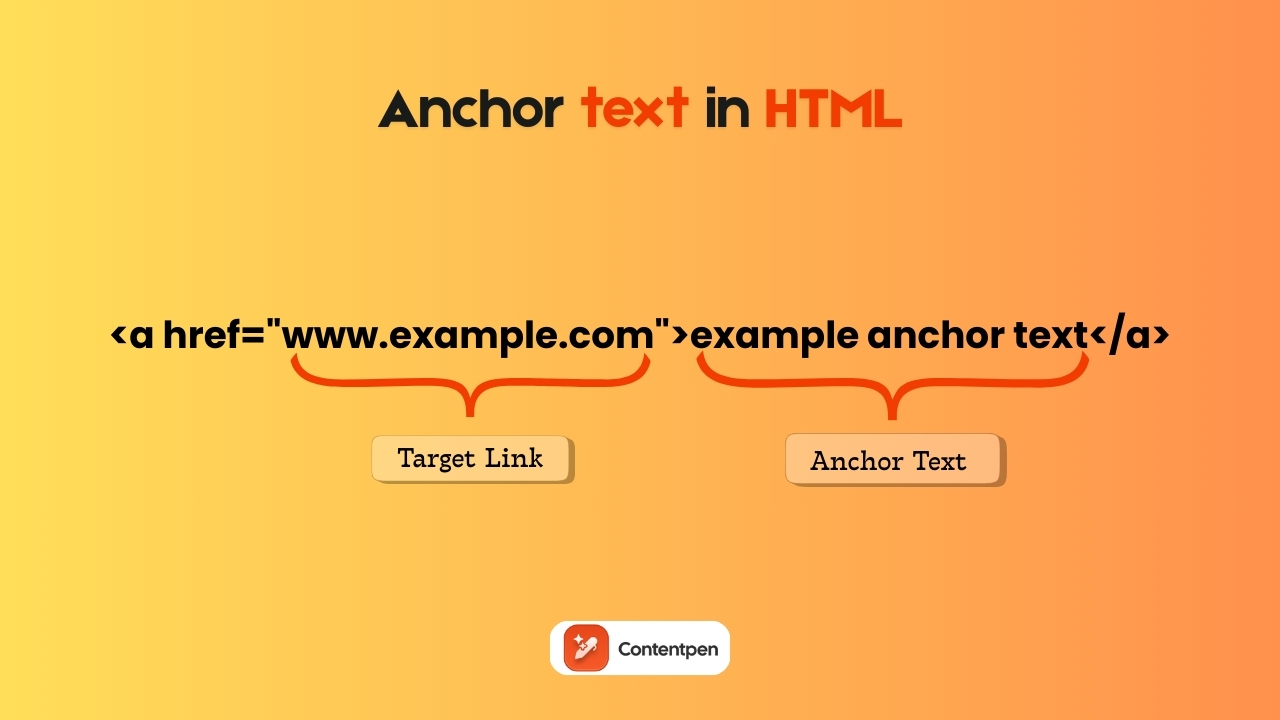
This is anchor text in HTML form, and it is what Google crawlers read during link analysis.
Anchor text has a dual role:
- It helps users decide whether to click.
- It helps search engines interpret the topic and relevance of the linked page.
The same principle applies when an image functions as a link. In this case, search engines rely on the image’s alt attribute to understand the link’s context. Because images contain no visible anchor text, the alt value becomes the primary descriptive signal.
For example:
<a href="/reddit-seo"><img src="reddit-seo-checklist.png" alt="Reddit SEO checklist"></a>Here, Google treats “Reddit SEO checklist” as the anchor text, helping associate the destination page even without visible link text.
Why anchor text matters for SEO
Anchor text matters because it provides context to Google. When many pages link to the same URL with relevant link text, the search engine can guess the topic of that page with more confidence.
If several trusted sites link with text like “what is off-page SEO,” that page is more likely to rank for searches related to off-page SEO guides.
John Mueller from Google has explained that anchor text helps Google understand what a page is about, but it is “just one of many factors” the system uses.
Also read: SEO glossary: 250+ terms to know in 2026.
Anchor text also affects how link equity flows. When an authoritative site links with descriptive backlink anchor text, it passes both authority and topical relevance.
That is why a strong link anchor can move rankings, while a weakly descriptive anchor text often does far less, even if it comes from an authoritative source.
To put it simply, relevant anchor text helps with:
- Keyword and topic relevance
- Stronger signals from high-quality backlinks
- Better user expectations and click-through rates
- Clearer internal navigation for readers and crawlers
Now, let’s see the types of anchor texts and different scenarios where you can utilize them for better search engine optimization.
Types of anchor text and when to use them
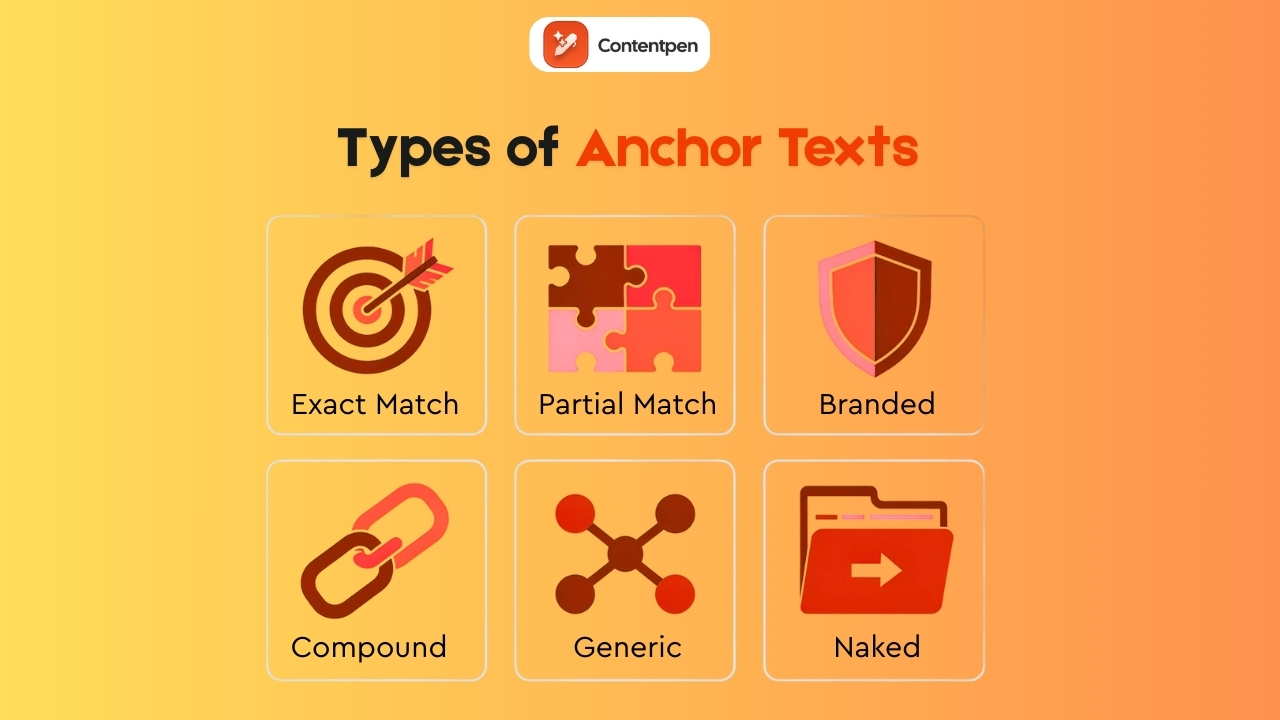
Not all anchor text looks the same. A healthy anchor text strategy uses a mix of styles, so your profile seems natural and helpful rather than forced. Each type comes with strengths and risks, which you can balance with a simple mental anchor text formula (we’ll get to it later).
Exact-match
Exact-match anchors use the exact keyword that the target page wants to rank for.
Example: A link with the text “what is on-page SEO” pointing to a guide with the same focus.
Exact-match anchors send very clear relevance signals, so you should use them sparingly for important internal links.
Partial-match
Partial-match anchors include the main keyword plus other words.
Example: A phrase like “18 best blog examples you can learn from in 2026” can be a partial match for the focus keyword of ‘best blog examples’.
This style fits better inside real sentences and feels more natural to readers. These types of anchors also work well for most internal links and many outreach efforts.
Branded
Branded anchors use only your brand name.
Example: Contentpen.
These anchors help build brand strength and trust. They tend to look normal to Google because many people use brand names when linking to sites they know.
Compound
These combine your brand name and a relevant phrase.
Example: Text such as “Contentpen SEO tools” falls in this group.
These anchors link brand and topic in a way that supports both awareness and rankings.
Naked
Naked anchors show the raw URL as the anchor text.
Example: A naked URL can be like “https://contentpen.com.”
People often use this style in forums, comments, and quick mentions. These links are less descriptive, yet they still count as part of a natural mix of hyperlink anchor text on the web.
Generic
These types of anchor texts are very general and less descriptive about the target page.
Example: “click here,” “read more,” or “this article.”
Such anchors rarely help users or search engines determine the page’s topic. In most cases, it is better to avoid generic anchors and replace them with more descriptive ones.
Image
Image link anchors rely on the image alt text.
Example:
(alt text: on-page SEO checklist)
When image alt text is descriptive, it acts as the anchor text meaning for search engines. If the alt field is empty, the image link provides almost no context.
Related
Related keyword anchors use terms that are close to your main topic but not exact matches.
Example: For a page about “best AI chatbot for professionals,” a phrase like “AI automation tools” can serve as a related anchor.
This style helps you show Google the broader topic cluster around a page.
Page title
Page title anchors match the exact title of the target page.
Example: A link that uses “What is technical SEO? Your complete guide to getting started” as the anchor text. Writers often use this style when they cite articles, so it feels natural in many contexts.
Here’s a breakdown of each anchor text type at a glance and its use cases at a glance:
| Anchor type | Example | Main use case |
| Exact match | Anchor text strategy | Strong relevance, use in moderation |
| Partial match | Guide to anchor text strategy | Natural linking is the most common |
| Branded | Contentpen | Brand building and trust |
| Brand + keyword | Contentpen SEO tools | Brand + topical relevance |
| Naked URL | https://contentpen.com | Mentions, profiles, citations |
| Generic | Click here | Avoid when you can. Not recommended |
| Image (via alt text) | alt=”on-page SEO checklist” | Visual links with context |
| Related keyword | Internal linking tips | Topic clustering and synonyms |
| Page title | Full article title | Citations and references |
You may also use this anchor text formula to help you get started:
Anchor Text = Relevant Keyword + Natural Flow of Text
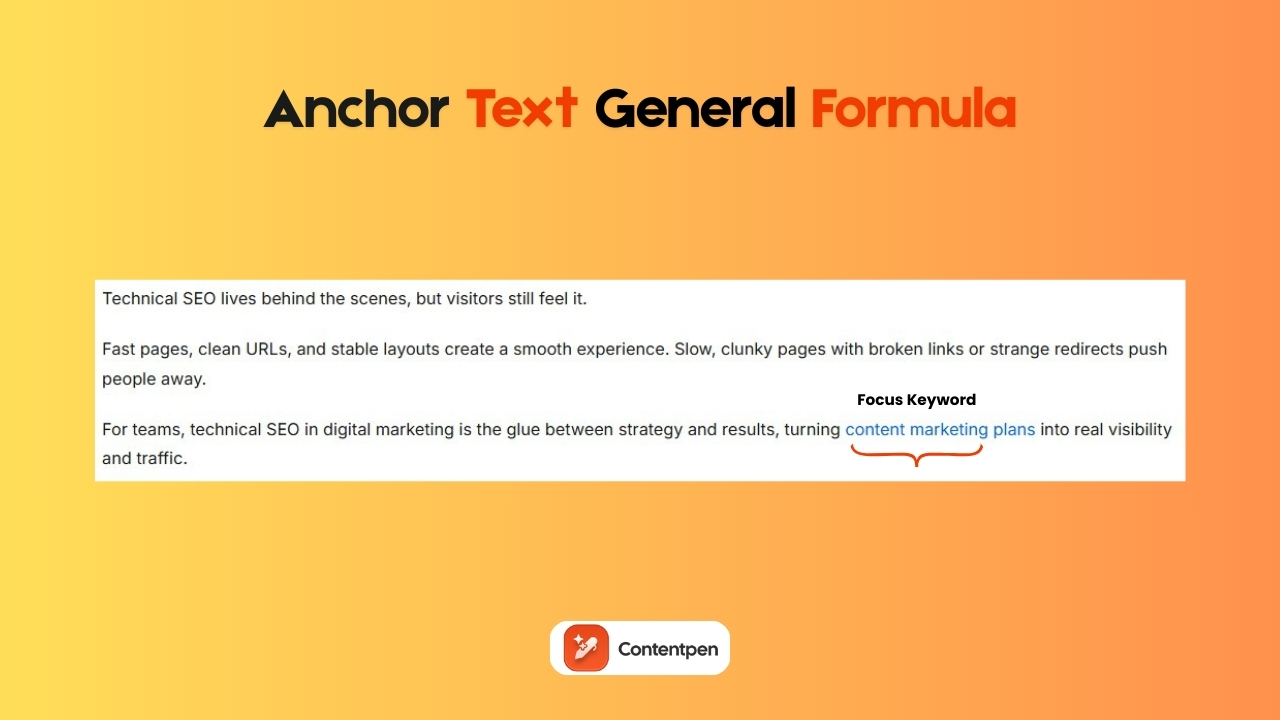
However, this formula is a general best practice and may vary based on your brand guidelines and SEO strategy.
How do I create anchor text?
Creating anchor text starts with understanding the page you are linking to and choosing words that clearly describe it in a natural sentence. Instead of thinking in terms of keywords first, think in terms of meaning and usefulness.
Here’s a simple process you can follow every time.
Identify the core topic of the destination page
Ask yourself one question:
What would I tell someone about this page in one short phrase?
That phrase becomes the foundation of your anchor text. For example, if the page explains how to audit a website for SEO, your anchor should reflect that purpose rather than a vague action.
Place the link inside a relevant sentence
Anchor text should live inside a sentence that already supports the topic of the linked page. Instead of adding a link at the end of a paragraph, embed it where the topic naturally appears. This improves readability and strengthens topical relevance for search engines.
Write the anchor as part of the sentence
Good anchor text feels like normal language, not a tag or label.
For example, instead of writing:
Click here to read our SEO audit guide.
Write:
Our SEO audit guide explains how to evaluate your site’s performance step by step.
This keeps the content smooth and user-focused.
Keep the anchor centered on one idea
Each anchor should represent a single concept. Avoid stacking multiple ideas into one link or using overly long phrases.
If a sentence introduces two different topics, it is better to use two separate links rather than forcing one long anchor.
Adjust the wording based on context
The same page can be linked with different anchor texts depending on the context. A guide about internal linking might be referenced as:
- “Internal linking strategy” in one article
- “How to structure internal links” in another
This variation helps search engines better understand the page without repeating the same phrase over and over again.
Anchor text best practices
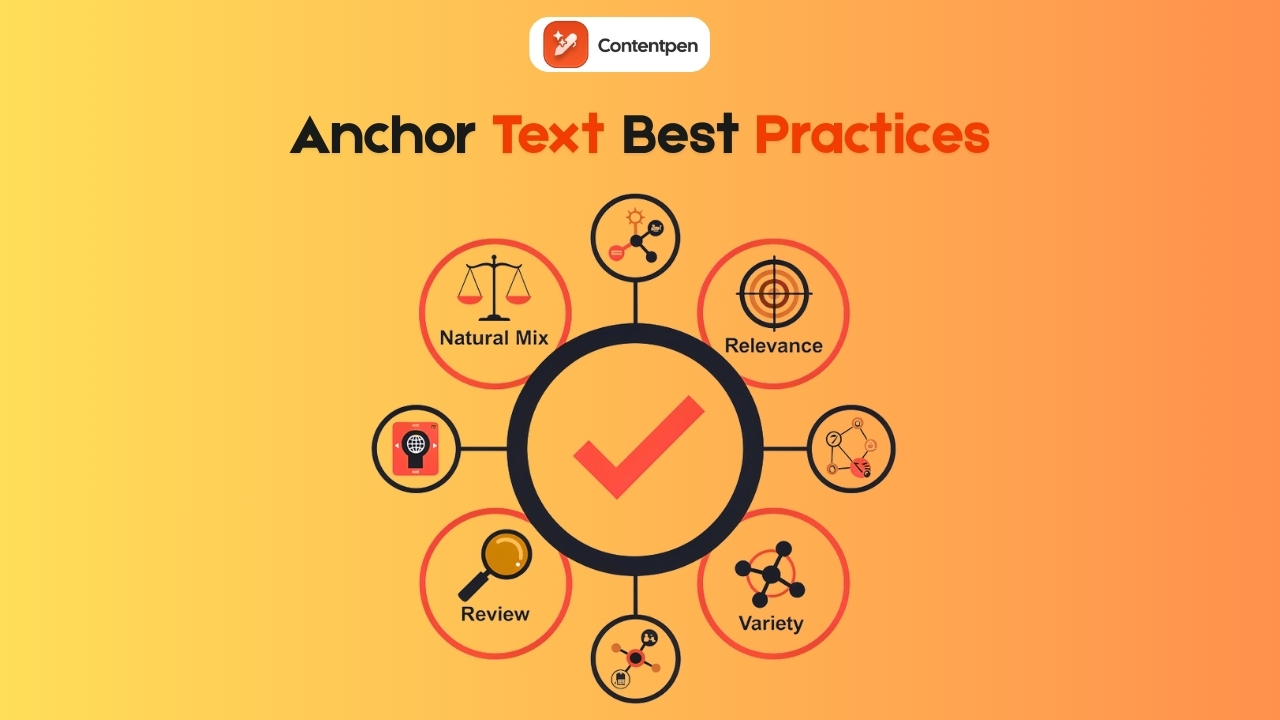
Good anchor text feels natural to readers and helpful to search engines. When you plan an anchor text strategy, it helps to think about the user first and the algorithm second.
The words you choose for an anchor must match the content of the target page. If a link says “keyword research guide” yet points to a pricing page, visitors will feel tricked. Over time, that kind of behavior can lead to lower engagement and weaker trust signals in search.
Natural flow also matters. If the phrase feels bolted on just to add a keyword, rewrite the line. Remember that internal links are not only about the clickable words. They also rely on the surrounding copy.
To keep things practical, you can follow a few simple rules:
Be watchful of keyword stuffing
Watch for keyword stuffing in anchors and nearby text. If a sentence repeats the same keyword several times just to squeeze it in, it weakens the copy.
Before Google’s Penguin update in 2012, many sites used exact keyword anchor text again and again to gain rankings. However, that tactic created unnatural link profiles, and Penguin went after those patterns.
Here’s one example from Google that can help you understand what to avoid while using your anchor texts:

Modern Google is much smarter. It looks at anchor text, the sending page, the receiving page, domain quality, and the overall mix of anchors.
Exact and partial-match keyword anchor text still helps when it looks natural. Yet heavy repetition, spammy phrases, and off-topic anchors can trigger spam filters.
A single, well-placed keyword anchor text within a single logical phrase usually sends a stronger, safer signal.
Make the links visible
Make sure links stand out visually on your pages. Use contrast and underlines carefully so people can see which words they can click.
When you make links visible, you also improve your platform’s dwell time. Users notice more of your pages and check them out, giving a highly positive signal to Google, Bing, and other search engines and AI discovery tools.
Monitor anchor texts
Review your anchor mix regularly with SEO tools. Online tools such as Ahrefs, Semrush, and Moz can show your internal and external linking anchor text types and ratios. Use the tool suggestions to gain rankings and retain users on your platforms.
Consider the accessibility of links
Screen readers often read link text aloud, so phrases like “this article” or “click here” can be confusing. Clear anchors, such as “anchor text best practices,” are much easier to understand.
Also, make sure to keep the anchors short and sweet. We recommend keeping it to 5 words or less.
How Contentpen streamlines anchor text optimization
Manually checking every link on a site and thinking through anchor text for each one takes time. It is even harder when a team manages hundreds of articles and has several writers, each with a different style.
In that setup, maintaining a healthy, consistent anchor text profile across the entire site can feel almost impossible.
Contentpen tackles this problem inside the writing workflow. As an end-to-end AI blog creation platform, it guides content teams from draft to SEO review in one place.
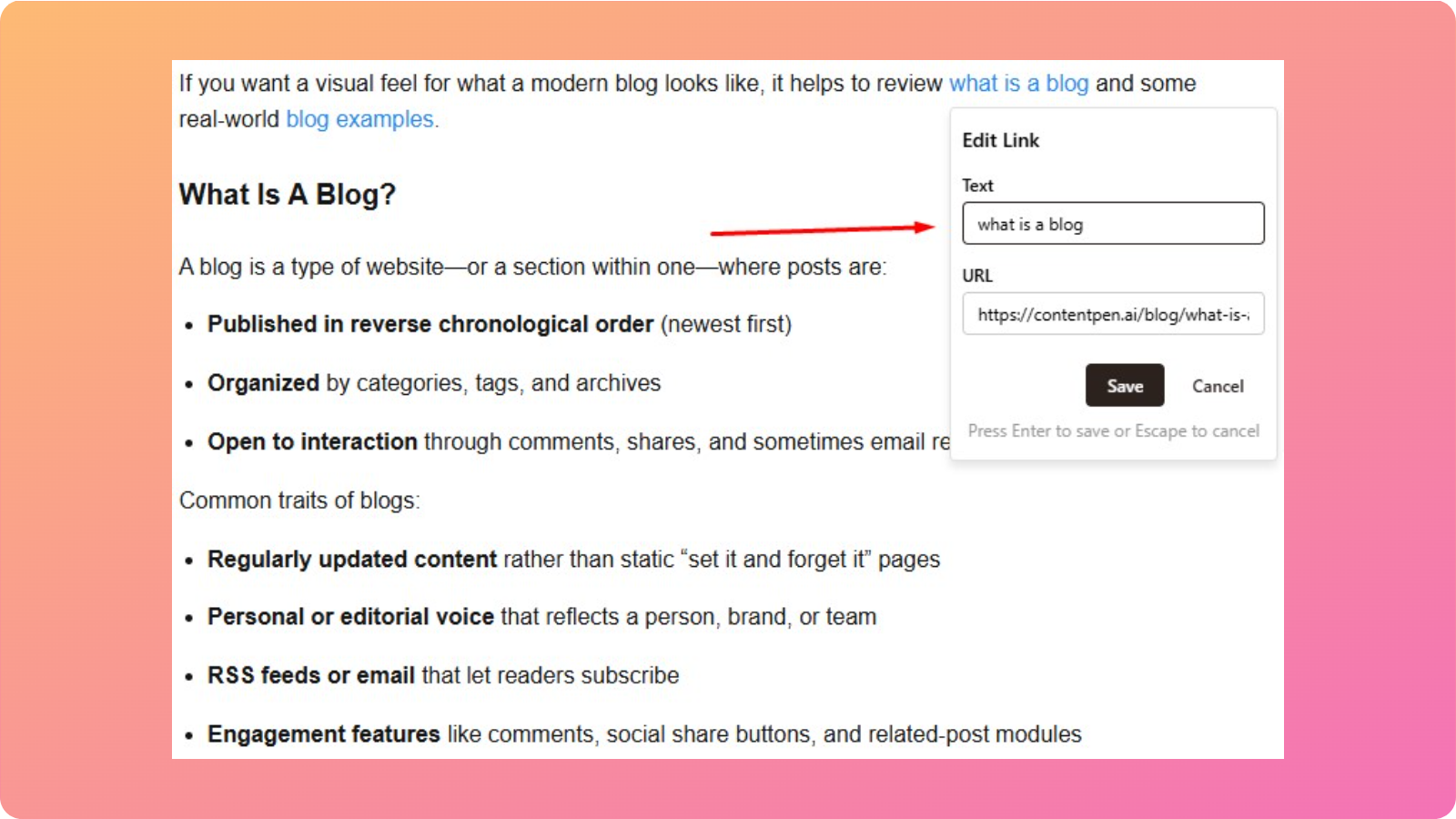
Its integrated SEO scoring highlights on-page gaps, including missed opportunities for helpful internal links. Writers see those insights as they work, so they adjust anchors before content goes live.
Contentpen helps you automate internal and external linking. The tool selects the most suitable anchor text based on context and topic as it generates your blog. This removes the need for manual link placement entirely.
You can think of it as an AI blog writing tool equipped with an anchor text generator that follows all the SEO best practices to help you rank on Google.
The platform also supports smarter planning. With built-in SERP and competitor analysis, you can study how top sites in your niche use links and anchor types. That insight makes it easier to design an SEO anchor text strategy that lines up with what already works in your niche.
Contentpen keeps teams in a single workspace for all tasks, eliminating the need to jump between tools to manage anchor optimization.
Over time, that leads to a site where keyword anchor text, related terms, and branded anchors follow a clear pattern without heavy manual review.
Concluding thoughts
Anchor text may look like a small detail, yet it carries a lot of weight. Those clickable words guide users through your content and tell search engines what each linked page is about. When that link text matches the topic, both people and algorithms get better signals.
The goal is balance. An innovative approach mixes branded, partial-match, related, exact-match, and other anchor text types in a way that feels human. You want anchors that are relevant, clear, and easy to read, without sliding into keyword stuffing or spammy patterns.
A good first step is to perform a simple audit of your internal links. Look for generic anchors and repeated phrases, then replace them with clear, keyword-rich anchor text that accurately reflects the target page.
If you want help placing anchors throughout the platform, use Contentpen. Integrate anchor text optimization into your normal content process so your links deliver more today.