 18 minutes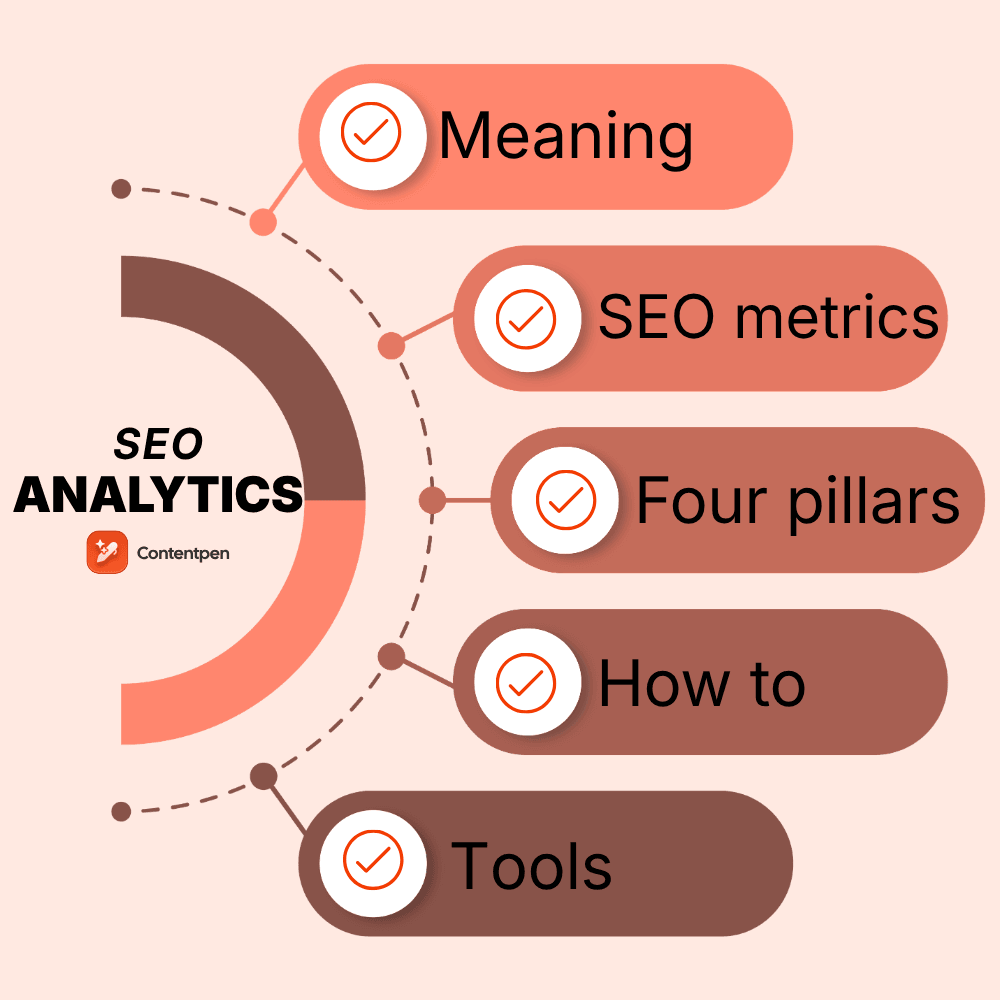
Search results feel very different now than they did a few years ago. There are AI summaries at the top and boxes with quick answers that people read.
In 2026, SEO analytics acts as a map that helps you understand this search experience, rather than relying on guesswork. Modern AI tools bring SEO analytics into everyday workflows, making it much easier to see user behavior and boost organic traffic in real time.
By reading this guide, you’ll get a clear picture of what SEO analytics mean, which metrics matter, and how to run a practical website analysis. You’ll also see how built-in analytics in Contentpen help you make smart SEO decisions without complex dashboards.
So, let’s get started.
Table of contents
- What is SEO analytics, and why does it matter in 2026?
- Essential SEO metrics every marketer should track
- The four pillars of SEO: Understanding what to measure
- How to perform a practical SEO analysis with a step-by-step framework
- Integrating SEO analytics into your content strategy
- Choosing the right SEO analytics tools in 2026
- Advanced SEO analytics strategies in 2026
- Common SEO analytics mistakes and how to avoid them
- Summing it up
- Frequently asked questions
What is SEO analytics, and why does it matter in 2026?
At its core, SEO analytics is the practice of collecting, reading, and acting on data about how a site performs in organic search.
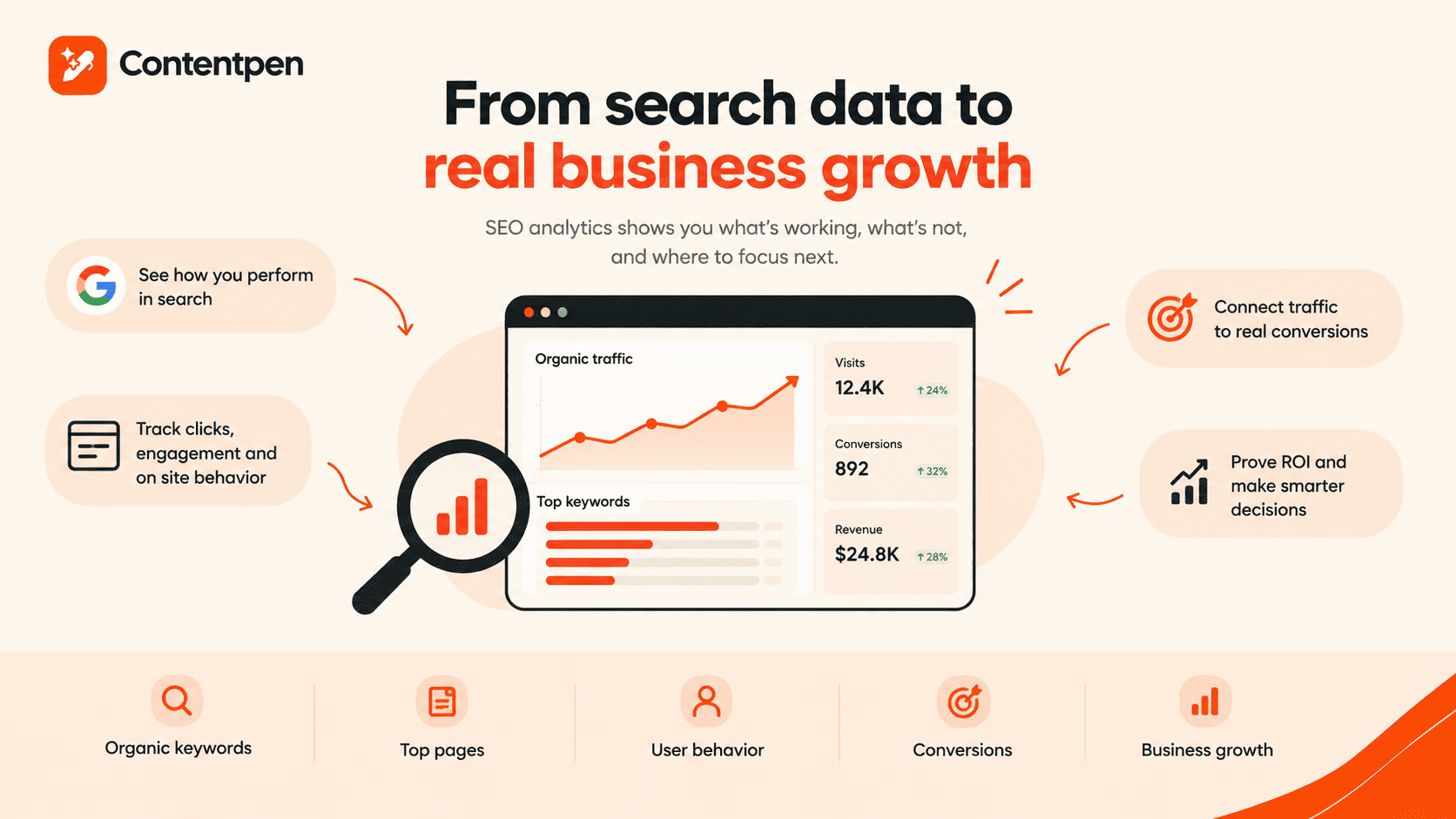
It connects what happens in Google Search and other engines with what happens on the site: traffic, engagement, leads, and revenue.
Old-school reporting focused on vanity metrics like keyword position or total visits. Those numbers can look good on a slide, but they do not indicate the correct user behavior.
Modern SEO analytics goes further. It links website traffic analysis with sign-ups, deals, and customer lifetime value. In tools such as Google Analytics 4, teams can tie organic visits to conversions and see which organic keywords and pages drive real business.
In 2026, this matters even more because of how search has changed. Google’s AI Overviews mean many searches end without an action. Therefore, competition for the remaining organic clicks is intense.
To keep up, teams need SEO analytics that show not only where they appear in results, but also:
- How often do people choose their snippet
- How long do visitors stay
- How many visitors take action
Without this view, it is tough to prove SEO return on investment or defend budgets.
The most significant shift is that SEO analytics is no longer only an expert sport. Content marketers, freelance writers, and small business owners now use search engine optimization keyword analysis in their daily tools.
When analytics informs content planning and writing, teams can double down on topics and formats that already work without a second thought.
Essential SEO metrics every marketer should track
Many tools show hundreds of numbers, but only a few should guide decisions. Strong SEO analytics start with a focused set of metrics that match business goals.
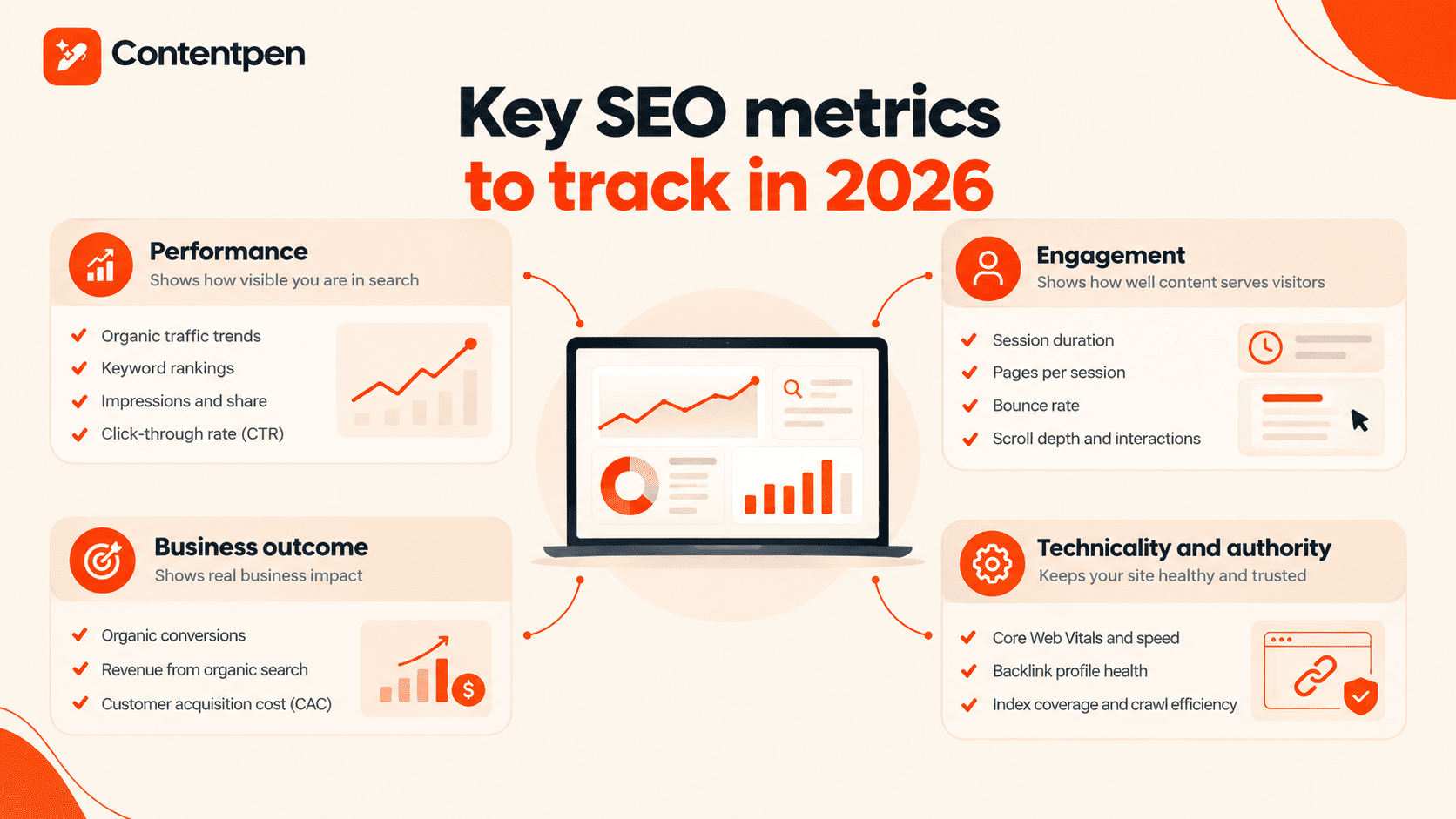
These can be grouped into performance, engagement, business outcomes, and technical or authority signals.
Performance
Performance metrics show how visible a site is in search:
- Organic traffic trends reveal whether content gains or loses reach week by week.
- Keyword rankings and website keyword rankings highlight where the site stands for target terms and how well it holds featured spots such as snippets or AI Overviews.
- Impressions and impression share give context by showing how often the site appears, even when users do not click.
- Click-through rate (CTR) links this all together by showing how attractive titles and descriptions are compared with other results.
Engagement
Engagement metrics reveal how well content serves visitors after the click:
- Average session duration and pages per session show whether users explore several pages or leave quickly.
- Bounce rate and top exit pages highlight where people often give up, which can point to misaligned intent or weak calls to action.
- More advanced SEO analytics tools also track scroll depth and interaction events such as button clicks or downloads.
These details help connect search engine optimization keyword analysis with real on-page behavior.
Also read: How to calculate CTR?
Business outcome
Business outcome metrics speak in terms that leaders and stakeholders care about:
- Organic conversions measure how many visitors from search take key actions such as signing up or buying.
- Revenue from organic search and customer acquisition cost (CAC) for SEO show how search compares with other channels in a complete search engine marketing analysis.
When SEO analytics is integrated correctly, teams can see whether organic traffic grows while cost per acquisition falls or remains steady.
Technicality and authority
Technical and authority metrics provide the base layer for all the other numbers:
- Core Web Vitals scores, page load speed, and mobile usability checks indicate how smooth the user experience is on your website.
- Backlink profile health shows how strong the site appears from the outside of your platform.
- Index coverage and crawl efficiency reports help teams catch broken links and blocked pages.
A simple dashboard that mixes a few metrics from each group keeps SEO analytics focused. Many AI tools now adjust these dashboards based on your goals so that the most useful web analytics sit at the top.
A helpful rule:
“If a metric never changes your decisions, it’s a vanity metric.”
Therefore, you should focus on the numbers that regularly shape your key objectives and try to improve them for better results.
That’s a lot of metrics to keep straight, so if any of the terms above are unfamiliar, our SEO glossary has a plain and simple explanation for each.
The four pillars of SEO: Understanding what to measure
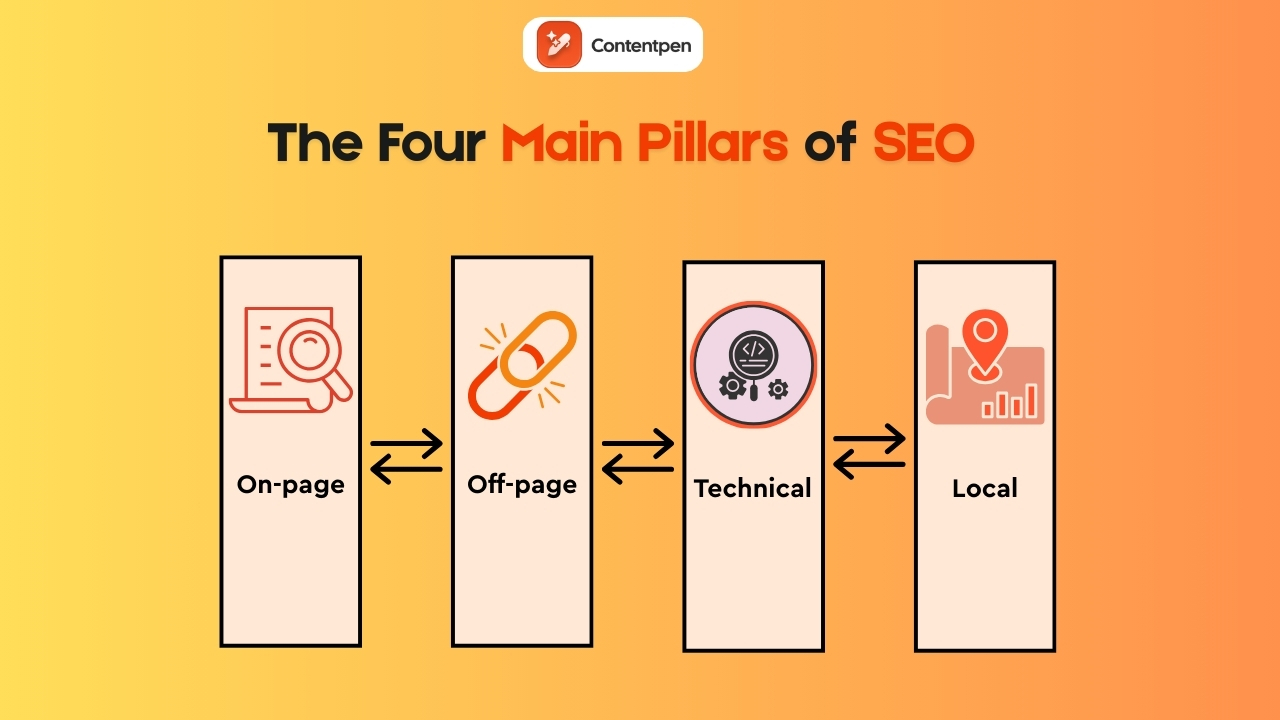
When people talk about SEO, they often mix many different ideas, which makes SEO analytics harder than it has to be. A simple way to think about the work is through four pillars:
Each pillar covers a part of your web page SEO analysis and gives clear targets for what to measure and improve.
On-page SEO
This pillar looks at how each page speaks to both users and search engines. It covers:
- Keyword use and topical coverage
- Headings and subheadings
- Title tags and meta descriptions
- Internal links
- Content quality and clarity
In SEO analytics terms, key on-page metrics include:
- Click-through rate (CTR) from search results
- Dwell time and average time on page
- Bounce rate
- Keyword rankings for each page
These numbers help show which topics and formats hold attention and which ones lose visitors fast.
Off-page SEO
This area covers authority and trust signals that live outside the site. Backlinks, brand mentions, and referring domains all fall under this category. In practice, that means tracking not only how many sites link back, but also how relevant and trusted those sites are.
Off-page SEO analytics helps answer questions such as:
- How strong is our domain compared with direct competitors?
- Which content attracts the best links?
- Where should we focus: Digital PR or outreach?
Clear off-page reporting supports smarter link-building efforts and brand visibility.
Together, these four pillars create the measurement framework that modern SEO analytics relies on.
Technical SEO
Even the best content fails if search engines cannot crawl and index it easily. This pillar looks at:
- Site speed and Core Web Vitals scores
- Mobile usability
- Crawl errors and broken links
- Index coverage and canonical tags
Good SEO analytics here rely on tools such as Google Search Console for index reports and PageSpeed Insights for performance checks. The aim is simple: remove friction so both users and crawlers move smoothly through the site.
Local SEO
Local SEO analytics matter a lot for physical locations and service areas. Here, teams focus on:
- Google Business Profile data
- See Google Maps pack rankings
- Local keyword performance
- Calls, direction requests, and menu clicks from search
When these numbers improve, it usually shows that the business is winning nearby searches and getting local traffic.
How to perform a practical SEO analysis with a step-by-step framework
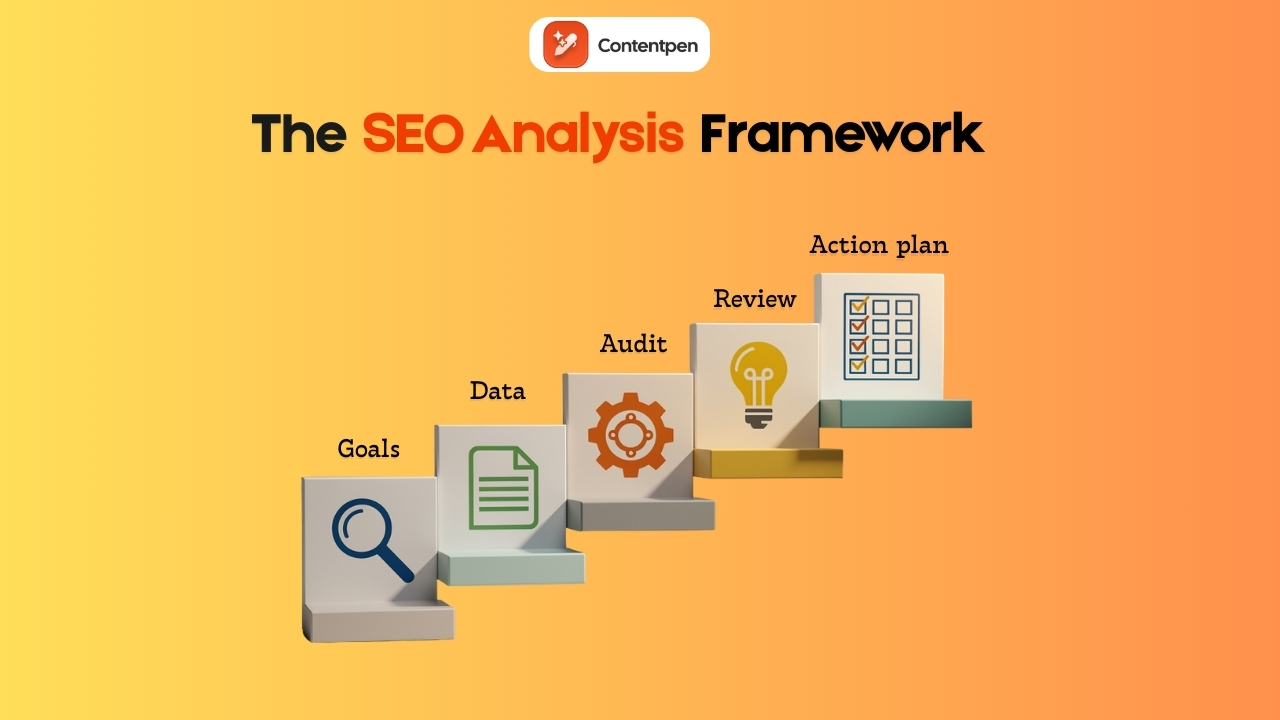
Without a clear process, SEO analytics turns into random clicks across charts. A simple framework keeps the work grounded in outcomes rather than noise:
- Step #1: Define clear goals
- Step #2: Gather baseline data
- Step #3: Run a technical health audit
- Step #4: Review content performance
- Step #5: Turn findings into an action plan
Now, let’s see each of these steps in more detail.
Step #1: Define clear goals and success metrics
Start from business needs rather than rankings. For example, the goal might be to:
- Add fifty qualified leads from organic search each month
- Increase demo requests by 20%
- Grow self-serve revenue from search by a set amount
Once that is clear, pick numbers that match, such as:
- Conversion rate
- Revenue from search
- Key keyword groups that support priority offerings
Write these goals down. These will guide all subsequent decisions and prevent the analysis from drifting from focus.
Step #2: Gather baseline data
Next, collect the data that shows your starting point:
- Pull query, impression, and click data from Google Search Console.
- Pull traffic, engagement, and conversion data from Google Analytics 4 so that search engine optimization analysis links directly to outcomes.
- Use an SEO analytics tool, such as Ahrefs or Semrush, for extra website analysis, current website keyword rankings, and backlink analytics.
- Check competitor web traffic analysis and their top-ranking pages, so the team knows the starting point in the market.
Modern AI-driven tools, such as Usermaven, can automate much of this collection, ensuring consistent analytics over time.
Step #3: Run a technical SEO audit
This part of SEO analytics checks for crawl errors, slow pages, and index problems. Tools such as Screaming Frog scan the site in detail to help you surface these issues with the SEO audit.
At the page level, this means reviewing title tags, meta descriptions, and performance for key URLs. Once these basics are in place, the content has a fair chance of ranking and converting.
Step #4: Review content performance and find gaps
Look in Google Analytics 4 for landing pages that already drive strong organic conversions and long sessions. Note what these pieces have in common, such as:
- Topic and search intent
- Format (guide, checklist, comparison, etc.)
- Depth and internal links
Then run keyword analysis and create keyword gap reports across competitors to see which valuable terms they rank for that your site has missed so far.
Use keyword analysis in Google Analytics and Google Search Console together to map search queries to pages and SEO performance metrics. From here, build a list of:
- New topics to cover
- Existing articles to update
- Pages to consolidate if they overlap too much
Step #5: Turn findings into an action plan
Group issues and ideas by impact and effort, then tackle easy, high-impact items first, such as:
- Fixing broken technical items on important pages
- Refreshing posts that already rank on page one but sit just below the top spots
- Improving internal links to high-value pages
Set simple deadlines to start working toward securing top positions on search results and AI discovery platforms. Plan a monthly mini-review and a deeper quarterly review to track progress.
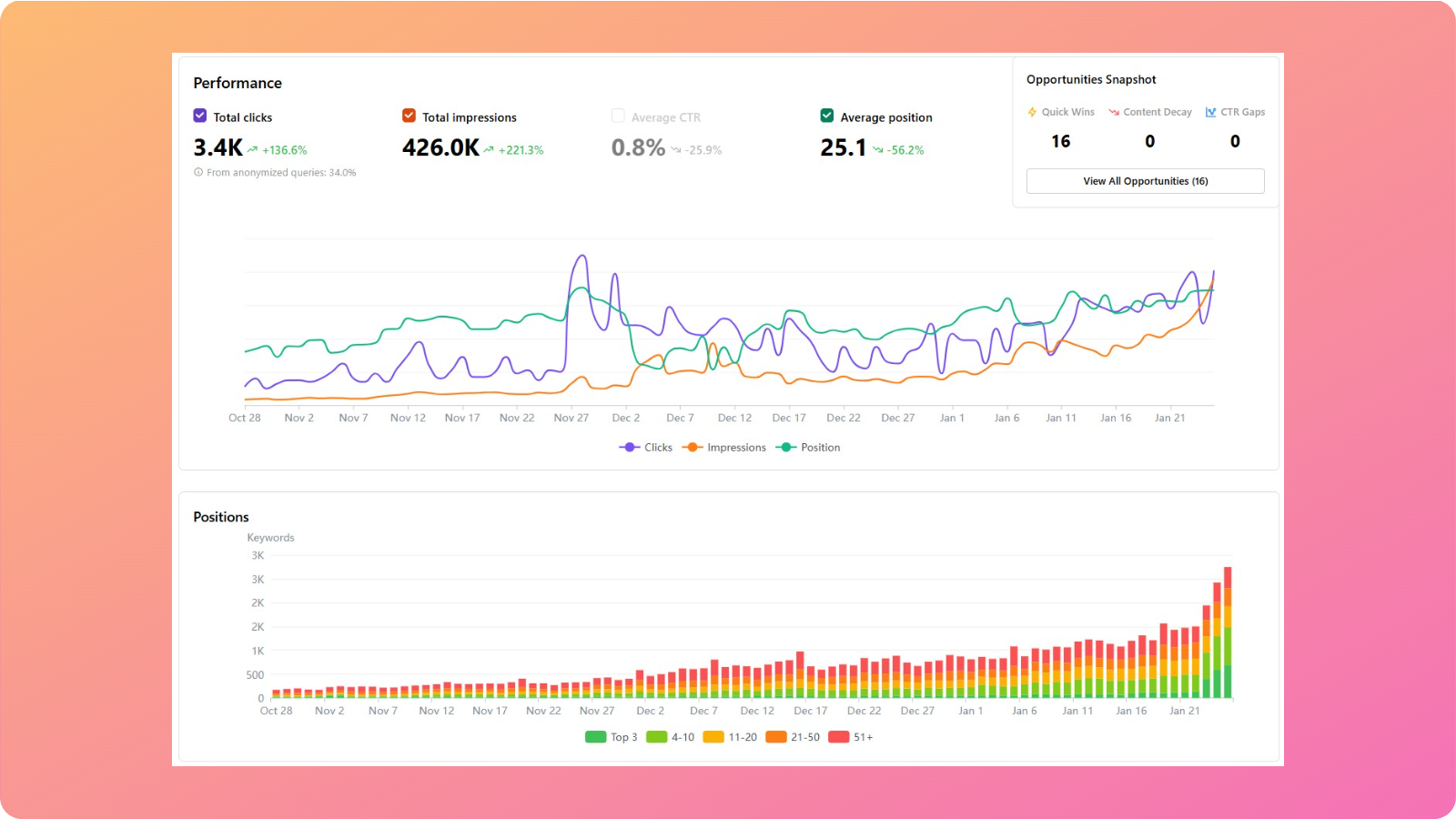
Tools like Contentpen can shorten the process by blending web SEO analysis with content creation. So, writers can see an on-page SEO checklist, GEO scores, and content gaps while drafting and publishing posts.
Write content that’s built to rank, not just read
Create search-optimized blogs aligned with SEO and GEO signals, so your content performs well across search and AI-driven discovery.
Try SEO Blogging FREE →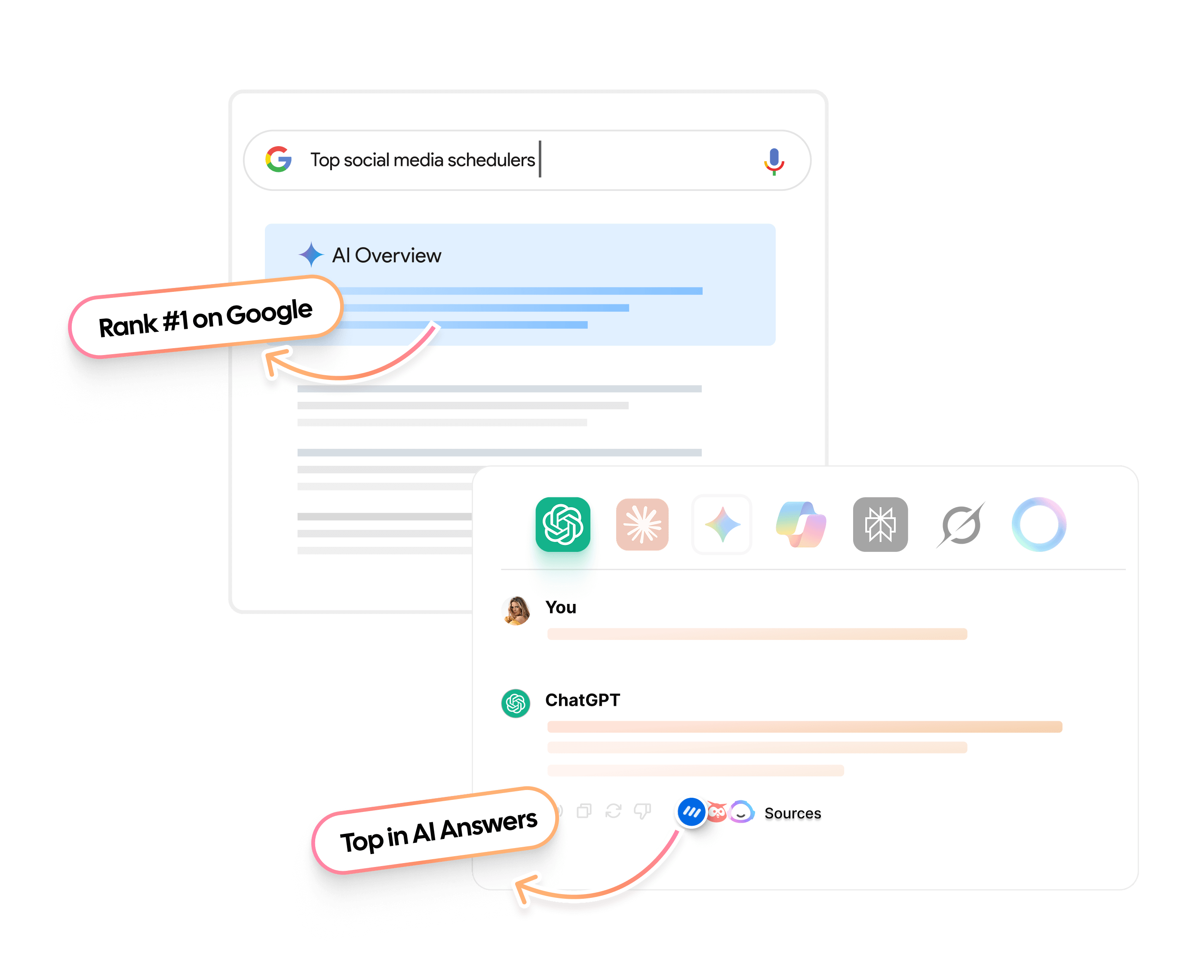
Integrating SEO analytics into your content strategy
A strong content strategy starts and ends with data. SEO analytics shows what people search for, which pages they read, and where they fall off. When that information feeds directly into planning and writing, each new piece stands a better chance of ranking and converting.
Let analytics guide content planning
Use keyword analysis and keyword gap data to build the editorial calendar. Focus on topics that mix:
- Search volume
- Clear intent
- Strong business value
Web SEO analysis can also reveal which formats work best in a niche, for example:
- Long how-to guides
- Quick checklists
- Videos
- Comparison pages
With this input, teams can decide not only what to write but also how to present it.
Build a feedback loop
Publish content, then watch SEO analytics in Google Search Console and Google Analytics 4 for a few weeks. Check:
- The number of queries you receive
- Click-through rates
- Engagement and conversion metrics
If a page gets strong impressions but weak clicks, improve the title and description. If people visit but bounce fast, rework the intro or adjust the offer.
Schedule regular content audits to update or merge underperforming pages. Over time, this turns content work into a steady cycle rather than random sprints.
Choosing the right SEO analytics tools in 2026
The best SEO analytics tools are not the ones with the most features. They are the ones your team actually uses every day to make better decisions.
In 2026, successful teams build lightweight, goal-driven stacks that connect analytics directly to content, conversions, and growth.
Rather than listing every tool again, this section focuses on how to choose the right SEO analytics setup based on your team’s needs, skills, and goals.
Match tools to your SEO goals
Different goals require different analytics strengths:
- Content growth teams need tools that connect keyword insights directly to writing, editing, and publishing.
- Revenue-driven teams need analytics that tie organic traffic to conversions, pipeline, and revenue.
- Technical SEO teams need deep crawl data, performance monitoring, and index diagnostics.
- Local businesses need visibility into map rankings, calls, and location-based engagement.
Strong SEO analytics starts by defining which of these outcomes matter most and choosing tools that serve them well.
A modern SEO analytics stack (simple and effective)
For most teams, a practical setup looks like this:
- Search performance layer: Tools that show how your site appears in search and which queries drive impressions and clicks.
- Behavior and conversion layer: Analytics that connect organic traffic to engagement, sign-ups, and revenue.
- Content and execution layer: A platform that blends SEO analytics directly into content creation, so insights turn into action immediately.
This is where Contentpen becomes the center of the workflow. It is a workspace where web analytics and SEO opportunities actively shape what gets written, updated, and published.
Quick comparison: SEO analytics tool categories
| Tool category | Tool example | Best for | Core SEO analytics role | Typical limitations |
| Search performance tools | Google Search Console | Visibility tracking | Queries, impressions, clicks, index coverage | Limited content or conversion insights |
| Web analytics tools | Usermaven | Behavior & revenue tracking | Engagement, conversions, attribution | Weak keyword and ranking context |
| All-in-one SEO suites | Semrush | Deep SEO research | Keyword research, backlinks, and rank tracking | Heavy, complex, costly |
| Integrated content + SEO platforms | Contentpen | Content teams | SEO analytics embedded in writing & publishing | Less focus on raw backlink data |
This structure helps teams see not just what tools exist, but what role each plays in a complete SEO analytics system.
Why integrated platforms outperform fragmented stacks
Traditional SEO workflows split analytics across multiple tools. This creates delays, data silos, and lost momentum.
Integrated SEO analytics platforms like Contentpen solve this by:
- Surfacing keyword opportunities inside the writing flow
- Providing live SEO scoring while drafting
- Highlighting content gaps before publishing
- Keeping brand voice, structure, and optimization aligned at scale
Instead of analyzing first and writing later, teams now analyze while writing, which dramatically shortens the time from insight to impact.
Choosing tools by team type
Here’s how different teams typically structure their SEO analytics stack:
- Solo creators & small businesses: Lightweight analytics + Contentpen for writing, optimization, and publishing.
- Content teams & startups: Search performance tools + conversion analytics + Contentpen as the central execution hub.
- Agencies & enterprise teams: Advanced SEO suites for research and reporting + Contentpen for scalable content production and optimization.
The common thread across all setups: SEO analytics works best when it directly informs content decisions, not when it lives in separate reports.
Advanced SEO analytics strategies in 2026
SEO analytics can move beyond simple reports into smarter, AI-assisted work. The big change in 2026 is that tools no longer just show what happened. Many now suggest the next steps and estimate the impact before changes go live.
How AI is transforming SEO analytics
On the AI side, several capabilities have become common:
- Anomaly detection: Instead of a person spotting a sudden drop in traffic weeks later, AI flags the change within a day, often linking it to a specific update, device type, or region.
- Personalized keyword difficulty: Instead of one generic score, AI looks at your domain strength, content history, and backlink analytics to judge if a keyword is realistic for your site.
- Forecasting: Some platforms can estimate traffic ranges for planned articles, giving teams a sense of likely returns before they invest many hours.
AI-driven topic clustering is another powerful method. Rather than staring at hundreds of phrases, teams can use AI to group them into clear themes or content hubs. Each hub then gets a main guide page with more focused pieces around it.
This approach aligns with how modern search understands topics, making internal linking plans much simpler.
AI can also scan existing pages and give specific on-page suggestions as part of your SEO analytics work, such as:
- Improving headings
- Adding missing subtopics
- Updating outdated facts
This is, however, just a starting point for your smart analysis. You can discover other tools that work well for you and incorporate their suggestions, one at a time, to see if you get the desired results.
Using competitive intelligence to outperform rivals
Competitor analysis is necessary to win a niche and the relevant audience. Here are some of the useful methods used in this regard:
- Keyword gap analysis: Highlights terms where several rivals rank but your site does not.
- Backlink gap analysis: Lists sites that link to competitors yet ignore your domain, which sets up targeted outreach plans.
- SERP feature tracking: Shows which content types (tools, checklists, guides) hold the most share of attention over time.
These tactics fit into broader search engine marketing analysis, helping you secure top spots and greater organic visibility.
Tracking brand visibility in AI-driven search results
A new frontier in SEO analytics is tracking brand presence in AI-driven search, especially as the Google vs ChatGPT market share situation continues to evolve and reshape how users discover information. That includes how often your brand or content appears in:
- Google AI Overviews
- Chat-style assistants
- AI-powered search engines such as Perplexity
To perform well here, sites benefit from:
- Clear authorship
- Strong E-E-A-T signals (experience, expertise, authority, trust)
- Accurate, well-structured content that other sources reference
Our AI writing assistant can help here by providing AI search optimization features. It guides writers toward clear structure, full coverage of topics, and proper internal and external linking.
The tool also helps you track your AI visibility in popular AI chatbots, including ChatGPT, Google AI, Perplexity, Grok, and Copilot.
Find your brand in AI search

Track AI citations, share of voice, and brand sentiment
Find the top sources driving citations
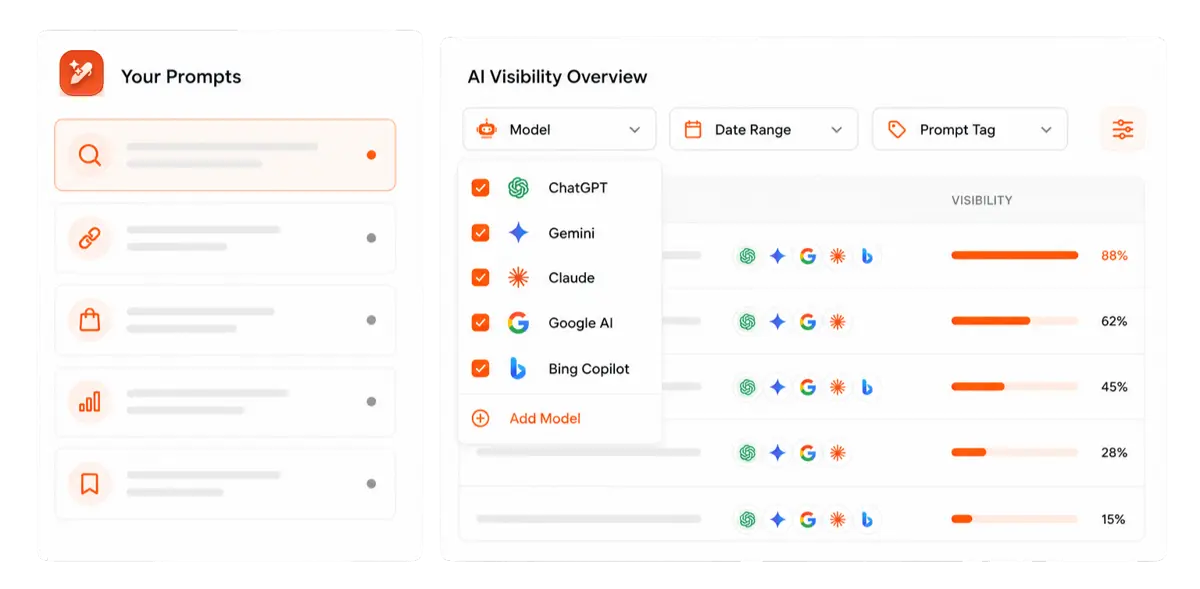
As a result, your content is more likely to be cited in both classic results and AI summaries or overviews.
Common SEO analytics mistakes and how to avoid them
Even strong teams fall into common traps when it comes to SEO analytics. The good news is that these mistakes are easy to fix once they are visible.
Mistake #1: Using too many SEO analytics tools without a clear system
It is tempting to sign up for every free SEO analysis, rank tracker, and site audit. The result is often confusion, since numbers do not match and reports are hard to compare. A stronger plan is to pick a small stack, one that shows clear analysis and no noise.
Mistake #2: Ignoring technical SEO signals in analytics
Some teams publish many articles, yet still struggle because pages load slowly or crawlers hit errors. Regular technical checks, as part of ongoing SEO analytics, catch these issues early.
Fixing speed issues, broken links, and mobile layouts often improves performance across many pages at once.
Mistake #3: Treating SEO analytics as a one-time project
Running a big SEO audit once a year and then forgetting about it means changes in search or on the site go unseen. Therefore, a light monthly review and a deeper quarterly review keep SEO analytics fresh without taking over the calendar.
Also, don’t let SEO sit in a silo. Linking data across tools provides a comprehensive view of search engine marketing analytics and helps demonstrate how organic, paid, and other channels work together.
Summing it up
SEO analytics turns data into a clear action plan for marketers, agencies, and businesses. In 2026, AI summaries, rich results, and changing user habits make simple rank reports far too shallow.
The main message is simple. You don’t need deep technical expertise for SEO analytics, but you do need a more innovative approach to improve rankings. Use the right tech stack and have a step-by-step framework to keep the four main pillars of SEO aligned.
The real edge comes from steady, small improvements. Run regular reviews, update existing content, and try one or two advanced tactics as the team grows. With this approach, SEO becomes a strong driver of growth for your brand.