 13 minutes
Imagine two brands in the same niche. Their products are similar, their ad budgets are close, and their teams are equally busy. Yet when people talk online, search on Google, or scroll social feeds, one brand keeps showing up, and the other feels invisible.
The difference is not only in ad spend. This difference is the share of voice.
Put simply, share of voice (SOV) is the percentage of visibility or conversation your brand holds in a market compared with competitors. In SOV marketing, it shows who appears most in ads, search results, and social media posts. When a brand builds its share of voice, it usually increases trust and, eventually, sales.
This guide breaks down everything about SOV and provides clear ways to grow it with content. By the end, anyone on a marketing or content team will know how to measure share of voice and improve brand visibility in no time.
So, let’s get started.
Table of contents
- Definition of share of voice and core concept
- Why does share of voice matter for your brand?
- The share of voice formula and how to calculate SOV
- Share of voice tools and measurement methods for each SOV type
- How to increase your share of voice with high-quality content
- Final thoughts
- Frequently asked questions
Definition of share of voice and core concept
Marketers use the term share of voice to describe how much space a brand takes up in market conversations relative to competitors.
It is a marketing metric that shows the portion of total visibility, impressions, or mentions in a category that belongs to a single brand. If many people see or talk about a brand compared with its rivals, that brand has a strong share of voice.
Related read: Understanding fundamentals of search engines.
The classic share of voice definition came from paid advertising and analyzing paid traffic. Teams reviewed media spend by channel or category. If a brand spent $5 million on ads in a category where all brands together spent $100 million, that brand had a 5% share of voice.
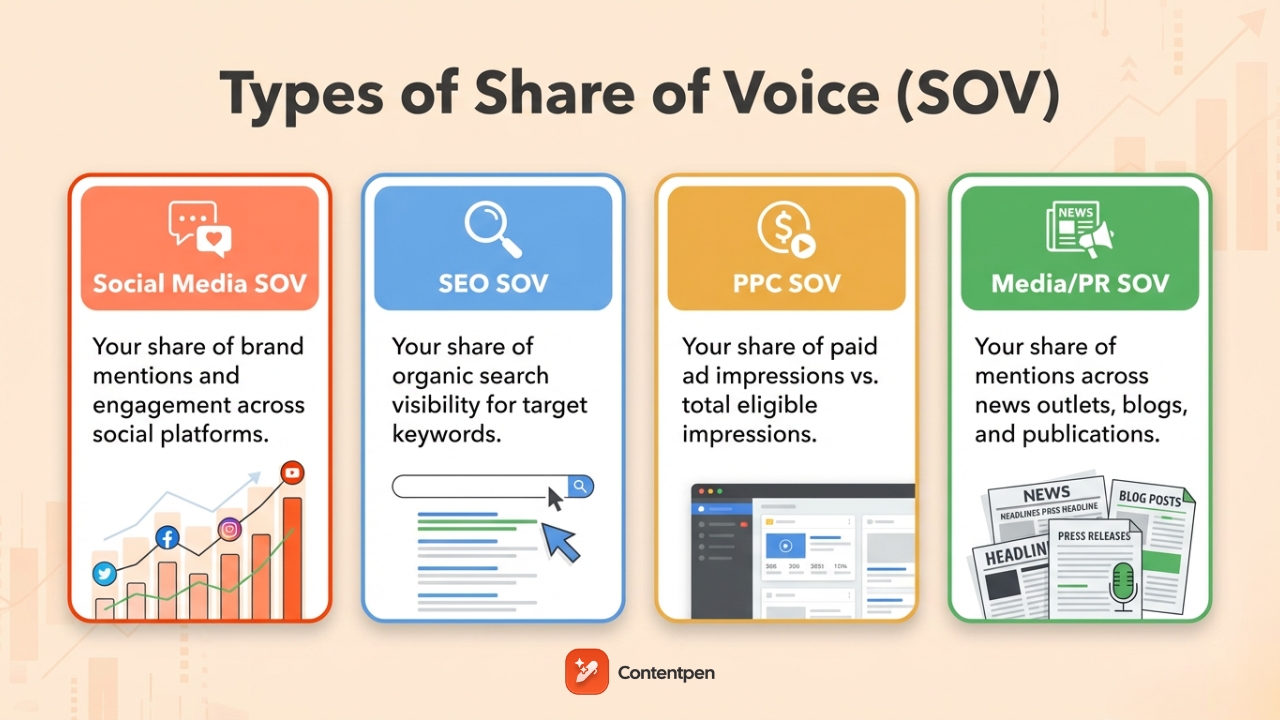
Now the definition is wider. In SOV marketing, experts define share of voice across multiple channels simultaneously. It can include:
- Social media posts and mentions
- SEO share of voice in Google search
- PPC impression share
- Media/PR with brand mentions in blogs, news, or articles (boosts AEO)
- AI search SOV in answers from ChatGPT, Gemini, Perplexity, and Google’s AI Overviews
The share of voice changes constantly. A campaign launch, a viral tweet, or a competitor price cut can move the numbers quickly. So SOV is not just about making the most noise. It is about having a strategic presence in the right topics and channels.
| Type of SOV | What it measures |
| Social media SOV | Your share of brand mentions and engagement across social platforms |
| SEO SOV | Your share of organic search visibility for target keywords |
| PPC SOV | Your share of paid ad impressions vs. total eligible impressions |
| Media/PR SOV | Your share of mentions across news outlets, blogs, and publications |
| AI search SOV | Your share of brand mentions in AI-generated answers for prompts in your category |
PR and media SOV help you build AI visibility as AI answer engines pick top sources in your niche to build summaries. Over time, this space in AI Overviews and chatbot responses builds credibility.
Why does share of voice matter for your brand?
Tracking share of voice provides context that raw traffic or click numbers cannot.
A site may gain visits, yet still lose ground if competitors grow faster. SOV shows where a brand truly stands inside the wider market conversation. That makes share of voice analysis a key part of serious marketing work and reporting.
SOV offers strong audience insight
A higher share of voice often means messages, angles, and content formats are landing well. When SOV is low or declining, it can signal that topics, tone, or channels no longer align with what people want.
Reading and tagging actual mentions can even reveal questions and needs that haven’t yet been answered.
SOV is a competitor research tool
By watching rival brands and their SOV, teams can spot which campaigns move the needle and which ones fade. It becomes easier to see where others overinvest or ignore gaps so that a brand can take the edge without much hassle.
SOV makes it easy to perceive brand reputation
A brand might appear often, but in negative threads. Therefore, tracking both volume and customer sentiment lets teams address issues early, before they spread.
When we talk about brand reputation, we must also see the strong link between share of voice and share of market (SOM).
Research by Les Binet and Field found that when a brand sets its SOV above its SOM, it is likely to grow in the long term.
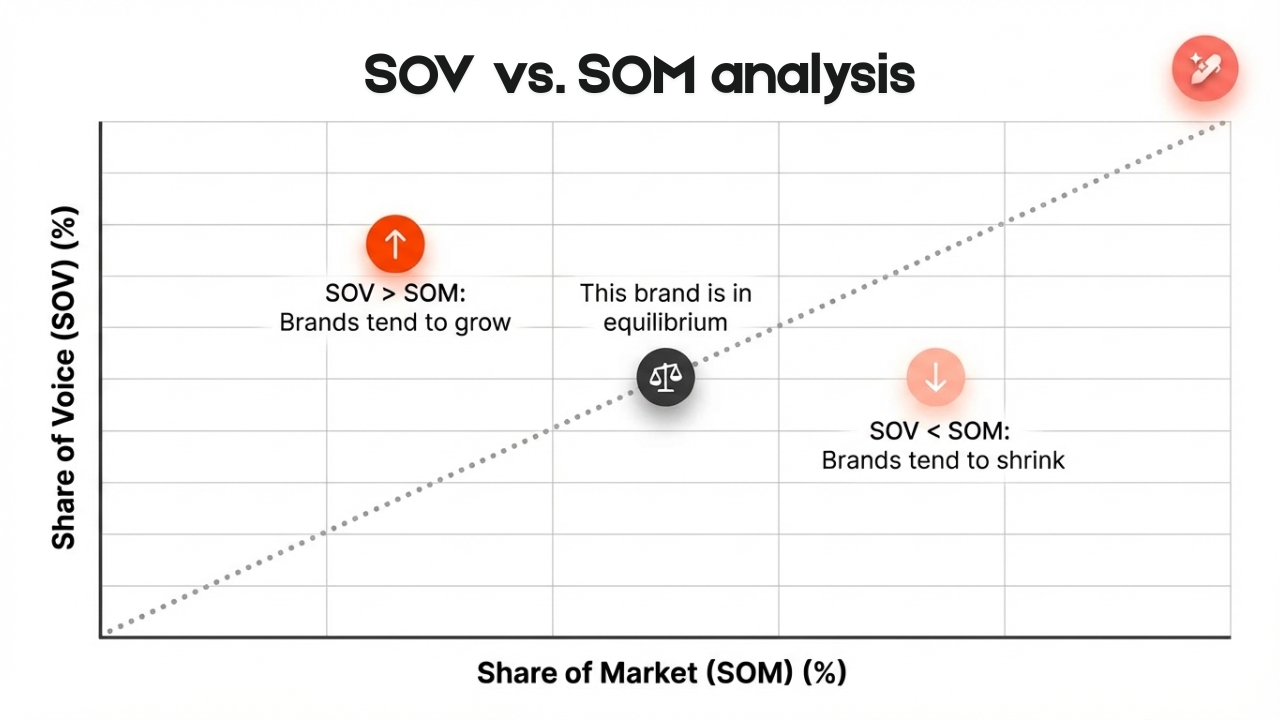
Les Binet also reported an annual 0.5% SOM increase for brands across different categories when 10% was invested in extra SOV (eSOV).
SOV is a useful score for a campaign review
Finally, SOV is a useful score for campaign review. Brands can compare share of voice before, during, and after major launches. If SOV rises in the period that matters, the campaign probably drew attention. If it stays flat, it is time to check the message, formats, or media mix.
The share of voice formula and how to calculate SOV
The good news for busy marketers is that the share of voice formula is simple and consistent. No matter which channel a team tracks, the math does not change; only the inputs do.
Mainly, the formula we use to calculate the share of voice is as follows:
Share of voice (%) = (Your brand metrics ÷ Total market metrics) × 100
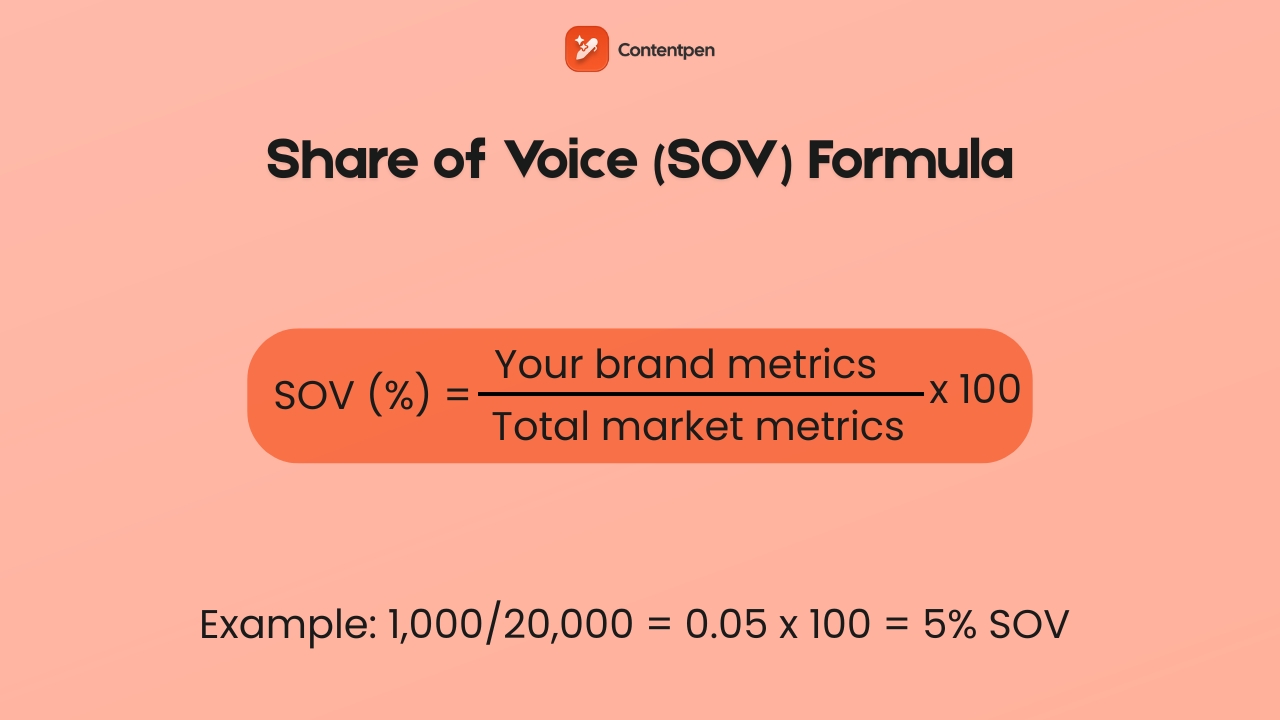
In this formula, your brand metrics refer to mentions, impressions, clicks, or press stories generated by your brand over a specific period. Total market metrics means the same measure for the brand plus all direct competitors in the defined set.
Before running the numbers, it helps to be clear about:
- The time period you are measuring
- The channel or medium (social, search, ads, or press)
- The competitors you want to compare against
- The metric you will use (mentions, impressions, clicks, or articles)
For a social share of voice example, imagine a month where a brand earns 800 tagged mentions across major platforms. In the same month, three key rivals earned 2,000 mentions between them. Total market mentions now equal 800 + 2,000 = 2,800. The SOV calculation is 800 divided by 2,800, times 100, which is about 28.6%.
For an SEO SOV example, consider clicks on organic keywords. Say a site receives 1,200 organic clicks in a month, while all the other brands gain 6,000 clicks. The SEO SOV is 1,200 divided by 7,200, times 100, which is 16.7%.
Share of voice tools and measurement methods for each SOV type
To see the full picture of brand share of voice, it helps to break SOV into types by channel. Each type of SOV requires different data and tools to understand the numbers properly.
#1: Social media SOV
For social media share of voice, the focus is on day-to-day conversation. This SOV type tracks how often people talk about the brand on platforms like X, Instagram, LinkedIn, or TikTok, compared with how often they talk about rivals.
To measure this social share of voice at scale, teams can lean on tools such as Sprout Social, Talkwalker, or ContentStudio.

These tools scan streams for brand and keyword mentions and compare them with a chosen competitor list. Many of them also sort mentions by sentiment and platform, which makes it easier to tie social SOV to content plans.
#2: SEO + AEO SOV
For SEO share of voice, the goal is to track how often searchers click the brand instead of a rival. This often appears under names such as ‘search visibility’ or ‘visibility index’.
For SEO SOV, you can start with a focused keyword set that aligns with the target audience’s search intent. Track rankings and estimated clicks for those terms and for competitors.
Click-through rate and position both matter, since a ranking that wins more clicks raises SOV more than a weak one in the same spot.
SEO share of voice tools such as Semrush, Ahrefs, and Moz help here. They estimate traffic share from keyword groups, highlight where a site lags, and show where rivals lead with detailed competitor analysis.
In practice, growing this type of SOV comes from steady, optimized content and strong technical SEO, so searchers keep seeing and choosing the brand.
#3: PPC SOV
For PPC share of voice, impression share gives the cleanest view. It shows how often a brand appears in paid ad slots when it is allowed to compete. A high value suggests bids, budgets, and ad quality are strong enough to win most chances to show.
In search engine marketing, when impression share is low, it often means one of the following things:
- Cost per click is too high for the current bids
- Ad quality scores are weak
- Targeting is too narrow for ads to enter auctions.
Watching how this SOV value changes during tests helps teams see whether budget shifts or creative refreshes are making any real difference.
Platforms such as Google Ads and Microsoft Ads report impression share inside their standard views.
Extra tools like SpyFu can add more detail on rival bidding patterns. By pairing those insights with creative tests, teams can grow their paid SOV without wasting budget.
#4: Media/PR SOV
Finally, for media and PR share of voice, the focus shifts to press and long-form coverage. This means tracking how often a brand appears in news stories, blogs, interviews, and reports in its space. Combined with social SOV, this type rounds out a fuller view of brand visibility.
Measuring media SOV starts with a source list. This can range from major national outlets down to small niche blogs, as long as they reach the right audience.
Tools for measuring share of voice in media include suites such as Talkwalker and Meltwater. These tools collect clippings, sort them by outlet and tone, and help teams see where they stand in earned coverage.
#5: AI search SOV
AI search share of voice measures how often AI engines mention your brand when people ask questions in your category. As more buyers ask ChatGPT, Gemini, or Perplexity for recommendations before they ever search Google, this is quickly becoming one of the most important SOV types to track.
The formula works the same way: take the number of times your brand is mentioned across a set of tracked prompts, divide it by the total mentions of all brands in your competitor set, and multiply by 100.
For example, if you’re mentioned 30 times across 50 prompts and your competitors are mentioned 120 times in total, your AI search SOV is 30 ÷ 150 × 100 = 20%.
Because AI answers vary from one run to the next, you need to check the same prompts regularly to see a reliable trend. Contentpen’s AI visibility tracking, does this automatically across up to seven AI engines and shows your share of voice alongside your average position, brand sentiment, and the sources AI engines cite for your competitors but not for you.

Find your brand in AI search

Track AI citations, share of voice, and brand sentiment
Find the top sources driving citations

How to increase your share of voice with high-quality content

Once teams know where they stand, the next step is to grow their share of voice in a smart way.
Content sits at the heart of that work. In 2026, content is the engine that feeds share-of-voice marketing across search, social, email, and media. More high-quality, relevant content often leads to more mentions, links, rankings, and better ad performance.
Step #1: Build thought leadership in niche topics
Instead of trying to dominate every broad term, it is often wiser to target a narrow niche.
By publishing clear, research-backed content, you can easily win a niche and become the default voice in the space. Over time, as that pocket of SOV grows, the brand can expand into related topics while having a stronger base.
Step #2: Create share-worthy and useful content
People share content that makes them look smart, helps them act, or makes them feel seen. That is why deep guides, checklists, data stories, and simple visual explainers often do well for SOV.
When content answers real questions, the likelihood of earning mentions and backlinks increases. These extra signals, in turn, help both SEO share of voice and social SOV grow.
Step #3: Encourage user-generated content and social proof
Testimonials from real customers often carry more weight than brand posts. Inviting buyers to share photos, short reviews, or use case stories can boost social share of voice in a natural way.
You can also boost discussions about your brand on Reddit, Quora, Medium, and other platforms. Create threads, comment, and provide genuinely useful insights to users to improve SOV.
As these posts stack up, the brand gains visibility and trust without adding extra strain on the internal team to pump out content.
Step #4: Stay consistent at scale with Contentpen
One of the biggest threats to brand share of voice is uneven publishing. A team may post a lot during a big launch, then go quiet for months. That silence creates room for competitors to step in.
This is where Contentpen makes a real difference. As an all-in-one SEO and AEO platform, Contentpen helps content marketers, small businesses, and agencies publish high-quality, SEO- and GEO-friendly articles on a consistent schedule, and on the Growth plan and above, Autopilot can keep publishing going even during busy periods.
Its built-in SEO scoring, AI search optimization, and content gap research show where more content can win extra SOV, and AI visibility tracking shows whether that content is actually raising your share of voice in AI answers. With planning, drafting, publishing, and measurement in one workspace, teams can grow SOV without burning out writers.
Write better blogs in less time, without sacrificing quality.
Let AI handle structure, clarity, and flow while you stay in control of the message.
Try AI blog writing →
Step #5: Monitor and join trends in real time
Brands that grow their share of voice pay attention to what people talk about right now. By setting alerts for brand names, key topics, and rival campaigns, teams can see rising themes early.
A quick, thoughtful response to a trend, meme, or news event can spark a sharp but meaningful spike in SOV. The key is to respond in a way that aligns with the brand voice and adds value, not noise.
Final thoughts
Share of voice is a simple way to see how much of the conversation a brand owns compared with competitors. By looking at SOV across social, search, ads, media, and AI answers, teams can see their real position and spot clear chances to grow.
When brands raise SOV in the right topics, they often see later gains in leads and revenue. That is why share-of-voice marketing matters for startups and large teams alike.
In the end, the most reliable path to higher SOV is steady, useful, and well-targeted content. Contentpen helps teams plan, write, and publish SEO- and GEO-ready content at scale in their own brand voice, then track how their share of voice in AI answers changes over time.