 14 minutes
Latent Semantic Indexing (LSI) are words or phrases that conceptually relate to your targeted keywords.
LSI keywords have a buzz about them. Some say that they are a secret to ranking on SERPs, while others say Google doesn’t use them at all. When the advice clashes like that, it is hard to know what to do with an LSI keyword in SEO.
Here is the twist. The original Latent Semantic Indexing (LSI) technique from old research papers is not part of Google’s stack anymore. That said, the idea behind so‑called LSI SEO is still valid.
This article keeps things honest and practical. You will learn exactly what LSI keywords are, why they still matter, how to find them, and use them in a way that feels natural.
By the end, you will have a clear, simple process you can apply to every piece of content to rank better on searches.
So, let’s get started.
Defining LSI keywords
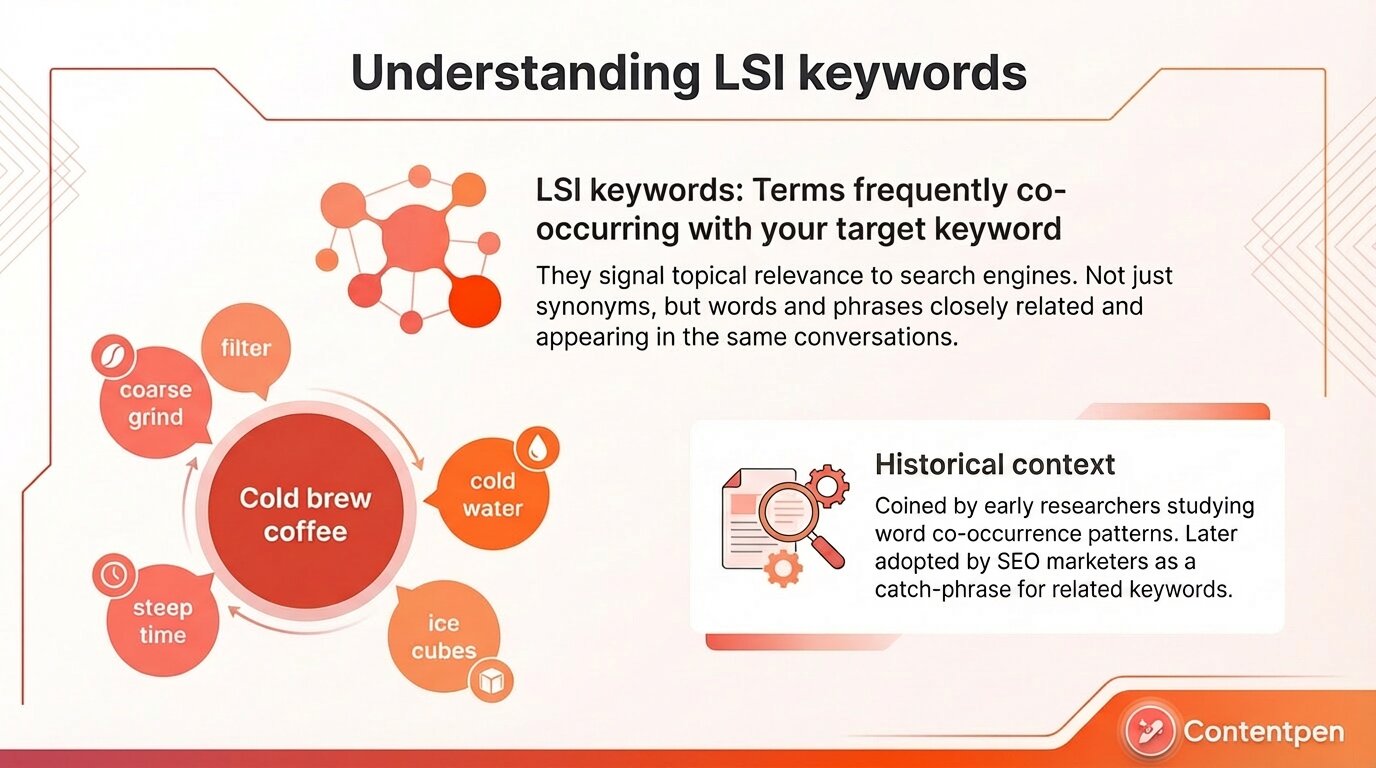
LSI keywords are terms that frequently co-occur with your target keyword across multiple documents, signaling topical relevance to search engines.
When marketers talk about LSI keywords, they usually mean words and phrases that are closely related to your main organic keyword. These are not only synonyms. They are terms that often show up in the same conversations, which helps search engines see the topic more clearly.
For instance, the keyword “cold brew coffee” has terms like “coarse grind,” “filter,” “steep time,” “cold water,” and “ice cubes” that are good LSI keyword examples.
Where did the term ‘LSI’ come from?
The term Latent Semantic Indexing came from a group of researchers who scanned documents and looked at patterns of word use based on how often they appeared in similar contexts. That was helpful for small, static document sets, long before modern web search.
Marketers later borrowed the concept and started talking about latent semantic indexing in SEO. Over time, the technical details were lost, but the label stayed.
People began using “latent semantic indexing keywords” as a catch‑all phrase for related keywords that SEO strategies should include.
Does Google use LSI?
Google has been clear that it does not run a “Google LSI” system behind the scenes. John Mueller from Google has said that there is no such thing as LSI keywords in their ranking system.

Google now uses newer methods such as natural language processing, the Knowledge Graph, and machine‑learning models like RankBrain and BERT. It focuses on meaning, entities, and keyword co‑occurrence, not on the original LSI math.
Differentiating between secondary, LSI, and semantic keywords
Let us clarify the differences between secondary, LSI, and semantic keywords, all of which are repeatedly confused by a lot of people.
| Type | What it is | Example (main keyword: “cold brew coffee”) |
| Secondary keyword | A variation of the main phrase with the same intent | “cold brew recipe,” “how to make cold brew” |
| LSI keyword | A term that statistically co-occurs across other ranking pages | “coarse grind,” “steep time,” “filter,” “cold water.” |
| Semantic keyword | A concept in the same idea-space, even without shared words | “morning routine,” “summer drinks,” “caffeine sensitivity.” |
Think of secondary keywords as supporting keywords to the target phrase, and LSI keywords as co-occurring or co-existing with the target phrase. Semantic keywords are phrases that do not share common words but concepts with the target phrase.
Why semantic keywords still matter for your SEO
Early SEO was obsessed with keyword density. If you wanted to rank for “SEO tips,” you stuffed “SEO tips” into every heading and paragraph.
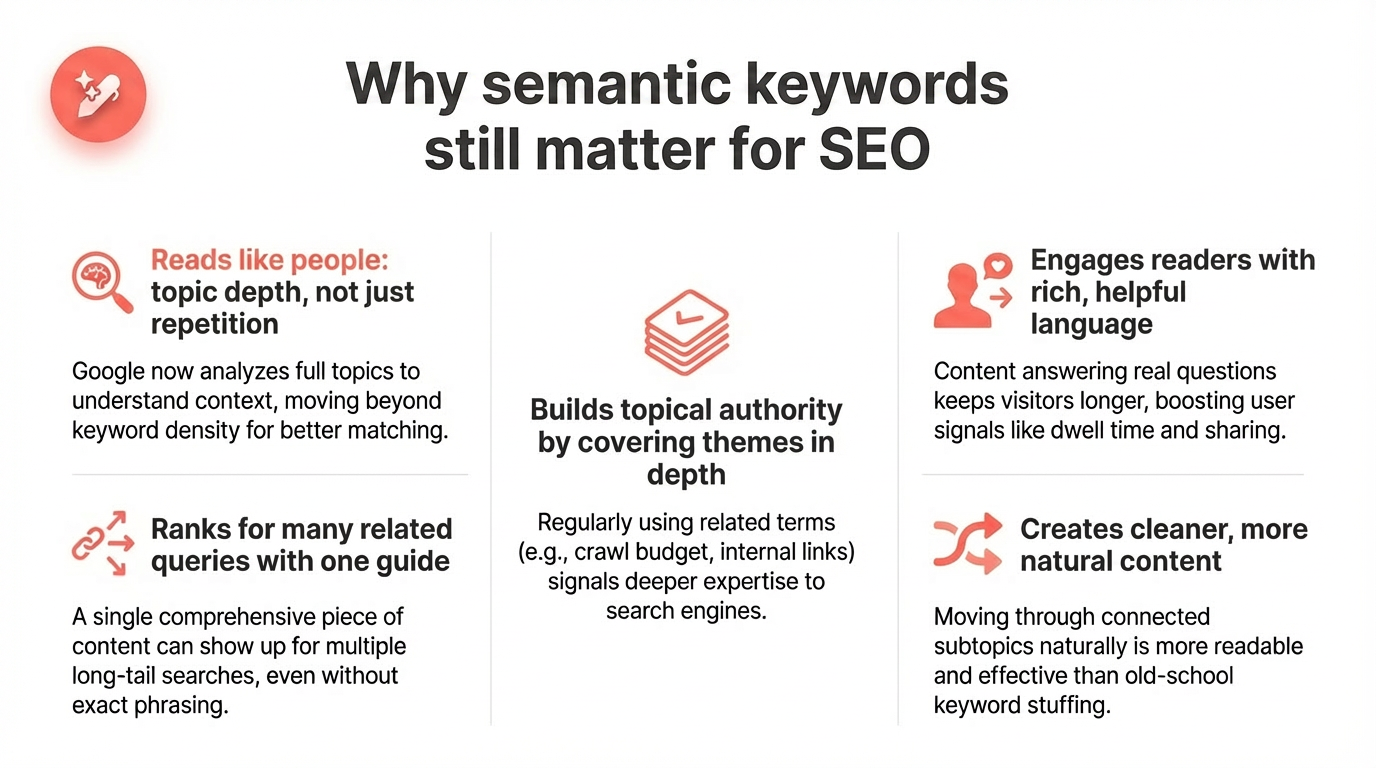
Search engines have grown past that. Thanks to semantic search, Google now reads pages more like a person does. It looks at the full topic, not just repeated terms.
When your content includes rich, relevant language, it sends strong signals.
Google can see that you cover the subject in depth, not only the exact phrase. That helps it match your page to many related searches. This is how one guide can show up for several long‑tail queries at once, even if those phrases never appear as exact matches.
Also read: 10 SEO keywords examples in 2026.
Using semantic keywords for SEO also helps build topical authority. If a group of your articles on technical SEO regularly uses terms like “crawl budget,” “internal links,” “canonical tags,” and “XML sitemap,” Google can be more confident that your site knows this subject.
If any of those terms feel unfamiliar, our SEO glossary defines 250+ of them in plain language so you can use them with confidence.
Readers feel the difference as well:
- A page that talks only about “credit cards” in vague terms is not very helpful.
- A page that also explains interest rates, credit scores, annual fees, rewards programs, and balance transfers answers real questions.
People stay longer, scroll further, and are more likely to share or link. Those user signals line up well with better rankings over time.
Semantic coverage is also cleaner than keyword stuffing. Instead of repeating the same phrase ten times in one section, you use related keywords your research uncovered to move through connected subtopics. This also makes your writing sound natural.
Here is a simple comparison to help you understand these topics better:
| Approach | Example text snippet | SEO impact |
| Keyword stuffing | “SEO tips, SEO guide, SEO best practices for SEO tips.” | Thin content, possible spam signal |
| Synonyms only | “Search engine optimization tips and tricks for marketers.” | Better than stuffing, but still narrow |
| Semantic keywords | “SEO basics like search intent, meta tags, backlinks, and crawlability.” | Strong topical authority, broader query coverage |
Modern rankings lean toward the last approach. A thoughtful semantic SEO strategy is no longer a nice extra. It is part of how you stay visible against competitors who are already writing this way.
How to find LSI keywords (free and paid methods)
Once you understand what LSI keywords are in practice, the next step is to find them. You do not need a math degree or a fancy LSI keyword generator to get started. A mix of Google’s own features and a few tools is enough to build a strong related‑term list before you write.
Free methods using Google
You can get a long way just by paying close attention to Google’s results pages. These features reflect real searches and natural keyword co‑occurrence patterns.
Google Autocomplete
Use Google Autocomplete when you type your main keyword into the search bar. As you type “content marketing,” you might see suggestions like “content marketing examples,” “content marketing tools,” or “content marketing jobs.”
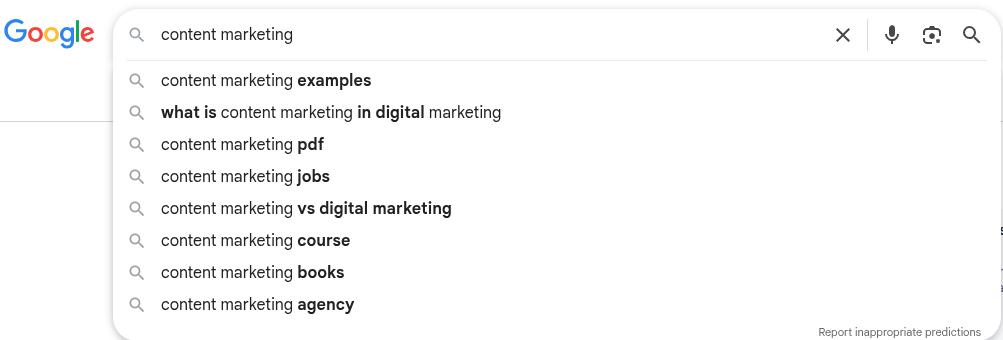
The bolded words after our primary keyword ‘content marketing’ are semantic suggestions by Google. Writing them down gives you a quick set of LSI keywords based on real user interest and intent.
Google People also search for
Scroll to the Related searches or ‘People also search for’ box at the bottom of the results page. These are full queries that connect to your starting term.
For “SEO tools,” you might see searches about ‘free audits’, ‘how to do keyword research’, ‘technical SEO checks’, or ‘SEO tools for beginners’.
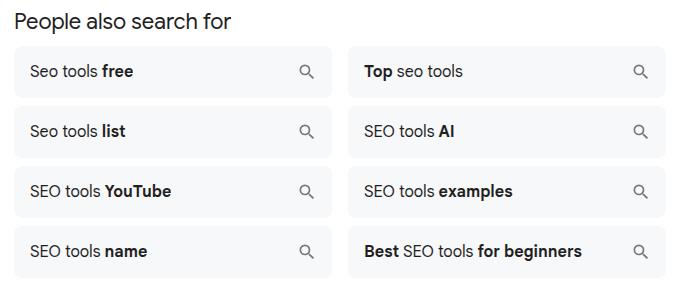
Each one points to subtopics your audience cares about. Turning those into headings or sections helps you cover the topic in a complete way.
Google People also ask section
You can also get a hint of Latent Semantic Indexing keywords from Google’s ‘People also ask’ section, which appears for many informational, transactional, or commercial queries.
These are mostly FAQs related to a topic, so it is not a bad idea to try to answer these questions in your content. Or in your frequently asked questions section at the end of a page.
Google Images
Try Google Images and look at the tags above the pictures. When you search a term there, you often see clickable chips such as “ideas,” “diagram,” or “examples.”
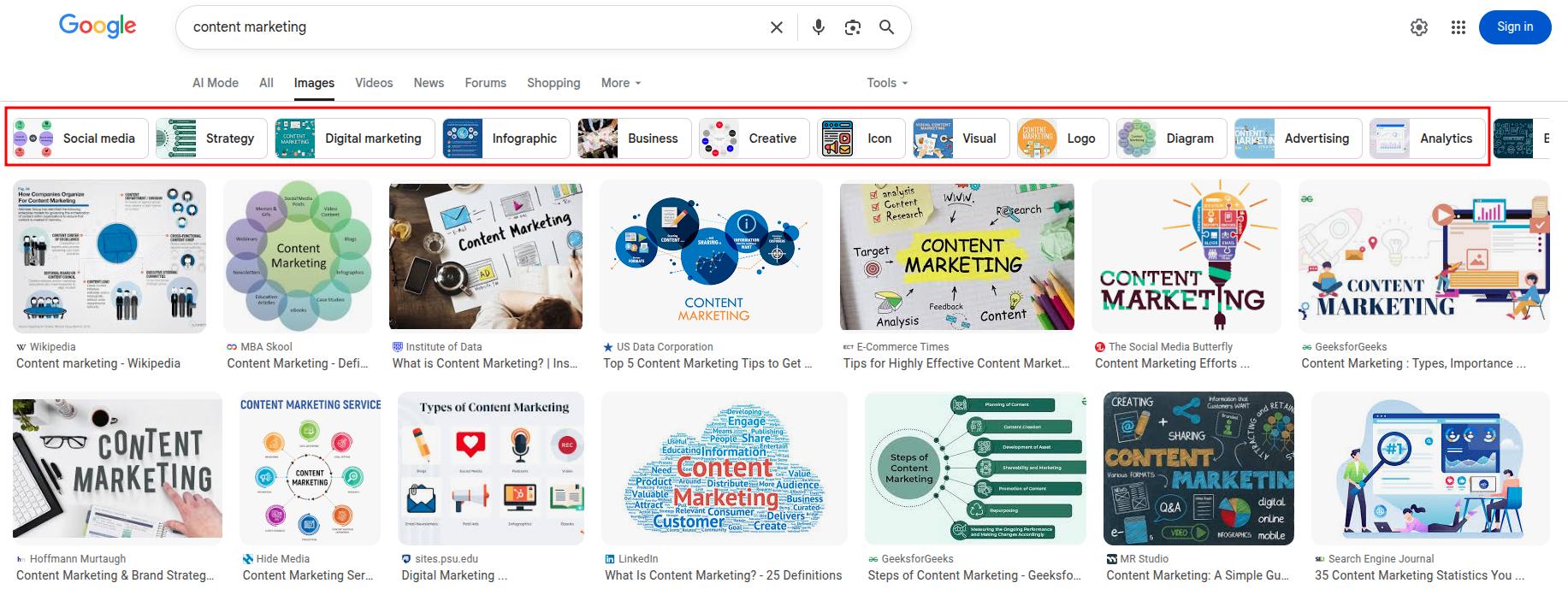
Those tags surface related concepts you may not have thought about yet. They are handy prompts for both new sections and extra semantic keywords.
Google Keyword Planner
Finally, use Google Keyword Planner in its free mode to get more ideas. You can enter a target keyword or even paste a competitor URL that already ranks. The tool returns many keyword ideas, including close variants and conceptually linked phrases.
Sorting through these ideas helps you find LSI keywords that matter most for your content, allowing you to establish your topical authority in a niche.
Paid and dedicated tools for deeper research
Free methods are great, but sometimes you want a deeper look at how top pages use LSI keywords. That is where paid tools and more focused workflows come in.
Contentpen
Put your research to use inside a writing workflow instead of leaving it in a spreadsheet. This is where Contentpen helps. Contentpen is an AI SEO tool that lets you plug in your main topic and related terms, then draft long‑form, semantically rich content around them.
It keeps your outline focused, suggests helpful angles, and gives you content that is ready to refine and publish.
Besides that, Contentpen also provides a dedicated keyword research tool that uncovers semantic terms related to your niche. It also provides helpful metrics, such as CPC, keyword difficulty, and keyword volume, to help you plan, write, and publish your content accordingly.

Automated keyword research
Work on keywords worth writing for
Get search terms with real ranking potential, not just high volume.
Try Keyword Research for FREE →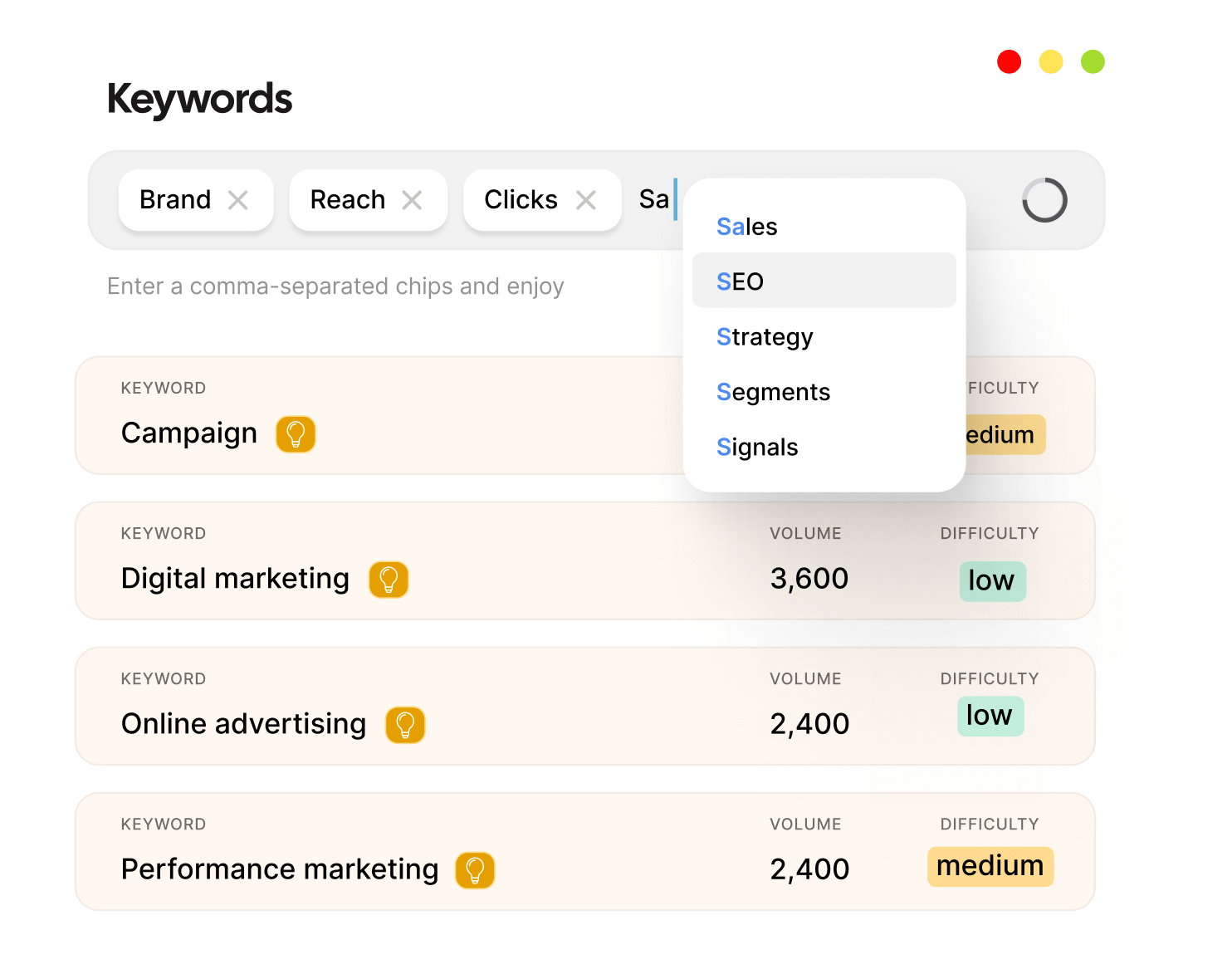
LSI Graph
LSI Graph is yet another useful tool to get related keywords for your targeted topic. You enter a seed keyword, and the tool pulls a list of semantically related terms from pages that already rank.
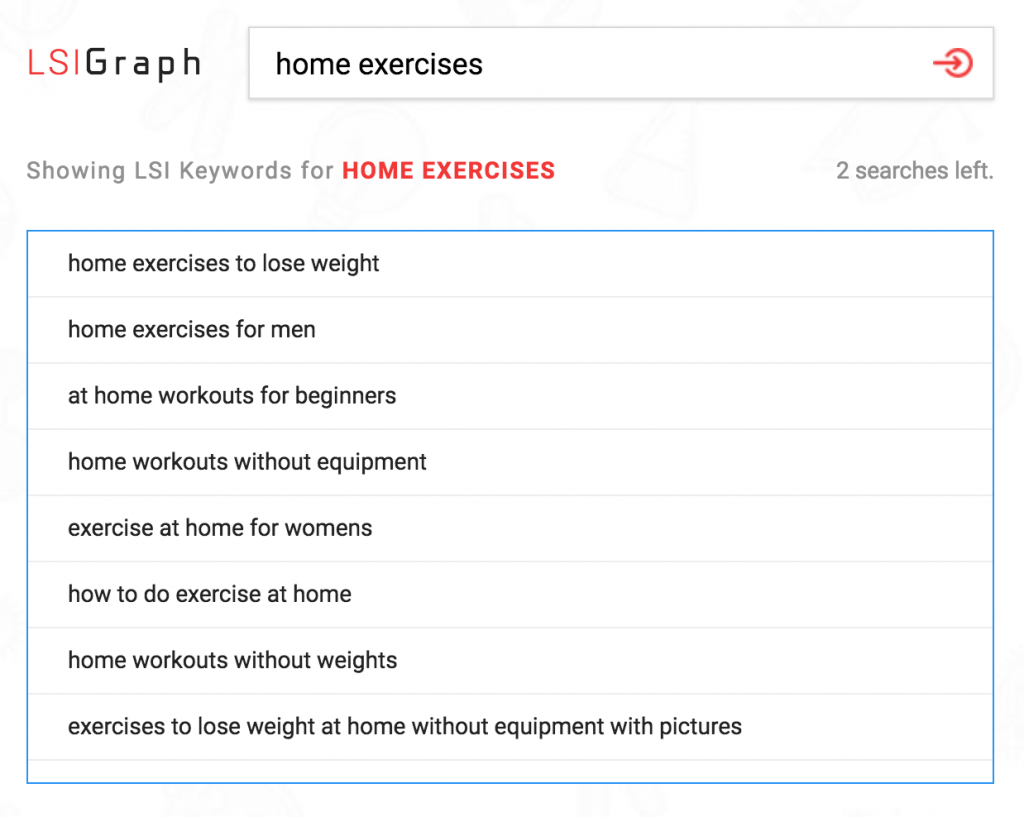
Credits: Magnetic Creative.
Many users treat this as a free LSI keyword tool on a limited plan, then upgrade if they need more data. The main value is that it shows how real content uses related language.
Semrush
Turn to suites like Semrush for content templates and writing help. Their content tools study the first page of results for your keyword, then suggest semantic keywords and phrases that those pages share. As an example, below are LSI keywords for the term ‘how to make pizza dough.’
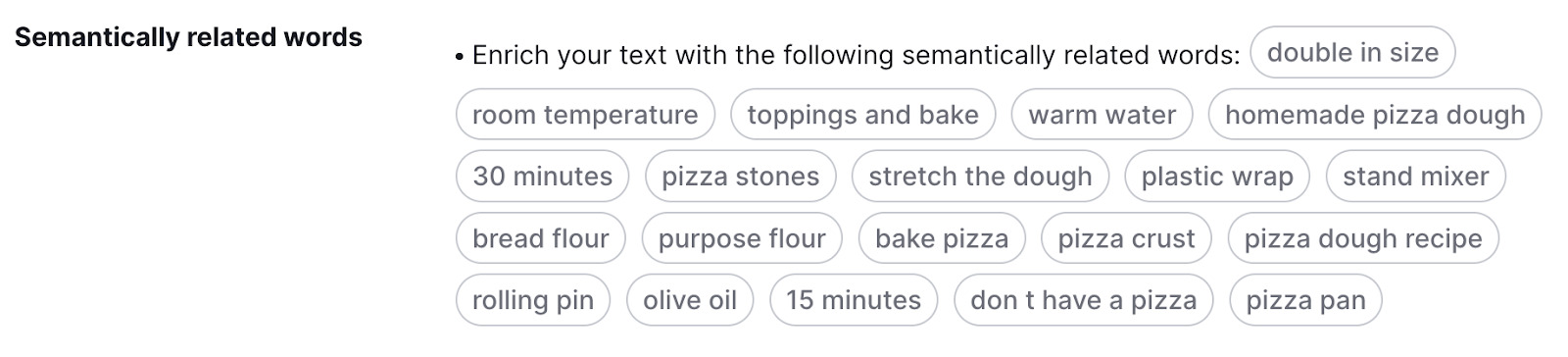
This feels like a guided LSI keyword generator based on live SERPs rather than guesswork. It is a fast way to spot gaps in your own outline as well.
Bonus method: Manual competitor analysis
Do a manual competitor analysis for an even richer context. Open the top five to ten results and note the H2s, H3s, and repeated terms they use.
Look at how they handle questions, examples, and comparisons. Patterns you see across several pages are strong hints that those terms matter for semantic search and topic depth.
You can also use some powerful competitor analysis tools for this purpose, such as Serpstat.

Simply enter your main keyword and go to SEO Research -> Related Keywords. There you will see a list of related words and phrases that your competitors are currently ranking for. Use them in your content for better ranking and positioning in your niche.
The key is not to chase every term that any LSI keyword generator shows you. Pick a focused set of semantic keywords that match your intent and the reader’s needs, then write around those with care.
How to use LSI keywords in your content (without overdoing it)
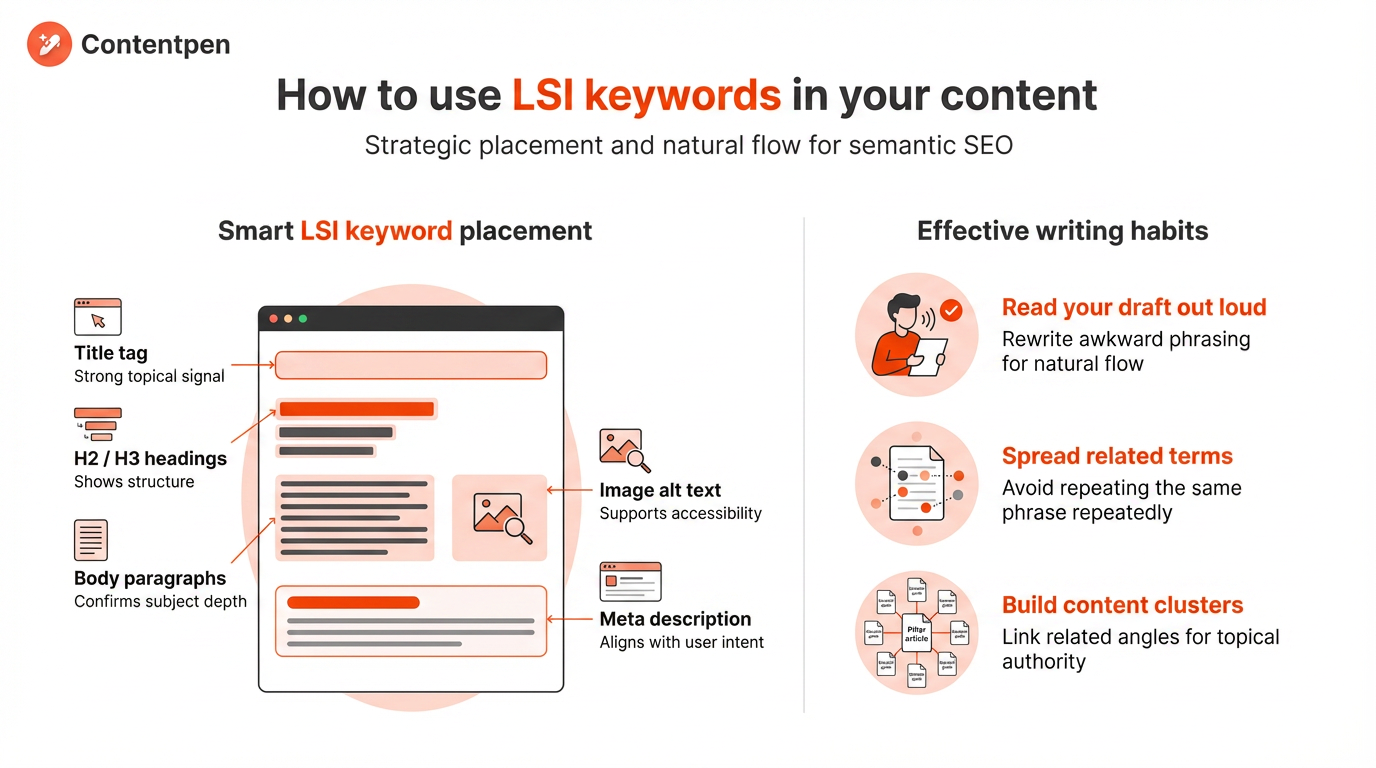
Finding related terms is only half the battle. The real value comes from how you use LSI keywords in real articles, landing pages, and guides.
The main rule is simple: let semantic terms guide what you talk about, not force you into awkward phrases or long lists that do not read well.
Start by deciding where semantic keywords should appear. Think about the key places where both readers and search engines look for context. Then use related language there when it fits.
You are not trying to hit a fixed number; you are trying to show a clear, well‑rounded view of the topic.
Here is a quick placement guide.
| Placement | Example use | Why it helps |
| Title tag | “Search engine basics and search intent for beginners” | Adds a strong topical signal right away |
| H2 / H3 headings | “On‑page SEO factors search engines still care about.” | Shows structure and core subtopics |
| Body paragraphs | Explaining “SEO backlinks, crawlability, and meta tags.” | Confirms that you cover the subject well |
| Image alt text | “Diagram of keyword co‑occurrence in an article” | Helps search and supports accessibility |
| Meta description | Mentioning “semantic SEO strategy and content depth.” | Aligns snippet text with user intent |
When you apply this, keep a few writing habits in mind:
- Read your draft out loud; any LSI keyword that sounds strange probably needs to be rewritten or removed.
- Let research lead your subtopics. If “keyword co‑occurrence” appears in many results for your main term, that is a sign it deserves at least a short section.
- Spread related terms across the page instead of repeating the same phrase in every paragraph.
Think beyond a single page as well. A smart semantic SEO approach uses clusters of content where a main pillar article links to several detailed guides. Each piece tackles a related angle and adds its own set of semantic keywords.
Over time, this linked group tells Google that your site understands the subject from many sides, allowing you to rank competitively for a broad term. HubSpot’s case study shows this cluster strategy compounding over time.
Contentpen can make this far less stressful. You can plan a cluster, feed your primary and related keywords into the platform, and have it draft articles that already include natural semantic coverage.
Write better blogs in less time, without sacrificing quality.
Let AI handle structure, clarity, and flow while you stay in control of the message.
Try AI blog writing →
Its internal linking support then helps tie those pieces together. You still steer the voice and final edits, but the heavy lifting of structuring and drafting is taken care of for you.
Concluding thoughts
The label “LSI keywords” comes from old research, and Google is not running a literal LSI engine. Even so, the reason behind the term lines up with how modern search works. Good pages do more than repeat a single phrase. They use related variations to rank better.
For your own content, the plan is straightforward. Research related terms, decide which ones match your audience and intent, and weave them into titles, headings, and sections where they naturally belong. Focus on answering connected questions, not chasing a magic keyword count.
If you want help turning that plan into consistent content, Contentpen gives you a practical path. It helps you move from topic ideas and semantic keyword lists to long‑form, link‑worthy articles that both readers and search engines understand.