 11 minutes
Citation SEO is the practice of building and cleaning up online mentions of your business name, address, and phone number across directories, apps, and review sites.
These mentions, known as local citations, tell Google your business is real, active, and worth trusting for nearby search queries.
This guide walks through what citation SEO means, why it shapes local search visibility, how to build citations step by step, and which tools can speed up this process.
So, let’s get started.
Key takeaways
- Citations are online mentions of your business name, address, and phone number (NAP) details that build trust and rankings with Google and help you appear in local user queries.
- Citation building usually comes first in any local SEO campaign, often within the first month.
- Tools like Whitespark, BrightLocal, and SE Ranking make auditing and building citations faster and less repetitive.
- Citation SEO works best when paired with a complete Google Business Profile and strong local content.
What is citation SEO?
Citation SEO is the process of managing how your business name, address, and phone number appear on other websites. It directly affects whether Google trusts your business enough to rank it for local queries that people may ask for services or goods in their area.
Search engines treat these mentions, called local citations, as proof that a business is real and operating exactly where it claims to be.
Mainly, there are two types of citations:
- Structured citations: These are online references on online directories, like Yelp, Facebook, Yellow Pages, etc., where your business details should be mentioned clearly and precisely.
- Unstructured citations: These are mentions of your business’s name and details in other marketing channels, such as blog posts, social media, news articles, etc., without a specific directory format.
Google’s local algorithm cross-checks all of this information, and the more consistent it looks, the more confidence it extends to your Google Business Profile listing.
That confidence plays directly into whether your business shows up in the Local Pack, Google Maps, or organic local results people scroll past every day.
Are citations good for SEO?
Yes, citations are good for SEO, and they work through two separate ranking roles inside Google’s local algorithm.
The first role is relevance verification, where Google matches your name, address, and phone number across multiple reputable sites to confirm your business is legitimate and located where it claims.
The second role is prominence, where a growing number of accurate citations signals that your business is established and recognized within its market.
Citations alone won’t carry a campaign forever, though. They work best stacked alongside a fully optimized Google Business Profile, locally relevant website content, and a healthy backlink profile.
All of this is part of a broader local citation strategy that gives Google several reasons to trust your listing.
Why NAP consistency matters
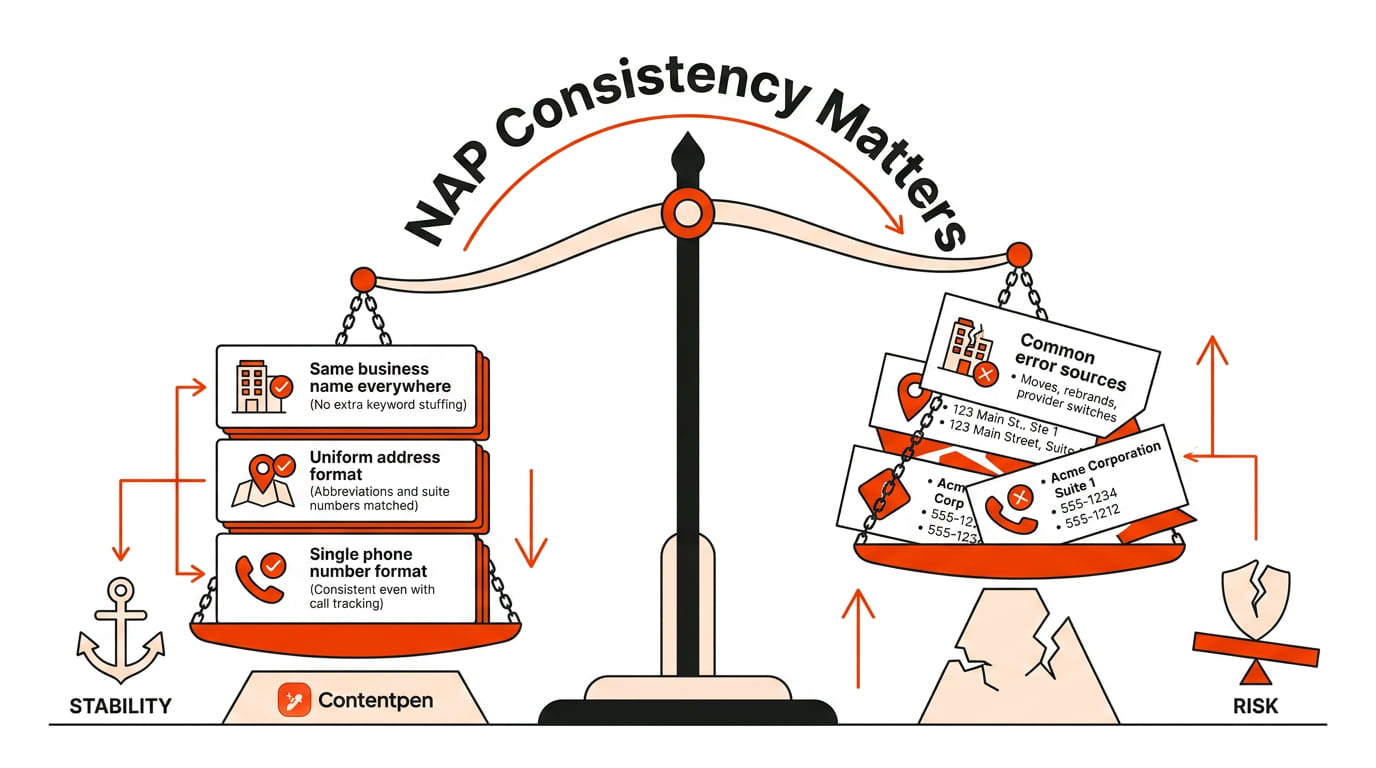
NAP consistency matters because Google treats mismatched business details as a red flag rather than a small mistake.
Therefore, it is important to keep the same business name spelled identically everywhere, including even the smallest case variations.
For example, write ‘Contentpen’ across all content distribution channels, instead of ‘ContentPen’ or ‘contentPen.’
Secondly, skip the temptation to stuff extra keywords into every field of your listing, and use one uniform address format including abbreviations and suite numbers.
Finally, stick to a single phone number format too, especially if you use call tracking software. All of this helps keep your business details consistent, which in turn helps you build credibility with search engines and a strong visitor flow.
How to do citations for local SEO (step-by-step)

Doing citation SEO the right way follows a repeatable process, whether you handle it yourself or hire a specialist to manage it.
Most local SEO professionals treat citation work as the very first task in a new campaign, often tackling it within the first month before shifting attention to content creation and links.
The steps below cover finding, submitting, and maintaining citations so your business information stays accurate everywhere it appears online.
Step 1. Audit your existing citations
Before adding anything new, run a full citation audit to see what already exists, what’s accurate, what’s missing, and what contains errors.
There are tools available online for this job, including those from Whitespark and BrightLocal. They can find all your existing online listings and help you fill in the new listings or edit existing ones according to your needs.
If budget is limited, you can use the -site:www.yoursitename.com “yoursitename” search command to see the existing citations for your business on third-party platforms.
This audit typically comes first in any new local SEO campaign, since it reveals whether you’re starting from scratch or simply cleaning up old mistakes.
Step 2. Find the right citation sites for your business
There’s no single list that works for every business, so a little research goes a long way here.
A citation finder tool like Whitespark publishes curated lists broken down by country and industry, which saves hours compared to searching blindly for citation SEO opportunities.
You can also run a plain Google search combining your city and industry, then note which directories rank in the first few results, since those are the sites your customers already trust.
Pro tip: Also check the Google AI Overviews appearing for your industry and locality. Make a note of the directories that the answer engines are mentioning. Then, try to get your business mentioned there with accurate details for better online visibility and traction.
Checking where competitors are listed online rounds out the picture and often uncovers gaps worth filling first.
Step 3. Choose a submission method
Once you know which sites matter, decide how you’ll actually get listed on them.
Your options range from doing every submission by hand to letting an automated local SEO software handle the entire process. The right choice usually comes down to how much time and budget you have available.
| Method | Best for | Time investment |
| Manual DIY submission | Businesses with few locations and tight budgets | High, since every listing needs an individual entry |
| Paid manual service | Owners who want accuracy without doing the data entry themselves | Low for the owner, moderate turnaround |
| Aggregator submission | Businesses wanting one submission to cascade across many directories | Low, but results take weeks to propagate |
| Automated syncing tools | Agencies or multi-location brands needing ongoing consistency | Low ongoing effort after setup |
No matter what method you choose, we prefer that you keep a human in the feedback loop. You must cross-check all business details so that your citation SEO efforts are actually impactful.
Step 4. Fill out complete, accurate listings
Fill in name, address, and phone data to get listed, but complete listings by adding more relevant business information.
For example, add your hours of operation, a clear business description, your logo, website link, email address, and a few photos of your office, product, service banners, etc.
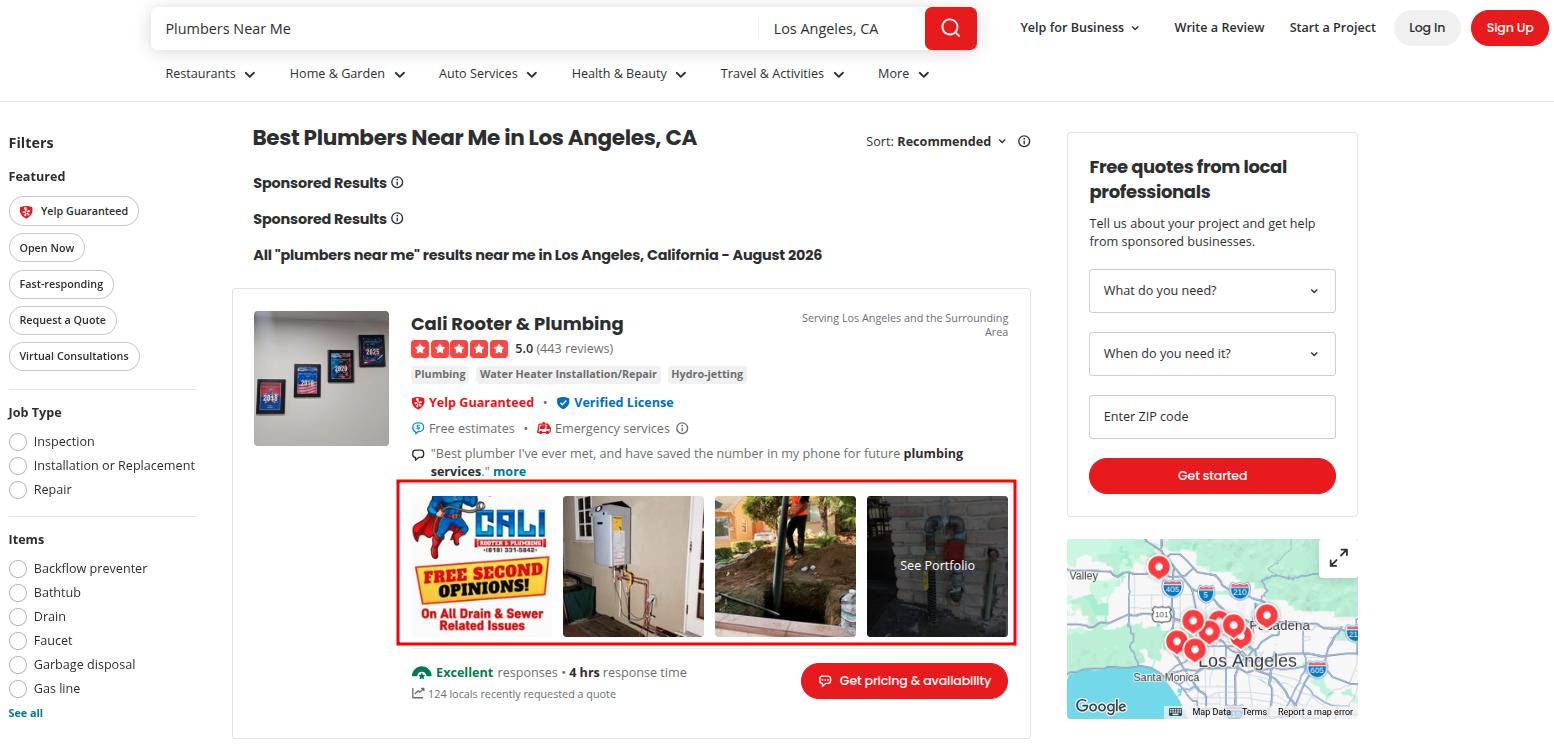
In this local citation example above, you can see Cali Rooter & Plumbing’s local listing with their portfolio presented clearly, business logo, and some on-site shenanigans. Perfect to build trust with users.
And because fuller profiles look more trustworthy to people, they also give Google bots more confidence to cite and rank your profile, helping you reel in more clients.
Step 5. Monitor and maintain consistency
Citation SEO is all about consistency. You have to keep doing them regularly, trickle them through, but not all at once, since Google needs time to index your content as well.
Citation work doesn’t end once your listings go live. You have to keep monitoring to see how your listings are performing and if you are getting any business from them or not.
To monitor and maintain consistency in your listings, set up autosync tools or schedule periodic audits so you catch new inconsistencies before they spread. This step is especially necessary after you change your address, phone number, or rebrand your company.
Once your citation foundation looks solid and consistent, you can shift your attention toward content creation and backlink building, since citations alone offer diminishing returns past a certain point.
What are the best citation sites and tools for local SEO?
The best citation sites combine broad reach with real authority, and pairing them with the right citation SEO software makes the whole process faster to manage.
Top universal citation sites to look for
Below is our local SEO citation list that works across nearly any industry or location:
- Google Business Profile: This is the most critical option for local companies looking to gain Google search and AI Overviews visibility.
- Facebook Business: Best for brands looking to enhance their social media visibility.
- Yelp: Recommended for service-based businesses that rely on star reviews for building online reputation and credibility.
- Apple Maps: Important for iOS users searching for products or services.
- Yellow Pages: Ideal for service-based businesses trying to reach more traditional, rural, or remote markets.
Beyond this core group of citation sites, you can also look for industry-specific directories for fields like legal or medical services.
Comparing citation-building tools

Below are the top citation-building tools that we recommend for local businesses in 2026. These will help you build and maintain consistent listings without a lot of hassle.
| Tool | Standout feature | Starting price |
| Whitespark | Citation lists by country and industry, plus audits | $1/location/month with separate local SEO services available |
| BrightLocal | Citation tracker with key citation prioritization | $41/month with local SEO audits and rank monitoring |
| SE Ranking Local Marketing | Business listing reports with autosync correction | $103.20 with rank tracking across AI engines, keyword research, and GSC integration |
| Loganix | Low-cost audits and competitor gap reports | $4/citation with social media citations unlocking at higher tiers |
| Yext | Automated push to a large directory network | Custom quote based on locations and listing volume |
Pricing styles vary just as much as features. Check whether you’d rather pay monthly, per citation, or per one-time package before committing to one software. Also, check if you can get a free trial for the software to try it out for your business before buying.
Beyond citations, building content that earns lasting visibility

Citations alone have diminishing returns once your listings are accurate and complete, which is why local content and backlinks carry momentum forward for any citation SEO strategy.
Strong, locally relevant content answers questions customers already search for, and it tends to earn the natural links and mentions that citations alone can’t generate.
This is where Contentpen fits in. It’s an AI blog creation platform built to produce answer-first, well-structured articles designed to earn attention from both Google and AI systems like AI Overviews.
The AI blog writer generates content with keyword research that covers local patterns such as service-plus-city and near-me searches, helping you get the attention you deserve.

Write content that’s built to rank, not just read
Create search-optimized blogs aligned with SEO and GEO signals, so your content performs well across search and AI-driven discovery.
Try SEO Blogging FREE →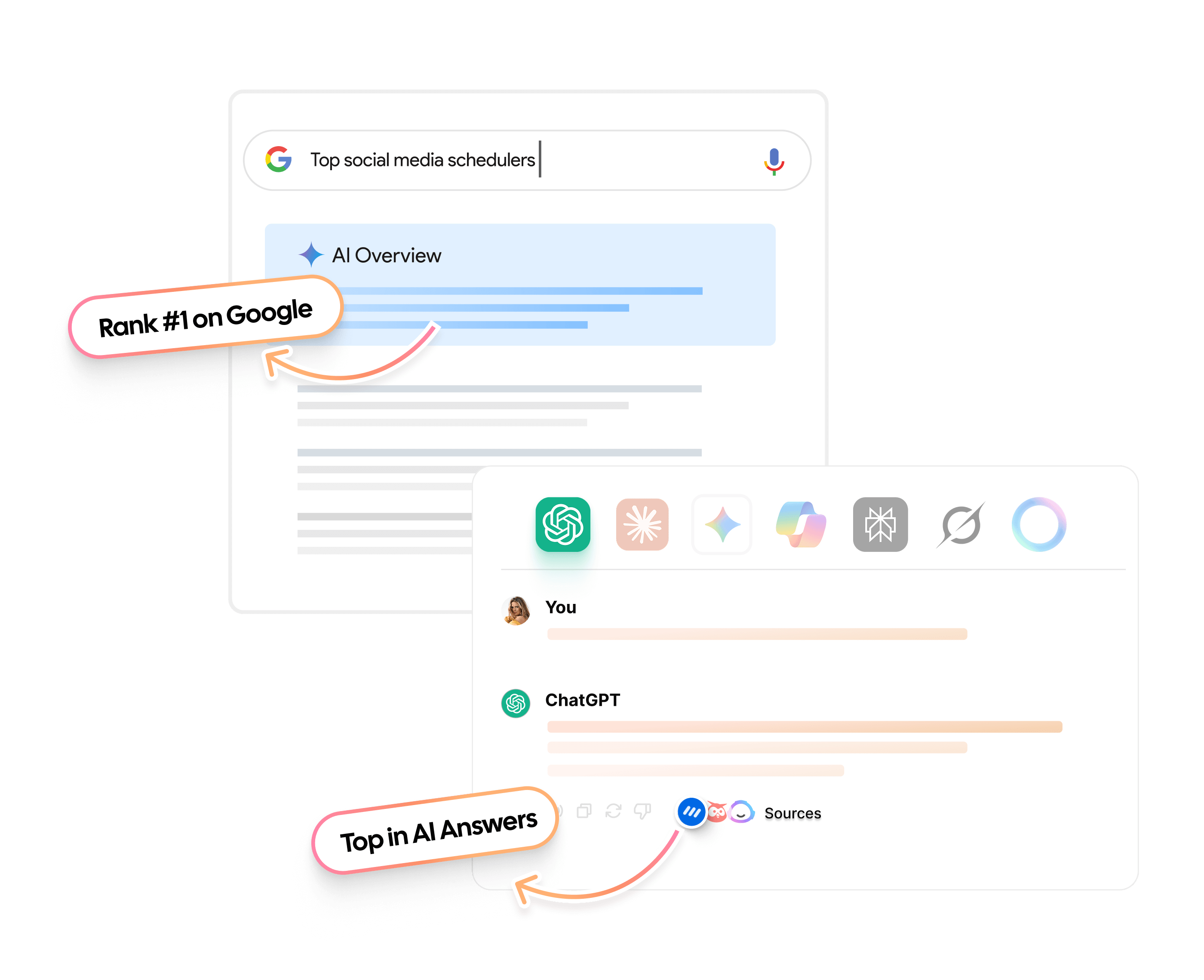
Final thoughts
Citation SEO builds the trust and prominence Google needs before it ranks your business locally. However, it is a part of a bigger picture, which involves creating quality, local content that answers people’s questions and earning backlinks that you earn naturally in your industry over time.
For the next steps, start with an audit, prioritize NAP consistency over volume, and lean on tools like Whitespark or BrightLocal to handle the repetitive work at scale.
Once your citations are clean and complete, shift your energy toward the content and links that keep building visibility long after the initial setup is done.
If you’re producing that next round of content, Contentpen can help turn local keyword research into structured, answer-first articles without adding another tool to your workflow.