 22 minutes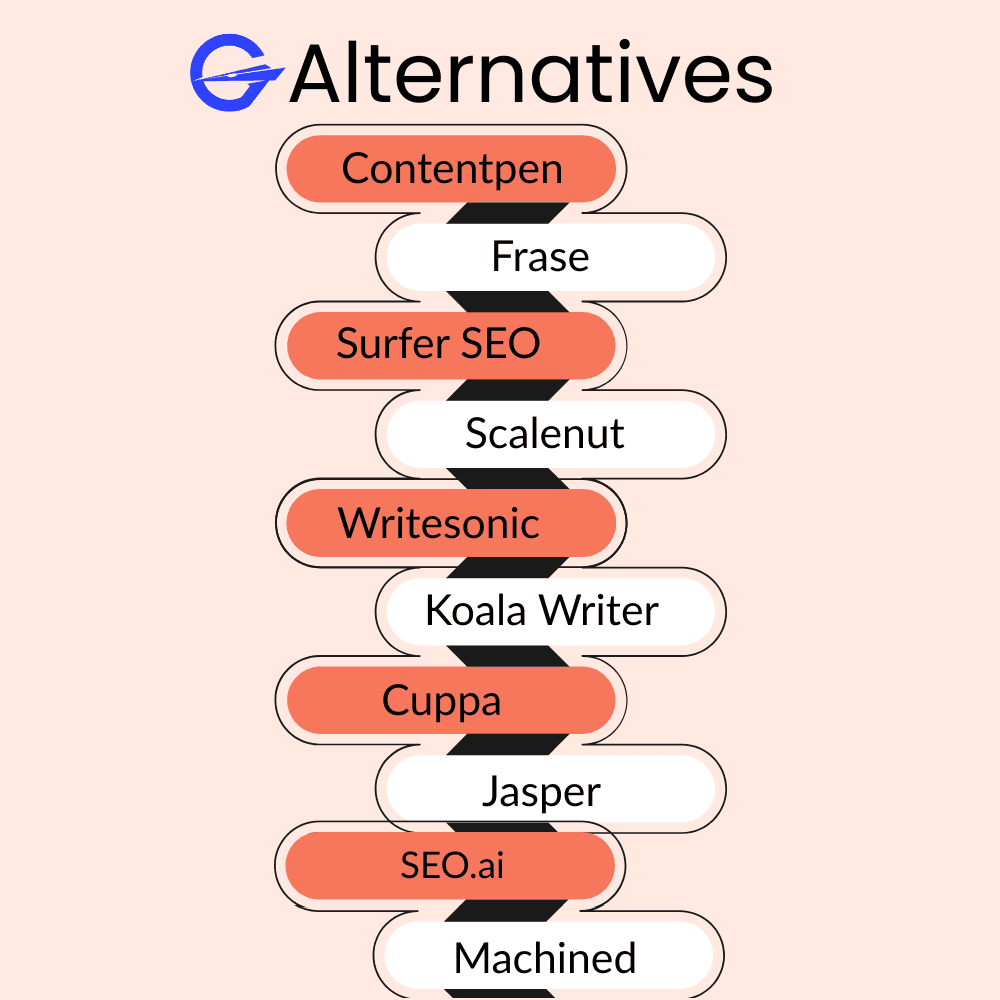
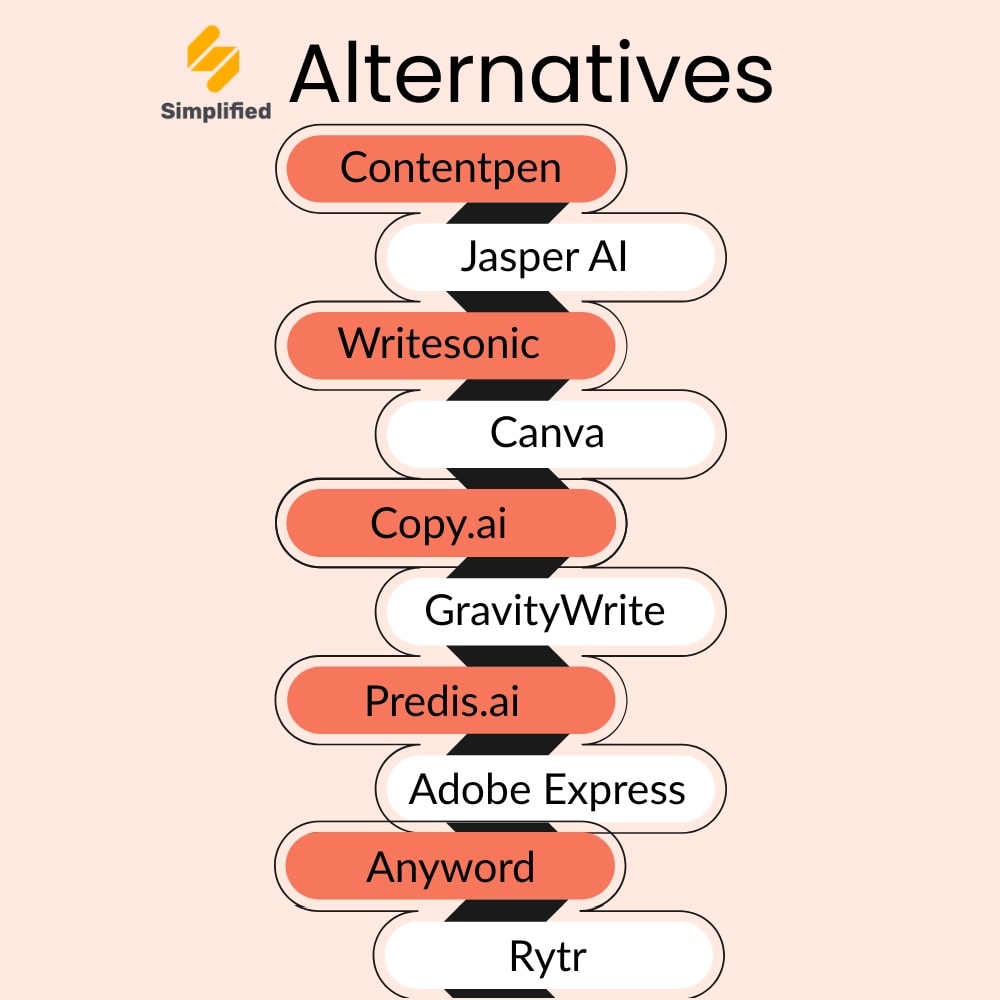
GravityWrite is a powerful content creation platform that creates images, videos, and blogs for users. However, it doesn’t go much deeper on SEO, structure, and workflow like other AI content writing tools in 2026, which makes users consider GravityWrite alternatives.
In this post, we’ll specifically talk about GravityWrite’s writing capabilities and see which other tools you can consider to plan topics better, write faster, and publish AEO- and SEO-optimized content at scale.
By the end, you’ll be able to make the right decision based on your budget, workflow, and daily needs.
So, let’s get started.
Table of contents
- Key takeaways
- What is GravityWrite?
- What do GravityWrite reviews say?
- How our GravityWrite alternatives were selected
- Quick comparison: GravityWrite alternatives at a glance
- The 10 best GravityWrite alternatives reviewed
- How to choose the right GravityWrite alternative for your needs
- The bottom line
- Frequently asked questions
Key takeaways
- GravityWrite limitations like constricted free trial capabilities, bugs, and low-quality content push users to consider GravityWrite alternatives.
- The alternatives picked were evaluated based on output quality, SEO depth, workflow coverage, pricing, and team fit.
- Better options cover more of your workflow than drafting alone, helping with keyword research, competitive analysis, outlining, optimization, and publishing.
- Contentpen is the best GravityWrite alternative, focusing on long-form SEO and GEO-friendly blog posts, while tools like Frase are better for SERP analysis.
What is GravityWrite?
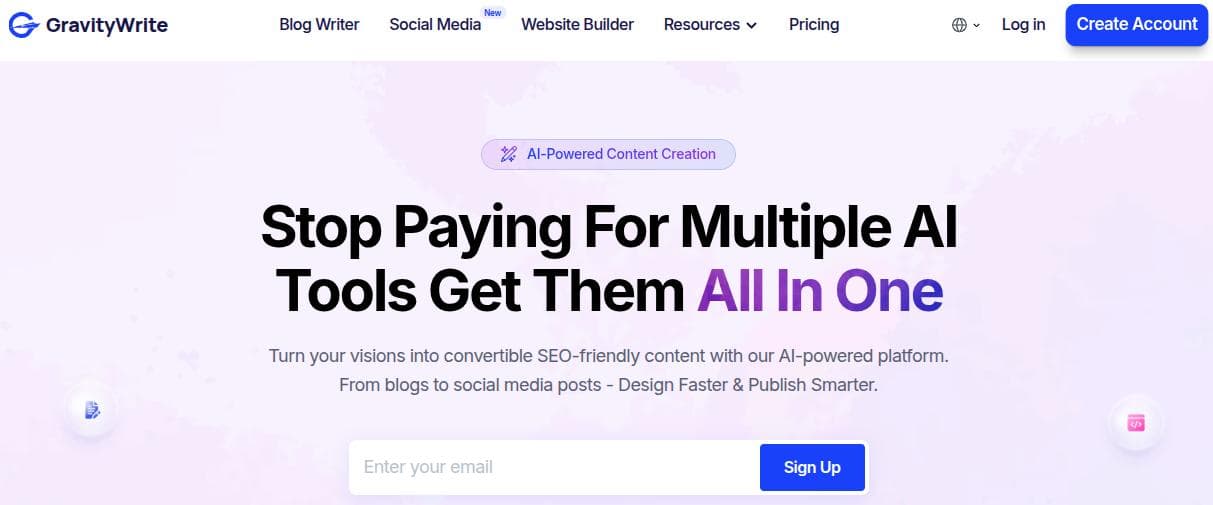
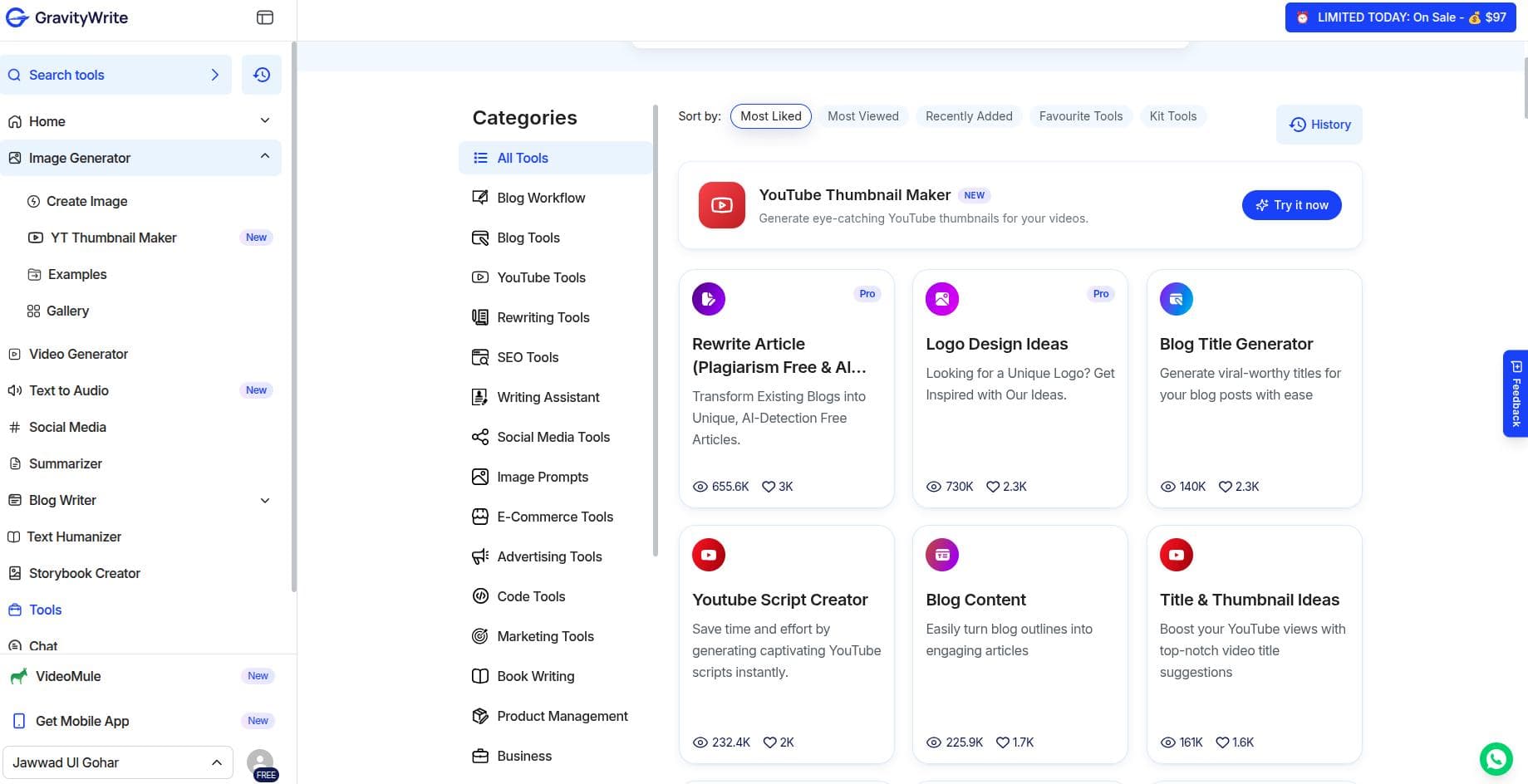
GravityWrite is an AI-powered content creation platform for digital marketers, agencies, and content marketers. It offers over 250 tools for social media, blogs, videos, SEO, filmmaking, product management, and other purposes.
It was launched back in July 2023 by Shyam Sundar. Their focus was on providing an all-in-one solution for people trying to create content online.
Why are people looking for GravityWrite alternatives?
GravityWrite is a great tool if you like to have tons of features in your tool but no proper use for it. The real problem is that it offers so much but masters none of it.
Talking strictly about AI blog writing, the tool generates content that is not publishable on the first draft. It contains:
- Em dashes that break the flow of writing a lot
- AI buzzwords, which affect content readability
- In-article images that contain blurry or incorrect text.
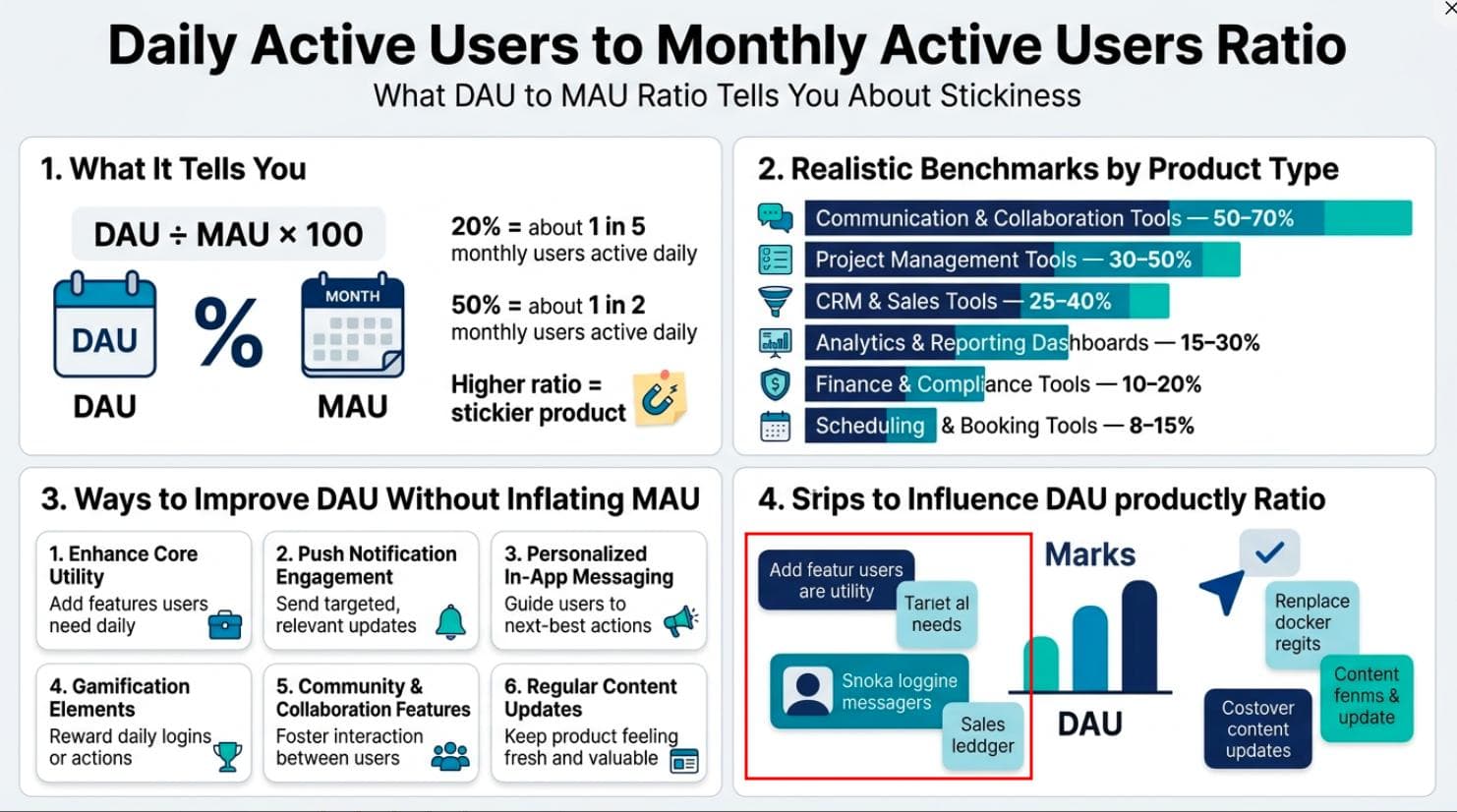
On most occasions, the created images alongside blogs were too complicated (design-wise) and barely usable for marketing purposes.
Besides that, GravityWrite features sometimes become unusable due to high load times and bugs in the system. While we were testing, the tool froze multiple times until we got our first blog output.
What do GravityWrite reviews say?
This review from Bhushan on G2 pretty much summarizes everything that we’ve already discussed so far about GravityWrite. Even the star rating for this review matches the overall rating of the product, 4.5/5 stars.
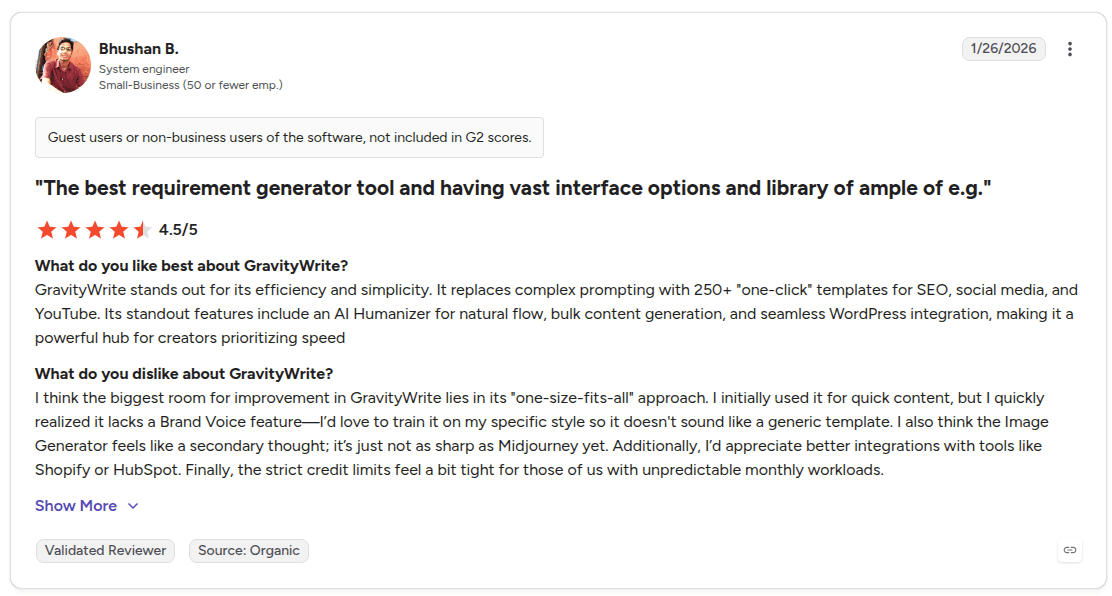
There’s also a bit of stigma around GravityWrite pricing. The strict credit limit is a problem that we’ve seen in many user reviews, which says that because the platform offers so many tools, the credits run out faster.
This causes a lot of unpredictability among users regarding GravityWrite pricing plans and their monthly workloads.
Reviewers also mention that unlike other AI writing tools, there are no strong brand voice control features. This may cause inconsistencies in tone and writing style when creating content.
How our GravityWrite alternatives were selected
These GravityWrite alternatives were selected to match how you actually plan, write, and ship content. Every tool had to show clear value over GravityWrite on strategy, scale, or quality so you are not switching for small upgrades, but meaningful additions to your workflow.
Key criteria used for this guide:
- Output quality and edit time: Each tool had to produce drafts that land close to publishable after one editing pass. You should spend your energy improving ideas and adding expertise, not fixing grammar or tangled structure, especially on long-form posts.
- SEO and GEO depth: Tools were checked for keyword research, SERP context, and on-page SEO support. Extra weight went to platforms that also think about GEO visibility, so your content can appear inside ChatGPT or Google AI answers.
- Workflow coverage: Strong AI tools now help with brief creation, outlines, drafts, optimization, and content publishing. We made sure that all of these aspects are covered when considering GravityWrite alternatives.
- Pricing transparency and scale: Pricing had to be clear, with no surprise add-ons for basic use. We also looked for a free trial or plan (if available), and if its geninuenly usable for these tools or not.
- Fit for different roles: Freelancers, small business owners, and agencies work differently. Each tool is labeled by best use case so you can quickly see whether it fits your setup before you even start a trial.
By making sure we have a fair selection of alternatives, we were able to find tools that you can use today to enhance your content.
Quick comparison: GravityWrite alternatives at a glance
Now let’s see these alternatives to GravityWrite AI at a glance from this comparison table.
| Tool name | Best for | Starting price/month* | G2 rating | Free trial? |
| Contentpen | End-to-end AI blog creation for SEO and GEO | $39/month | 4.9/5 | Yes, 7-days |
| Frase | Research-first SEO writers and content refresh work | $49/month | 4.8/5 | Yes, 7-days |
| Surfer SEO | SEO teams wanting writing plus analysis tools | $119/month | 4.8/5 | No |
| Scalenut | Template-friendly SEO blogs with ready structure | $59/month | 4.7/5 | Yes, 7-days |
| Writesonic | Teams wanting one SEO and content platform | $99/month | 4.7/5 | Yes, limited words |
| Koala Writer | Solo creators on a budget | $9/month | 4.5/5 | Yes, limited words |
| Cuppa | Writers who want live SERP context in the editor | $119/month | 4.8/5 | Yes, 7-days |
| Jasper | Larger marketing teams focused on brand voice | $69/seat/month | 4.7/5 | Yes, 7-day access to Pro plan |
| SEO.ai | Small businesses wanting autopilot publishing | $149/month | 4.5/5 | Yes, 7-days |
| Machined | SEO agencies building large content clusters | $19/month | 4.9/5 | Yes, 3-days |
*Pricing can change, so always confirm current plans on each vendor’s site.
You can use this table as your shortlisting map, then jump into the next section for a deeper look at every GravityWrite alternative in 2026.
The 10 best GravityWrite alternatives reviewed
These 10 GravityWrite alternatives give you stronger AI content writing options in 2026 by filling specific gaps in research, SEO scoring, visibility monitoring, and distribution.
#1: Contentpen
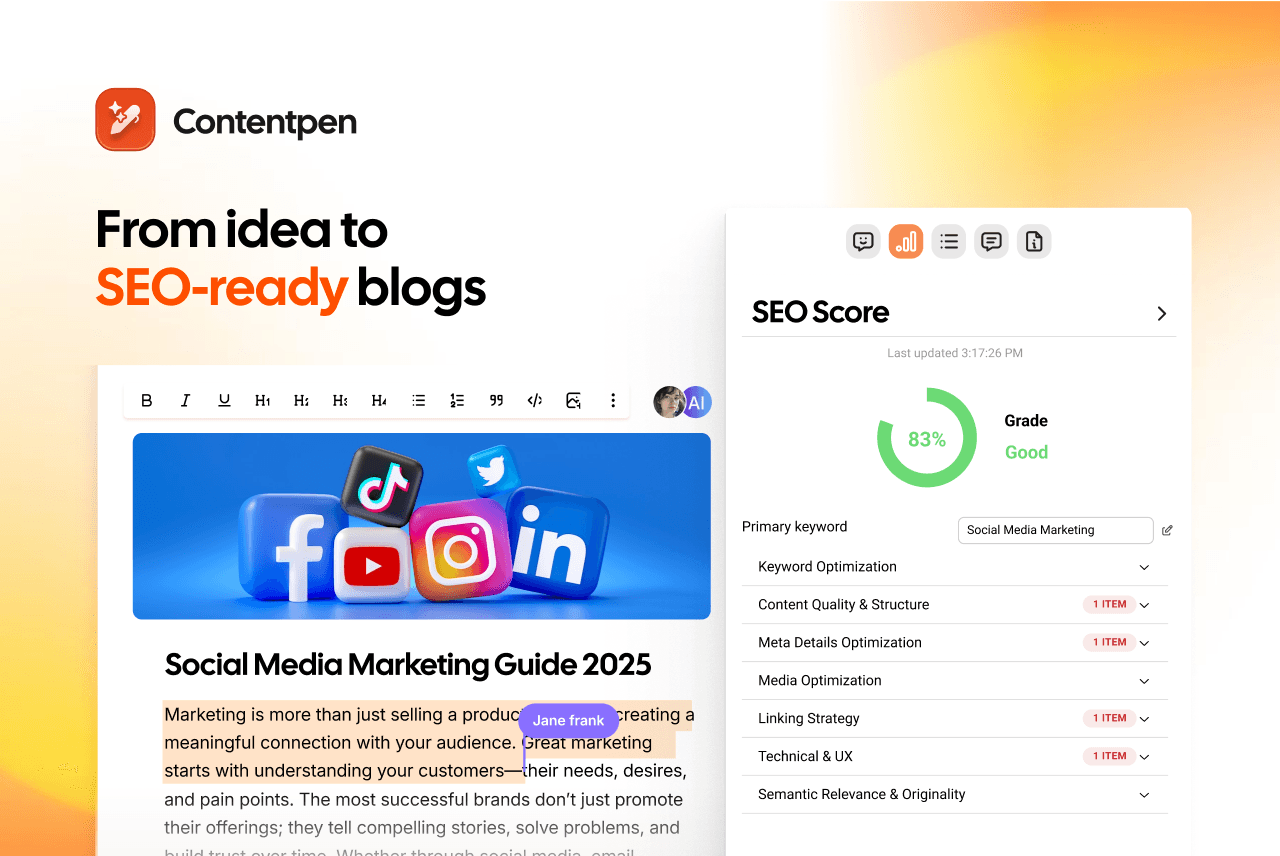
Contentpen is built as an end-to-end AI blog creation platform focused on long-form posts that rank and earn AI citations. You get a workflow that runs from keyword research through to one-click WordPress, Wix, Webflow, Ghost, and Shopify publishing.
The tool also provides AI visibility monitoring for 7 LLMs, which makes it a strong GravityWrite alternative for teams that need to know about their standing in AI engines.
Standout features
- Keyword research based on search intent: You start from phrases your audience already types into Google, and Contentpen groups related ideas so you cover topics in depth across posts rather than chasing isolated keywords.
- Detailed outline generation for every article: The platform creates section-level outlines before any draft is written, and you can adjust headings and talking points so each article keeps a clear angle.
- Dual SEO and GEO scoring: The editor guides you toward answer-first openings, focused headings, and FAQ blocks that help you get better SERP results and positions in AI answer engines like ChatGPT, Claude, and Google AI.
- Automated internal and external linking: Contentpen suggests internal links to your own pages and external references to stats, figures, and important resources while you’re writing, saving time on manual link hunting and improving site navigation.
- Content calendar and CMS publishing: You can plan posts in a calendar and send them into WordPress, Wix, Webflow, Ghost, and Shopify platforms with formatting intact. This cuts out copy-paste steps and reduces formatting errors.
- Web analytics and SEO opportunities: The tool keeps monitoring your content post-publish, providing you with key CTR, average position, and organic clicks data. It helps you spot ranking opportunities and act upon them without leaving the interface.
Worth knowing
- Contentpen focuses on long-form blogs and articles, not short-form social posts or video scripts.
- AI blog writer is not focused on providing backlink data. For those purposes, you may need to pair it with dedicated AI SEO tools.
- The platform suits teams that care about rankings, structure, and workflows more than instant one-click drafts, so the process feels more guided than free-form.
Pricing
Contentpen now provides pricing for two separate products: the SEO and AEO platform. Both start at $39/month, in which you can get 10 articles, 30 AI images, and 80 AI visibility tracking credits, making a total sum of $78/month.
We also offer a free 7-day trial period for both our SEO and AEO platforms. You can get access to all our main features and decide for yourself if you want the AI blog writer or not.
#2: Frase
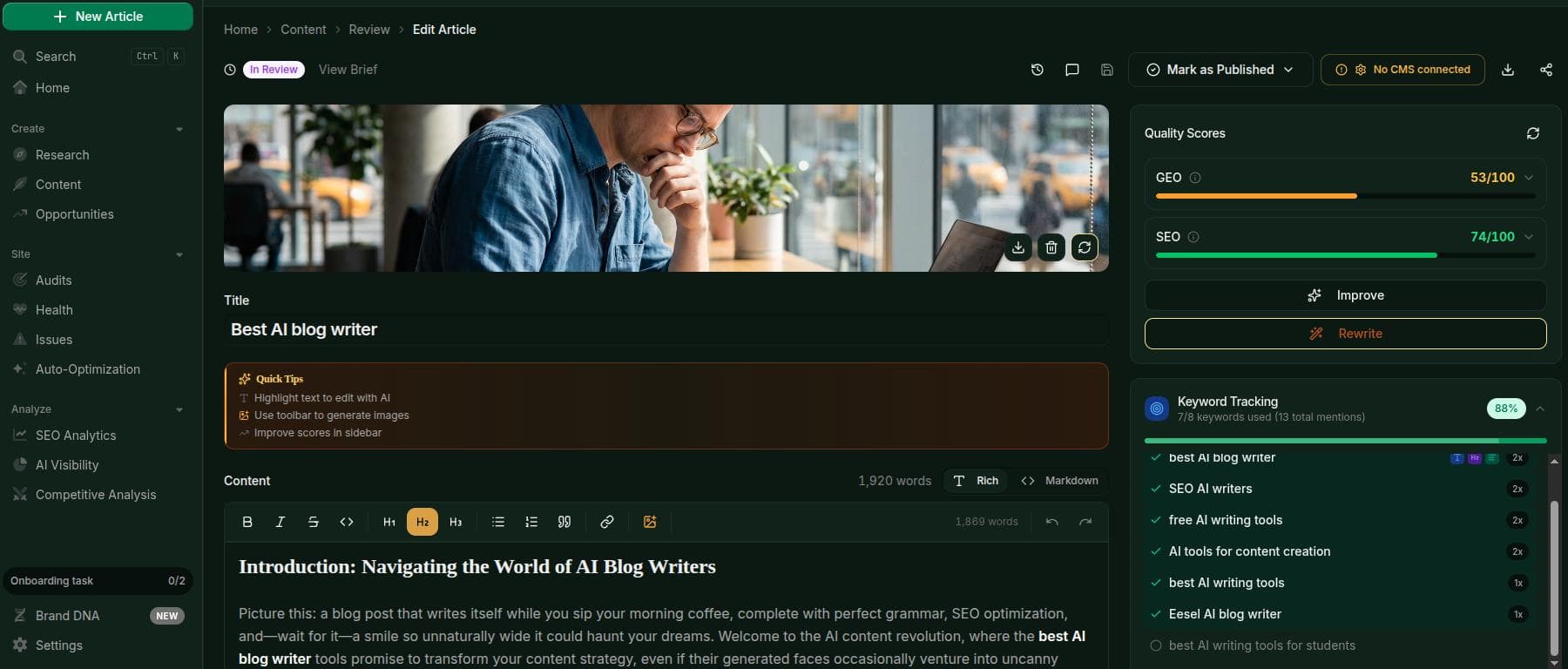
Frase has been around since 2016 and is popular with SEO writers who prefer detailed SERP research.
You paste in a keyword, and Frase pulls headings, FAQs, and snippets from top-ranking pages into one research view. This makes it a strong fit if you use AI mainly as a research and brief assistant.
Standout features
- SERP driven outline builder: Frase shows you what top pages cover so you can pick headings and questions in a few clicks and line your outline up with real search intent.
- Competitor content preview in the editor: You can open sections from rival articles without leaving Frase, making it easier to see where you can add depth, data, or new angles.
- Content brief export for freelancers: Once your outline is ready, you can export it as a structured brief, so writers get context, sections, and key points in one place.
- Site-level content audits: Frase can scan existing URLs and compare them against current SERPs so you spot posts that need updates instead of writing a new article for every keyword.
Worth knowing
- Lower plans limit how many articles you can fully optimize each month, which can feel tight if you publish daily.
- Long-form content can produce some uneven results, so many users prefer to work section by section instead of generating full posts in one go.
Pricing
Frase offers pay-as-you-go credits plus monthly plans that start at $49/month and rise for higher article limits and team features. You can test the platform according to your workflow needs for 7-days before deciding whether or not to add this tool to your tech stack.
#3: Surfer SEO
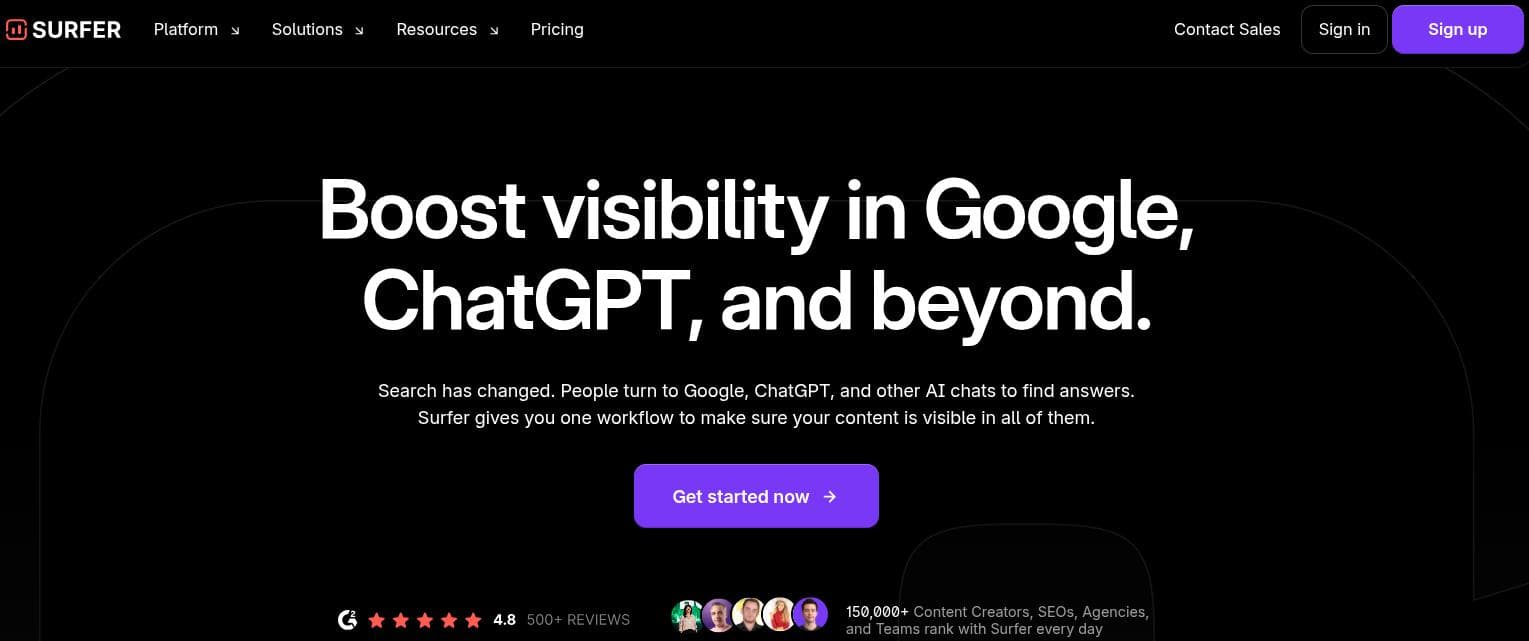
Surfer SEO mixes AI writing with deeper SEO scoring inside one interface. You get keyword research, topical maps, SERP analysis, rank tracking, and content editing in a connected workflow, which suits SEO specialists who want data and drafting in the same place.
Standout features
- Topical maps for planning clusters: Surfer helps you group related keywords into topic clusters so you can plan pillar and supporting posts that grow topical authority.
- Content Editor with real-time scoring: While you write, Surfer scores your draft against top pages for word count, headings, and keyword usage so you can adjust on-page elements before publishing.
- AI Articles for quick drafts: You can generate full drafts from your outline and keyword set, then have editors refine tone, examples, and internal references.
- Rank tracker and SERP analysis tools: Surfer lets you follow keyword positions and examine SERPs for difficulty and intent, helping you decide what to update and which topics to tackle next.
Worth knowing
- Some useful capabilities, such as deeper SERP analysis and rank tracking, sit behind add-ons, so your real monthly cost may be higher than the entry plan.
- Monthly credits do not roll over, so unused editor or article slots expire at the end of each billing period.
Pricing
Surfer SEO pricing starts at $119/month for a Standard plan and at $219/month for the Pro plan, with custom packages for larger teams. Instead of a free trial, the company relies on a 7-day money-back guarantee for all of its paid subscriptions.
#4: Scalenut
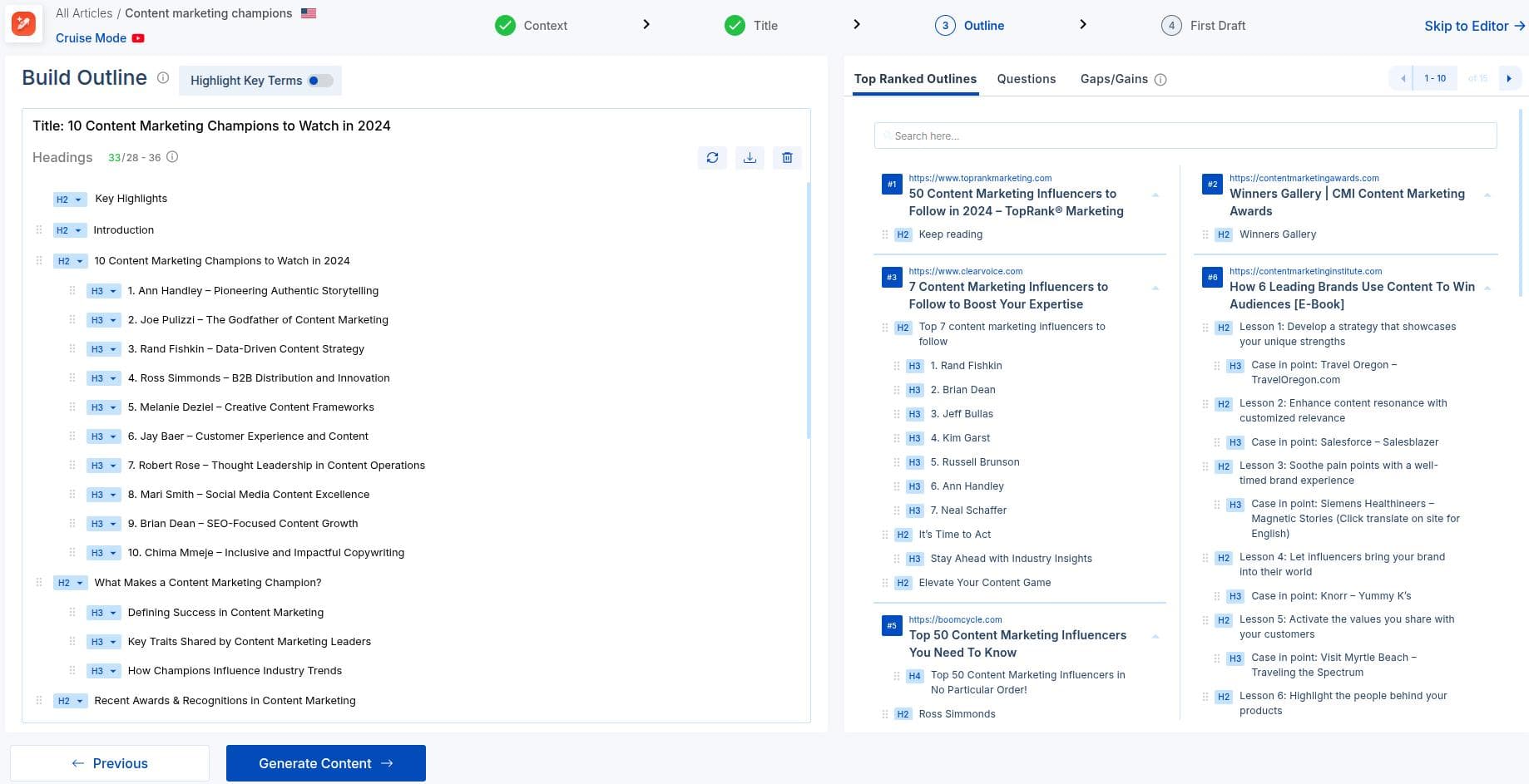
Scalenut aims to give you near-publish-ready SEO drafts that follow clear patterns. It leans on strong structure with comparison tables, FAQs, and summaries already filled out in most long-form pieces, which is helpful if your team likes templates and repeatable post types.
The tool also offers the Social Upreach feature, where you can tap into Reddit threads to better understand your brand sentiment or discover exciting, new topics to write about.
Standout features
- Pre-structured long-form drafts: Generated articles usually include headings, tables, and FAQ blocks, so you avoid rebuilding the layout each time and can focus edits on accuracy and voice.
- AI visibility dashboards: Scalenut tracks how content performs in search and AI overviews, giving you a simple view of which topics gain traction and where to focus next.
- Internal linking and topic gap tools: The platform suggests internal links and missing supporting topics so you can build simple content clusters without separate research software.
- Publishing integrations with major platforms: Scalenut connects to WordPress, Shopify, and PrestaShop, letting you push content directly into your CMS instead of copying and reformatting.
Worth knowing
- The default content structure can feel rigid, so you might have to spend some extra time reshaping sections according to your requirements.
- Clustering helps but is not perfect on intent, so you still need to think about overlap between similar articles.
- The backlinks marketplace is very basic in functionality, so you’ll still need separate SEO tools to fulfil that purpose.
Pricing
Scalenut pricing plans start at $59/month, with 5 GEO-ready articles, 10 prompts to track, and access to only 1 workspace. You can also get a 7-day free trial to experience the Cruise Mode, content optimizer, keyword planner, and a bunch of other features before committing.
#5: Writesonic
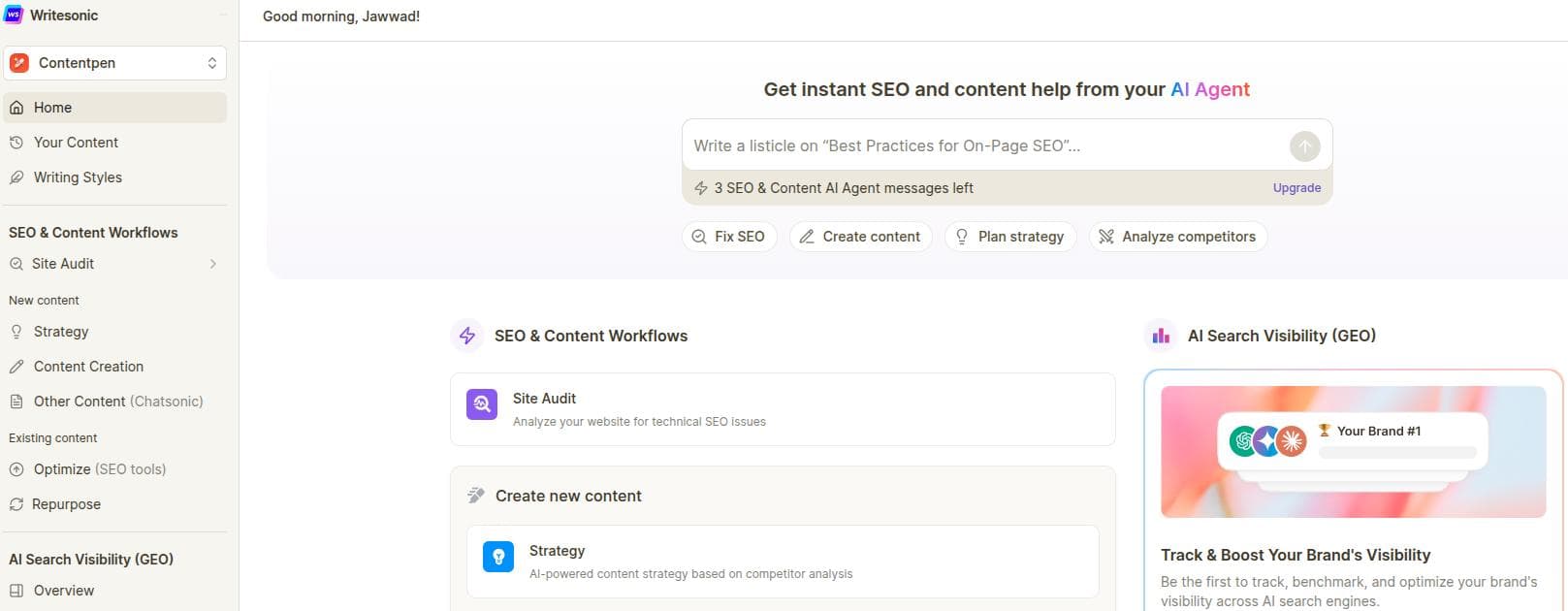
Writesonic presents itself as a full SEO content platform rather than a basic AI text generator. You can run keyword research, site audits, content generation, and basic GEO-aware optimization in one place, which is appealing if you want fewer tools in your stack.
Standout features
- Guided multi-step article workflow: You pick competitors, define primary and secondary keywords, tweak tone, and approve the outline before drafting, giving you more control than a single prompt.
- Automatic link and element insertion: Writesonic can add internal links, external links, FAQs, quotes, and images during generation so drafts feel richer out of the box.
- Integrations for publishing and automation: The tool connects with WordPress, Sanity, Contentful, and Contentstack, helping you push drafts into your CMS directly. It also offers REST API and Zapier integrations to automate parts of your workflow.
- Site audit and keyword features: You can scan your domain for content gaps and basic technical issues and tie that insight directly to new articles.
Worth knowing
- The step-based mode can take several minutes to finish a single article, which may slow down teams looking to scale their content creation process.
- Credit-based pricing can be confusing for users, and the word credits can diminish quite quickly when creating or auditing content for SEO or GEO.
Pricing
Writesonic pricing starts at $99/month, where you can get 50 prompts and 50 AI answers tracked daily for ChatGPT, Gemini, and Google AI Overviews. Higher plans unlock access for up to 10 AI models. You can get free access to Writesonic’s AI writing capabilities (limited words).
#6: Koala Writer
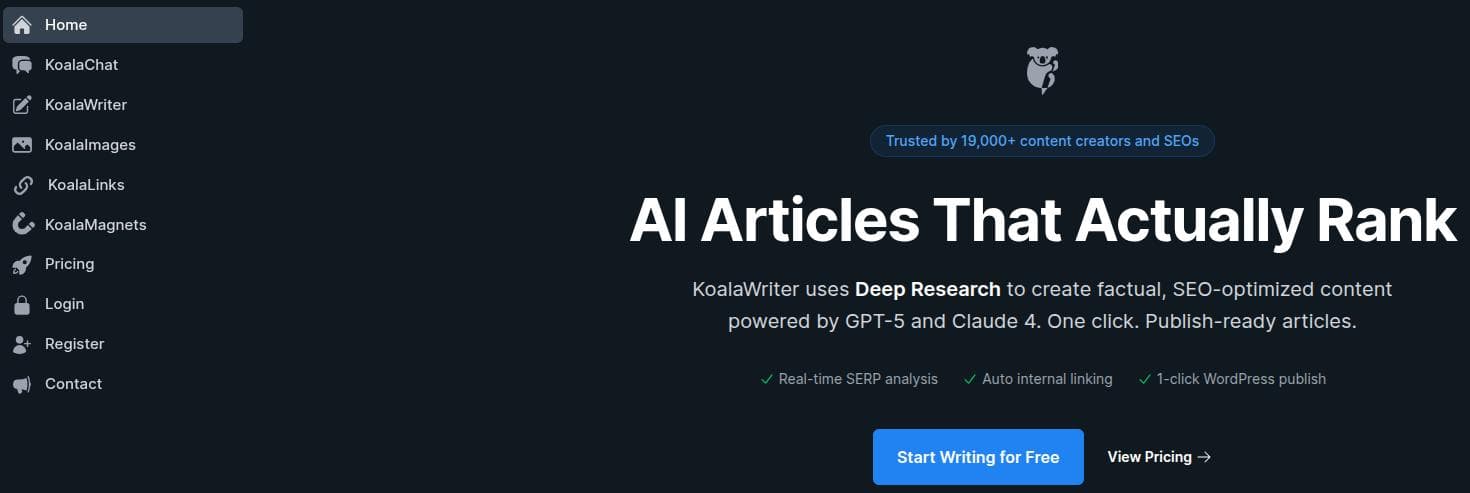
Koala Writer built its reputation on fast, affordable blog generation for solo creators and small sites.
The tool skips heavy workflow steps in favor of getting a keyword to a publishable draft with minimal setup. This makes it a reasonable pick if GravityWrite’s price and reliability issues are your main complaint.
Standout features
- Real-time SERP data pull: Drafts pull in live search data during generation, so outputs reference current top-ranking articles instead of relying only on the model’s training data.
- Built-in AI image generation: Koala includes image creation alongside text, so you are not forced into a separate tool just to get a featured image.
- Multiple AI models available: Koala Writer provides its users with the option to choose between GPT-5 mini, GPT-5.2, and Claude 4.5 Sonnet models, providing flexibility when creating content.
Worth knowing
- The tool may offer a very simplistic UI, which does look outdated to many users.
- Outputs from Koala Writer still require a lot of editing to maintain originality and technical accuracy for specific niches.
- Restrictive monthly word credit system means you might have to skip some content for your clusters and plan them when the billing cycle renews.
Pricing
Koala Writer pricing starts at $9/month for the ‘Essentials’ plan with 15,000 words and AI-powered SEO optimization.
#7: Cuppa
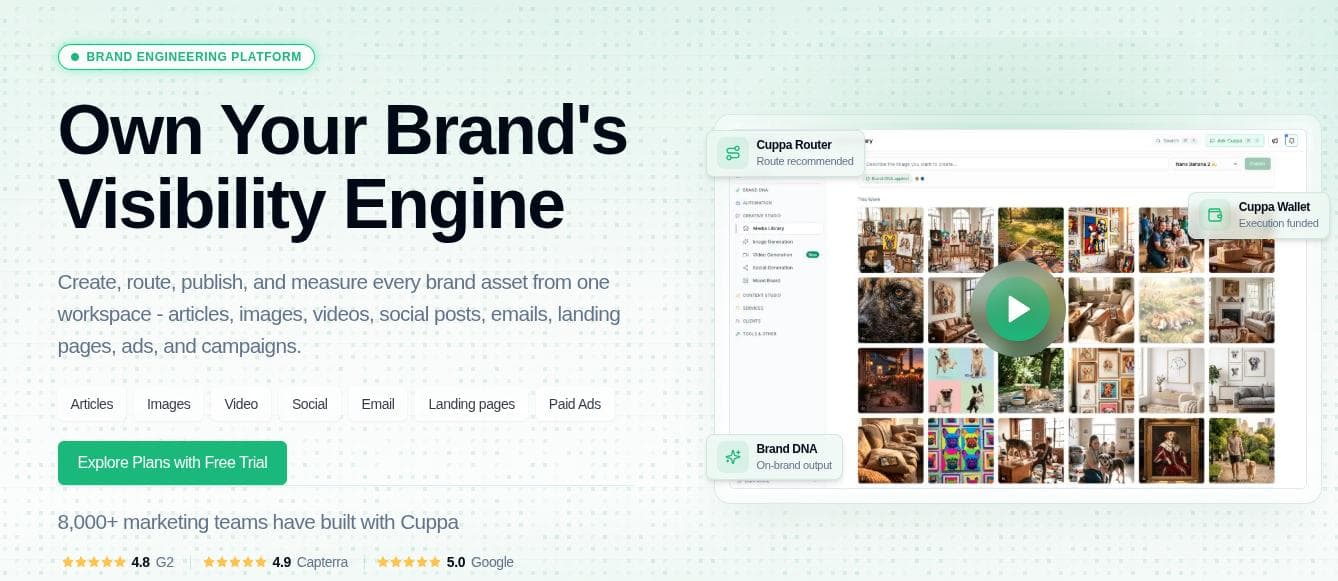
Cuppa is designed for writers who want robust editing controls. Instead of hiding research in another tab, Cuppa keeps headings, questions, and guidance beside the text as you write, making it a good GravityWrite alternative if you enjoy hands-on editing.
Standout features
- SERP context inside the editor: You see top page headings and questions while drafting so you can cover the right angles without copying layouts.
- Flexible, natural-sounding drafts: In our testing, we found Cuppa’s outputs to feel less rigid than template-heavy tools, such as Scalenut or Frase, making it easier for editors to tweak tone or structure.
- Support for other types of content: Cuppa not only focuses on long-form content, but can also write landing pages, newsletters, and emails for you.
- Local SEO component: Unlike many tools on this list, Cuppa AI also offers local SEO features where you can create lead-capturing service pages with proper keyword optimization according to your location.
Worth knowing
- To unlock deeper research features, you need the Power User plan plus a Perplexity API key, which adds extra setup and cost.
- Bulk or fully automated workflows are limited, so larger agencies may want another tool for high-volume production.
Pricing
Cuppa pricing plans start at $119/month, named as ‘Build Your Brand System’ with discounts for yearly commitments. The starter plan contains SERP analysis, brand DNA feature, and a detailed performance dashboard. You can try the tool for free for 7-days before purchasing.
#8: Jasper

Jasper grew quickly as one of the first widely known AI writing platforms and now leans toward larger marketing teams that care about brand voice and approvals across channels. If your main worry is keeping many writers on message, Jasper can be a much better fit than GravityWrite.
Standout features
- Central brand voice controls: You can set tone, style, and messaging in one place so Jasper keeps drafts closer to your brand standards across writers and formats.
- Workflows for many content types: The platform supports blog posts, ads, emails, product copy, and more so you can keep most of your writing work in one system.
- Collaboration and approval tools: Managers can review, comment, and approve content inside Jasper, which shortens feedback cycles and keeps work history in one place.
- Template library for repeatable tasks: You get many writing templates for common copy and blog writing tasks, helping non-specialist writers produce content faster.
Worth knowing
- SEO features exist but are not as deep as tools like Contentpen, Surfer, or Frase, so search specialists often pair Jasper with a dedicated SEO platform.
- Pricing is per user, so large teams can see costs rise if many people need direct access to the platform.
Pricing
Jasper Pro commonly starts at $69/user/month, with custom Business plans for bigger organizations that need more seats, security, and support.
#9: SEO.ai
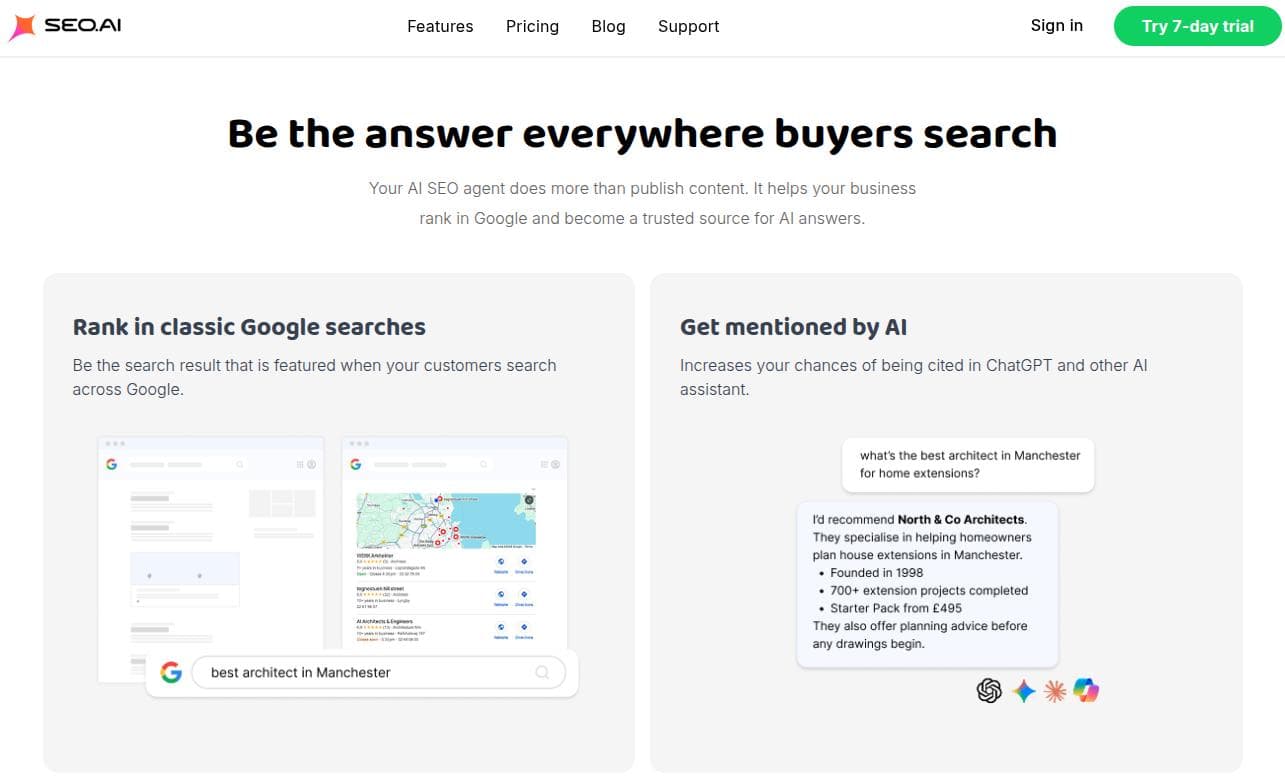
SEO.ai behaves more like a content autopilot than a regular AI writer. You give it a site, and it builds a content calendar, writes posts on a fixed schedule, and publishes them with internal links added.
It appeals to small businesses who want content without hiring an expensive in-house team or raising overheads.
Standout features
- Automated content calendar creation: The tool scans your site and plans topics itself, giving you a schedule without spending hours planning different types of keywords.
- Automatic writing and publishing: SEO.ai writes and posts around 4 – 8 articles per month per site, adding internal links and basic optimization with little ongoing input from you.
- Localization strength: Content often reflects local phrases and context for your region and language so local service businesses can sound natural to nearby readers.
- Multi-site support at higher tiers: Agencies or owners with several sites can connect them in one account and see activity at a glance.
Worth knowing
- You give up fine-grained control of content structure and depth. Your tweaks may also show up, but not until the next content cycle.
- This pattern suits hands-off owners more than SEO practitioners who want frequent, detailed tuning of their platform.
Pricing
SEO.ai pricing starts at $149/month for one site in one language and climbs for higher tiers that support more domains and posts per month. You can avail the 7-day free trial to learn more about the tool before purchasing it.
#10: Machined
Machined is built for SEO agencies and publishers who think in clusters, pillars, and internal linking from day one. The tool lets you define a topic and have the system plan and generate the related set of articles for you, automating your content marketing strategies.
If we do a direct Machined vs. GravityWrite comparison, we can see that Machined is the better option if you want to put your content on autopilot. While GravityWrite features are more diverse, Machined is more focused on organic growth through a systematic approach.
Standout features
- Cluster-first approach to planning: Machined assigns each article a role inside a cluster so pillar content and pieces focusing on long-tail keywords work together to grow topical coverage.
- Automated internal linking setup: Links between articles use natural anchor text and follow your structure, which saves hours of manual link mapping.
- CMS ready output: Articles can be pushed into your CMS with structure and links already in place, supporting bulk content creation.
- Bring your own API model: You connect your own AI provider keys so content costs stay close to raw usage, which is helpful when you publish content at scale.
Worth knowing
- Machined focuses on SEO articles only, not email, ads, or social content, so you may still pair it with other AI writing tools.
- Drafts need editorial review, especially on specialist subjects, before you approve them for clients or publication.
Pricing
Machined offers a starting plan of $19/month, which contains 30 articles/month, AI images, and content clusters. You can only try the tool for free for 3 days.
How to choose the right GravityWrite alternative for your needs
Choosing between these GravityWrite alternatives starts with your workflow, not the tool with the longest feature list. Every platform here solves a slightly different problem, so you get the best results when you match that strength to your main pain point.
If we review the tools by team size constraint, you can get the following recommendations:
- Solo creators and freelancers: Koala Writer works well if budget is your main constraint, while Cuppa AI suits writers who want strong SERP context in the editor and can spend a bit more.
- Small content teams and startups: Scalenut or Contentpen are good fits. Scalenut gives you quick, structured SEO drafts, while Contentpen adds research, GEO optimization, and a content calendar in one workspace.
- Agencies and large publishers: For agencies, Machined, Surfer SEO, or Contentpen are the best options. Machined supports cluster building, Surfer combines writing with rank tracking, and Contentpen streamlines long-form blog production for many clients.
Reviewing these GravityWrite alternatives by goals and budget surfaces these important recommendations:
- Rankings and AI search visibility: For this purpose, we’ll give the edge to Contentpen, Frase, and Surfer SEO, all of which emphasize SERP intent, structure, and GEO and SEO scoring.
- Simplifying your tool stack: Writesonic or Contentpen can reduce the number of separate apps you manage. Both of these are end-to-end solutions, with Contentpen slightly edging Writesonic on content planning and bulk creation.
- Hands-off content execution: For this purpose, SEO.ai, Machined, and Contentpen are suitable options as they can run much of the content process for you without any manual hassle.
The bottom line
The best GravityWrite alternative for you depends on what is slowing you down right now. Maybe your drafts feel too generic, your SEO plan sits in scattered sheets, or you burn hours moving content between tools.
Each platform in this guide targets one of those friction points, and selecting the right one becomes easier when you understand what’s hurting your team.
You do not need a huge stack to start seeing better results. Pick one tool that fixes your biggest gap, then add others only if a real need appears.
If long-form, search-ready blog content is your main growth lever, Contentpen is worth a close look, since it covers research, drafting, optimization, and publishing for your blog in one place.

Write content that’s built to rank, not just read
Create search-optimized blogs aligned with SEO and GEO signals, so your content performs well across search and AI-driven discovery.
Try SEO Blogging FREE →