 9 minutes
Schema markup for AI optimization means using structured data to help AI search systems identify your brand, products, and authors without guessing. It won’t get you cited on its own.
Google says no special schema is needed for AI Overviews, and a 1,885-page study found almost no citation lift. However, schema still strengthens the search indexes and entity data that AI answers draw from.
Sounds confusing? You’re not alone.
Half the internet says schema is the secret to AI visibility, and the other half says AI ignores it.
That noise leads teams to spend weeks on markup and then wonder why ChatGPT still doesn’t mention them. Or they skip schema entirely and leave their entity data a mess.
This guide sorts the evidence, explains how AI systems actually treat schema, and gives you a seven-step plan plus a way to test it.
Here’s what we know in 2026.
Table of contents
- Key takeaways
- What is schema markup for AI optimization?
- How do AI search engines use schema markup?
- What does the evidence actually say?
- Which schema types matter most for AI search?
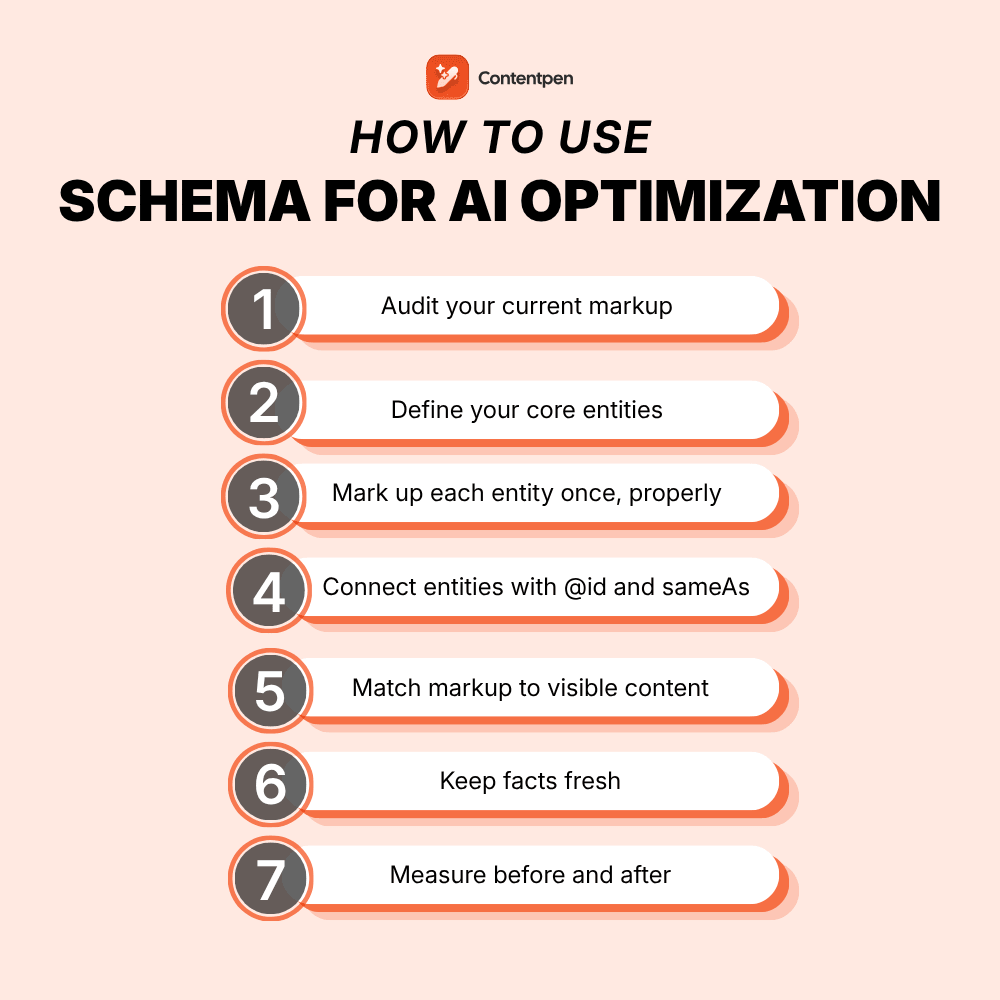
- How to use schema markup for AI optimization in 7 steps
- How can you test whether schema helps your AI visibility?
- When does schema matter most for AI?
- What mistakes hold back schema for AI?
- How Contentpen helps you measure AI optimization
- Schema is the label, your content is the reason
- Frequently asked questions
Key takeaways
- Schema markup supports AI optimization indirectly, mainly by making entities clear to search indexes and knowledge graphs.
- Google states there is no special schema required to appear in AI Overviews or AI Mode.
- A controlled Ahrefs study of 1,885 pages found AI citations barely moved after adding schema.
- LLMs that fetch pages live tend to read JSON-LD as plain text, valid or not.
- Organization, Person, Product, and LocalBusiness, linked with sameAs and @id, matter most.
- Test it yourself with control pages and AI visibility tracking instead of trusting vendor claims.
What is schema markup for AI optimization?
It’s the practice of using schema.org markup to make your content easier for AI-powered search to understand. The goal isn’t a rich result. It’s entity clarity.
When an AI system builds an answer, it needs to know who you are and what you sell. It also needs to know which facts on your page are current.
Schema states those facts in a fixed format. Think of it as the fact sheet stapled to your content. It sits beside the broader work of answer engine optimization, which focuses on answers worth quoting.
How do AI search engines use schema markup?
Here’s where most guides get it wrong. “AI search” isn’t one system, and schema plays a different role in each path.
| Pathway | What happens | Does schema help? |
|---|---|---|
| Model training | Pages are scraped and cleaned into training text | Rarely, since common pipelines strip scripts, including JSON-LD |
| Live retrieval | Tools like ChatGPT search or Perplexity fetch a page when answering | Partly, as JSON-LD may be read as plain text, not parsed as schema |
| Search index and knowledge graph | Google and Bing index pages and build entity graphs that AI features draw from | Yes, this is where structured data is actually used |
The third path is why schema still matters. Google’s AI Overviews and Bing Copilot lean on the same indexes that have used structured data for years.

What does the evidence actually say?
Let’s look at the sources, not the hype. This table pulls together the main statements and studies so far.
| Source | Finding | How strong is it? |
|---|---|---|
| Google, AI features and your website | “There’s also no special schema.org structured data that you need to add” for AI Overviews or AI Mode | Official guidance |
| Bing, via Search Engine Land | Fabrice Canel said at SMX Munich 2025 that schema helps Microsoft’s LLMs understand content | Paraphrased report, some dispute the context |
| Ahrefs, 1,885 pages | After adding schema: AI Overviews citations fell 4.6%, AI Mode rose 2.4%, ChatGPT rose 2.2% | Controlled study; only the AI Overview change was significant |
| Search Engine Land experiment | Only the page with well-built schema appeared in an AI Overview | Three pages, described by its authors as inconclusive |
| Mark Williams-Cook test, via Search Engine Roundtable | ChatGPT and Perplexity returned an address found only in invalid JSON-LD | Small test, but clear on how live retrieval reads code |
So what’s the verdict? Schema isn’t a citation switch. It’s infrastructure that helps the search side of AI understand you.
Does ChatGPT read JSON-LD?
Sometimes, but probably not the way you’d hope. In the Williams-Cook test, ChatGPT pulled a fact from broken JSON-LD, which suggests it read the code as text.
That means it may notice what’s in your markup. It just doesn’t seem to reward valid schema over the visible content on your page.
Do you need special schema for AI Overviews?
No. Google’s guidance says AI Overviews and AI Mode have no extra technical requirements beyond normal Search eligibility.
It does list one structured data best practice: your markup should match the visible text on the page. Accuracy beats volume.
Which schema types matter most for AI search?
Focus on types that define who and what you are. These carry the entity facts AI answers repeat most.
| Schema type | Why it helps AI search | Key properties |
|---|---|---|
| Organization | Confirms your brand name, logo, and official profiles | name, url, logo, sameAs |
| Person | Ties authors to real credentials and profiles | name, jobTitle, worksFor, sameAs |
| Product with Offer | States price, availability, and ratings precisely | name, offers, aggregateRating |
| LocalBusiness | Fixes your address, hours, and service area | address, openingHoursSpecification, geo |
| Article or BlogPosting | Signals freshness and authorship | datePublished, dateModified, author |
| BreadcrumbList | Shows how your topics connect | itemListElement |
What about FAQPage? Google stopped showing FAQ rich results in May 2026. A clear, visible FAQ section is still worth keeping, though, because AI tools quote well-formed questions and answers.
How to use schema markup for AI optimization in 7 steps
Ready to put this into practice? Follow these steps in order.
- Audit your current markup: Run key pages through the Rich Results Test and the Schema Markup Validator. Note errors, duplicates, and missing types.
- Define your core entities: List your brand, key people, products, and locations. Each one should get a single, authoritative page.
- Mark up each entity once, properly: Add Organization on the homepage, Person on author pages, and Product or LocalBusiness where relevant.
- Connect entities with @id and sameAs: Give each entity a stable @id and link it to its official profiles. This builds one consistent identity.
- Match markup to visible content: Every fact in your JSON-LD should appear on the page, with the same price, name, and dates.
- Keep facts fresh: Update dateModified and prices whenever the page changes, and never fake freshness.
- Measure before and after: Track the AI prompts you care about for a few weeks before the change and a few weeks after.
This entity-first approach is one of the biggest differences in AI search optimization vs. traditional SEO.
How can you test whether schema helps your AI visibility?
Don’t take anyone’s word for it, ours included. Run a simple test on your own site.
- Pick matched pages: Choose 10 to 20 similar pages and add schema to half of them. Leave the other half as your control group.
- Track the same prompts: Monitor the questions buyers ask in ChatGPT, Perplexity, Gemini, and Google AI Mode.
- Wait, then compare: Give it at least four weeks, then compare citation changes between the two groups.
- Check live retrieval: Put a harmless, unique detail only in your JSON-LD, then ask an AI tool about it.
A structured AI visibility audit gives you the baseline to make this comparison fair.
When does schema matter most for AI?
Not every site gains the same amount. Schema tends to matter more in a few situations:
- New or small brands that search engines don’t know yet.
- Ambiguous names that clash with other companies, products, or people.
- Product catalogs where price and stock change often.
- Local businesses with several locations or service areas.
It matters less for well-known brands that already have a clear knowledge panel. That may be why the Ahrefs study, which tested pages already being cited, saw so little change.
What mistakes hold back schema for AI?
These errors waste effort or, worse, send conflicting signals.
- Treating schema as a shortcut: Markup can’t make thin content quotable.
- Mismatched facts: A price in JSON-LD that differs from the page confuses every system that reads both.
- Fake freshness: Bumping dateModified without real changes erodes trust.
- Inconsistent entity names: Using “Brand Inc.” in one place and “Brand” in another splits your identity.
- Ignoring off-site signals: AI answers lean heavily on mentions elsewhere, which is why share of voice in AI results matters as much as your own code.
How Contentpen helps you measure AI optimization
Schema is only worth the effort if you can see whether it moves anything. Contentpen, an AEO tool built for SEO and AI search, gives you that visibility.

Find your brand in AI search

Track AI citations, share of voice, and brand sentiment
Find the top sources driving citations
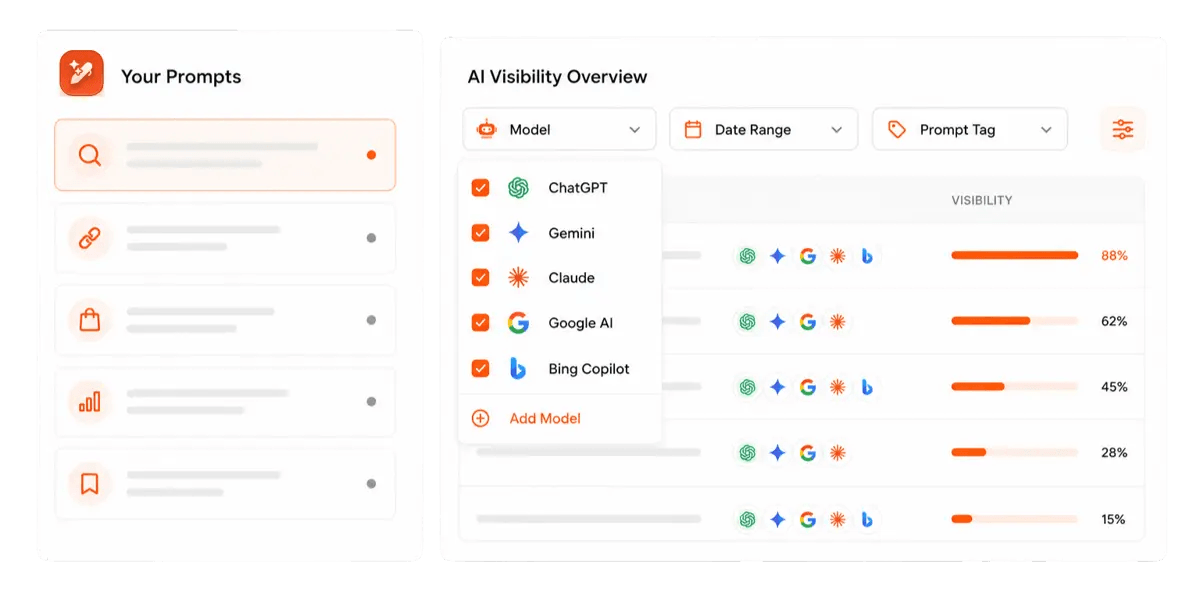
- Track AI mentions across seven engines: The AI visibility tool monitors ChatGPT, Google AI, Copilot, Perplexity, Gemini, Grok, and Claude for the prompts you choose.
- Write content worth citing: The GEO optimization tool scores drafts in real time and flags fixes, so the page under your schema is clear and extractable.
- Compare before and after: Shareable visibility reports and exportable analytics make your control-group test easy to run and report.
- Work from your AI assistant: The new Contentpen MCP server connects Claude, ChatGPT, Cursor, and other MCP-compatible assistants to your workspace.
Contentpen doesn’t generate schema for you. It shows whether your schema and content changes actually change what AI says about your brand.
AI Visibility is included in every plan. Check Contentpen pricing and start tracking your first prompts.
Schema is the label, your content is the reason
Schema markup won’t make AI cite you by itself. The best evidence in 2026 says it’s a supporting layer, not a growth lever.
What it does well is remove doubt. It tells search indexes exactly who you are, what you offer, and how your pages connect.
So mark up your core entities, keep the facts accurate, and spend most of your energy on content worth quoting. Then measure, and let your own data decide.
Frequently asked questions
They do different jobs. llms.txt is a proposed file that points AI tools to key pages, while schema describes entities on each page, and Google says neither is required for its AI features.
Yes, tools like ChatGPT or Claude can draft JSON-LD in seconds. Always validate the output, since AI often invents properties or misses required ones.
Perplexity hasn’t published official guidance on schema. Small tests suggest it reads JSON-LD as plain text when it fetches a page.
Start with the pages that define your entities: homepage, about, author, product, and location pages. Blog posts and other content pages can follow once those validate cleanly.
Give it at least four to six weeks. Search engines must recrawl your pages, and AI answers shift gradually as indexes update.
Speakable is still a beta feature in Google’s gallery, with limited support. It’s worth testing for news content, but don’t expect wide voice assistant coverage.

Eeman Bokhari
Eeman Bokhari has over 9 years of experience in creating high-quality written content and more than 6 years of expertise in SEO and content marketing. She specializes in building search-first content strategies, aligning content with user intent, and driving sustainable organic growth for SaaS and B2B brands. Eeman’s work focuses on combining SEO insights, content systems, and performance data to create content that ranks, engages, and converts.
View all posts by this author