 28 minutes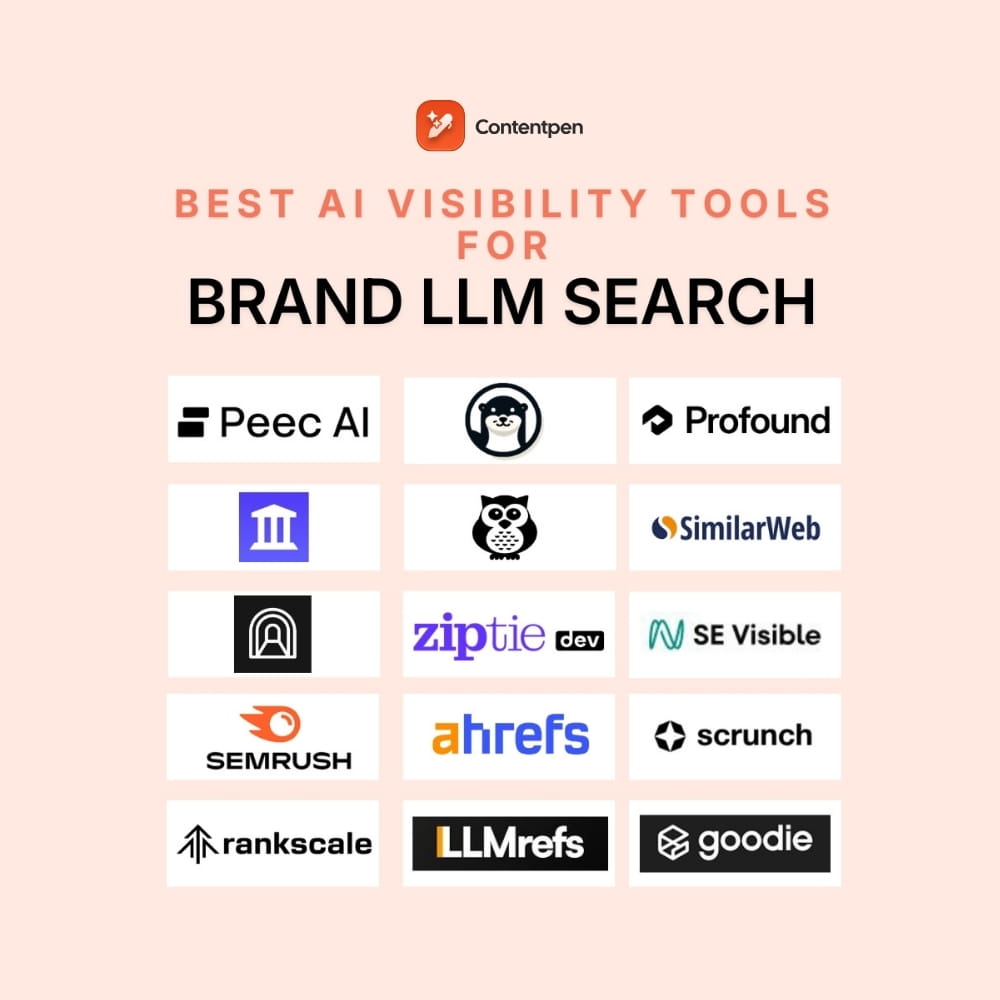
AI visibility tools tell you where your brand shows up in ChatGPT, Perplexity, Gemini, Copilot, and other AI answer engines.
When you only look at classic rankings, you miss how these models talk about you in real conversations. That gap can quietly drain traffic, leads, and trust while your SEO dashboards still look fine. That’s why AI visibility tools are absolutely necessary in 2026.
This guide covers the best AI visibility tools right now in the market, along with their strengths, weaknesses, pricing details, and ideal use-case scenarios.
So, let’s get to it, shall we?
What features should you look for in an AI search visibility tool?
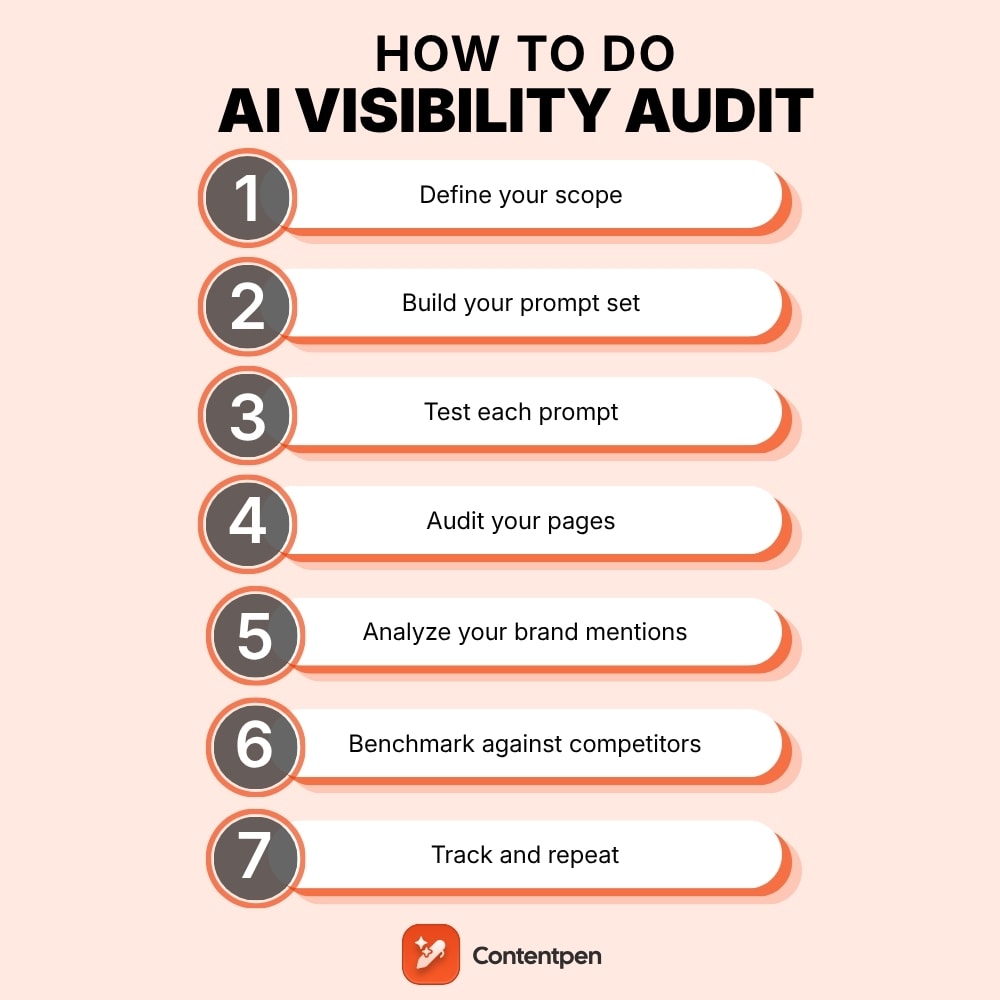
The right AI search visibility tool gives you clear coverage across major engines, explains why you appear, and points to next steps. Think of it as moving from random screenshots to a steady AI visibility audit that your team can act on.
With so many options on the market, you want AI SEO tools that cut through the noise instead of adding more dashboards.
To select the best tool, you need to look for the following things:
- Answer engine coverage should match where your audience spends time. Strong AI search visibility tools should track popular AI chatbots, such as ChatGPT, Google AI Overviews, Perplexity, Gemini, Claude, and Copilot. If a tool only tracks one or two models, your AI visibility checker has blind spots.
- Citation source detection matters because it shows why models trust certain pages. Good AEO tools list which URLs each engine cites for a prompt. That helps you see if AI prefers your blog, third‑party reviews, or a rival playbook.
- Brand sentiment analysis keeps you from chasing empty visibility metrics. A mention that calls your product confusing hurts more than it helps, so AI brand visibility monitoring should catch that shift.
- Share of voice and a clear AI visibility score let you compare progress against competitors. Instead of a single vanity metric, look for filters by engine, topic cluster, and device.
- Technical and crawler insights show whether AI bots can actually read your site. Features such as agent analytics, indexation checks, or AI crawler logs behave like an AI visibility tracking tool for your code and structure.
- Agency‑friendly extras can save hours every week. If you manage many clients, those LLM SEO optimization tools and automations matter as much as the core AI tracking features.
Also read: How to turn off AI Overviews.
Testing criteria for the tools
We didn’t just compile a list from product pages and press releases.
We spent several weeks actively working with these platforms, running real brand queries, and cross-referencing outputs against what AI platforms were actually returning at the time.
Our evaluation process covered a few specific angles.
- Prompt consistency testing
We ran the same set of prompts across multiple tools, tracking the same AI platforms and comparing what each returned.
We investigated details where results diverged significantly. Some tools sample queries infrequently or smooth data in ways that can obscure sudden AI visibility drops.
- Pricing verification
Every price in this article was checked against the tool’s official pricing page or the G2 and Capterra review sites. If we still couldn’t find any pricing numbers, we mentioned ‘Custom pricing’ clearly.
- Coverage gap checks
We tested each tool against a fixed set of AI platforms and noted which engines were included in base plans versus locked add-ons.
A tool claiming to cover 6 platforms that puts 4 of them behind add-on fees is a different proposition than one that includes them by default.
- Use-case fit assessment
We evaluated each tool from three perspectives: a solo content marketer with a limited budget, a mid-size marketing team running an active AEO program, and an agency managing multiple client accounts.
The same tool performs very differently depending on which of those you are.
What you’re reading reflects real hands-on evaluation combined with cross-referencing user reviews from trusted websites.
The best AI visibility tools in 2026
Below is our list of the 15 best AI visibility tools online today.
| Tool | Best for | AI platforms tracked | Starting price | Free trial |
| Contentpen | Content-first teams | 5+ | $39/month | 7 days |
| Peec AI | Marketing teams, agencies | 6 | $95/month | No |
| Otterly AI | Budget teams, Semrush users | 4 base + add-ons | $29/month | 7 days |
| Profound | Enterprise brands | Up to 10 | $99/month (limited) | No |
| AthenaHQ | Mid-market to enterprise, action layer | 8 | $295/month | No ($95 first month) |
| Nightwatch | SEO + AI combined | 4 | $131/month combined | 14 days |
| Similarweb AI | Market-level intelligence | 4 | $99/month | Demo |
| Hall | Startups, agencies, free entry | 5 | Free / $239/month | Free Lite plan |
| ZipTie | SEO agencies, technical teams | 3 | $69/month | 14 days |
| SE Visible | Multi-market brands | 5 | $99/month | No |
| Semrush | SEO and AI visibility teams | 5 | $99/domain/month | 7-days for SEO + AI |
| Ahrefs Brand Radar | Ahrefs enterprise users | 6 | $199/month add-on | No |
| Scrunch AI | Enterprise AI crawler tracking | 7 | $250/month | No |
| Rankscale AI | Multi-engine tracking + AEO audits | 7+ | $99/month | No |
| LLMRefs | Keyword-focused, multi-engine | 10 | $79/month | No |
| Goodie AI | Mid-market to enterprise, end-to-end AEO | 11 | $399/month | No |
Read each of their details below.
1. Contentpen
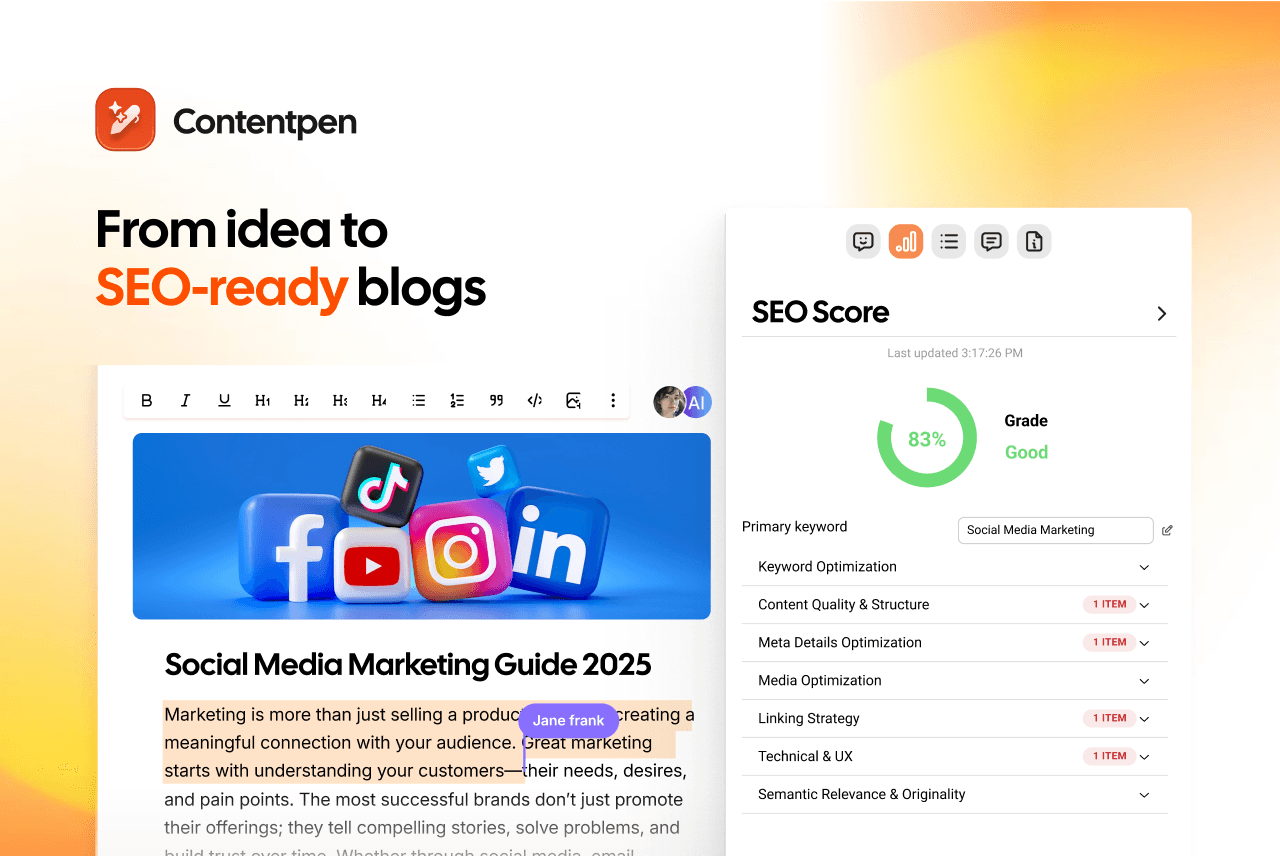
Best for: Content-first teams that need AI visibility tracking, brand sentiment, share of voice, and top sources in one place.
Contentpen is a powerful AI blog writing tool that provides SEO and GEO-friendly content at scale.
It tracks your visibility, position, brand sentiment, and share of voice across ChatGPT, Google AI Overviews, Perplexity, Copilot, and Grok.
You set up your prompt library, pick which AI models to track, and the tool returns clean data on visibility trends and competitors.
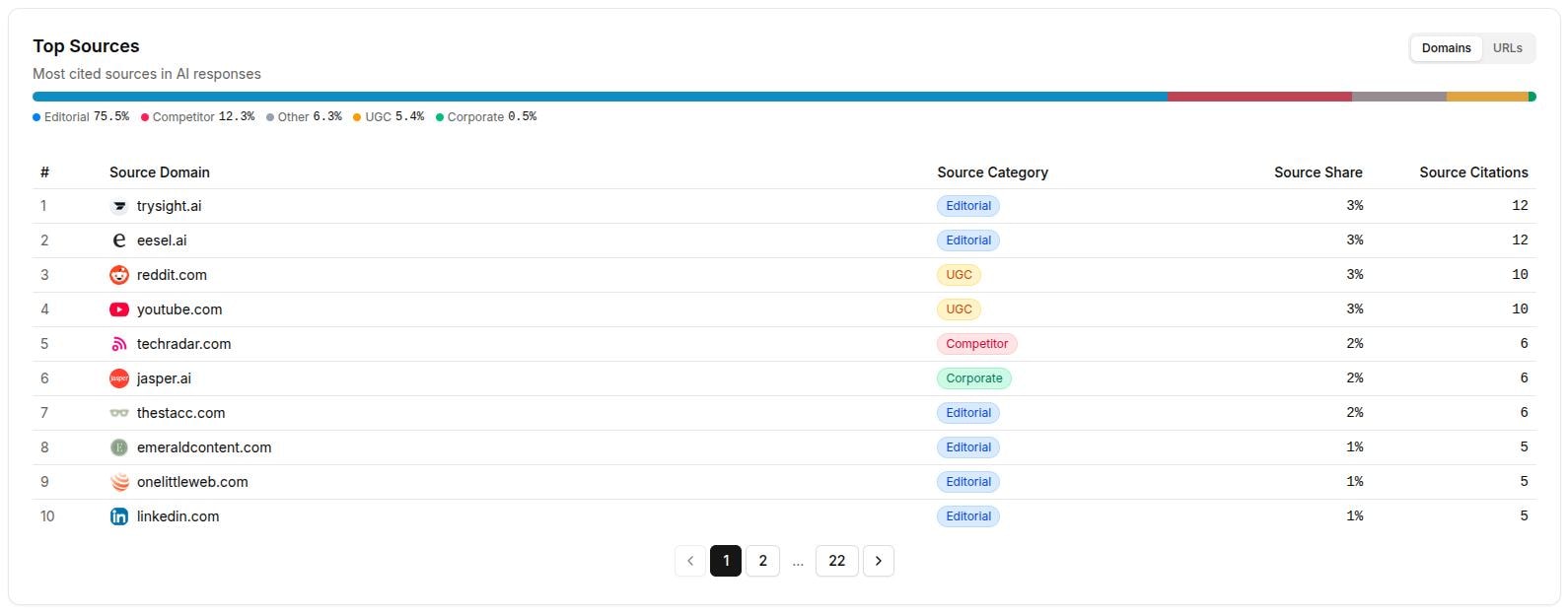
You can see the gaps in your content strategy and fix them right in the same platform without switching any tabs.
What we like:
- Multi-location tracking across 5 major AI platforms
- Accurate average position, share of voice, and brand sentiment data
- An opportunity score showing where you need to appear, where your competitors do
- Add prompts manually or with AI
Limitations:
- There is a slight learning curve for beginners
- Only tracks 10 active prompts at a time in the starter plan
Pricing:
- Essential: $39/month (10 prompts, 2 AI models, 1 project)
- Growth: $99/month (30 prompts, 3 AI models, 3 projects)
- Business: $199/month (Unlimited prompts, competitors, and workspaces, 5+ AI models)
- Custom: According to individual business needs
2. Peec AI
Best for: Marketing teams and agencies that want clean, daily AI tracking without enterprise pricing.
Peec AI was built to answer one question clearly: where does your brand actually stand inside AI search?
It tracks your visibility, position, and brand sentiment across ChatGPT, Perplexity, Google AI Overviews, Gemini, and Microsoft Copilot every day.
You set up your prompt library, pick which AI models to track, and the tool returns clean data on visibility trends, citation sources, and how you’re stacking up against competitors.
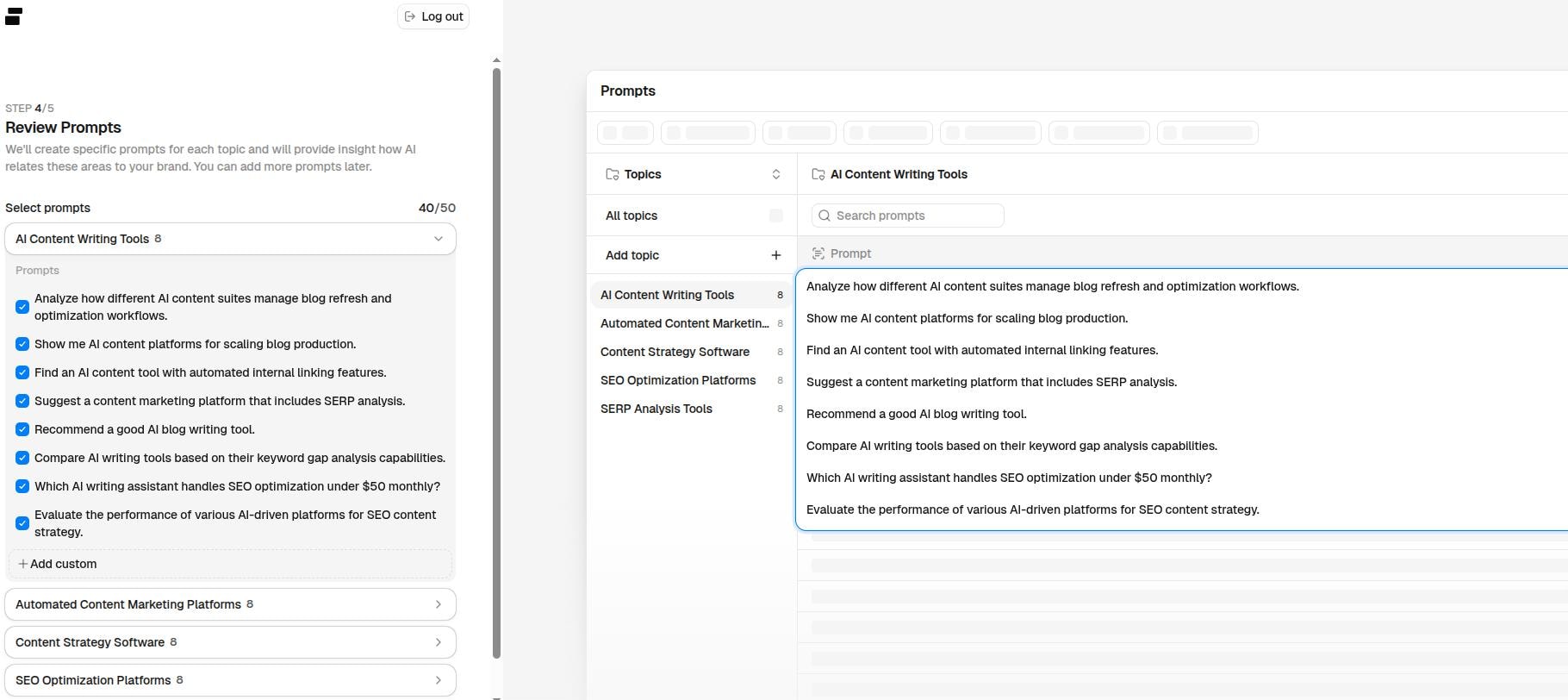
There’s no content creation module, no workflow automation bolted on. It stays in its lane, and that’s actually a good thing.
The part that makes Peec genuinely useful is the prompt-level granularity.
You can see exactly which prompts your audience is using in AI search, the pages that get cited in responses, and third-party sources influencing the AI answers you want to own.
What we like:
- Daily tracking across 6 AI platforms with unlimited user seats
- Prompt-level data on citation sources and competitive gaps
- Flexible model selection per project
- Agency-friendly with multi-workspace support
Limitations:
- Pure monitoring, with no built-in content optimization
- No free trial: you commit to a paid plan upfront
- Per-engine add-ons can raise the effective cost on lower tiers
- Entry plan prompt volume can feel tight for broad monitoring
Pricing:
- Starter: $95/month (50 prompts, 3 AI models, 1 project)
- Pro: $245/month (150 prompts, 3 AI models, 2 projects)
- Advanced: $495/month (350 prompts, multi-project, Looker Studio integration)
3. Otterly AI
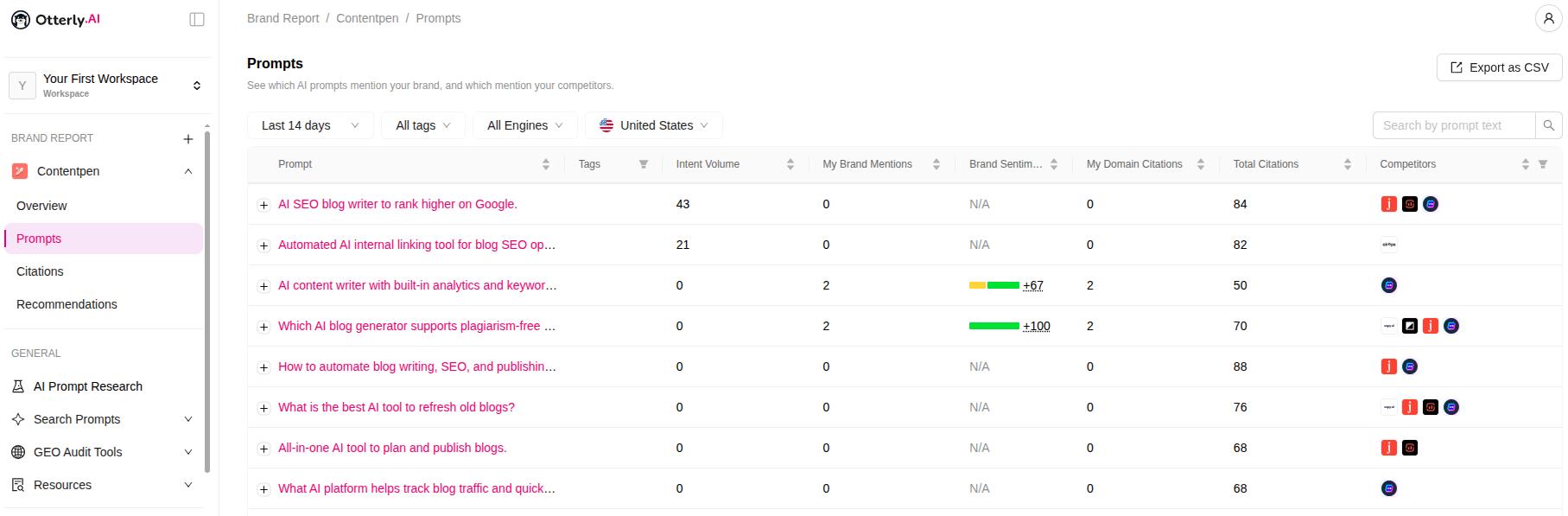
Best for: Teams on a budget and anyone getting started with AI visibility tracking.
Otterly AI launched in late 2024 and has since grown to over 15,000 marketing professionals, which is a fast uptake for a new tool in this category. The main reason is pricing.
Its Lite plan starts at $29/month, making it the most accessible serious AI visibility tool on the market right now. And before you write it off as a budget option, Gartner named it a Cool Vendor for 2025.
The platform tracks mentions and citations across ChatGPT, Perplexity, Google AI Overviews, and Copilot, with Gemini and Google AI Mode available as add-ons.
The GEO Audit feature is what most reviewers point to first: it analyzes over 25 on-page factors and returns SWOT-style recommendations for improving your citation likelihood.
If you’ve ever wondered why a competitor keeps showing up in AI responses when you don’t, this is the kind of analysis that starts answering that.
The AI Keyword Research tool is another underrated feature. It takes your existing SEO keywords and converts them into the conversational prompts your audience actually uses inside AI search engines.
If your team is still stuck in keyword-first thinking, this feature helps you bridge that gap without starting from scratch. Besides, you get a free 7-day trial (no CC required) to test this tool before committing.
What we like:
- Lowest entry price in the market ($29/month)
- GEO Audit with SWOT-style on-page recommendations
- Native Semrush integration for unified SEO and AI reporting
- AI Keyword Research
Limitations:
- 15 prompts on the Lite plan are minimal for any real-world monitoring
- Weekly data refresh on base plans rather than daily
- Gemini and Google AI Mode cost extra on top of the base plan
- Platform coverage is narrower than enterprise-focused tools
Pricing:
- Lite: $29/month (15 prompts)
- Standard: $189/month (100 prompts)
- Premium: $489/month (400 prompts)
4. Profound
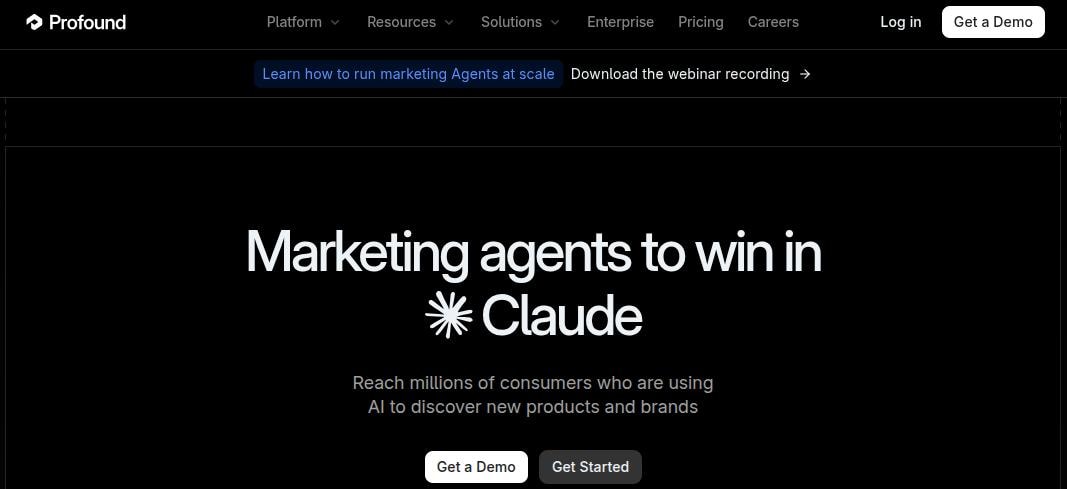
Best for: Enterprises with complex brand requirements and ecosystems.
Profound offers deep, unparalleled AI visibility features. It covers up to 10 AI platforms, including ChatGPT, Perplexity, Gemini, AI Mode, Claude, Copilot, Meta AI, Grok, DeepSeek, and Google AI Overviews.
Its Agent Analytics feature tracks how AI crawlers interact with your website, which URLs they visit, and what technical changes are needed to improve your information retrieval. That kind of input-side visibility is rare.
Profound also provides actual AI search optimization volume data. The Conversation Explorer shows you how often topics and prompts are being discussed inside ChatGPT, Perplexity, and other AI tools.
Combined with SOC 2 Type II compliance, SSO, and multi-brand management, it’s the only tool in the category that fully meets the governance needs of large organizations.
The significant downside is access. There’s no self-serve signup and no free trial. You apply, go through a sales process, and get custom scoping from their team.
What we like:
- One of the largest AI platform coverages (up to 10 AI engines on the Enterprise plan)
- Agent Analytics for AI crawler behavior on your site
- AI search volume data for market research
- SOC 2, HIPAA, and enterprise security compliance
Limitations:
- No self-serve access. Requires a sales demo
- High cost, especially for multi-engine coverage
- Overkill for small or mid-market teams
- Enterprise complexity may slow down iteration for marketing teams
Pricing:
- Starter: $99/month (ChatGPT only, 50 prompts)
- Growth: $399/month (3 AI platforms, 100 prompts)
- Enterprise: Custom pricing (up to 10 AI engines tracked)
5. AthenaHQ
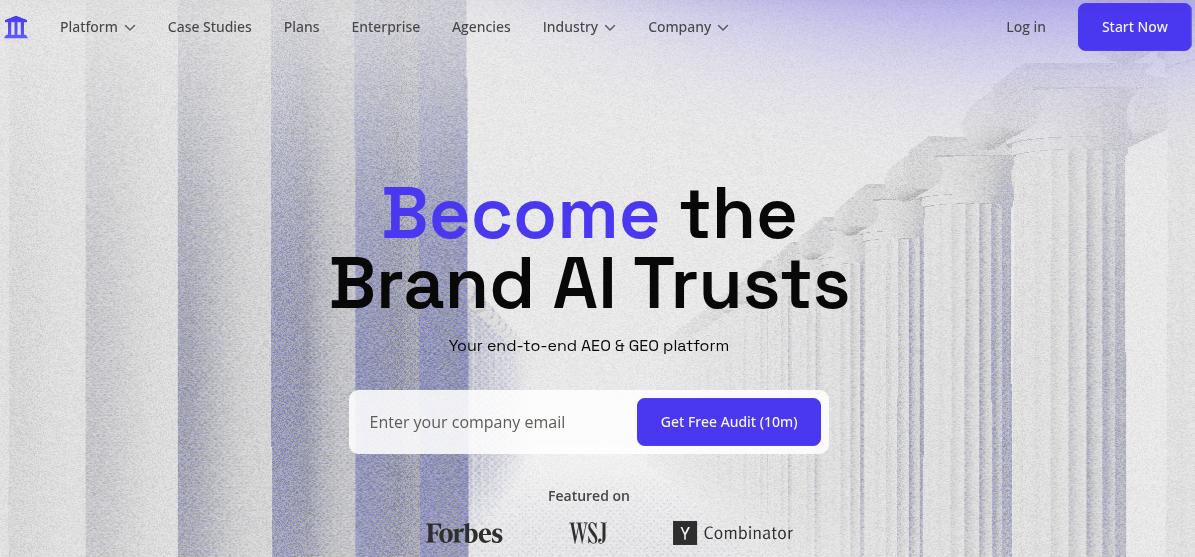
Best for: Mid-size companies and large-scale enterprises that need multi-engine AI visibility and an action layer.
AthenaHQ isn’t a monitoring tool that was built by an SEO agency. It’s a platform built by people who understand how LLMs actually work, backed by companies like Y Combinator.
Every plan, including the entry-level Self-Serve tier, gives you access to all 8 AI platforms: ChatGPT, Perplexity, Gemini, Google AI Overviews, Google AI Mode, Claude, Copilot, and Grok.
That’s a different model from something like Profound, which restricts you to ChatGPT on the base plan and makes you upgrade to get Perplexity and Gemini.
With AthenaHQ, you’re not paying to unlock engines. You’re paying for usage volume.
The platform centers on an Olympus dashboard that shows you full AI responses, including what the model said, what sources it cited, and how your share of voice is shifting.
The Action Center takes those insights and converts them into specific recommendations: which pages to update, what questions to answer, and where your content is missing authority signals.
However, the credit-based pricing model is the thing you need to think carefully about before committing.
What we like:
- All 8 AI platforms are included on every plan, with no AI engine paywalls
- Action Center converts monitoring data into specific, prioritized content fixes
- Revenue attribution via Shopify and GA4 integration
- SOC 2 Type 2, GDPR, and NIST compliance for enterprise buyers
- Unlimited topic tracking on the base plan
Limitations:
- Credit-based pricing makes the monthly cost hard to predict at higher usage volumes
- No free trial
- Enterprise features like persona targeting and ACE (Athena Content Engine) are locked behind a steep paywall
Pricing:
- Self-Serve: $295/month standard ($95 first month introductory offer)
- Enterprise: Custom pricing
6. Nightwatch
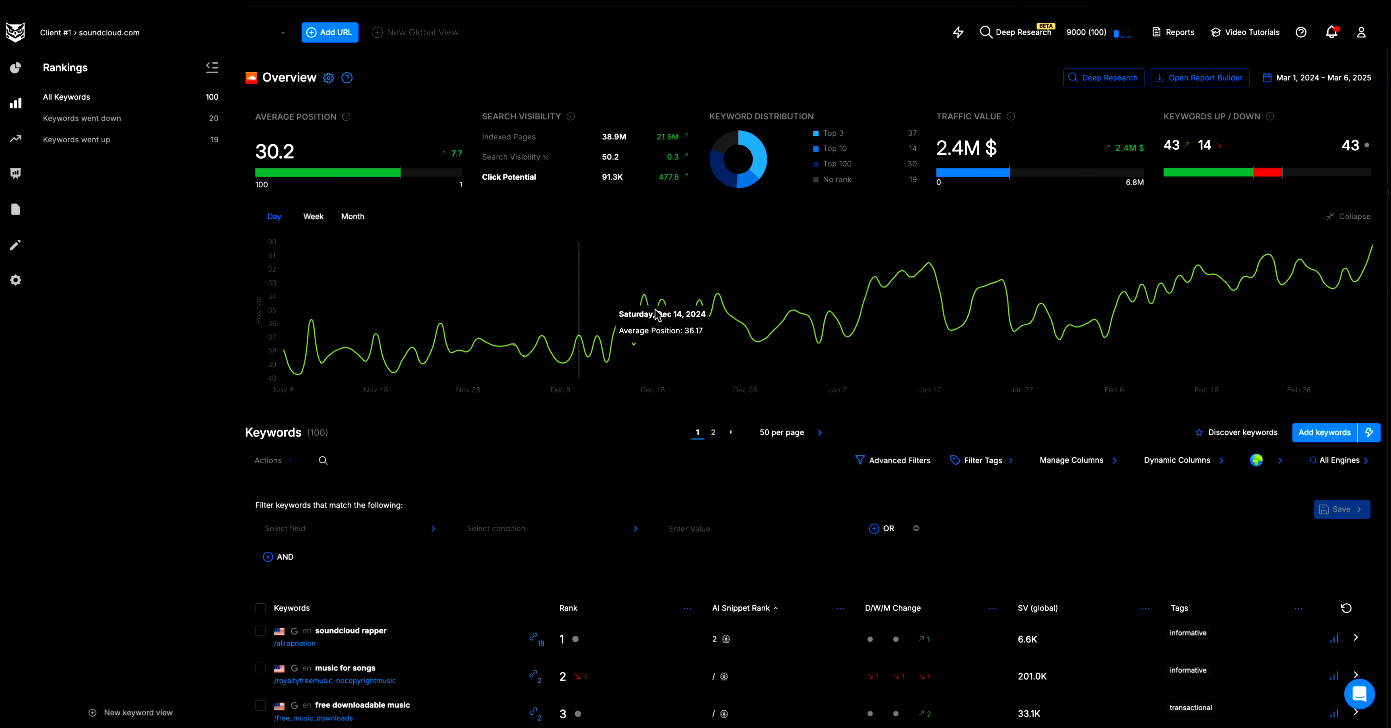
Best for: SEO teams that want traditional rank tracking and AI visibility in one platform.
Nightwatch started as a classic SEO rank tracker and competitor analysis tool that has meaningfully expanded into AI monitoring.
If your team already uses Nightwatch for keyword tracking, the AI monitoring add-on covering ChatGPT, Claude, Perplexity, and Google AI Overviews is a realistic option.
The core advantage here is something dedicated AI visibility tools can’t match: you see your organic keyword rankings and your AI share of voice in the same dashboard.
For teams running both SEO and AEO programs and trying to connect performance across channels, that unified view is genuinely valuable.
Nightwatch also includes prompt research capabilities and citation-level sentiment analysis powered by its SEO Agent.
One thing to be honest about: Nightwatch tracks 4 AI models compared to the 5 to 10 that other dedicated AI visibility platforms cover.
Also, in our testing, we noted that LLM-specific features are still catching up to the company’s established SEO capabilities.
So, if you specifically need AI visibility depth, then a tool like Peec AI will serve you better.
What we like:
- Unified SEO rank tracking and AI visibility in one dashboard
- Prompt research and citation-level sentiment analysis
- Strong traditional SEO toolset as the foundation
- 14-day free trial with full feature access
Limitations:
- AI tracking feels like an add-on to the platform
- 4 AI model tracking is subpar compared to what other tools offer
- LLM-specific features are still maturing compared to other competitors
- Combined pricing adds up if you need both SEO and AEO features
Pricing:
- Base SEO tracking: from $32/month (billed annually)
- AI tracking add-on: $99/month (100 prompts)
7. Similarweb AI brand visibility

Best for: Executives, strategists, and brands that need market-level AI intelligence.
Similarweb comes at AI visibility from a completely different angle than everyone else on this list.
Rather than asking “how often does ChatGPT mention us?” it asks “how is AI reshaping our entire category?”
That difference in framing produces a tool that’s less about prompt-level monitoring and more about strategic market intelligence.
You see mention share, momentum trends, and how your AI visibility compares to branded search demand, all in one view.
The Citation Analysis feature reveals which domains LLMs cite most in your category, helping you identify third-party sites carrying the influence you need to earn a spot on.
The AI Traffic feature is where Similarweb does something most tools can’t. It breaks LLM referral traffic into a dedicated channel view rather than burying it in generic referrals.
This isn’t the right tool if you’re a small team that just wants to track brand mentions and compare against a couple of competitors.
Similarweb is built for teams making category-level strategic decisions.
What we like:
- Market-level AI intelligence across your entire category, not just your brand
- AI Traffic module for actual LLM referral tracking as a distinct channel
- Prompt tracking with real user queries and AI responses
- Strong context for competitive and category-level strategy
Limitations:
- More than most teams need for basic brand mention tracking
- Enterprise-oriented pricing and positioning
- Less prompt-level granularity than other dedicated AI visibility tools, such as Peec AI
Pricing:
- AI Search Intelligence (AEO): from $99/month
- Full Competitive Intelligence (SEO + AEO suite): $399/month
- AEO & SEO & Ads & Competitive Intel: $542/month
8. Hall
Best for: Startups, growth teams, and agencies that want a free entry point with real daily AI visibility tracking across five major LLMs.
Hall tracks your brand appearances in ChatGPT, Gemini, Perplexity, Claude, and Copilot.
The tool performs AI tracking at three levels: what the AI says about you, which of your pages it cites, and how AI crawlers are actually interacting with your site.
That third layer, the agent analytics, is what makes Hall stand out at the mid-market level.
You can see how AI bots like GPTBot, OAI-SearchBot, and ChatGPT-User crawl your site, what they’re accessing, and how that behavior correlates with your share of voice in AI responses.
Most tools give you output-side data. Hall gives you output plus a meaningful amount of input-side data without charging enterprise prices for it.
The Conversational Commerce feature is also worth noting if you’re in e-commerce.
Hall tracks product visibility in ChatGPT’s shopping results, measures which prompts trigger product placements, and tracks retailer citations alongside sentiment.
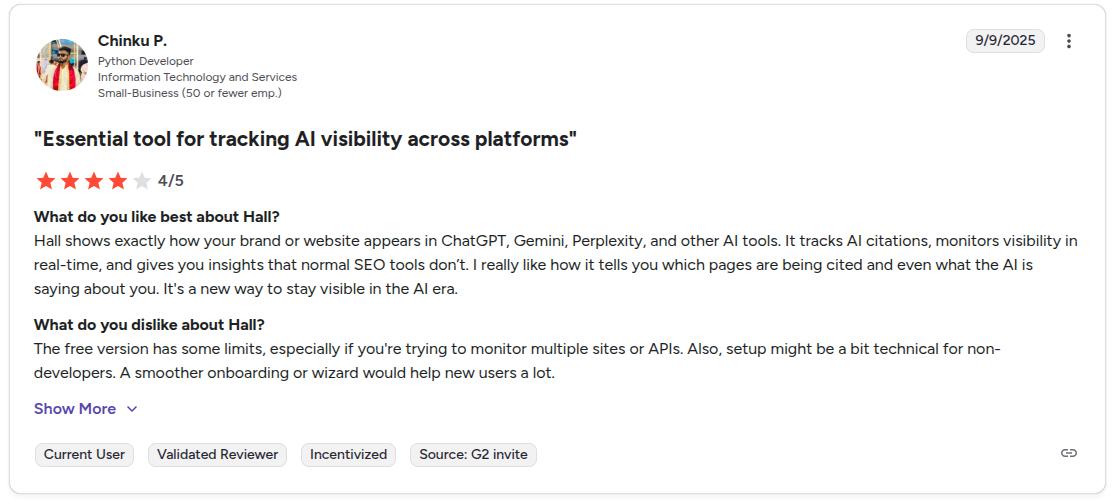
Source: G2.
That said, we also agree with G2 reviewers that the setup is too technical and does require support to finalize onboarding.
What we like:
- Agent analytics showing how AI crawlers interact with your site
- Conversational Commerce tracking for e-commerce product visibility
- Covers 5 major AI platforms: ChatGPT, Gemini, Perplexity, Claude, and Copilot
- Unlimited viewers on all plans, no per-seat charges for stakeholders
Limitations:
- Free tier updates weekly, not daily
- Filtering and segmentation options less granular than dedicated analytics tools
- Newer platform with fewer third-party integrations than established competitors
- Difficult onboarding and setup
Pricing:
- Lite: Free (1 project, 25 tracked questions, 300 answers/month, weekly updates)
- Starter: $239/month (20 projects, 500 tracked questions, 45,000 answers/month, daily updates)
- Business: $599/month (50 projects, 1,000 tracked questions, 120,000 answers/month)
- Enterprise: Custom pricing
9. ZipTie
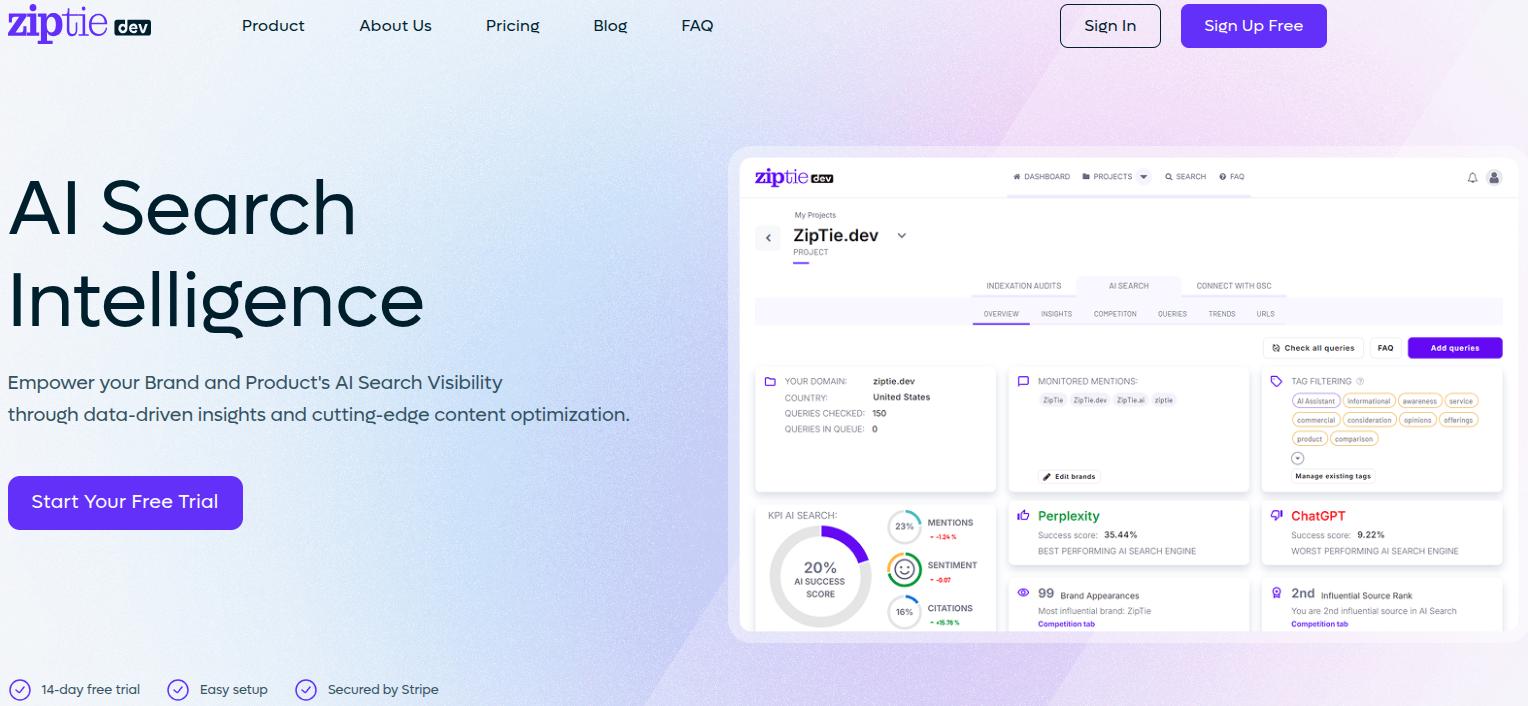
Best for: SEO agencies and technical teams that want AI Overview tracking with real content optimization guidance.
ZipTie doesn’t just tell you whether you appear in AI responses. It analyzes why you appear or don’t, and then gives you specific content changes to act on.
That combination of monitoring and optimization guidance is what separates it from tools that only surface AI visibility data.
The platform focuses on three platforms: Google AI Overviews, ChatGPT, and Perplexity.
ZipTie runs checks that simulate real user behavior rather than using API calls, which means the results you see are closer to what your actual audience sees.
Each “AI Search check” covers all three AI platforms simultaneously, so one tracked prompt counts once, even if it runs across all engines.
The AI Success Score is one of ZipTie’s more distinctive features.
It blends mention frequency, citation presence, answer placement, and sentiment into a single score that gives you a measurable number for presenting to stakeholders.
The content optimization module is the “now what” layer that AI monitoring tools often lack.
The tool tells you to add a comparison table, restructure H2s to match question patterns, or improve E-E-A-T signals for a specific topic.
What we like:
- The content optimization module gives specific, actionable improvement steps
- Screenshot verification of actual AI appearances
- AI Success Score for stakeholder reporting and progress tracking
- Real user behavior simulation rather than API-based queries
Limitations:
- Only 3 AI platforms tracked (Google AI Overviews, ChatGPT, Perplexity)
- Credit-based pricing scales up quickly for large prompt sets
- Limited to 14 countries only
- Can feel heavy for solo marketers just getting started
Pricing:
- Basic: $69/month (500 AI Search checks, 10 content optimizations)
- Standard: $99/month (1,000 AI Search checks, 100 content optimizations)
- Pro: $159/month (2,000 AI Search checks, 200 content optimizations)
10. SE Visible (by SE Ranking)
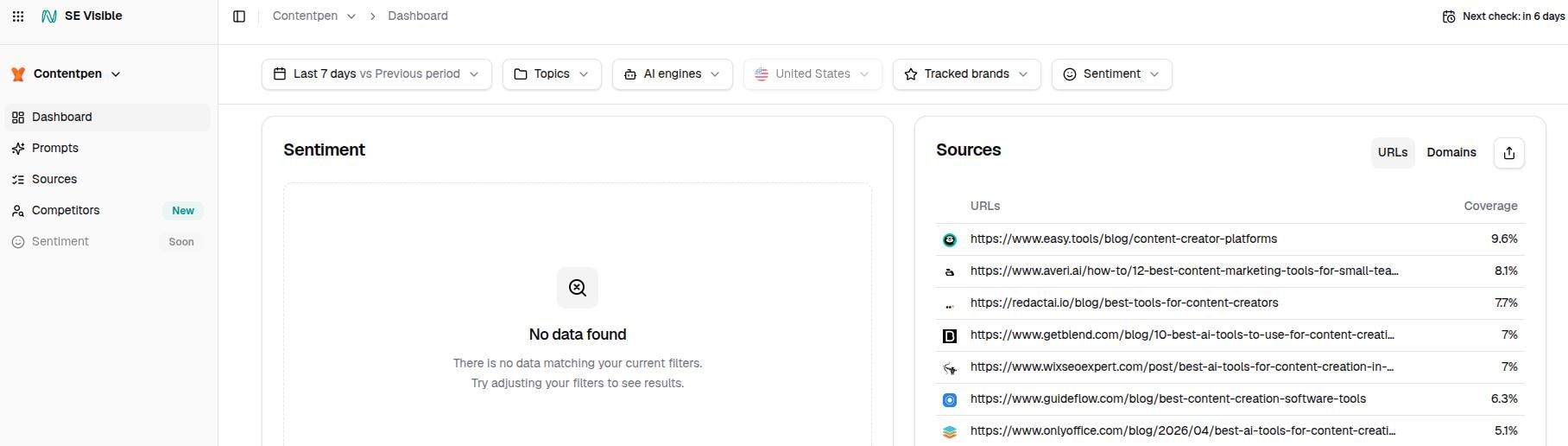
Best for: Brands and agencies in the SE Ranking ecosystem that want a clean, standalone AI visibility layer.
SE Visible is SE Ranking’s standalone AI visibility product, built separately from its main SEO suite to focus entirely on AI brand monitoring.
The tool covers ChatGPT, Google AI Overviews, AI Mode, Gemini, and Perplexity, with particular depth in multi-country and multi-language monitoring.
For brands operating across multiple markets, SE Visible supports up to 10 brands with regional breakdowns, which is rare at this price point.
The dashboard keeps things straightforward. AI visibility score, rank, average position, and sentiment are all front and center.
Competitor comparison is built in, so you can directly benchmark your brand against specific rivals for the same prompt set.
SE Visible draws on SE Ranking’s 13+ years of data infrastructure, which gives it a credibility edge as a newer entrant in the AI visibility space.
What we like:
- Multi-brand and multi-language tracking at accessible pricing
- Clean dashboard with prominent metrics
- Standalone product that doesn’t require a full SE Ranking subscription
Limitations:
- 5-engine coverage is solid but not the broadest available
- Less prompt-level granularity than other specialized tools on the list
- Steep learning curve for beginner-level users
Pricing:
- Basic: $99/month (3 brands, 200 prompts)
- Core: $189/month (5 brands, 450 prompts)
- Plus: $355/month (10 brands, 1000 prompts)
11. Semrush
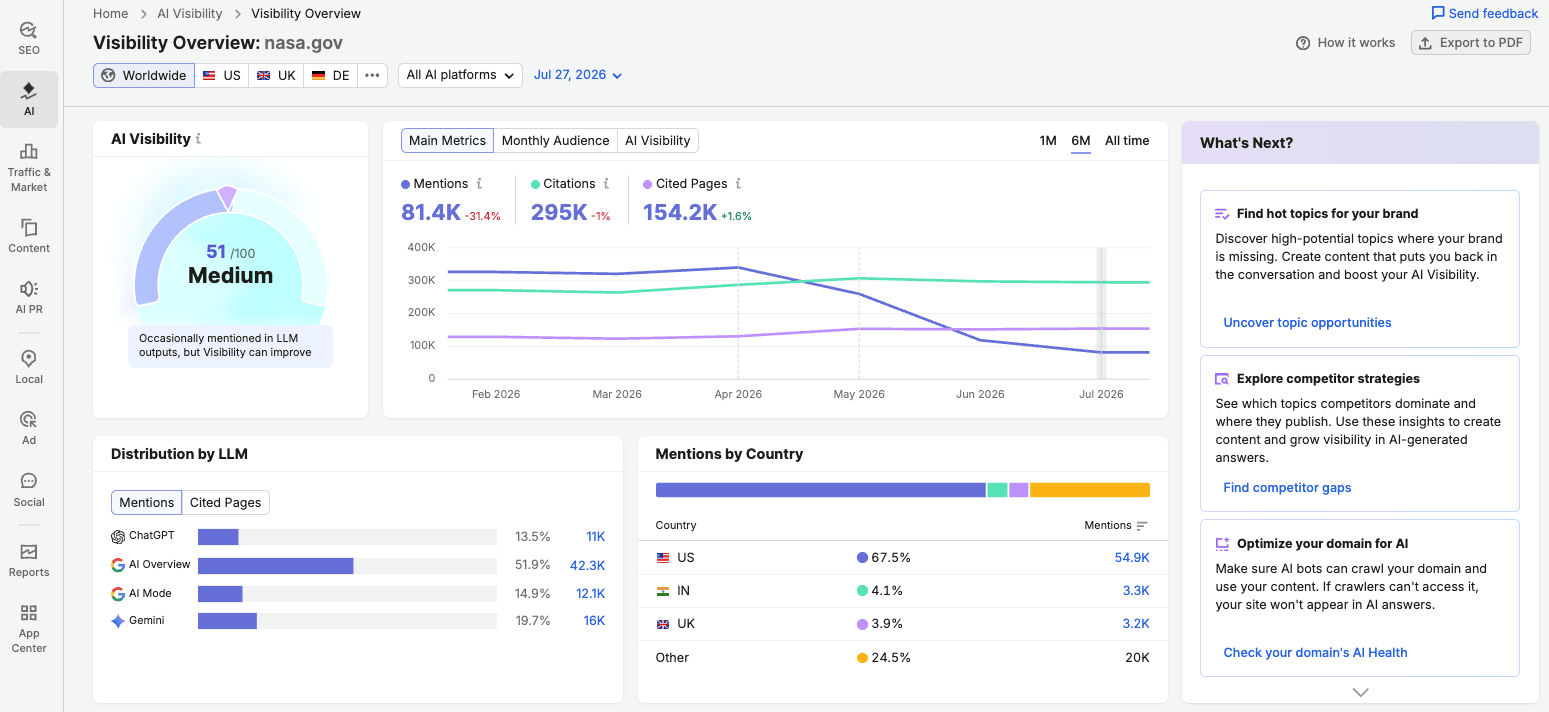
Best for: Marketing teams and agencies that want AI visibility, SEO, and competitive research in one platform.
Semrush is a search visibility platform that connects traditional SEO data with AI brand monitoring.
Its AI Visibility Toolkit tracks how your brand appears across ChatGPT, Gemini, Google AI Overviews, Google AI Mode, and Perplexity.
The AI Toolkit adds a prompt database of over 239 million prompts, along with visibility scoring, daily prompt tracking, sentiment analysis, citation tracking, and competitor research.
The main advantage is the connection between AI visibility and the wider web signals influencing it.
If ChatGPT or Google AI Mode mentions a competitor more often, Semrush lets you investigate potential causes using its keyword, backlink, content, competitive research, and technical SEO data.
This makes Semrush useful for teams that want to understand not only where they appear in AI search but also what may be driving those results.
Larger organizations can use Semrush Enterprise AIO for broader platform coverage and AI visibility management across multiple brands, markets, and locations.
What we like:
- Combines AI visibility, SEO, and competitive research in one platform
- 239M+ prompt database for broad coverage
- Tracks visibility, daily prompts, citations, sentiment, and competitors
- AI Search Site Audit identifies technical readiness issues
Limitations:
- No free trial for the standalone AI Visibility Toolkit
- The broader feature set may be excessive for teams that only need basic mention tracking
- Additional domains and advanced enterprise coverage increase the cost
Pricing:
- AI visibility toolkit: Starts at $99/month per domain
- SEO and AI visibility: $199/month
Check the official Semrush pricing page for current pricing and packaging.
12. Ahrefs Brand Radar 2.0
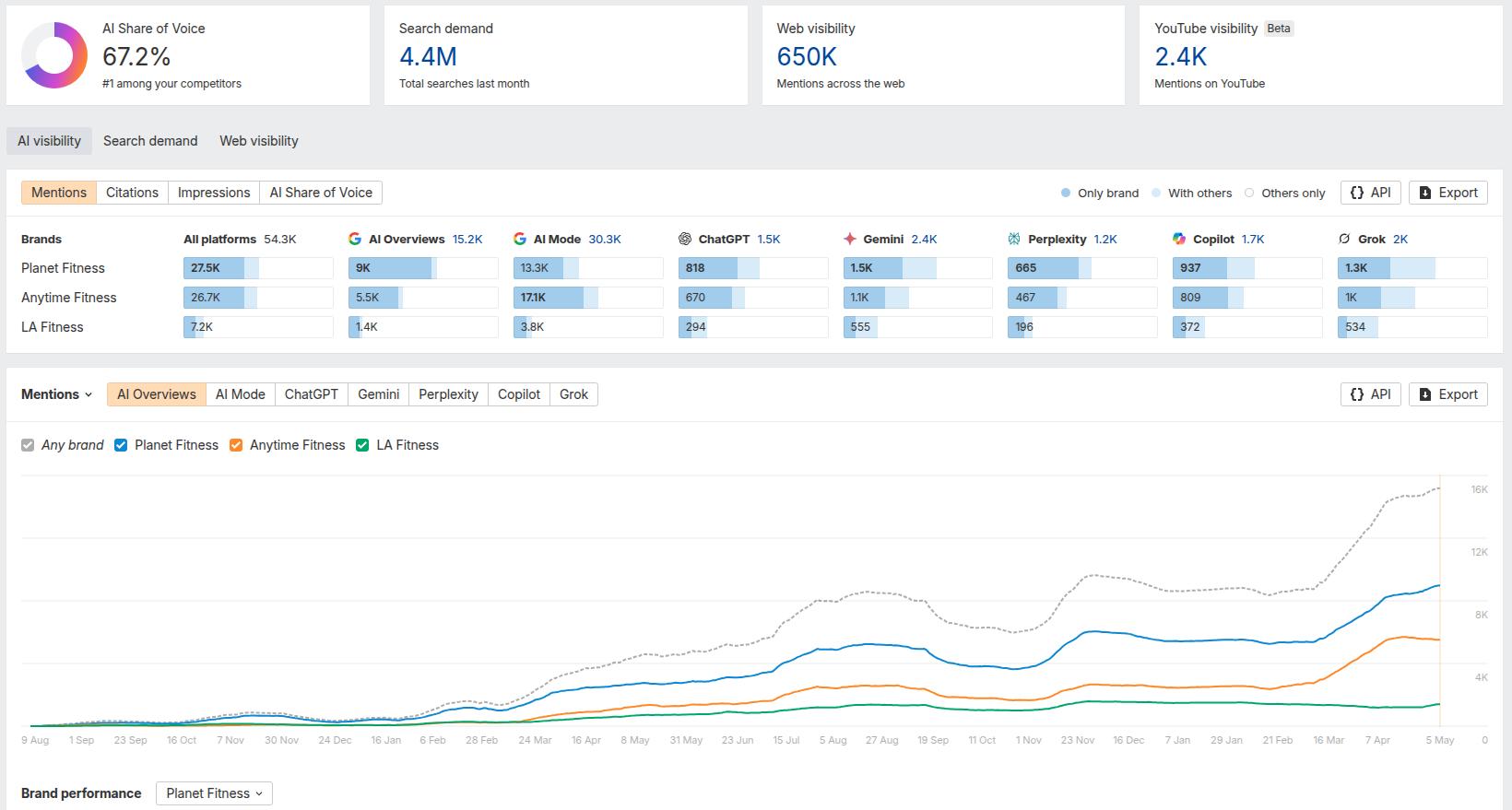
Best for: Enterprise and agency teams already using Ahrefs who want AI visibility integrated with their SEO data.
Ahrefs Brand Radar is built on a 243M+ prompt database and covers ChatGPT, Google AI Overviews, AI Mode, Perplexity, Gemini, and other tools.
The standout capability for data-focused teams is its Web Analytics integration.
Unlike most tools that dump AI traffic into the generic “referrals” bucket, Ahrefs breaks out ChatGPT, Perplexity, Claude, and Gemini as separate channels.
The Real-Time Trend Detection feature is also worth calling out. It surfaces rising topics and new phrasing, gaining traction in AI responses before those patterns become widely competitive.
This is useful for content teams that want to get into a topic before everyone else does.
The main problem is the pricing structure.
Brand Radar is an add-on to your existing Ahrefs subscription, priced at $199/month per AI index or $699/month for a bundle of all 6 AI indexes.
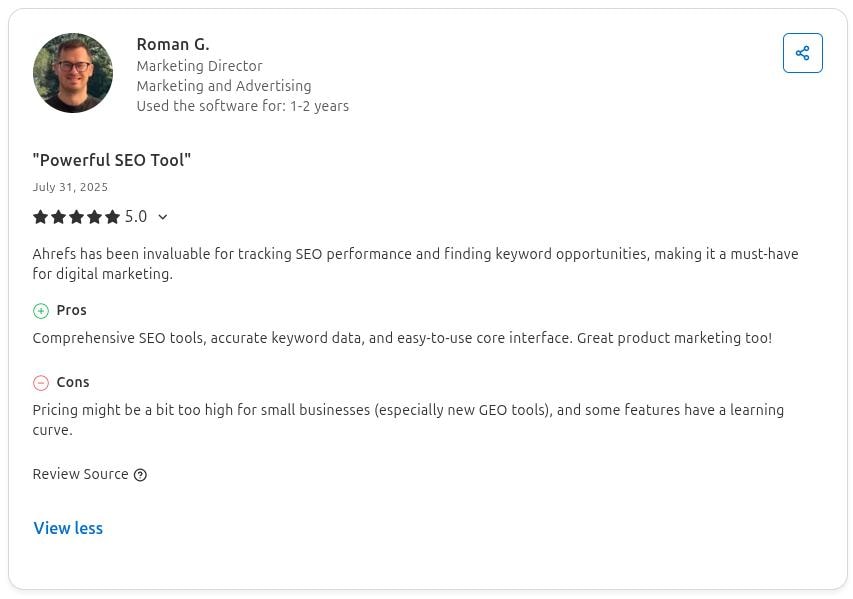
Source: Capterra.
Stack that on top of an Ahrefs base subscription starting at $129/month, and you’re looking at a huge monthly number.
What we like:
- 243M+ prompt database for broad coverage
- Web Analytics integration that breaks AI referral traffic into distinct channels
- Real-time trend detection for emerging prompts
- Enterprise plan includes Brand Radar with custom prompts
Limitations:
- Add-on pricing makes the total cost substantial on top of the base subscription
- Steep learning curve, especially for the GEO features
- Full 6-engine coverage is too expensive for small business owners and individuals
Pricing:
- AI index add-on: $199/month
- All AI platforms: $699/month
13. Scrunch AI
Best for: Enterprise brands that need AI crawler behavior tracking alongside mention monitoring.
Scrunch AI takes a broader view of the problem than most tools in this category. It monitors brand presence and citations across ChatGPT, Claude, Perplexity, Gemini, Google AI Overviews, AI Mode, and Meta AI.
But the part that makes it genuinely different at the enterprise level is the Agent Experience Platform (AXP).
Rather than just measuring what shows up in AI answers (output-side visibility), it addresses what AI crawlers actually see when they visit your site (input-side visibility).
That dual focus gives enterprise teams a more complete picture of their AI search optimization efforts.
API access is also included for feeding visibility data into internal dashboards or BI pipelines, which matters for large organizations with existing SEO analytics infrastructure.
The tradeoff is complexity and cost.
What we like:
- Tracks both what AI crawlers see on your site and what shows up in AI answers
- Agent Experience Platform (AXP) creates AI-optimized site versions
- API access for custom reporting and BI integration
- Multi-brand management for enterprise scale
Limitations:
- More capabilities than most teams need for day-to-day marketing work
- Higher entry pricing than mid-market tools
- Feature depth requires dedicated resources to actually use
Pricing:
- Core: $250/month (125 prompts, 1 brand workspace)
- Enterprise: Custom pricing
14. Rankscale AI
Best for: Teams that want multi-engine AI tracking with AEO-focused audits.
Rankscale AI is a solid AI visibility tracker that tracks ChatGPT, Claude, Perplexity, Grok, Google AI mode, AI Overviews, and other API/GUI engines with a credit-based pricing model.
The tool layers in AI-focused site audits to surface content and technical issues to help your AI visibility in the long run.
Visibility tracking, sentiment analysis, and competitive benchmarking are also included without significant bloat.
That said, the credit-based model can be confusing for teams on a budget.
It works well for users performing periodic diagnostic checks. However, it becomes limiting if you need continuous high-frequency tracking across a large prompt set.
What we like:
- Covers multiple AI engines
- AI-focused site audit for technical readiness
- Clean and accessible interface
Limitations:
- Credit-based pricing scales up quickly with heavy use
- Less analytical depth than premium tools
- Fewer integrations and reporting options
Pricing:
- Pro: $99 (1200 credits, 4800 AI responses)
- Growth: $385 (5500 credits, 22000 AI responses)
- Enterprise: $780 (12000 credits, 48000 AI responses)
15. LLMRefs
Best for: Teams that think in keywords instead of prompts.
Most AI visibility tools ask you to start with a prompt. LLMRefs asks you to start with a keyword. The difference sounds subtle, but it changes how you work with the data.
Instead of maintaining a prompt library that you’re constantly guessing at, you track keyword-level patterns across multiple AI responses and let the platform surface how different models handle your topics.
The platform covers 10 AI engines: GPT-5, Gemini, Perplexity, Claude, Google AI Overviews, AI Mode, Grok, Copilot, Meta AI, and DeepSeek.
It works on the query fan-out process that most AI search platforms use to respond to users.
With LLMRefs, you get real-time results alongside weekly keyword updates, and the default plan includes 50 keywords across all ten AI engines for $79/month.
The data exports include CSV downloads and API access, which let teams use visibility data in their own dashboards without manual exports.
What we like:
- 10 AI engines are tracked on the base plan with no add-ons required
- Keyword-focused approach surfaces visibility patterns across many related prompts
- API access and CSV exports on all plans
- Auto-updating engine mappings as AI models evolve
Limitations:
- Keyword-level tracking is less precise than prompt-level tools for specific query analysis
- Weekly keyword updates rather than a daily monitoring schedule
- Less actionable optimization guidance compared to tools like ZipTie
Pricing:
- All in One: $79/month (500 prompts, unlimited teams and projects)
- Enterprise: Custom pricing
16. Goodie AI
Best for: Mid-market to enterprise brands across SaaS, e-commerce, fintech, and travel.
Goodie AI is an end-to-end AI visibility tool. It monitors where you appear, tells you why you’re missing, writes optimized content to close the gap, and then attributes the result back to actual traffic and conversions.
That full loop, from prompt research to revenue attribution, is what separates it from tools that hand you a visibility score and leave the rest to you.
The platform covers 11 AI engines: ChatGPT, Gemini, Claude, Perplexity, Google AI Overviews, Google AI Mode, Microsoft Copilot, Meta AI, DeepSeek, Grok, and Amazon Rufus.
Also, the Optimization Actions feature takes your visibility data and turns it into a prioritized list of specific fixes rather than a generic recommendation to “improve your content.” This is a major differentiation for Goodie on this AI visibility tool list.
What we like:
- 11 AI engines tracked, including Amazon Rufus, the broadest coverage on this list
- Full closed-loop AEO: monitoring, content creation, optimization, and revenue attribution in one platform
- SOC 2 Type II compliance, multi-brand architecture, and enterprise-grade security
Limitations:
- A higher entry price
- A richer feature set means a steeper learning curve
- No free trials available
Pricing:
- Starter: $399/month
- Enterprise: Custom pricing
How to choose the right AI visibility tool
The market is noisy right now. Here are five questions that you need to answer when selecting your AI visibility tool.
#1: What do you need to measure?
If you primarily need to know whether your brand is being mentioned in AI platforms and how that compares to competitors, tools like Peec AI or Otterly.AI cover that well.
But if you need to understand AI crawler behavior on your own site, you’re looking at Scrunch or Profound. If you need market-level intelligence, Similarweb is the better fit.
#2: How many AI platforms do you need to track?
Coverage varies significantly. Rankscale tracks 4 engines. ZipTie tracks 3 with real user behavior simulation. Peec tracks 6. Profound tracks up to 10 on the Enterprise plan.
If you’re primarily focused on ChatGPT and Perplexity, a narrower tool may be entirely sufficient. If you need Grok and Google AI Overviews tracking as well, then Contentpen is the best option.
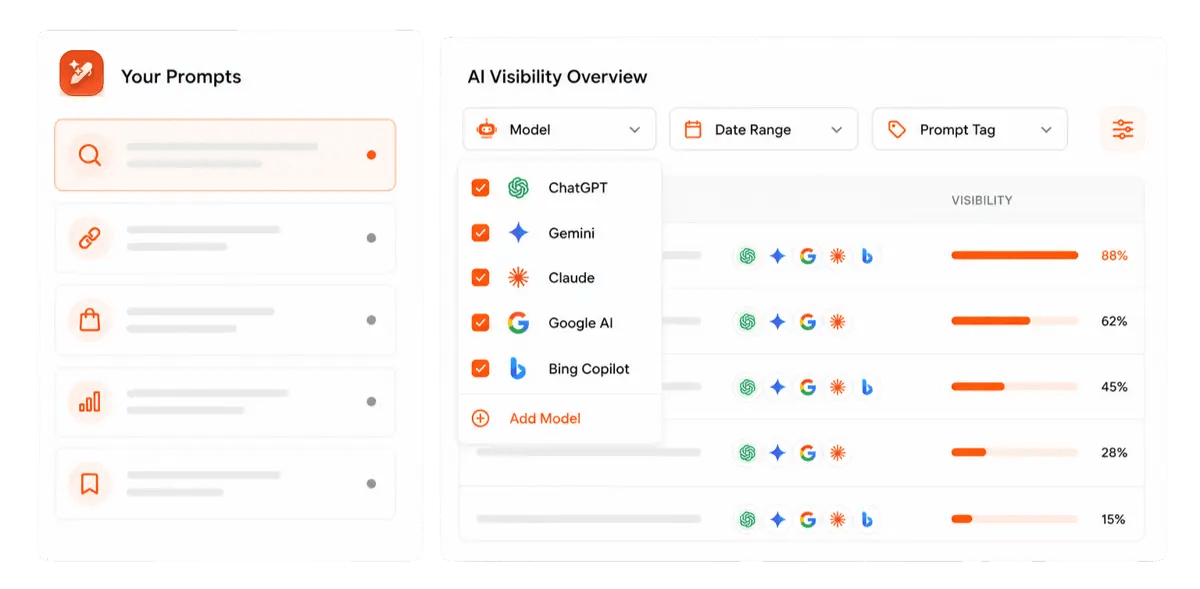
Find your brand in AI search

Track AI citations, share of voice, and brand sentiment
Find the top sources driving citations
#3: Do you need it integrated with your existing tools?
If your team runs on Semrush, the AI Toolkit removes friction. But if you’re in Ahrefs, Brand Radar keeps data in one place. If you need to feed visibility data into a BI pipeline, you need API access (Peec, Scrunch, Profound, and Ahrefs all offer this).
#4: What’s your prompt volume?
Per-prompt pricing models look affordable at the base tier and scale steeply once you start tracking a real brand across multiple topics, geographies, and customer personas.
Map out how many prompts you actually need and calculate the real cost at that volume before you commit.
#5: What’s your team size and technical capacity?
Contentpen, Otterly AI, Peec AI, and ZipTie are all designed to be usable without a dedicated analyst.
Profound and Scrunch are built for teams with technical resources and dedicated AEO programs. Know which situation you’re in before you choose your AI visibility tool.