 21 minutes
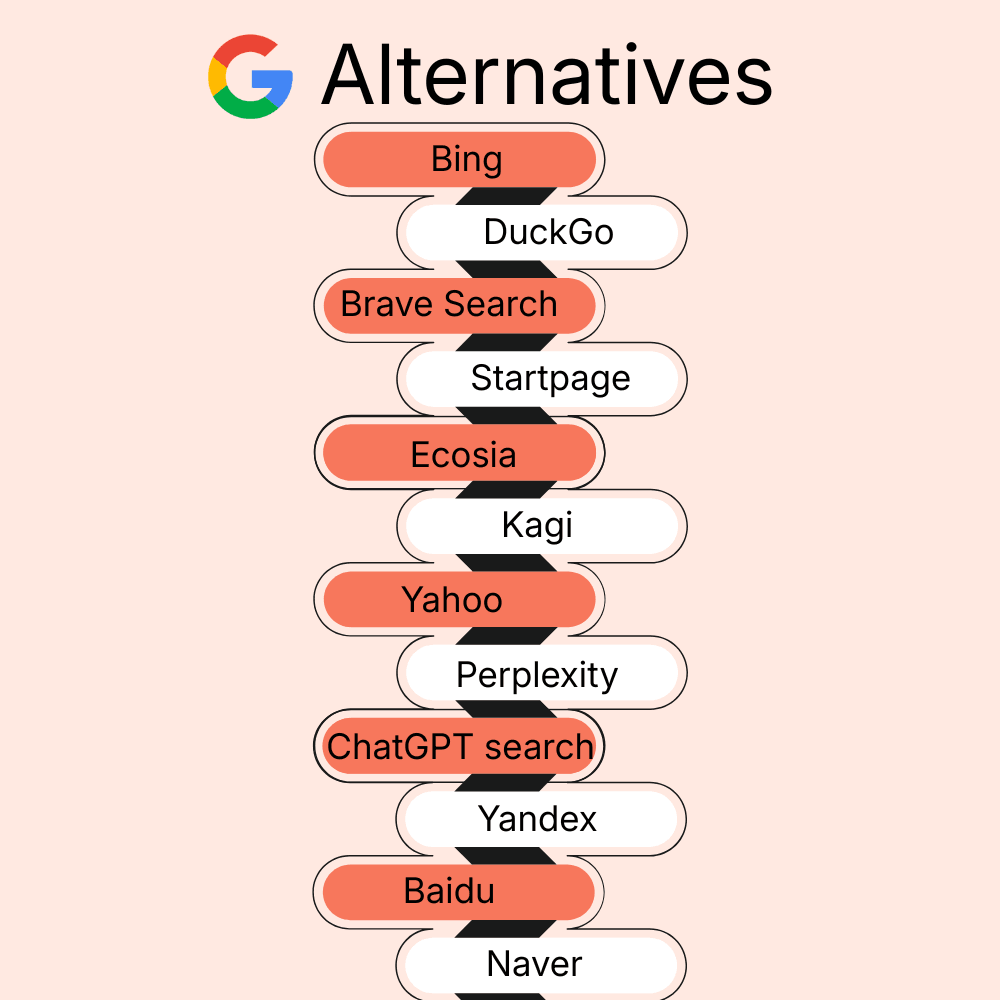
The best search engines other than Google are Bing, DuckDuckGo, Brave Search, Startpage, and Ecosia for everyday searching. Perplexity and ChatGPT search work better when you want a sourced answer instead of ten links. For regional results, Baidu, Yandex and Naver still lead their home markets.
The right pick comes down to what you want more of: privacy, fewer AI summaries, a cleaner results page, or answers with citations.
Plenty of people only started looking after Google went AI-first in 2026. You type a simple question and get a long summary, a few ads, and the actual websites pushed far down the page. Add Google’s AI Overviews and personalized tracking to the mix, and “just Google it” stops feeling simple.
The good part? You have more real choices today than at any point in the last decade. Below you’ll find 15 engines worth trying, who each one suits, what really powers their results, and how to switch your default in under a minute.
Table of contents
- Key takeaways
- Which search engine should you use instead of Google?
- Who actually powers the results?
- The best search engines other than Google in 2026
- Are there search engines other than Google without AI?
- Which search engines don’t track you?
- How to change your default search engine
- Why marketers should care about search beyond Google
- Track your visibility across AI search with Contentpen
- Picking a search engine that fits how you search
- Frequently asked questions
Key takeaways
- Google still handles about 90% of searches worldwide, but Bing, Yahoo, Yandex, DuckDuckGo and Baidu make up most of the rest.
- Many “alternative” engines borrow results from Bing or Google. Brave Search, Mojeek and Kagi are among the few with their own index.
- DuckDuckGo, Startpage and Brave Search are the easiest privacy upgrades for most people.
- If you want search without AI, DuckDuckGo now offers a dedicated no-AI version.
- Perplexity and ChatGPT search are answer engines. They are great for research, but you still need to check their sources.
- For brands, visibility on Bing and AI engines now matters almost as much as ranking on Google.
Which search engine should you use instead of Google?
Short on time? Match your main reason for leaving Google to the engine below.
| If you want… | Try this | Why |
|---|---|---|
| Results closest to Google | Bing | Large own index, strong image and video search |
| Privacy with zero setup | DuckDuckGo | No search history tied to you, simple interface |
| Google results without Google tracking | Startpage | Fetches Google results on your behalf |
| An independent index | Brave Search or Mojeek | Results not rented from Google or Bing |
| No ads, more control | Kagi | Paid, ad-free, lets you boost or block sites |
| Search that does some good | Ecosia | Profits fund tree planting |
| Sourced AI answers | Perplexity | Cites sources next to every answer |
| Search inside a chatbot | ChatGPT search | Web results inside your ChatGPT chat |
| A family-safe default | Swisscows | Filters adult content by default |
| Chinese, Russian or Korean results | Baidu, Yandex, Naver | Built for local language and local services |
Who actually powers the results?
This part surprises most people. A search engine has two layers: the index (the giant library of pages it has crawled) and the interface you see. If you want a quick refresher on crawling and ranking, here’s how search engines work.
Only a few companies run a full web index. Many popular engines rent results from Bing or Google and add their own privacy or design layer on top. DuckDuckGo, for example, says its traditional links and images come largely from Bing, alongside its own crawler and specialist sources.
| Search engine | Main results source | Own index? |
|---|---|---|
| Bing | Microsoft | Yes |
| Brave Search | Brave | Yes |
| Mojeek | Mojeek | Yes |
| Yandex | Yandex | Yes |
| Baidu | Baidu | Yes |
| Naver | Naver | Yes |
| Kagi | Own index plus third-party sources | Partly |
| DuckDuckGo | Mostly Bing, plus its own crawler | Partly |
| Qwant | Bing plus its own work | Partly |
| Yahoo | Bing | No |
| Ecosia | Bing and Google | No |
| Startpage | No |
Why does this matter? If you leave Google but land on an engine that serves Google results, you change the privacy story, not the results. Want a truly different view of the web? Pick something with its own index.
The best search engines other than Google in 2026
Google held 89.94% of worldwide search in September 2026, according to StatCounter. Bing came second at 5.29%, followed by Yahoo (1.36%), Yandex (1.30%), DuckDuckGo (0.74%) and Baidu (0.44%). Small numbers, sure. But each one still serves millions of people every day.
Here’s how the top 15 stack up.
How we picked these engines: every option below is actively maintained in 2026 and works in English or leads a major market. We looked at where results come from, privacy practices, AI features, pricing and how useful each one is for a specific job. Dead or shady engines that still clutter older lists didn’t make the cut.
1. Bing
Bing is the biggest search engine after Google and the only other Western engine with a web index on a similar scale. In the US, it handled 9.89% of searches in September 2026, per StatCounter’s US data. If you want results that feel familiar without using Google, start here.
Quick facts: owned by Microsoft · launched 2009 · own index · free
What stands out:
- Copilot built in: Ask a follow-up question and Copilot answers with linked sources, right beside the regular results.
- Image and video search: Large previews, hover-to-play video thumbnails, and visual search that lets you search with a photo.
- Microsoft Rewards: You earn points for searching, which you can trade for gift cards or Xbox credit.
- Deep Microsoft ties: Results, Copilot and your Microsoft account work together across Windows, Edge and Office.
Where it falls short: the results page can feel busy, with shopping modules, news carousels and Microsoft promotions. If you’re curious how its AI side compares, see our Copilot vs ChatGPT breakdown.
For marketers: Bing’s index also feeds Yahoo, DuckDuckGo, and Ecosia. Verifying your site in Bing Webmaster Tools and turning on IndexNow helps new pages get indexed faster across all of them.
2. DuckDuckGo
DuckDuckGo is the default choice for people who want privacy without changing how they search. It doesn’t save your search history or build a profile of you, and the layout looks a lot like Google’s. In the US, it held 1.75% of the market in September 2026, more than double its global share.
Quick facts: founded in 2008 by Gabriel Weinberg · based in Pennsylvania, USA · mostly Bing results plus its own crawler · free
What stands out:
- Bangs: Type a shortcut before your query to search another site directly. !w searches Wikipedia, !a searches Amazon, and !yt searches YouTube. There are thousands of them.
- Search Assist: Short AI answers appear for some questions, and you can switch them off in settings.
- Duck.ai: A private chat page where you can talk to several AI models without an account. DuckDuckGo says chats aren’t used to train models.
- A full privacy toolkit: Its browser blocks trackers, and Email Protection strips trackers from emails sent to your inbox.
Where it falls short: local results are less tailored because it doesn’t know much about you. You may need to add a city name to get nearby restaurants or services.
For marketers: DuckDuckGo has no webmaster console of its own. Rank well on Bing, and you’ll usually rank well here.
3. Brave Search
Brave Search is the fastest-growing independent engine on this list. It handled 2.46 billion queries in July 2026 and joined Chrome’s list of default search engine options that month, as reported by PPC Land. Earlier company disclosures put its index at more than 35 billion pages.
Quick facts: owned by Brave Software · launched 2021 · own index · free
What stands out:
- Its own index: Results aren’t rented from Google or Bing, so you get a genuinely different set of links for many queries.
- Goggles: Custom rules that re-rank results. You can favor personal blogs, hide big media sites or focus on tech sources.
- Discussions: Forum and Reddit threads appear in their own block, which is handy for honest product opinions.
- Answer with AI: AI summaries with sources appear at the top, and you can turn them off.
Where it falls short: image, video, and map results are thinner than on Google or Bing. Very local or niche queries can also return fewer useful pages.
For marketers: Brave sells access to its index through the Brave Search API, which many AI apps use. Showing up in Brave Search can quietly put your pages in front of AI tools too.
4. Startpage
Startpage gives you Google’s results without handing Google your data. It sends your query to Google on your behalf, strips out identifying details, and shows you the results. It hasn’t logged user IP addresses since 2009.
Quick facts: started as Ixquick in 1998 · based in The Hague, Netherlands · Google results · free
What stands out:
- Google-quality results: You get the same core links, just without personalization or a tracking profile.
- Anonymous View: Open any result through Startpage’s proxy so the site you visit can’t see your IP address.
- Dutch and EU privacy law: Being based in the Netherlands means GDPR protections apply to how it handles data.
- No filter bubble: Everyone sees the same results for the same query, which is useful for research.
Where it falls short: you lose Google’s extras, like rich maps, flight tools, and deep shopping panels. Some privacy fans also point out that System1, an advertising company, has held a majority stake since 2019.
For marketers: your Google rankings carry over here, minus personalization. There’s nothing extra to optimize.
5. Ecosia
Ecosia turns everyday searches into climate funding. The Berlin company puts its profits into tree planting and renewable energy, and it publishes monthly financial reports so anyone can check where the money goes. On average, it plants 48,000 trees a day, and its homepage counter only shows trees it has verified in the ground.
Quick facts: founded in 2009 by Christian Kroll · based in Berlin, Germany · results from Google and Bing, plus its own European index · free
What stands out:
- It can’t be sold for profit: In 2018, the founders gave up the right to sell the company or take profits out of it.
- Solar-powered search: Ecosia has built its own solar plants since 2017 and runs its servers on renewable energy.
- A European index in the making: Its joint index with Qwant started serving part of its results in 2025.
- Familiar results: Because it draws on Google and Bing, quality rarely feels like a step down.
Where it falls short: advanced filters and extras are limited. You also see ads, since that’s how the trees get funded.
For marketers: Ecosia’s audience skews eco-conscious and European. Ranking on Google and Bing covers most of your visibility here.
6. Kagi
Kagi flips the usual model. Instead of showing ads, it charges a subscription, so its only job is to give you good results. Plans start at $5 a month for 300 searches, and unlimited searching costs $10 a month, according to Kagi’s plan page.
Quick facts: founded by Vladimir Prelovac · based in the USA · own index plus third-party sources · paid, with a 100-search free trial
What stands out:
- You control the rankings: Raise, lower, pin, or block any website, and those choices apply to every future search.
- Lenses: One click narrows results to forums, academic papers, programming sites, or anything you define.
- Small Web results: Kagi surfaces independent blogs and personal sites that big engines often bury.
- Built-in AI tools: Kagi Assistant and a summarizer that condenses any page or video, available when you ask.
Where it falls short: it costs money, and the free trial runs out fast. If you only search a few times a day, a free private engine may be enough.
For marketers: Kagi’s audience is small but full of developers and power users. Because users can block domains, thin or spammy pages lose visibility fast.
7. Yahoo
Yahoo is less a search engine and more a content hub with search attached. Its results come from Bing, so they look similar. Still, it handled 2.64% of US searches in September 2026, more than DuckDuckGo.
Quick facts: owned by Apollo Global Management · based in the USA · Bing results · free
What stands out:
- Yahoo Finance: One of the most-used free sources for stock quotes, portfolios, and market news.
- News and sports in one place: Headlines, scores, and search share one homepage.
- Yahoo Mail integration: Handy if your inbox already lives there.
Where it falls short: the homepage is crowded with ads and news. If you want a clean search box, this isn’t it.
For marketers: Yahoo audiences tend to be older and finance-minded. Bing Webmaster Tools covers your Yahoo visibility too.
8. Mojeek
Mojeek is proof that a small team can still build a search engine from scratch. It runs its own crawler, MojeekBot, and its index passed 9 billion pages in 2025, according to Mojeek’s about page. It has offered search without tracking for more than 15 years.
Quick facts: based in Brighton, UK · own index · free
What stands out:
- Truly independent results: No Google, no Bing, no Yandex under the hood.
- No personalization: Everyone sees the same ranking, so results aren’t shaped by your past clicks.
- Focus: Search only within a set of sites you choose, such as news outlets or documentation.
- Optional summaries: A short Search Summary is available, but the classic link list stays front and center.
Where it falls short: the index is far smaller than Google’s or Bing’s. Fresh news, local businesses, and very new pages can be missing.
For marketers: make sure your robots.txt doesn’t block MojeekBot. Mojeek’s users actively look for independent sites, which can favor small brands.
9. Qwant
Qwant is France’s homegrown search engine and one of Europe’s main privacy options. It doesn’t track searches or sell personal data. Together with Ecosia, it co-owns the European Search Perspective, a joint venture building a shared European index, as Verdict reported.
Quick facts: launched 2013 · based in Paris, France · Bing results plus a growing European index · free
What stands out:
- EU-based and GDPR-first: Your data stays under European privacy rules.
- Strong French and German results. The new European index focuses on these languages first.
- Qwant Junior. A separate, filtered version built for children and schools.
Where it falls short: English-language results can feel less complete than Bing’s or Google’s. Feature updates also roll out more slowly.
For marketers: worth watching if you target France or Germany. As the European index grows, ranking there may depend less on Bing.
10. Swisscows
Swisscows is built with families in mind. It removes explicit results entirely, and that filter can’t be switched off. Its servers sit in data centers under the Swiss Alps, outside both the EU and the US.
Quick facts: launched 2014 · based in Switzerland · Bing results plus its own German-language index · free
What stands out:
- Family-safe by design: Adult and violent content is filtered out for everyone.
- Swiss privacy: Searches aren’t stored, and Swiss data laws apply.
- Extra tools: Music search, a translator, and TeleGuard, a private messaging app, come from the same company.
Where it falls short: the always-on filter can block legitimate medical or health pages. Adults doing serious research may find it too strict.
For marketers: family, education, and kid-focused brands can benefit here. Keep content clean, as borderline pages may simply not appear.
11. Perplexity
Perplexity is the go-to answer engine for research. Instead of a list of links, it writes an answer and places numbered sources right beside it. It now handles an estimated 1.2 to 1.5 billion queries a month and has more than 100 million monthly users, according to Index.dev’s Perplexity statistics.
Quick facts: launched in 2022 · based in San Francisco, USA · its own crawler plus live web search · free, with paid Pro and Max plans
What stands out:
- Cited answers: Every claim links to a source, so you can check it in one click.
- Follow-up questions: It keeps context, so you can dig deeper without rewriting your whole question.
- Deep Research: Pro users can run longer searches that read hundreds of sources and return a structured report.
- Spaces: Group related searches, upload your own files, and share a research space with your team.
- Comet: Its own AI browser, now free, can browse and complete tasks for you.
Where it falls short: answers sometimes misread or overstate a source. Click through for anything medical, legal, or financial. Curious how it stacks up? See how Perplexity compares with ChatGPT.
For marketers: PerplexityBot needs to be able to crawl your site. After that, clear answers, original data, and strong third-party mentions decide whether you get cited.
12. ChatGPT search
ChatGPT search brings live web results into the chatbot hundreds of millions of people already use. OpenAI launched it in October 2024 and later opened it to free users. When a question needs fresh information, ChatGPT searches the web and links to the pages it used.
Quick facts: owned by OpenAI · launched 2024 · live web search with its own crawler (OAI-SearchBot) · free, with paid plans
What stands out:
- Search inside a conversation: Ask a question, then refine it with follow-ups like “only show options under $500.”
- Inline citations and a sources panel: You can see exactly which pages shaped the answer.
- Shopping and local results: Product cards, prices, and maps appear for buying and “near me” questions.
- Great for multi-step questions: Comparisons, planning and “explain this to me” searches are where it shines.
Where it falls short: it’s slower than a classic engine for quick lookups like a website’s login page. Answers can also blend what it already knows with what it found, so check the links.
For marketers: allow OAI-SearchBot in your robots.txt, or your pages can’t appear in ChatGPT search results. Pages that answer questions directly are the ones it tends to cite.
13. Yandex
Yandex is Russia’s dominant search engine, with 70.33% of the Russian market in September 2026, per StatCounter’s Russia figures. Outside Russia, people mostly use it for one thing: reverse image search.
Quick facts: launched in 1997 · based in Moscow, Russia · own index · free
What stands out:
- Reverse image search: It’s widely used to trace where a photo came from or find similar faces and products.
- Russian-language depth: Results understand Russian grammar and local sites far better than Western engines.
- A full ecosystem: Maps, taxi, email, the Alice voice assistant, and AI answers all sit under one account.
Where it falls short: results follow Russian regulations, so news and political topics are filtered. Privacy-minded users outside Russia should also think twice.
For marketers: if you target Russian-speaking audiences, set up Yandex Webmaster. It reports indexing and search queries much like Google Search Console.
14. Baidu
Google is blocked in mainland China, and Baidu is the search engine most Chinese users rely on instead. It held 46.65% of China’s search market in September 2026, according to StatCounter’s China data.
Quick facts: founded in 2000 by Robin Li · based in Beijing, China · own index · free
What stands out:
- Baidu Baike: China’s largest online encyclopedia, which often ranks at the top.
- Baidu Tieba: Huge community forums that show what Chinese users actually think.
- ERNIE AI answers: Baidu’s own AI model writes summaries for many queries.
- Maps and local services: Essential for anyone living in or traveling to China.
Where it falls short: results are censored and heavy on ads and Baidu’s own properties. It’s built for Simplified Chinese, so English searches are weak.
For marketers: Baidu favors Simplified Chinese content hosted in mainland China, which usually requires an ICP license. Baidu’s webmaster platform helps you submit and monitor pages.
15. Naver
Naver is South Korea’s homegrown giant and runs neck and neck with Google there. In September 2026, Naver held 43.06% of Korean searches against Google’s 47.97%, per StatCounter’s South Korea data.
Quick facts: launched in 1999 · based in Seongnam, South Korea · own index · free
What stands out:
- A portal, not a link list: Results are split into blocks like blogs, cafés (community forums), news, shopping, and video.
- Knowledge iN: A massive Q&A community that often answers questions before websites do.
- Naver Blog content: User-written blog posts rank heavily, especially for reviews and recipes.
- Papago: Its own translator, popular for Korean, Japanese, and Chinese.
Where it falls short: it’s built for Korean speakers, so English results are limited. Its own content blocks also push external websites further down.
For marketers: register with Naver Search Advisor and consider a Naver Blog presence. In Korea, Naver often decides whether people find you at all.
Bonus: specialist tools worth bookmarking
Some searches don’t need a general engine at all. These tools do one job better than anyone:
| Tool | Use it for | Example search |
|---|---|---|
| WolframAlpha | Math, unit conversions and data | “Distance from Earth to Mars today” |
| Openverse | Free-to-reuse images and audio | “Mountain sunrise” with a commercial-use filter |
| Wayback Machine | Old versions of websites | A competitor’s homepage from 2020 |
| Semantic Scholar | Academic papers | “Large language models in education” |
Are there search engines other than Google without AI?
Yes, and demand for them is climbing fast. After Google announced its AI-first search revamp in May 2026, traffic to DuckDuckGo’s no-AI search page tripled in a single day, TechCrunch reported. DuckDuckGo then released browser extensions to make that version the default.
If you want classic blue links and nothing else, these are your best bets:
- noai.duckduckgo.com: regular DuckDuckGo with Search Assist, Duck.ai, and AI-generated images switched off
- Startpage: plain Google results with no AI summaries on top
- Mojeek: a simple, independent results page with no chatbot features
- Kagi: AI tools only appear when you ask for them
- Brave Search: AI answers can be turned off in settings
Would rather stay on Google? You can also turn off AI Overviews in Google with a few workarounds.
Which search engines don’t track you?
Privacy-first engines don’t tie searches to a personal profile or sell your history to advertisers. They still show ads, but those ads match your current query, not everything you’ve done online.
| Engine | Stores search history? | Ads | Based in |
|---|---|---|---|
| DuckDuckGo | No | Query-based | USA |
| Startpage | No | Query-based | Netherlands |
| Brave Search | No | Optional, privacy-preserving | USA |
| Mojeek | No | Minimal | UK |
| Swisscows | No | Query-based | Switzerland |
| Kagi | No | None (paid) | USA |
One caveat: your browser, internet provider, and the sites you visit can still track you. A private search engine helps a lot, but pair it with a privacy-focused browser for the full effect.
How to change your default search engine
Trying a new engine only sticks if it’s your default. Here’s how to set it up on the most common devices.
On Chrome (desktop)
- Open Chrome and go to Settings.
- Click Search engine in the left menu.
- Choose an engine from the dropdown, or open Manage search engines and site search to add a new one.
On Android
- Open the Chrome app and tap the three dots, then Settings.
- Tap Search engine.
- Pick Bing, DuckDuckGo, Yahoo, Ecosia or another listed option.
Prefer a home screen widget? Most engines, including DuckDuckGo and Brave, have their own Android apps.
On iPhone (Safari)
- Open Settings, then Apps, then Safari.
- Tap Search Engine.
- Select Bing, Yahoo, DuckDuckGo, or Ecosia.
Why marketers should care about search beyond Google
Here’s the part most lists skip. If people search in more places, your brand has to show up in more places too.
Bing is the obvious first step. It feeds results to Yahoo, DuckDuckGo, and Ecosia, so one set of rankings travels further than you’d expect. Setting up Bing Webmaster Tools and submitting your sitemap takes minutes.
AI engines are the bigger shift. When someone asks Perplexity or ChatGPT “what’s the best tool for X,” there’s no page two. You’re either cited in the answer, or you’re invisible.
That’s where answer engine optimization and generative engine optimization come in. A few habits help across every engine:
- Answer the main question in the first lines of each page
- Use clear, question-based headings and short paragraphs
- Back claims with cited stats and original data
- Earn mentions on forums and review sites that AI engines trust (think Reddit SEO)
- Keep important pages fresh so engines don’t drop them for newer sources
Track your visibility across AI search with Contentpen
Knowing which engines your audience uses is step one. Knowing whether those engines actually mention you is stepWhy marketers should care about search beyond Google two, and that’s hard to check by hand.
Contentpen’s AI visibility tracking tool monitors how seven AI engines talk about your brand: ChatGPT, Google AI, Gemini, Perplexity, Claude, Copilot, and Grok. Here’s what you can do with it:
- See your visibility score: the share of tracked AI answers that mention your brand
- Compare share of voice: your mentions against competitors for the same prompts
- Check sentiment: whether each engine describes you positively, neutrally, or negatively
- Find source gaps: sites that cite your competitors but not you, so you know where to earn coverage
From there, the gaps turn into content. Find the right terms with the keyword research tool, write the article, and check it against live SEO and AEO scoring before you publish. It’s one SEO and AEO tool for ranking on Google and getting cited everywhere else.
Picking a search engine that fits how you search
Google is no longer the only sensible default. Bing gives you familiar results with its own index, DuckDuckGo and Startpage make privacy effortless, and Brave Search or Mojeek show you a web that isn’t filtered through Big Tech.
Want answers instead of links? Perplexity and ChatGPT search earn a spot, as long as you check their sources. Searching in China, Russia, or Korea? Go local with Baidu, Yandex, or Naver.
You don’t have to pick just one. Set a default that matches your priorities, keep one or two others for specific jobs, and switch whenever your needs change.
Frequently asked questions
No. DuckDuckGo is an independent company founded by Gabriel Weinberg in 2008. It has no ownership ties to Google.
The well-known ones are. Be careful with unfamiliar “search engines” that appear after installing a free extension or app, as these are often browser hijackers that redirect your searches. If your default changes without your permission, remove recently added extensions and reset it.
No. Google Search and Google’s other apps are separate. You can search with another engine and still use your Google account for email, Maps, documents, and video.
Add site search shortcuts in your browser. In Chrome, you can assign a keyword like “p” to Perplexity, then type p plus a space in the address bar to search there. Your main default stays the same.
Your personal choice of search engine has no effect on how your site ranks or your SEO. What matters is where your audience searches. Check your analytics referral data to see how much traffic comes from Bing, DuckDuckGo, or AI tools like ChatGPT.
Mostly because it’s the default almost everywhere. Google pays browser makers and phone companies to be the preset search engine, and most people never change it. In 2024, a US federal judge ruled that Google illegally maintained its search monopoly, partly through these default deals.

Eeman Bokhari
Eeman Bokhari has over 9 years of experience in creating high-quality written content and more than 6 years of expertise in SEO and content marketing. She specializes in building search-first content strategies, aligning content with user intent, and driving sustainable organic growth for SaaS and B2B brands. Eeman’s work focuses on combining SEO insights, content systems, and performance data to create content that ranks, engages, and converts.
View all posts by this author