 23 minutes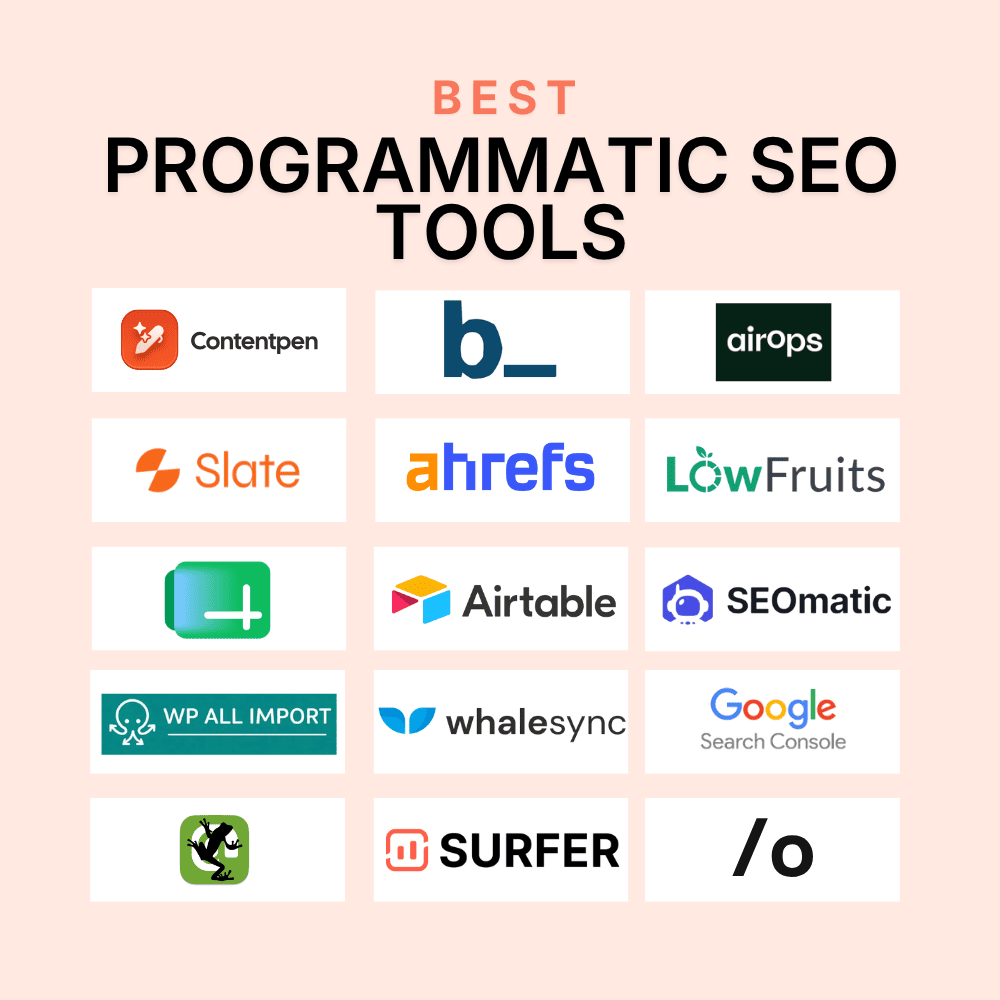
Programmatic SEO (pSEO) tools are software and platforms that turn structured data into hundreds or thousands of SEO-optimized pages. They help you automate the content-to-live-page workflow, reducing manual hand-offs.
The best programmatic SEO tools in 2026 depend on your needs. Contentpen is the best all-in-one pick for keyword-led pages, while tools like WP All Import suit data-led pages. Tools like Airtable are good for dataset building, and Screaming Frog keeps your pages healthy.
This guide compares 14 such pSEO tools across five jobs: content creation, keyword research, dataset building, page publishing, and monitoring, plus some bonus tools. By the end, you will see which option to pick and when.
Key takeaways
- The best programmatic SEO tools depend on where your page differences come from, either keyword research and writing or rows of structured data.
- Contentpen suits keyword-led pSEO because it handles research, writing, scoring, publishing, and post-publish monitoring in one workspace.
- Data-led pages need a dataset tool like Google Sheets or Airtable plus a publisher like SEOmatic or WP All Import.
- No tool fixes thin pages, so review a small batch by hand before you scale.
Defining programmatic SEO: How has it changed in 2026?
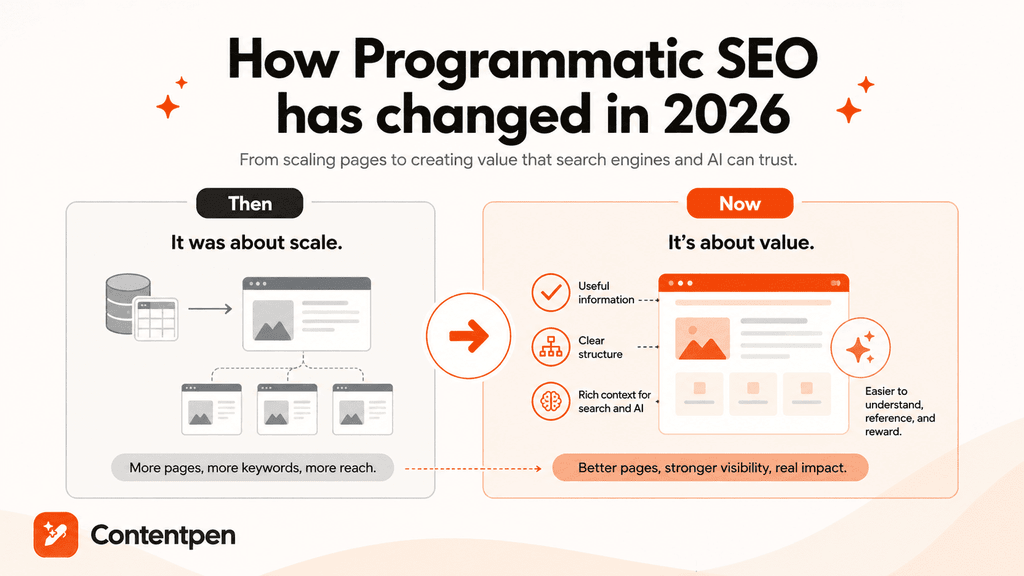
Programmatic SEO means building many keyword-targeted pages from a template and a data source. It started with a simple idea. Give a system structured data, build a reusable page template, and generate multiple pages without creating each one from scratch.
That basic idea still works. What has changed is that those pages need to do more once they are published.
Search is no longer limited to ten blue links. AI Overviews and other AI search experiences can extract information from web pages and use it to build direct answers.
This means programmatic pages need to be more than keyword-targeted variations of the same template. They need useful information, clear structure, and enough context for search engines and AI systems to understand and reference them.
So, the focus has shifted from how many pages you can publish to how much value each page adds.
What modern programmatic SEO tools should do?
A modern programmatic SEO tool should be able to handle much more than page generation. It should connect data sources, map search intent to templates, generate page content, add internal links and schema, publish to a CMS, and help manage indexing.
Some tools also support content refreshes and AI visibility tracking, bringing post-publishing work into the same workflow.
This makes programmatic SEO less of a page creation tactic and more of an end-to-end content system.
Why the human role still matters
Keep in mind that even though automation handles repetitive work at scale, it does not remove the need for human judgment.
Someone still needs to decide which pages are worth creating, whether the content adds something useful, and when a page should be refreshed or removed.
That is why the best programmatic SEO tools are not necessarily the ones that generate the most pages. They are the ones that give teams enough control to scale without turning their site into a collection of thin, repetitive URLs.
How did we choose the best programmatic SEO tools?
To enter a tool on our list, we reviewed its workflow, documentation, pricing, and product pages. We evaluated every tool against the same eight-point criteria:
| Criteria | What we looked for | Why it matters |
| Page uniqueness | Can each page differ through data, research, or both? | Near-identical pages are the fastest route to thin content |
| Quality controls | Review gates, brand voice training features, source grounding | Someone has to catch mistakes before they repeat across hundreds of pages |
| Technical SEO | Schema, canonicals, internal links, sitemaps, metadata | These need to be right on every page |
| Publishing | CMS integrations, scheduling, bulk publishing | We need quicker ways to make pages live |
| GEO and AEO readiness | Clear structure, scores, or AI visibility tracking | Pages also need to be cited in AI answers |
| Ease of use | Technical skill required to operate the tool | Onboarding and setting up workflows can be time-consuming |
| Cost | Pricing tier clarity | Enterprises, agencies, and teams need to purchase quickly and move fast |
| Maintenance | Content refresh and decay detection | Pages that aren’t maintained fade after launch |
Please keep this distinction in mind: Data-led pSEO builds pages from rows of facts, like store locations or product specs. Keyword-led pSEO builds pages from a keyword pattern, like “best AI for [use case]”, where each page gets its own research and writing.
Most tools pick one of the approaches, while some combine both (AirOps and Slate). We prefer keyword-led pSEO because each page gets its own research and writing, as long as someone reviews the output.
Top programmatic SEO tools compared in 2026
Below are the best pSEO tools compiled for content creation, keyword research, dataset building, publishing, and monitoring. The price chosen for the platforms is based on the programmatic SEO requirements in 2026.
| Tool | Best for | Price for pSEO | Standout feature |
| Contentpen | Keyword-led pSEO | $359/month for 150 AI articles | Unified content research, creation, optimization, publishing, and post-publish monitoring |
| Byword | High-volume articles | $249/month for 80 AI articles | Integrations with Zapier, Make, Airtable, Notion, and Slack |
| AirOps | Custom AI workflows | N/A | Setting up nodes according to business needs |
| Slate | AI search visibility tracking | $399/month for 1000 pages monitored | 24/7 AI agent monitoring |
| Ahrefs | Pattern recognition and competitor research | $374/month for 5,000 tracked keywords | Current and historical keyword and backlink data |
| LowFruits | Finding low-competition keywords | $62.45/month for 10,000 credits | Bulk SERP analysis to reveal weak spots |
| Google Sheets | Free starter dataset builder | Free, $19.99/month for AI features inside worksheets | Google AI access and formulas |
| Airtable | Relational, larger datasets | $20/seat/month for 25,000 automation runs | Interface designer for translating complex data to dashboards |
| SEOmatic | Dataset-to-page template creation | $208/month for 8M AI credits | Strong approval-based workflows |
| WP All Import | WordPress bulk imports | $299/year for import + export | Visual drag-and-drop data mapping |
| Whalesync | Two-way data syncing for Webflow or WordPress | $64/month for 5,000 records in sync | API rate-limiting handling |
| Google Search Console | Indexing and performance | Free | First-party data for page performance monitoring |
| Screaming Frog | Technical audits | Free up to 500 URLs, then $279/year | Comprehensive JavaScript crawling |
| Surfer SEO | Page-level optimization | $299/month for unlimited document optimizations | Bulk AI engine execution |
Now, let’s see each of these tools category-wise.
Best programmatic SEO tools for content creation
Tools in this category write or generate the page content and, in most cases, publish it too.
1. Contentpen
Best for: Keyword-led pSEO, where each page needs its own research, writing, publishing, and post-publish monitoring.
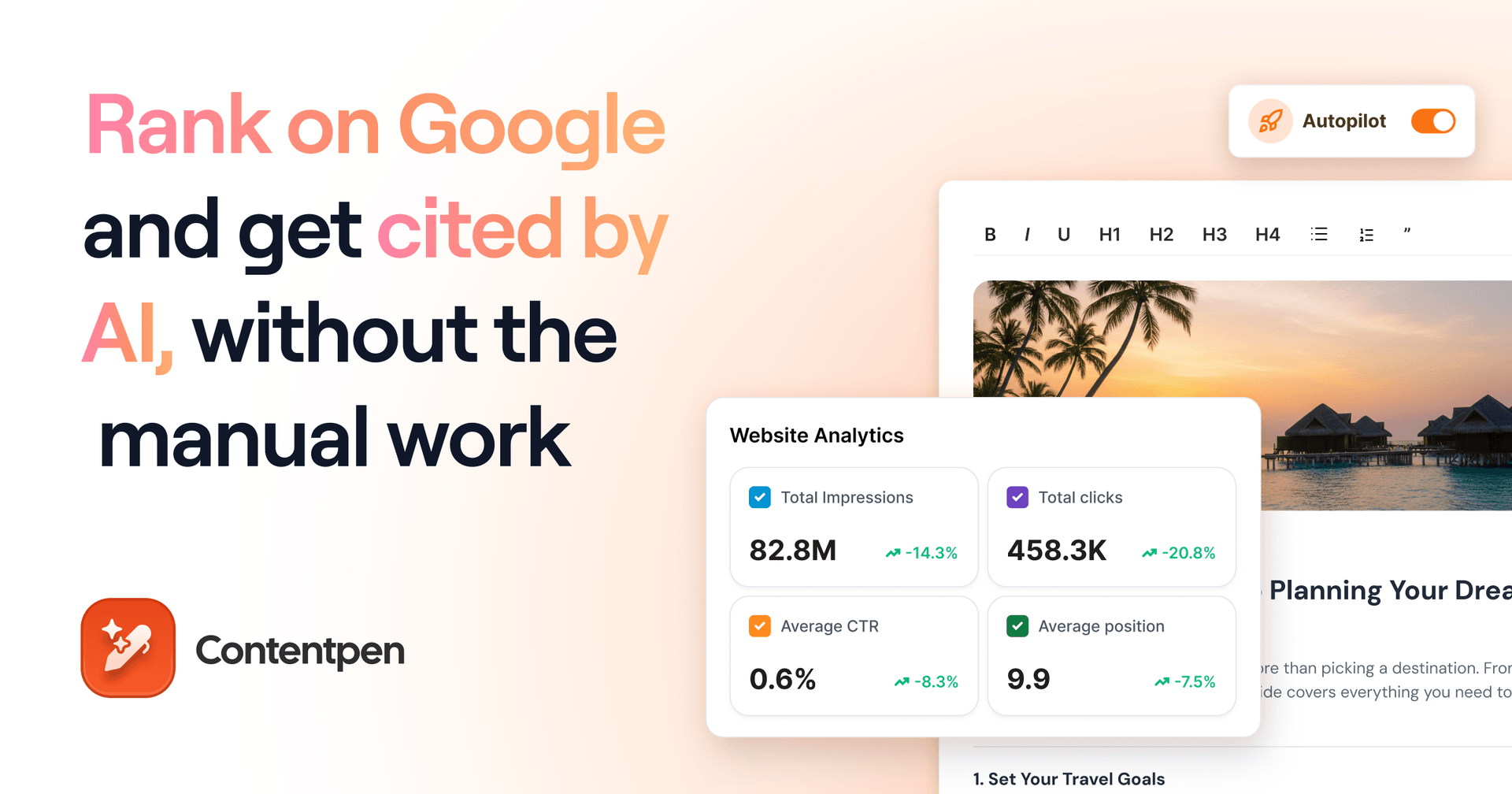
Contentpen is an SEO and AEO tool that takes you from keyword research to a published page in one workflow. Also, the AI visibility feature tracks your brand mentions, sentiment, and share of voice for ChatGPT, Grok, Copilot, Claude, Google AI, Gemini, and Perplexity AI models.
Key features:
- Keyword research and clustering: The platform helps you group a seed query into a repeatable pattern.
- SEO and GEO scoring: Every draft helps you get ranked on Google and win AI citations in chatbots like ChatGPT and Perplexity.
- SEO autopilot: Automates the entire keyword-to-publishing workflow with approval checkpoints you choose.
- Content decay monitoring: With the SEO opportunities dashboard, you get content refresh recommendations that you can apply with a click to sustain rankings and organic traffic on pages.
Limitation:
Contentpen is built around keyword-led content. Also, it doesn’t offer any backlinking data (if that’s your priority).
Pricing:
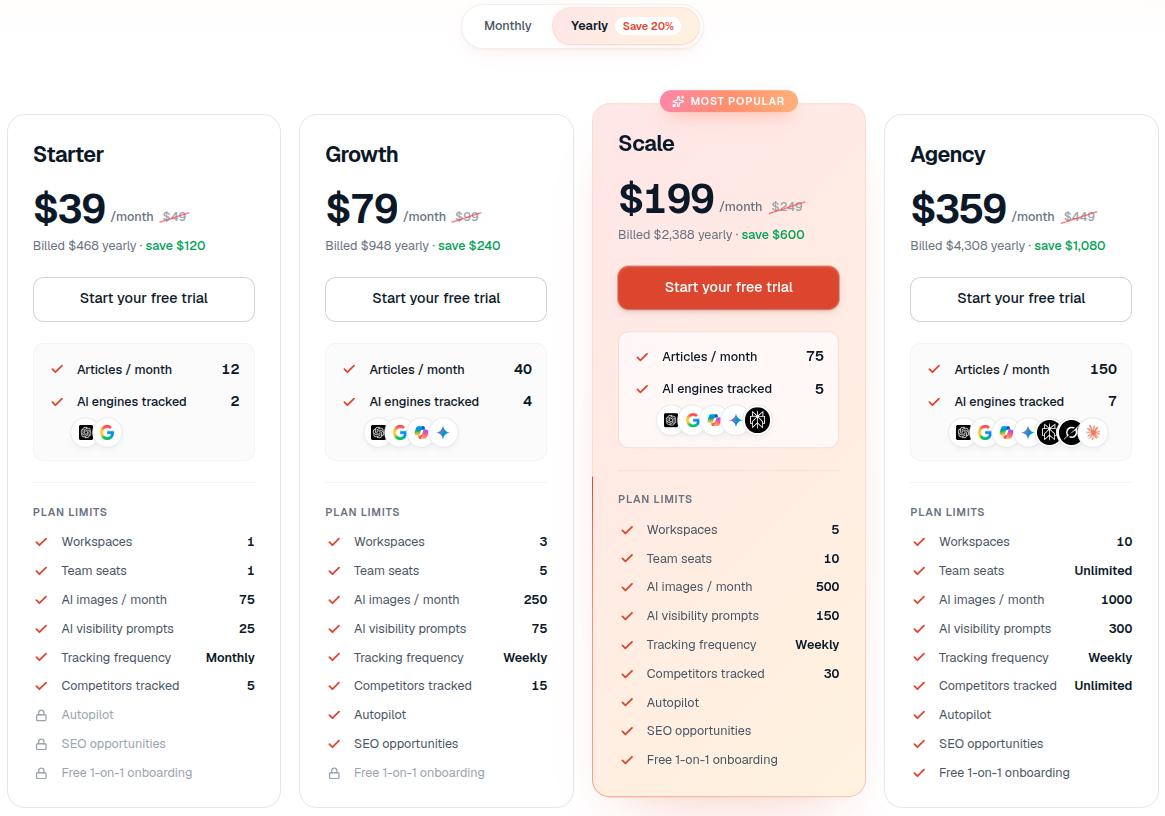
You can choose the Scale plan ($199/month, 75 AI articles, 500 AI images, 5 AI engines tracked) or the Agency plan ($359/month, 150 AI articles, 1000 AI images, 7 AI engines tracked). Sign up for the 7-day free trial to get started with pSEO today.
2. Byword
Best for: Teams that need a high volume of informational articles with direct CMS publishing.
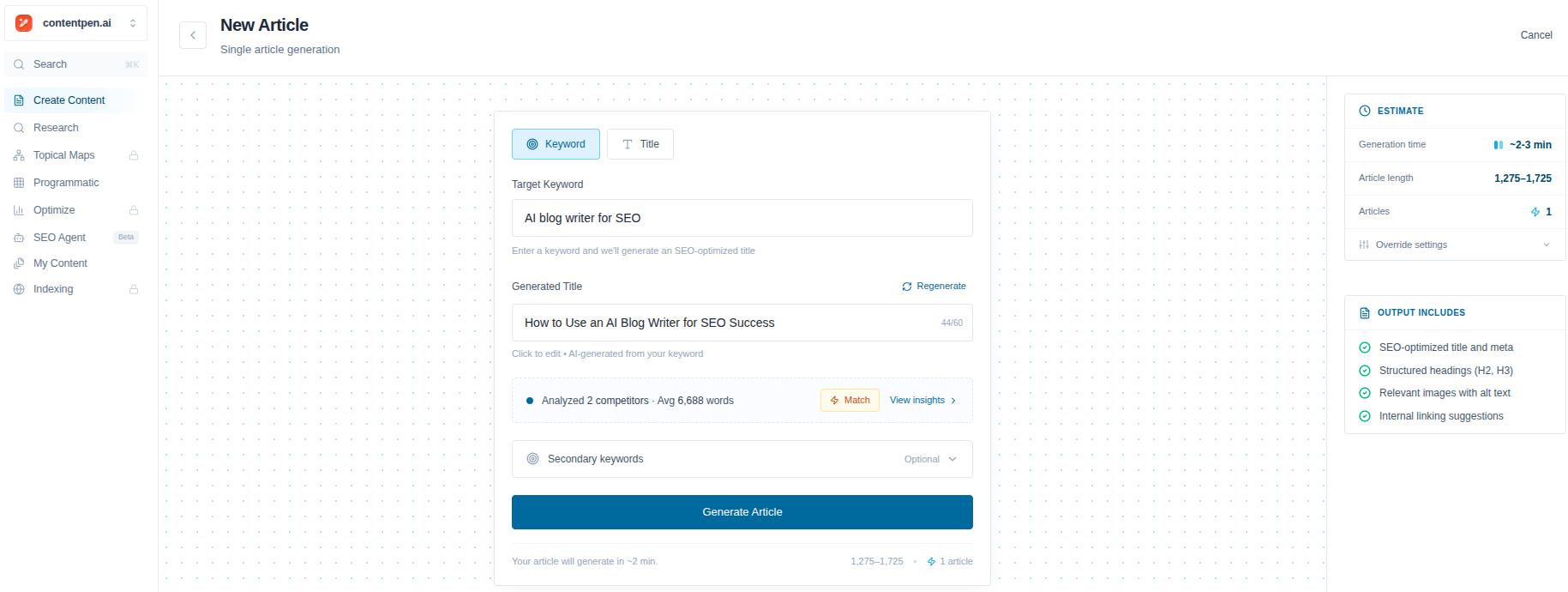
Byword generates long-form SEO articles in batches from a keyword list, with a builder that expands a title pattern into every keyword combination.
Key features:
- Keyword research and brand-voice article writing in one workflow.
- Native publishing to WordPress and Webflow.
- Scheduled batches so pages don’t all go live on the same day.
Limitation:
Byword has strict article-based credit caps, which may hinder your workflow. Also, the tool may place links to competitors in its one-shot generation mode.
Pricing:
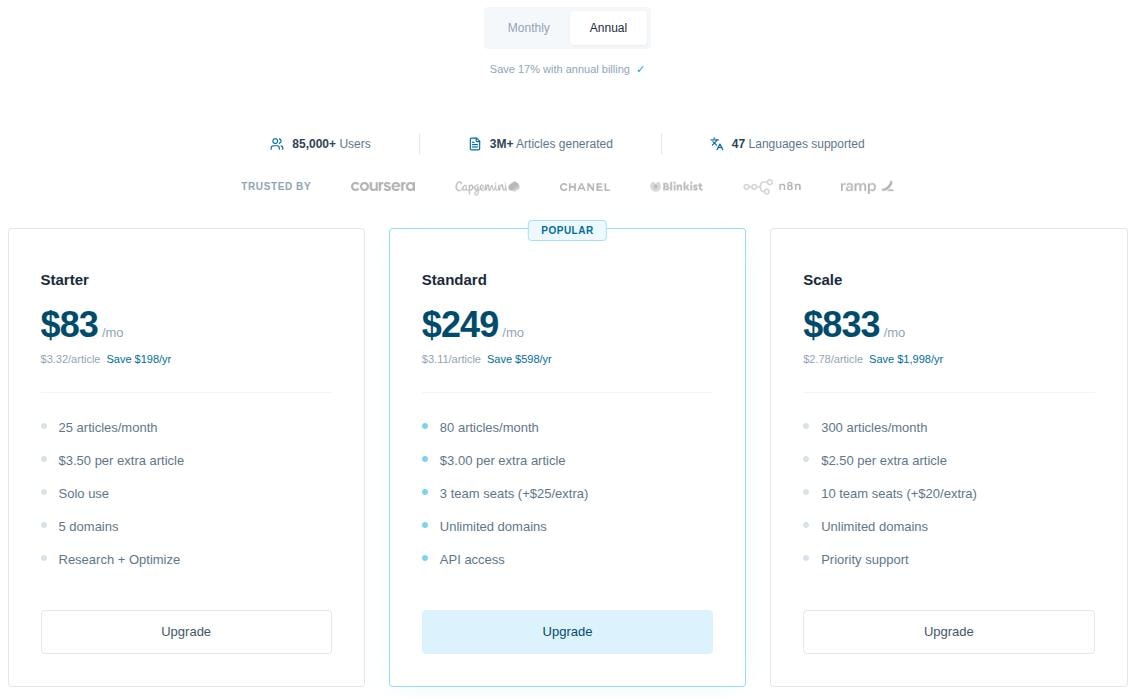
Byword pricing starts at $83/month (billed annually). However, you won’t be able to programmatically create pages with anything less than their Standard plan, which costs $249/month and provides 80 articles.
3. AirOps

Best for: Teams wanting to create custom content creation pipelines.
AirOps is a workflow platform where you set up your own writing, interlinking, image creation, and optimization nodes and run it across rows in a spreadsheet-style grid.
Key features:
- Visual workflow builder with a choice of AI models at each step.
- Brand Kits and Knowledge Bases to keep output on-brand.
- Grids that import from CSV, Search Console, Webflow, or WordPress.
- Publishing to 13 CMS platforms.
Limitation:
You assemble the workflow yourself, so setup takes longer as compared to other types of programmatic SEO tools.
Pricing:
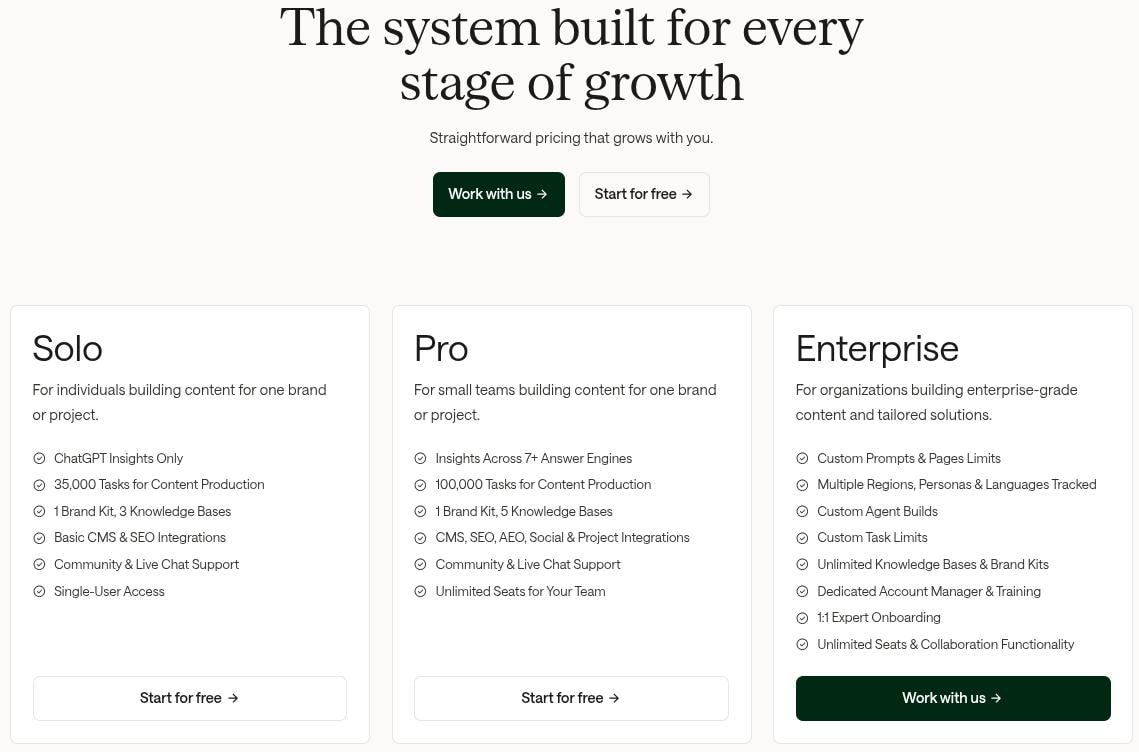
AirOps doesn’t quote transparent pricing publicly. You’ll have to contact their team to get a number.
4. Slate
Best for: Teams trying to program structured page types like integrations, comparisons, and glossary pages with AI visibility tracking.
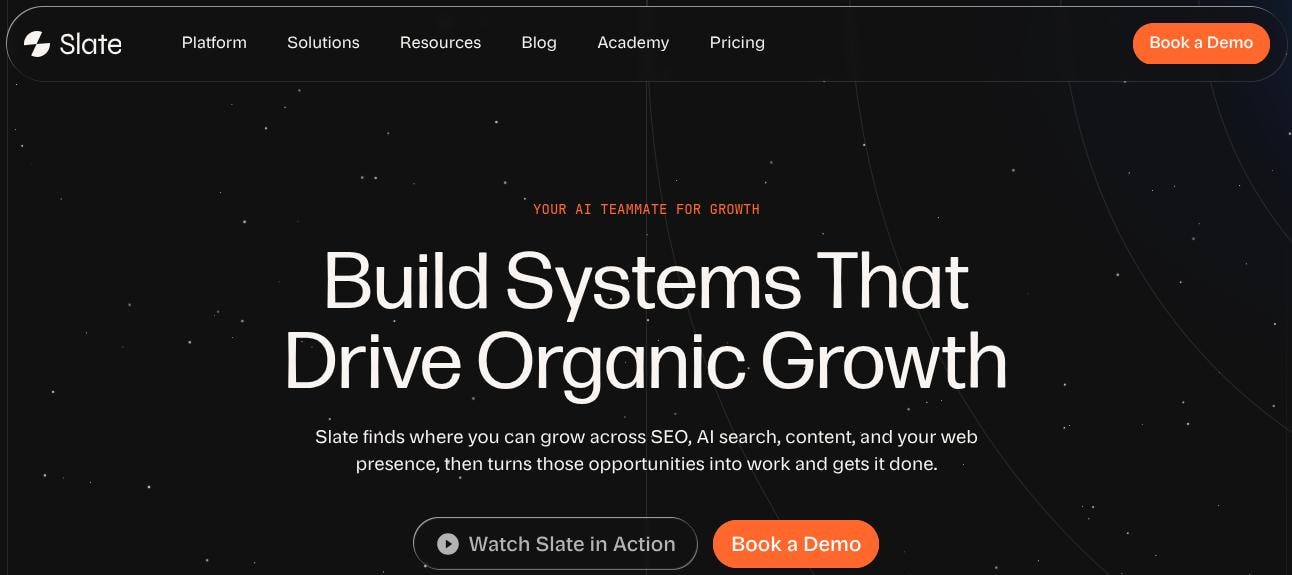
Slate is a marketing automation platform that combines workflows with AI search visibility tracking. It helps enterprises optimize for AI citations while scaling their content efforts.
Key features:
- AI search tracking across ChatGPT, Google AI Mode, Gemini, Google AI Overviews, Claude, and Perplexity.
- Power Sheets for bulk creation and refreshes across many URLs.
- Brand Kit and knowledge base for consistent output.
- Connects CMS, SEO data sources, analytics, and outreach tool stacks.
Limitation:
Despite a vast array of integrations, publishing is limited to Webflow, Sanity, and WordPress CMS platforms only.
Pricing:
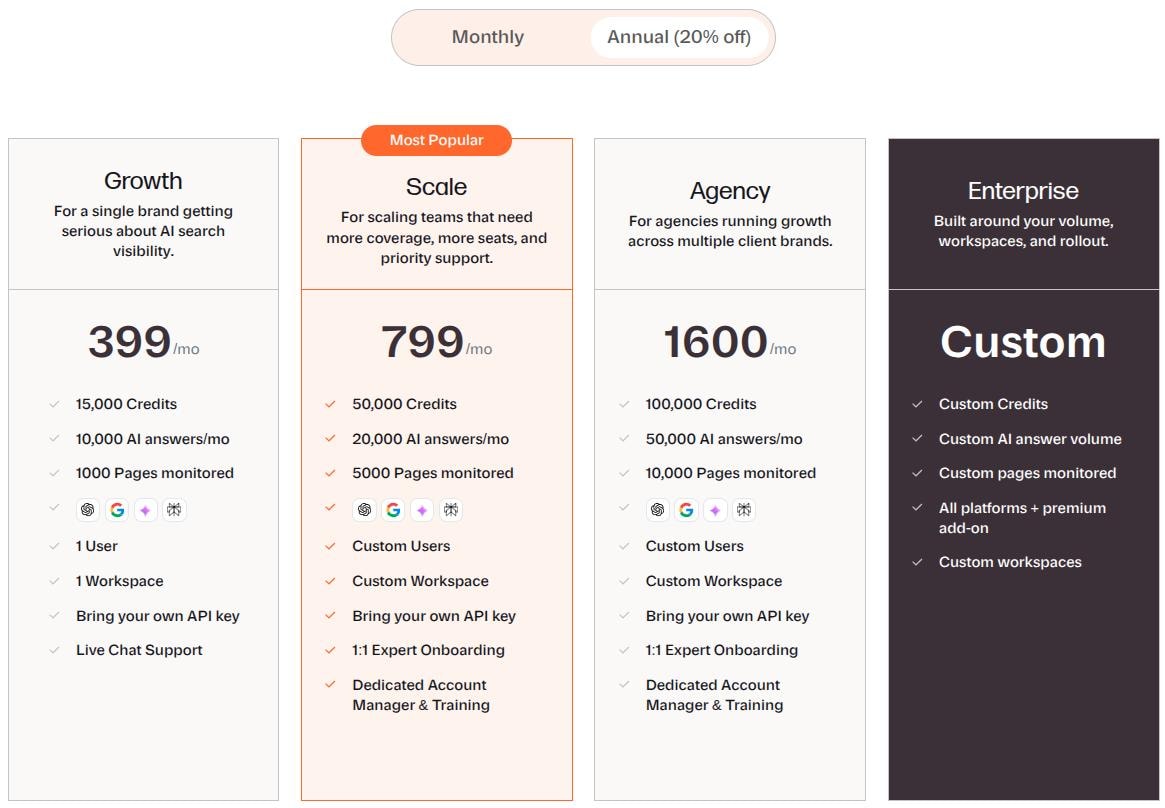
Slate pricing starts at $399/month (annual billing), which provides monitoring for 1000 pages, 15,000 AI credits, and 10,000 AI answers per month.
Best programmatic SEO tools for keyword research
Keyword research is an essential part of your programmatic SEO strategy. These tools ensure that you create pages with real search demand and not gut feeling.
5. Ahrefs
Best for: Validating a pattern before you build anything.
Ahrefs is a powerful SEO and AEO-focused platform for finding keyword patterns and reverse-engineering competitors.
Key features:
- The Keywords Explorer provides users with Matching Terms and Questions to expand a head term into every variation
- Ahrefs Site Explorer allows you to see which keywords your competitors are ranking for and where the gap lies.
- Bot Analytics provide a clear view if pSEO strategies are improving your AI traffic or not.
- Detailed current and historical data for organic keywords and traffic.
Limitation:
Ahrefs is an SEO research and audit tool, not a page generator. It does provide an AI content helper, but that’s not enough for programmatic content creation purposes.
Pricing:
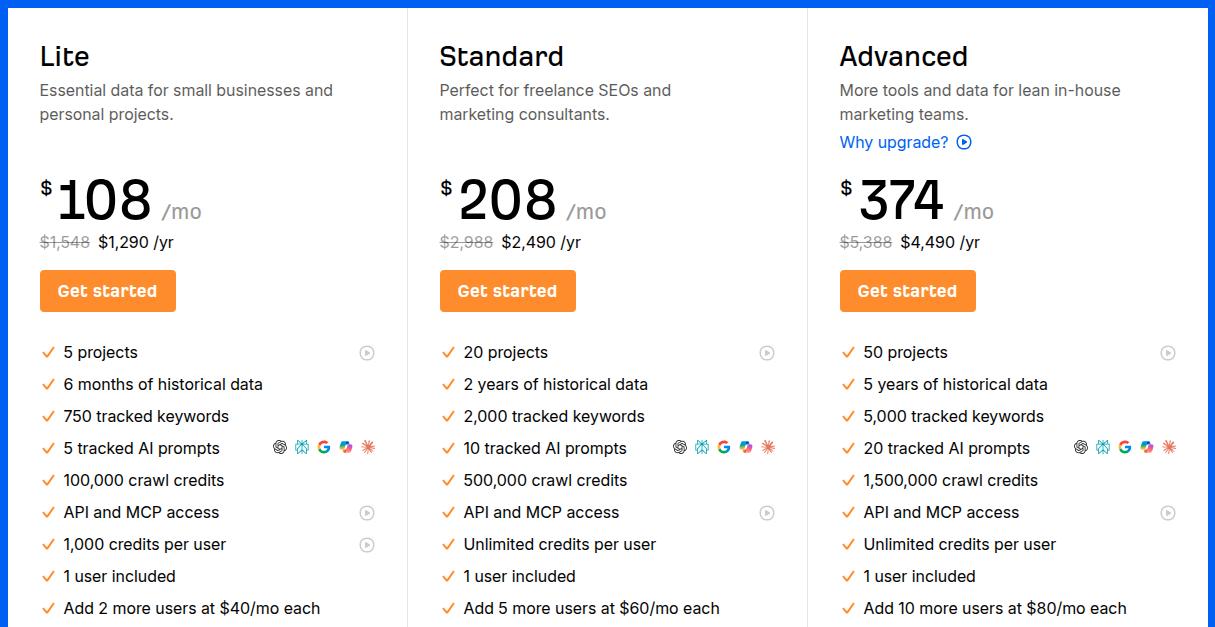
Pricing starts at $108/month. But you get the most value from the $374/month Advanced package that gives 5 years of historical data, 5,000 tracked keywords, and 20 tracked AI prompts.
6. LowFruits
Best for: Finding low-competition, high-opportunity keywords for new or low-authority sites.
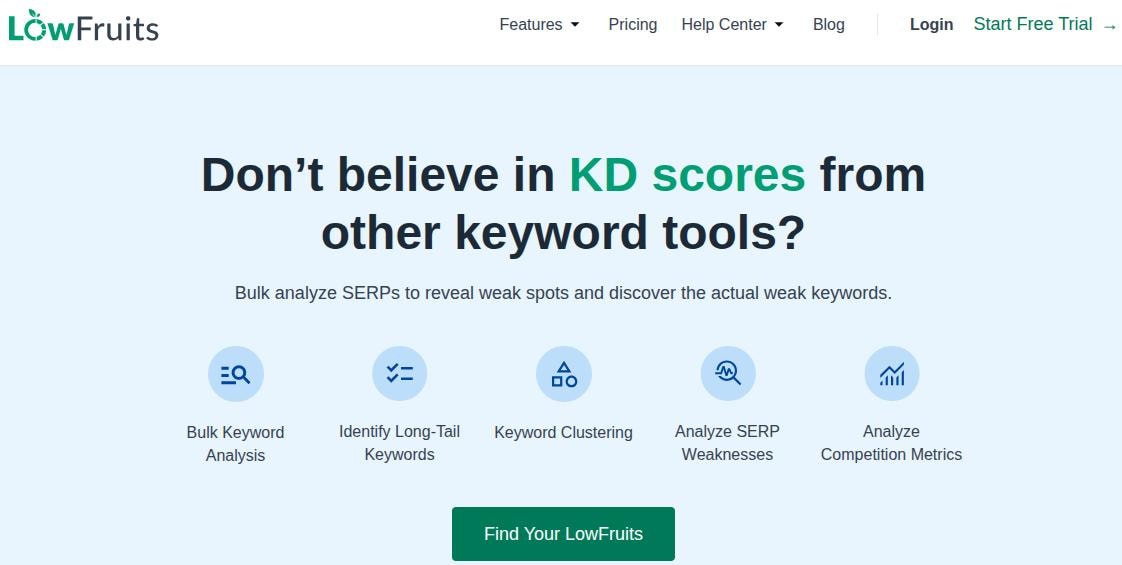
LowFruits is a keyword research tool that analyzes search results in bulk and shows where weak websites already rank in your niche. For pSEO, you can import a list of keyword variations and see which ones are actually winnable before you build any pages.
Key features:
- Bulk SERP analysis that highlights weak spots, like low-authority sites ranking on page one.
- Keyword clustering that groups terms with similar intent.
- Long-tail keywords pulled from Google, with wildcard (*) searches and intent filtering.
- Competitor keyword and sitemap extraction, so you can see what rivals rank for.
Limitation:
LowFruits is a research tool, not a content creator or publisher. It also doesn’t offer backlink data, and each keyword you analyze uses one credit, so large keyword lists can use up your plan quickly.
Pricing:
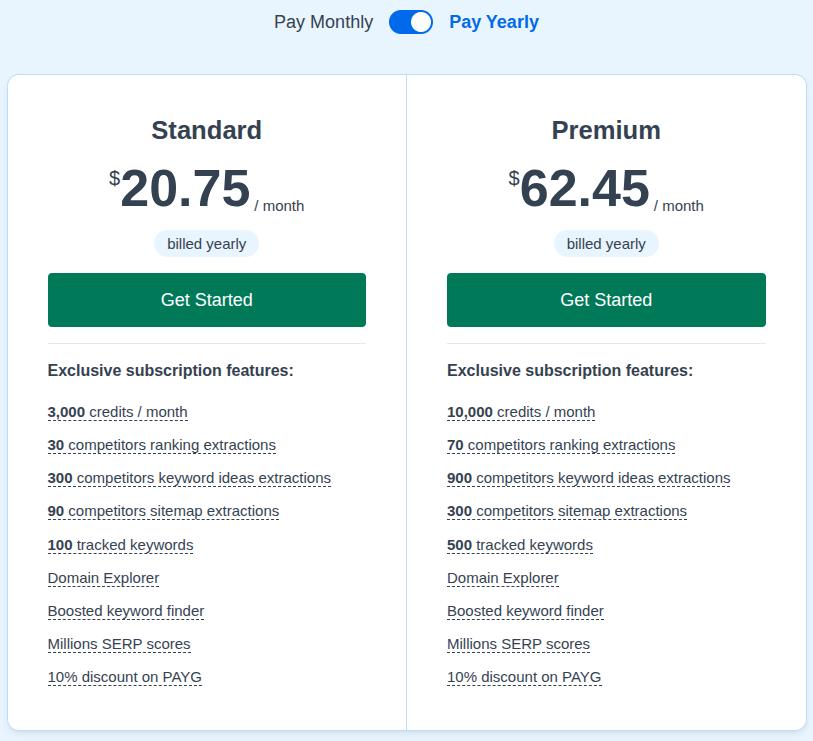
The Standard plan starts at $20.75/month for 3,000 credits, and the Premium plan costs $62.45/month for 10,000 credits and 500 tracked keywords. The Premium plan is the better fit for pSEO campaigns, since big keyword lists burn credits faster.
Best programmatic SEO tools for dataset building
Dataset building tools help you execute the keyword lists according to a content template for pSEO.
7. Google Sheets
Best for: SMBs and individuals learning how pSEO works.
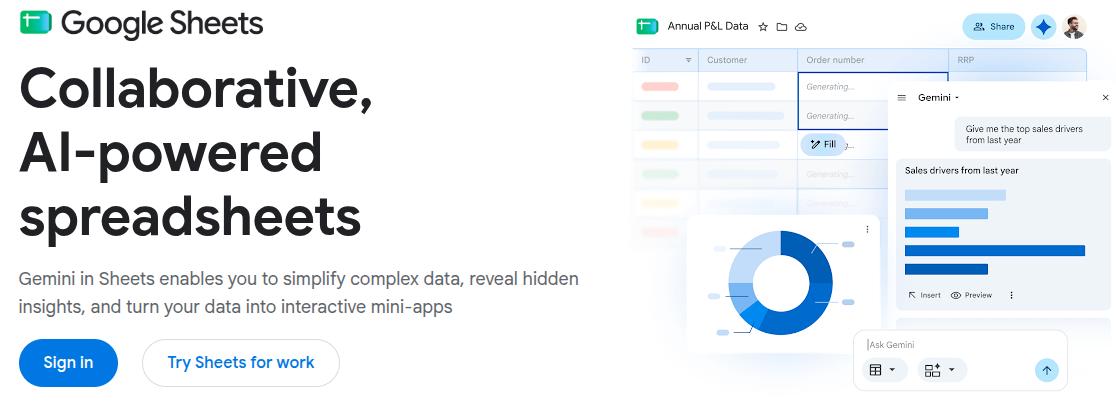
Google Sheets is a free online spreadsheet tool that can contain all your keyword and content template data. You can set up each row as a page to be published through your CMS.
Key features:
- Built-in formulas help build titles, intros, and FAQs from every row.
- Easy sharing and CSV export to your CMS.
- You can generate AI text through the “=AI()” function on paid plans, or through a Gemini script on free plans.
Limitation:
The tool can get slow with thousands of rows of data. Also, you’ll have to manually set up publishing for your pages, which can be time-consuming.
Pricing:

Google Sheets is free to use. A paid plan of at least $19.99/month (Google AI Pro) will unlock advanced AI features inside the worksheets that may help in your pSEO efforts.
We built a free programmatic SEO template so you can see the whole workflow in a sheet on your own.
8. Airtable
Best for: Larger datasets and relational data, like services linked to locations.
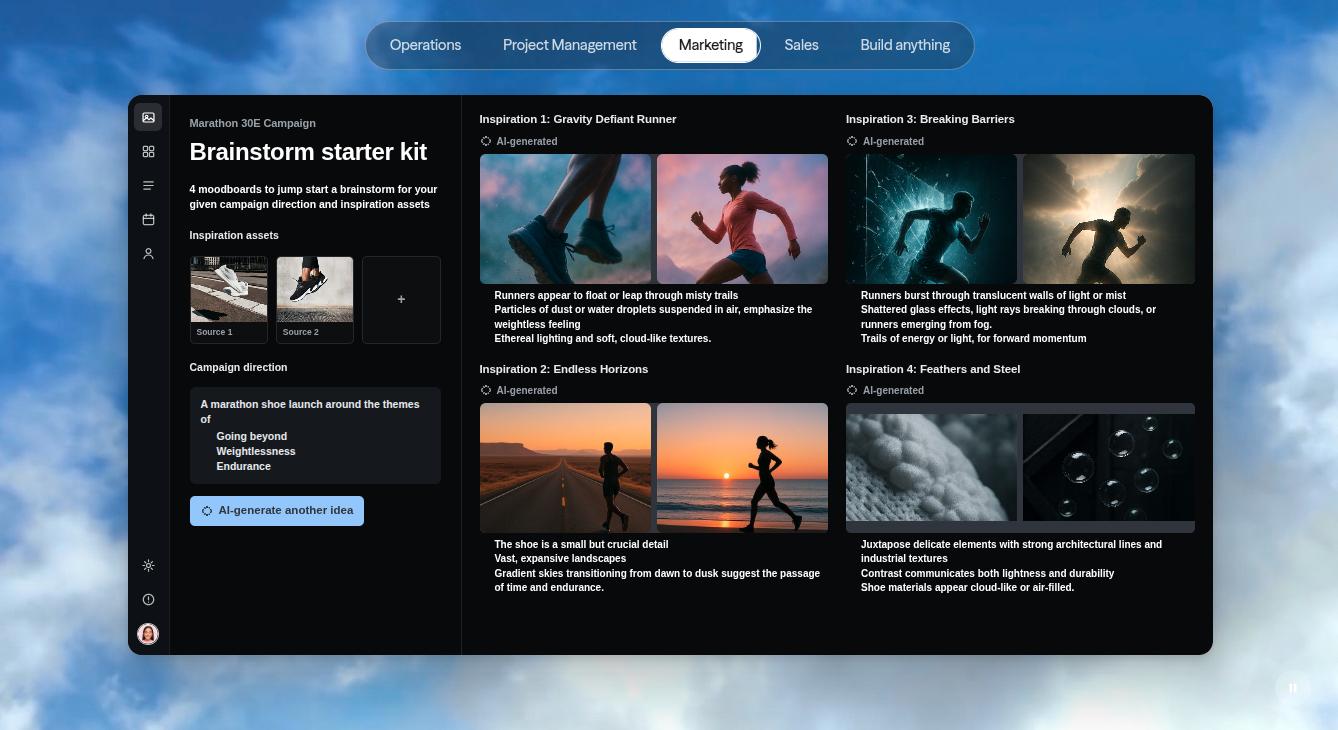
Airtable is a spreadsheet-style database with linked tables, views, and automations. It also provides its native AI, which helps users generate entire multi-table schemas from text prompts and extract instant insights from data.
Key features:
- Linked records, filtered views, and status fields for approvals.
- Built-in “if this, then that” trigger-action workflow sequences to automate internal updates or connect with external applications like Slack, Jira, Salesforce, and Gmail.
- Offers specialized columns such as single or multiple select dropdowns, attachments, checkboxes, formulas, rollups, and lookups.
Limitation:
Airtable is built to extract and hold your data but not for publishing pages or monitoring them after publishing for content decay or rank drops.
Pricing:
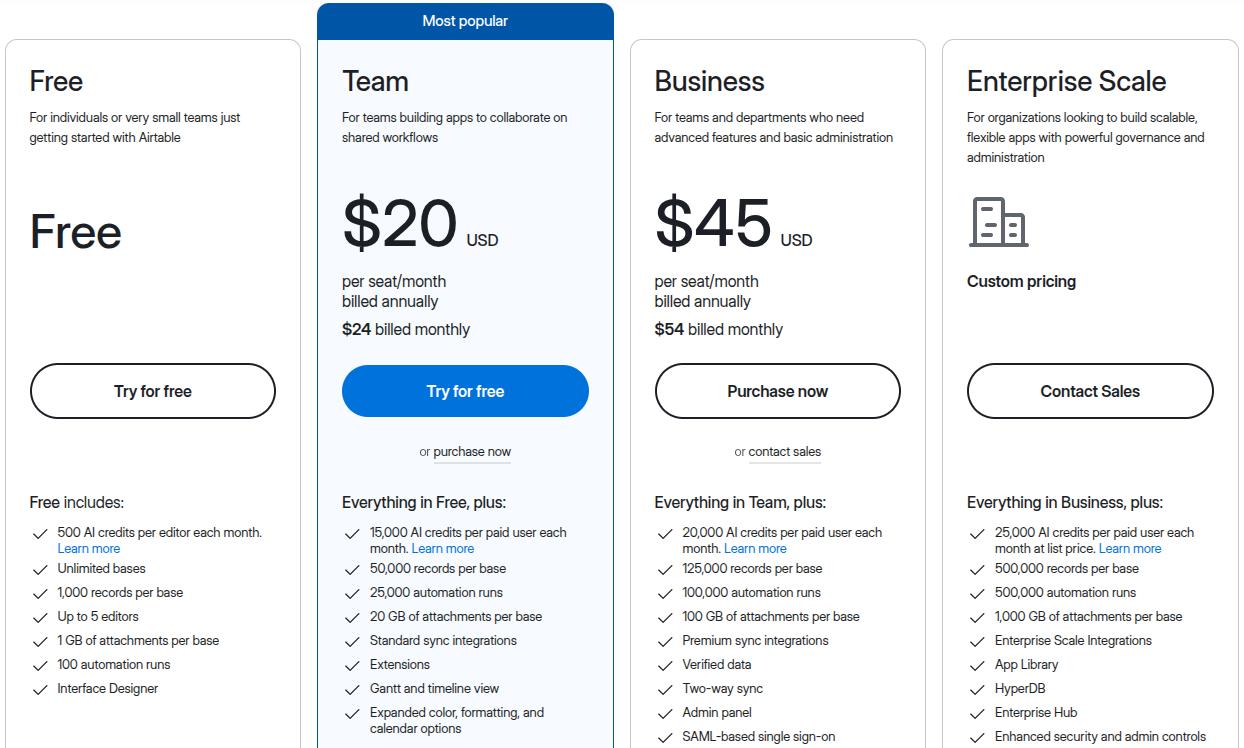
Airtable provides the Team plan for $20/seat/month, which grants 25,000 automation runs and 20GB of attachments per knowledge base. You can try the platform for free with 500 AI credits granted each month.
Best programmatic SEO tools for page publishing
Publishing pSEO platforms specialize in receiving structured data and turning it into live pages for your site.
9. SEOmatic
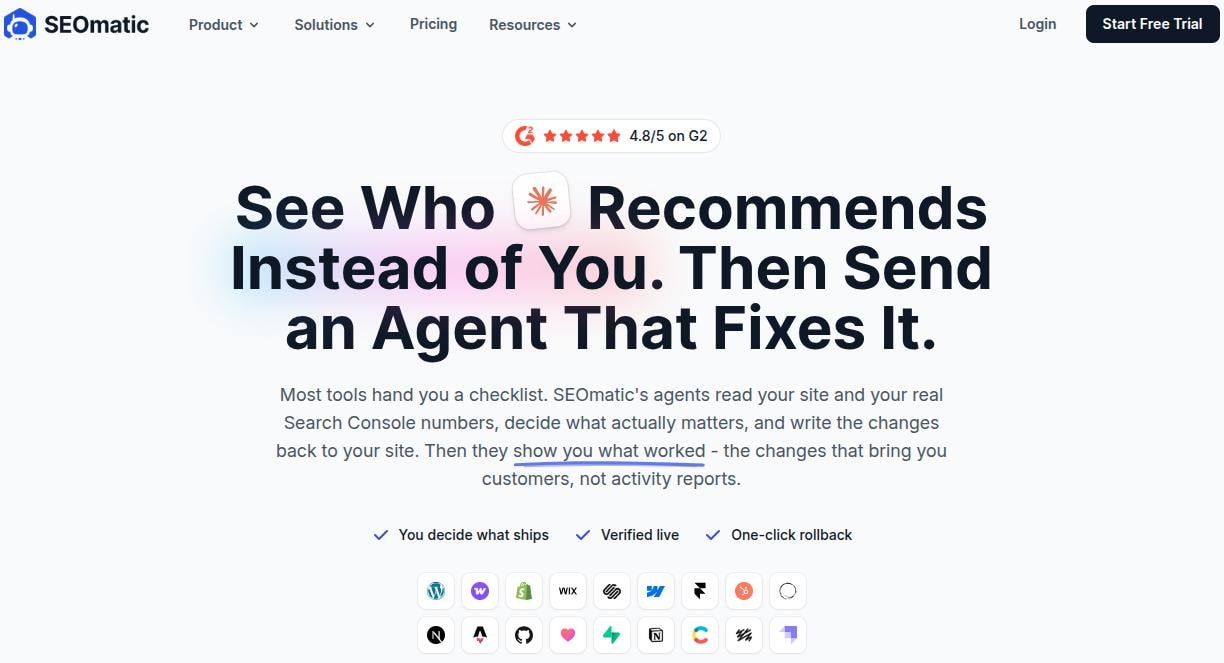
Best for: Data-led pSEO, like location pages, product specs, or integration pages.
SEOmatic is a bulk page generator and AI visibility tracker that connects a dataset to a visual template and publishes every row as a page.
Key features:
- Imports from CSV, Google Sheets, or Airtable.
- Visual template builder with variable fields.
- Approval workflow, drip publishing, and rollback options.
- Integrations with WordPress, Webflow, Shopify, Ghost, Wix, and Framer CMS platforms.
Limitation:
Page quality depends heavily on the depth of your dataset.
Pricing:
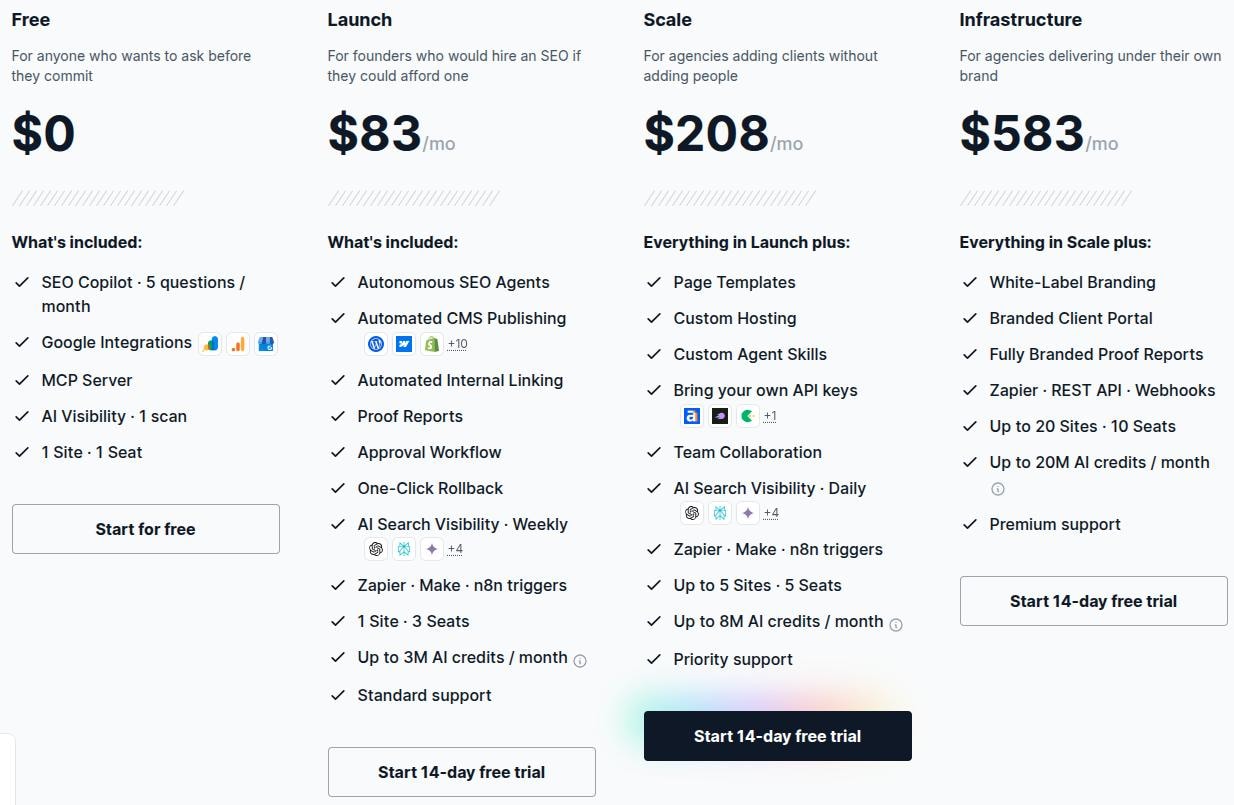
SEOmatic provides a 14-day free trial. Paid plans start at $99/month, but the best value for programmatic SEO is the Scale plan ($208/month), providing 8M AI credits, Zapier, Make, n8n triggers, and team collaboration features.
10. WP All Import
Best for: WordPress teams with structured data.
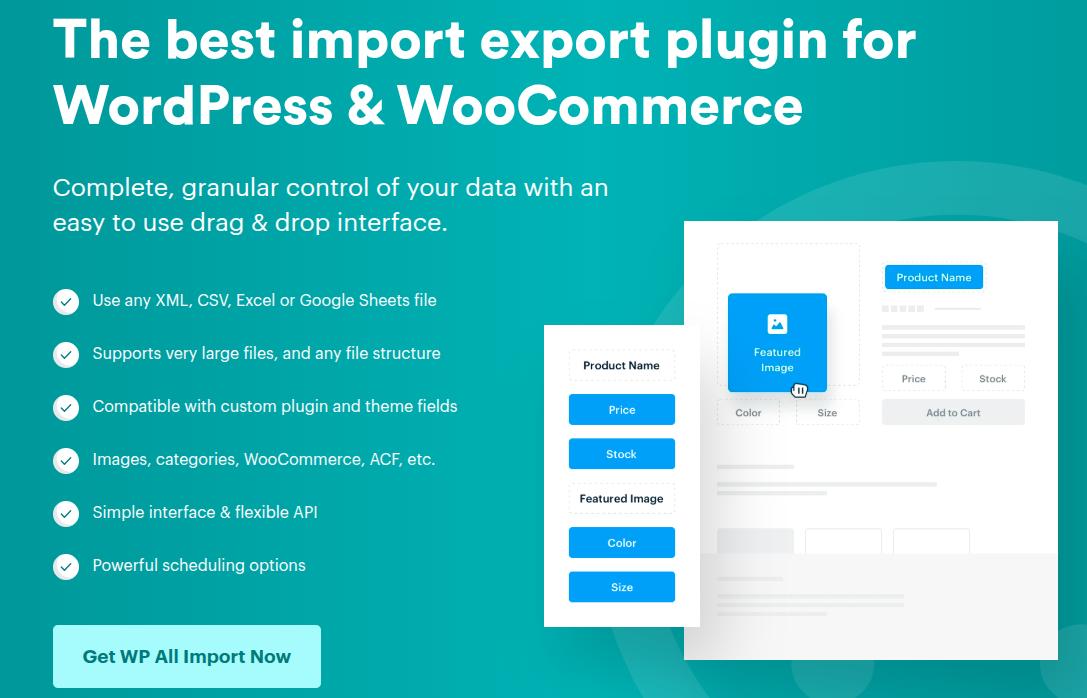
WP All Import is a WordPress plugin for dynamic page creation from CSV, XML, Excel, and Google Sheets files.
Key features:
- Drag-and-drop mapping to posts, pages, custom post types, and ACF fields.
- Scheduled imports to keep data fresh.
- WooCommerce support.
Limitation:
It’s only for users already in the WordPress ecosystem. Also, there is no AI content automation or text generation feature since the tool is specifically made for page publishing.
Pricing:
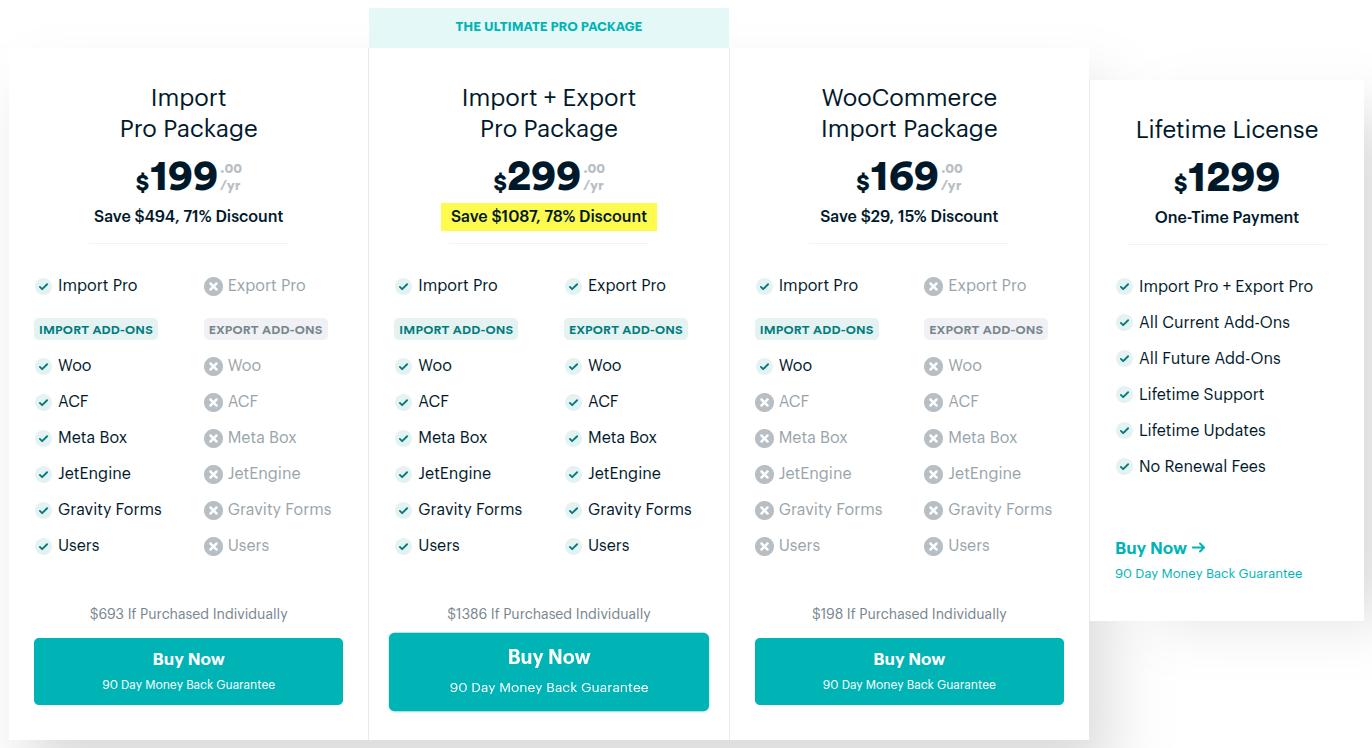
The Import and Export Pro package starts at $299/year, which provides WooCommerce, ACF, Meta Box, JetEngine, and Gravity Forms import and export options.
11. Whalesync
Best for: No-code teams running Airtable, Notion, or Sheets with Webflow or WordPress CMS.
Whalesync is a two-way data syncing platform that works between a database and your CMS. It instantly updates your pages as source data changes, which removes the manual workload of maintaining content while implementing pSEO strategies.
Key features:
- The tool syncs copy written by Airtable AI or formulas into each CMS item, so the writing happens in Airtable and Whalesync delivers it.
- The tool continuously monitors your data to keep sync status up to date and logs errors regarding any page issues.
- Record matching on a primary key links pages that are already live to their spreadsheet rows.
Limitation:
It handles data only, not content generation. So, you’ll most likely use Whalesync as a connecting layer between your AI writer and CMS platform.
Pricing:
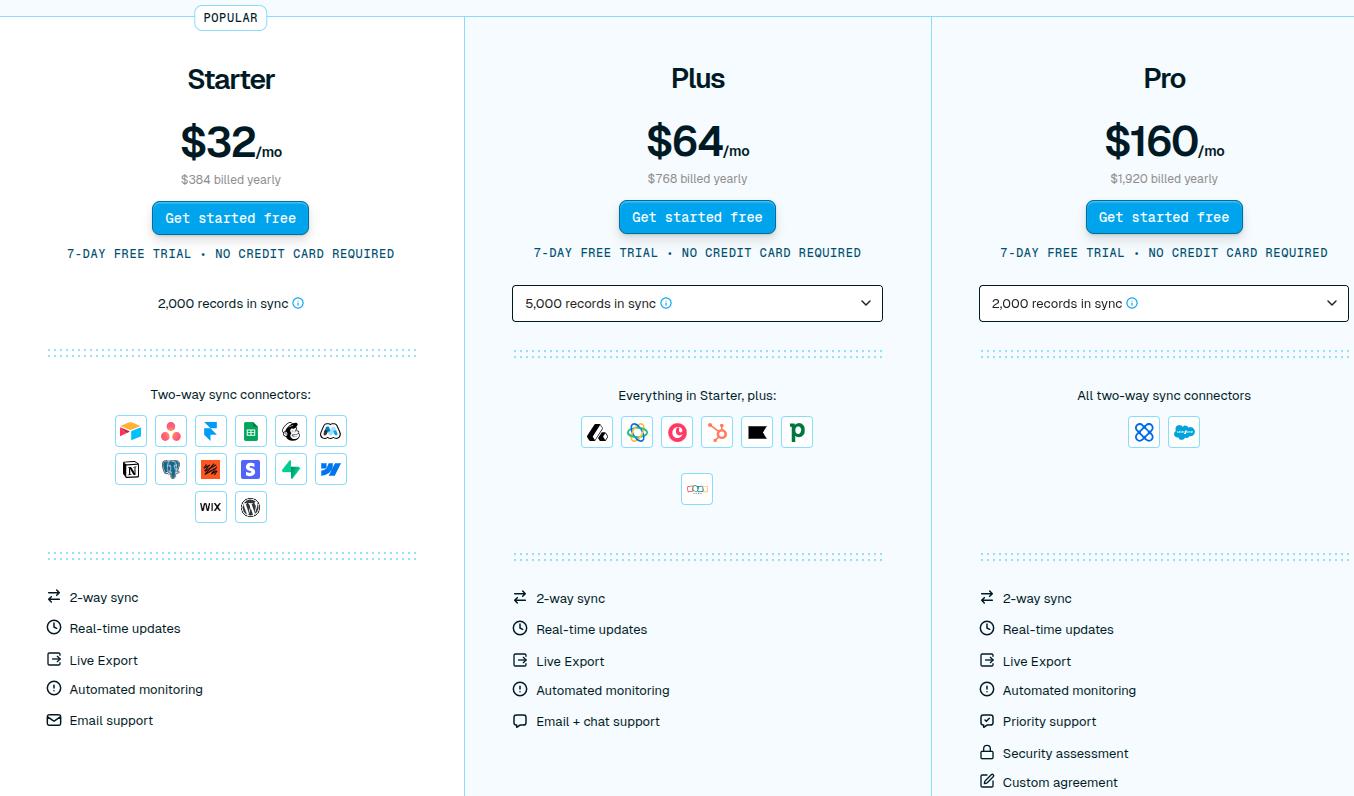
Whalesync pricing starts at $32/month. But you’ll get the most programmatic SEO value out of the Plus package ($64/month) or more. A 7-day free trial is available before you commit to purchase.
Best programmatic SEO tools for monitoring and QA
Creating pages at scale isn’t enough. You need to know what happens after publishing content. This is where programmatic SEO tools for monitoring come in.
12. Google Search Console
Best for: Checking first-party data for indexing and page performance reports.
Google Search Console shows what Google has indexed for your site and how your pages perform. It is the best free way to learn if your programmatic SEO efforts are paying off or not.
Key features:
- Page indexing report for what’s indexed and why pages are excluded.
- URL Inspection for canonical, crawl, and indexing status.
- Performance report filtered by URL folder.
- Sitemap submission to allow Googlebot crawlers to access your newly published pages.
Limitation:
Reports are not displayed in real time and most likely have a delay of 1-2 days. Also, the average ranking position metric is an aggregate number, which may or may not accurately depict the actual keyword performance.
Pricing:
Free to use.
13. Screaming Frog
Best for: Pre-pSEO-launch checks and periodic technical audits.
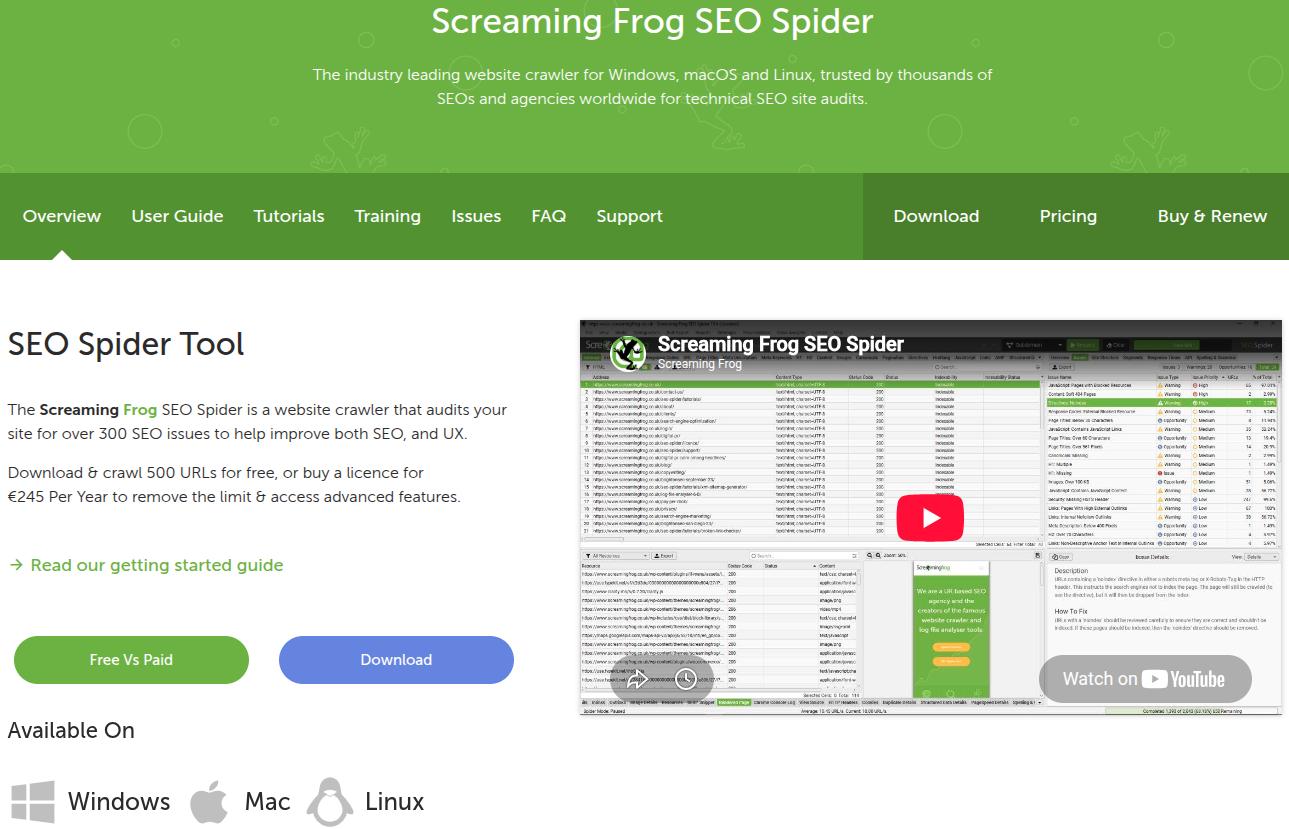
Screaming Frog is a desktop-based crawler that highlights all important technical issues in your site, including broken internal or external links, schema errors, missing headers, bad assets, and more. It is an essential tool to maintain the health of your site while scaling content.
Key features:
- Finds broken links, redirect chains, missing metadata, and duplicate titles.
- Checks canonicals and directives across the whole set.
- Integrates with Google Search Console and Google Analytics 4.
- Provides opportunities to improve clicks and rankings, such as meta title optimization, indicating missing alt text for images, and low-content pages.
Limitation:
It’s a desktop tool, so it doesn’t monitor your site continuously. You can only set up periodic audits (daily, weekly, monthly).
Pricing:
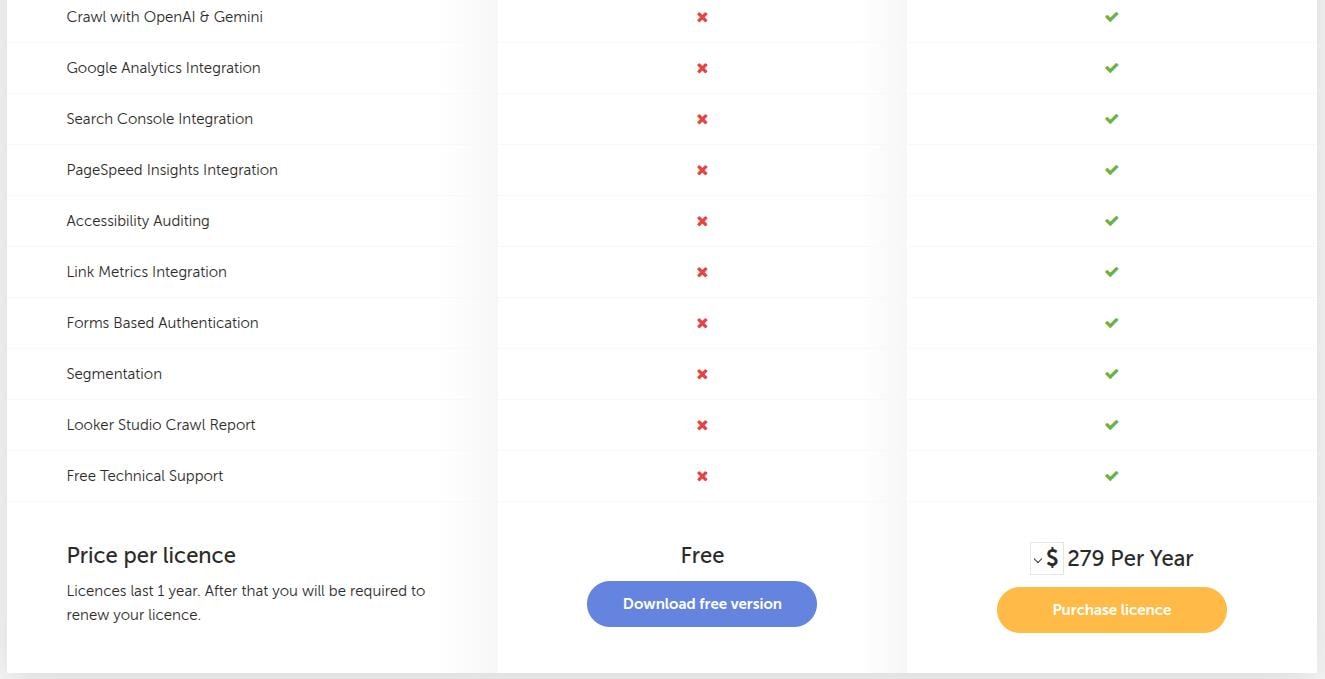
The tool is free to use for up to 500 URLs. A paid annual license beyond that starts at $279/year.
14. Surfer SEO
Best for: Improving your highest-priority template pages with on-page SEO optimizations.
Surfer SEO is a page-level optimization tool with content scores and AI visibility tracking features. It also surfaces topical gaps in your site by analyzing it against your competitors in the niche so that you know what to write next.
Key features:
- Content Score and optimization guidelines against competitors.
- AI visibility tracking across ChatGPT, Gemini, Perplexity, Google AI Mode, and Google AI Overviews.
- Spotting weak pages and fixing them to boost rankings using Surfer AI.
Limitation:
It works page by page, so it isn’t built to optimize thousands of pages at once.
Pricing:

You can try Surfer’s capabilities with the starting package of $49/month. But for a pSEO use case, the ideal starting point would be $299/month, which grants unlimited document optimizations.
Bonus programmatic SEO tools
There are some bonus tools that can be used for your first programmatic SEO campaign in 2026.
| Tool | Use it for | Limitation |
| Figma | Wireframing your page template | Doesn’t generate or publish pages |
| Canva | Quick layout sketches and visual creation | Not a page publishing or generation tool |
| Bardeen AI | No-code data collection and automation | Check site terms and copyright details before scraping data |
| ScrapingBee | A scraping API that helps fill your database for pSEO | The same legalities apply as Bardeen AI |
| Metaflow | Agentic workflows for comparison and use-case pages | Credit-based limits can cause work interruptions |
| Google Analytics | Knowing traffic and landing-page performance | You have to pair it with Search Console to know the entire picture about your rankings |
| Usermaven | AI-powered analytics and attribution data | Setting up wrong conversion goals can include biases in analysis |
Try one of these tools in combination with the ones we’ve already discussed in detail to create your own stack. Make sure to go over the documentation, integrations, and pricing information thoroughly before committing.
How to choose the right programmatic SEO tools
Picking the right pSEO tool starts with how you want your pages created, followed by a publishing or monitoring tool to ensure content quality throughout the site.
Contentpen stands out from the pack due to its ability to handle competitor content gap analysis, keyword research, content creation, SEO and GEO-optimization, and publishing at scale in one place. It is a complete pSEO system for teams that want scalability with control.
Write content that’s built to rank, not just read
Create search-optimized blogs aligned with SEO and GEO signals, so your content performs well across search and AI-driven discovery.
Try SEO Blogging FREE →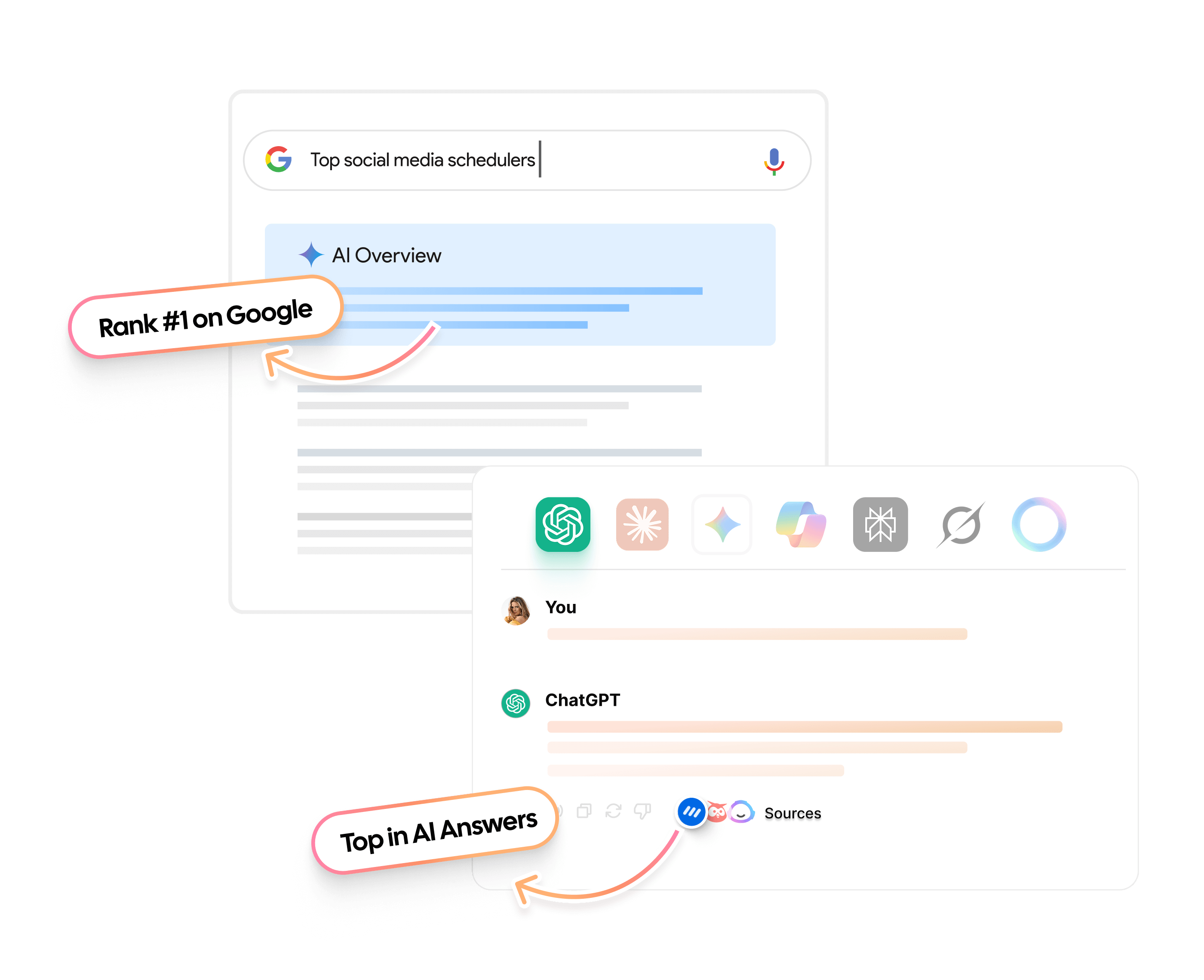
Besides that, we have some other tools that we can recommend for specific use case scenarios:
- Strictly data-based pSEO: Use SEOmatic. Add Whalesync if you want live two-way syncing to your preferred CMS.
- Superior dataset building and handling: Airtable is an excellent choice for pSEO campaigns that rely on relational databases.
- You want a custom pipeline: AirOps is a good option to create custom workflows for programmatic SEO.
- You have no budget: Start free with tools like Google Sheets, Search Console, and Screaming Frog’s free tier.
You can also make a stack of free and paid tools, such as choosing Ahrefs for detailed keyword analysis and combining that with Google Sheets, Search Console, and Screaming Frog.
Whatever you pick, publish 20 to 50 pages first and check how many get indexed after a couple of weeks. Scale only if most do.