 22 minutes
SaaS content marketing is the practice of creating blog posts, product pages, comparison pages, videos, and other resources to attract, convert, and keep customers returning to the platform.
It differs from regular content marketing because it must speak to multiple buyers at once, explain a product that isn’t always simple, and tie directly to measurable outcomes.
This guide covers what the term means, how to build a strategy around it, which content types matter most, real brand examples, and how Contentpen fits into a modern content workflow. Keep reading to see how each piece connects.
Key takeaways
- SaaS (software-as-a-service) content marketing has to match the buyer’s actual research process, not just chase search volume.
- Bottom-of-funnel pages like use cases and comparisons should get built before you scale broad blog content.
- AI tools speed up drafting, but product knowledge and original insight still decide whether content performs.
- Distribution and measurement matter just as much as the writing itself, so plan both from day one.
What is SaaS content marketing?
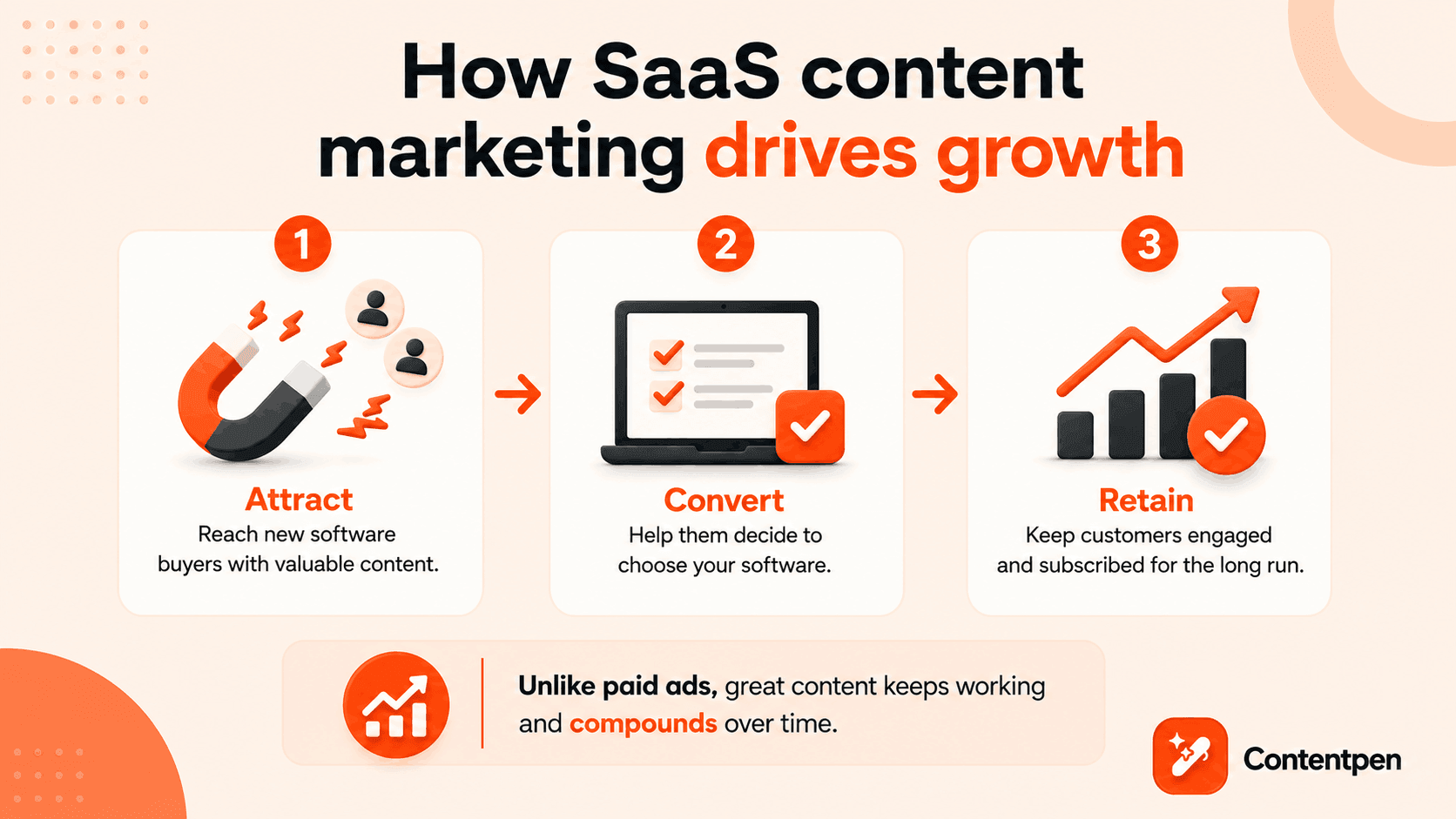
SaaS content marketing means creating and distributing content to attract new software buyers online, help them decide to purchase, and keep them subscribed once they’re customers.
Unlike paid ads, which stop the moment you stop paying, well-built SaaS resources keep pulling in visitors long after they’re published.
Strategic content marketing for SaaS companies tends to compound over time. That compounding effect is what makes it worth the up-front investment of time and planning.
How do you build a SaaS content strategy that actually works?
A SaaS content strategy that works starts with your audience, goals, product story, and website, not with keyword research. Below are the 10 steps that you should follow to help grow your brand online.
#1: Know your audience beyond generic personas
Real SaaS content strategy depends on understanding what your buyers actually do at work, not a made-up persona with a name and a hobby.
For that, you need to pull real intelligence from the sources where your buyers already describe their problems in their own words.
- Sit in on a few demo calls and sales conversations each month, since prospects often reveal the exact phrase they’d type into Google when frustrated.
- Read through support tickets regularly to spot recurring complaints and confusion points that content could resolve before they turn into churn.
- Watch relevant Slack groups, Reddit threads, or LinkedIn discussions where your audience already argues about tools like yours.
- Study your highest lifetime value customers specifically, since they often reveal the use case your product actually wins at, not just the one you market hardest.
Most SaaS products serve more than one type of buyer. Naming these profiles clearly and keeping them visible while planning content keeps every article tied to a real reader instead of a guess.
#2: Set goals with OKRs, not guesswork
Next are the goals that you set for your business, which are mostly driven by objectives and key results, or OKRs. It is a measurable outcome that your team can act on to drive results, not something vague like “grow traffic” or “get more subscribers.”
Your goals should also match where your company actually stands right now.
| Company stage | Primary focus | Example goal |
| Bootstrapped | Direct sign-ups | 100 product sign-ups a month |
| Seed to Series A | Visibility | 30% more blog traffic |
| Series B and beyond | Retention | 15% better activation rate |
If your SaaS business is in the early stages, talking directly to customers often helps more than generic content marketing pieces.
For example, an email marketing platform founder can create Loom videos discussing the product’s honest pros and cons in detail. This will help people recognize the genuine people behind the product and may convince them to buy more than blog posts or anything else.
Once that same business gets up and running, for instance, 3k MRR or ARR, then visibility comes into the picture.
A simple example might be:
- Objective: Driving 400 sign-ups from SEO this quarter.
- Key results: publishing 6 use case pages, 4 comparison pages, and 40 optimized blog posts
Treat these as stretch goals rather than guarantees. Hitting 70% to 90% of an OKR is generally considered a solid result, while consistently landing over 100% usually means the target was set too low to begin with.
Building accurate OKRs takes a bit of trial and error, so lean on last quarter’s actual numbers when setting the next target. This is especially true for large businesses (Series B and beyond) that may focus more on customer retention than gaining new ones.
#3: Creating a content lifecycle
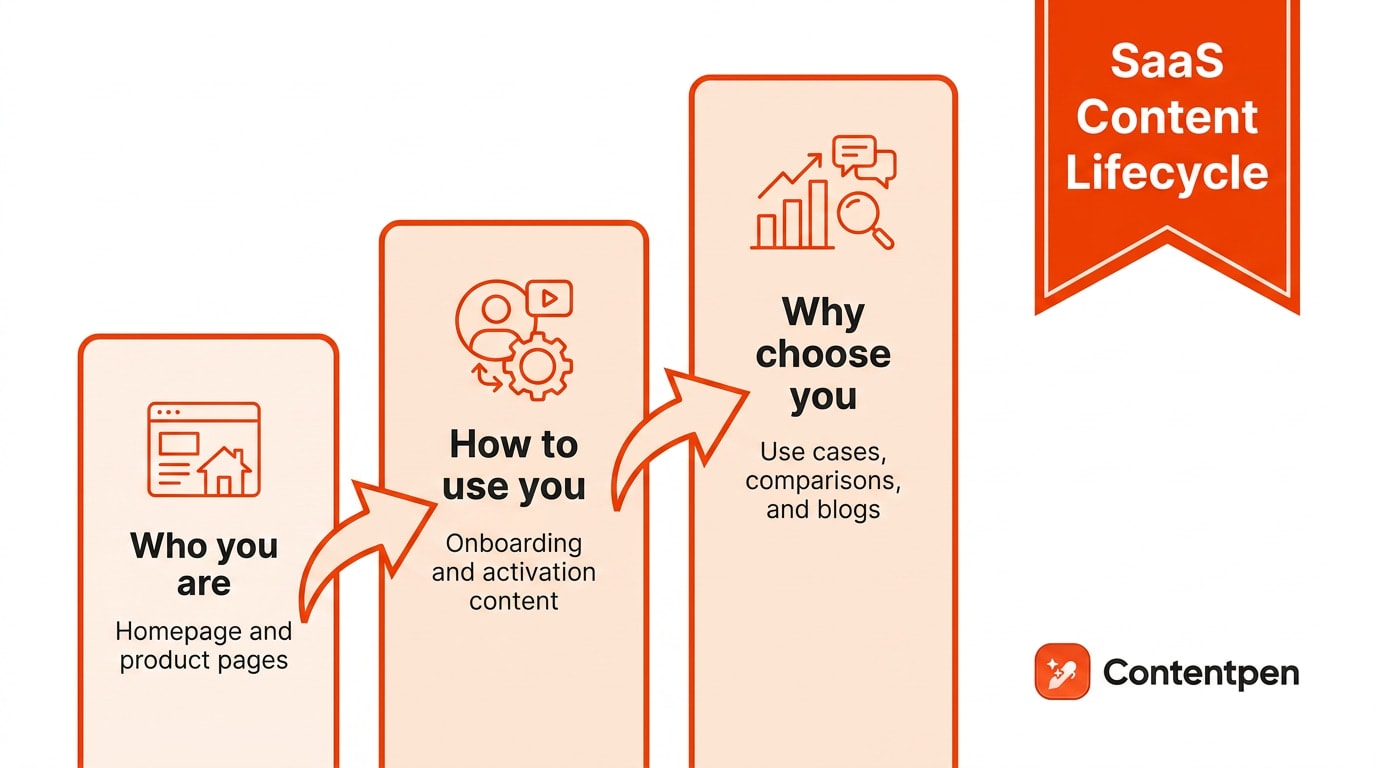
SaaS companies should build content that mirrors the customer lifecycle, moving through three phases that answer who you are, how to use you, and why someone should choose you over the alternative.
The first phase covers your homepage, product pages, and feature pages. The second covers onboarding and activation content, like a resource hub or learning content similar to what you can find in Semrush Academy.
The third phase is where growth happens, through use case pages, comparison pages, and broader blog content aimed at non-branded search terms.
Since most visitors land on a single page through a search query rather than browsing your entire site, every stage needs its own entry point built to rank on its own.
That’s why the smartest sequence is to build bottom-of-funnel pages first, then scale blog and other types of content once some conversion paths already exist.
#4: Types of content
Before writing a single blog post, your messaging needs to explain exactly how your product solves a real problem. Your website needs foundational pages, meaning a homepage, feature pages, and use case pages that make the value proposition clear within seconds.
Start planning from the bottom of the funnel and build upward toward broader awareness content. This means going from use case pages -> Vs comparisons -> blog posts -> social media posts in that particular order.
Use case pages
After your feature and product pages, your use case pages should be the first type of content you create for your SaaS business. This is because the user must learn what your product can do for them before any awareness (blog posts, social posts) comes into play.
Here is how Contentpen, an AI blog writing tool, does it:
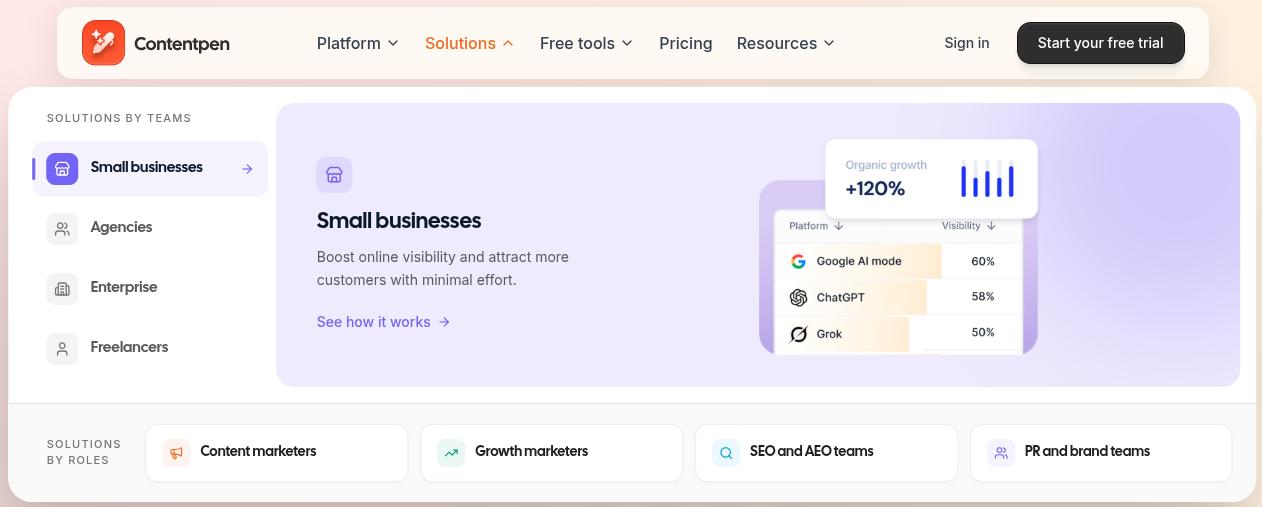
Each URL traces back to the use-cases pillar like this:
- Small businesses (https://contentpen.ai/use-cases/small-businesses)
- Agencies (https://contentpen.ai/use-cases/agencies)
- Enterprises (https://contentpen.ai/use-cases/enterprises)
The idea of setting the URL structure like this is to help each type of user navigate the website properly and understand the benefits of the tool clearly.
You could also structure use case pages under a clear folder like /for/recruitment-outreach, with a central hub page linking out to each one. However, this depends on the CMS you’re using.
Some SaaS brands, like Contentpen, differentiate use cases by roles and teams, as shown in the image earlier. This is also an efficient manner of displaying all the required knowledge categorically without overwhelming the reader.
Vs pages
After use case pages, you should create pages for those users who are ready to convert (remember we’re trying to get to that ARR/MRR goal first).
Write honest comparisons between you and other competitors in the space. Highlight true gaps and how your tool fills them.
Again, we’ll use our Contentpen example:
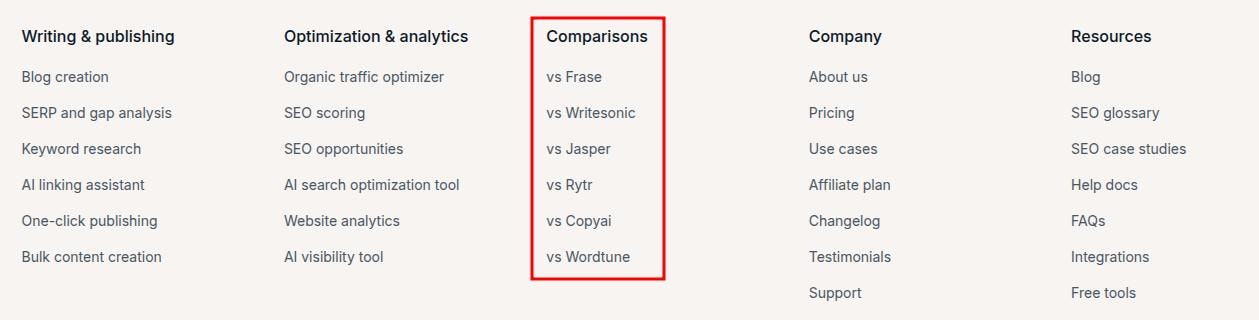
Notice that we have multiple comparison pages up on our site, like Contentpen vs. Frase, Contentpen vs. Jasper, and so on. Each page does the job of setting all the SEO and GEO features head-to-head with the competitors to help those near a decision make the right one.
On the left, we have the feature pages. On the right are the essentials of the company (about us, pricing), and other resources like blogs, SEO glossary, help docs, and the FAQs page.
This is the type of structure you should aim for when creating the best SaaS content marketing strategy.
Blog posts
Blog posts remain the biggest traffic driver for most SaaS content marketing programs, but only when they stretch beyond product updates into topics your actual audience searches for.
One documented case of Joshua Parkinson’s brand, Post Planner, grew from 9,000 to 500,000 monthly unique visitors through consistent publishing of 550+ evergreen posts over 24 months.
For startups, blogs are an ideal way to improve recurring traffic without spending on ads. If done right, comprehensive, evergreen content keeps bringing in visitors long after it’s been published (doesn’t mean you don’t have to update them every once in a while).
Ideally, keep blog titles under 60 characters so they don’t get cut off in search results, and keep URLs clean and focused on the target keyword rather than mirroring the full title.
For example:
- Recent innovative marketing examples (https://contentpen.ai/blog/recent-innovative-marketing-examples)
- Search Engine Marketing (https://contentpen.ai/blog/search-engine-marketing)
- Content marketing tools (https://contentpen.ai/blog/content-marketing-tools)
Notice that our blog structure is simple (https://sitename/blog/x-y-z). This helps us keep each post under the main blog page, allowing for easier navigation.
Social content
Videos and social content play a supporting role rather than a search-driving one, and each platform rewards different formats.
- Long-form videos tend to work best on YouTube, where viewers expect a deeper walkthrough or tutorial rather than a quick clip.
- Short-form video fits TikTok and Instagram Reels, where entertainment or a fast tip beats a polished pitch every time.
- Short threads or quick tips perform well on platforms like X, where attention spans are shorter, and scrolling is constant.
Avoid posting the same link or company update across every channel, since that approach rarely earns engagement anywhere. Keep adapting your message to each platform instead of repeating one post everywhere.
#5: Perform keyword research
Keyword research is one of the most fundamental things in your SaaS content marketing strategy.
Regardless of the tool you use, you need to find the queries your audiences are searching for and create content that caters to their needs.
Keyword research tools to consider
As a content marketer, you can start by utilizing tools like Ahrefs to find the top keywords for your business.
For example, a project management SaaS brand might start with head phrases like ‘project management’ or ‘project management software.’
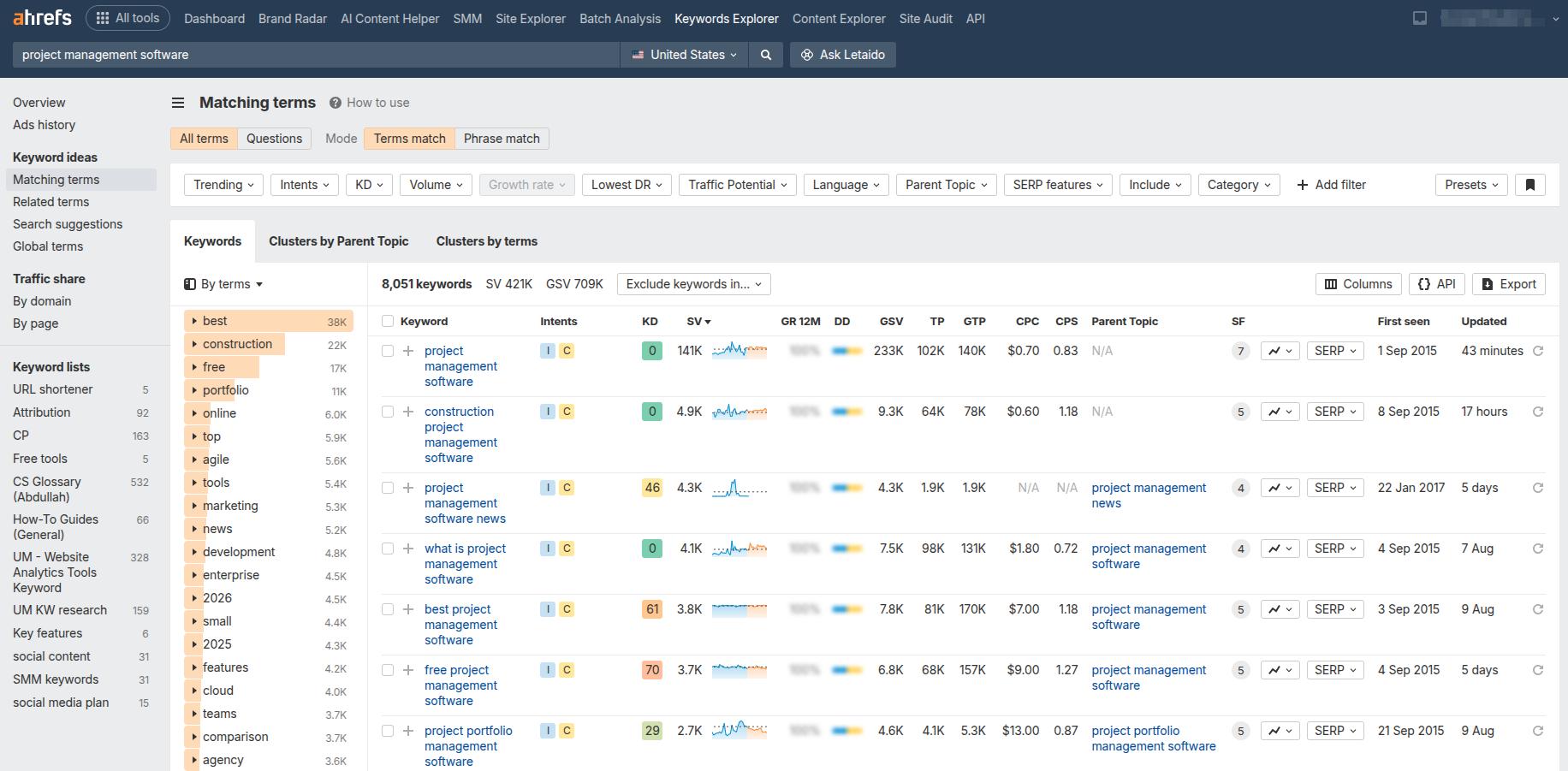
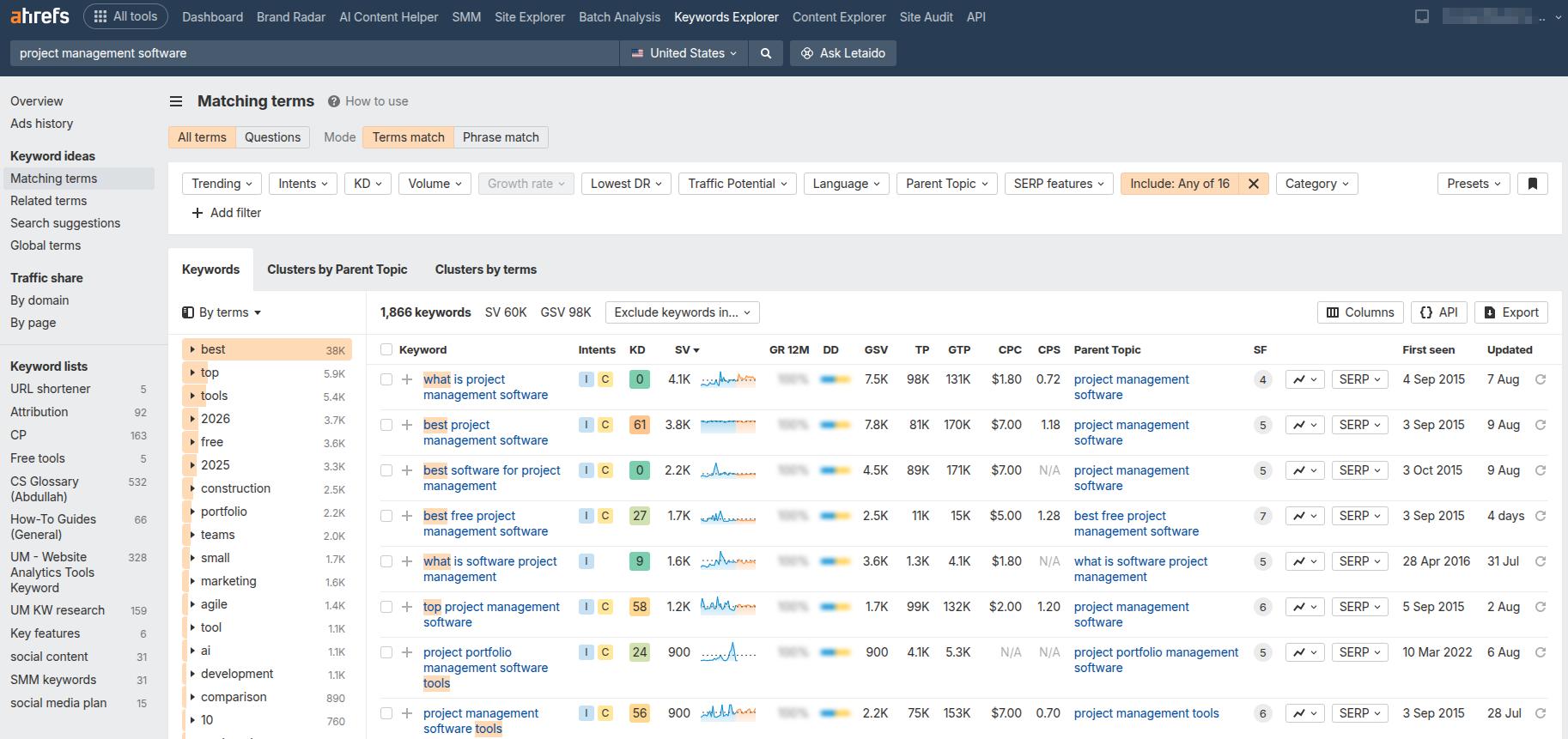
The next step could be to add filters or modifiers to find keywords that match different stages of the content lifecycle.
Use terms like ‘How, why, what, examples, example, tool, tools, best, top, guide, template, tutorial, course, courses, inspiration, help.’
Add them to the filters by clicking the ‘Include’ button and pasting them separated by commas, after each term. Choose the option ‘Any word’ instead of ‘All words’ to include instances where either one of these filter words was mentioned alongside our main target head term.
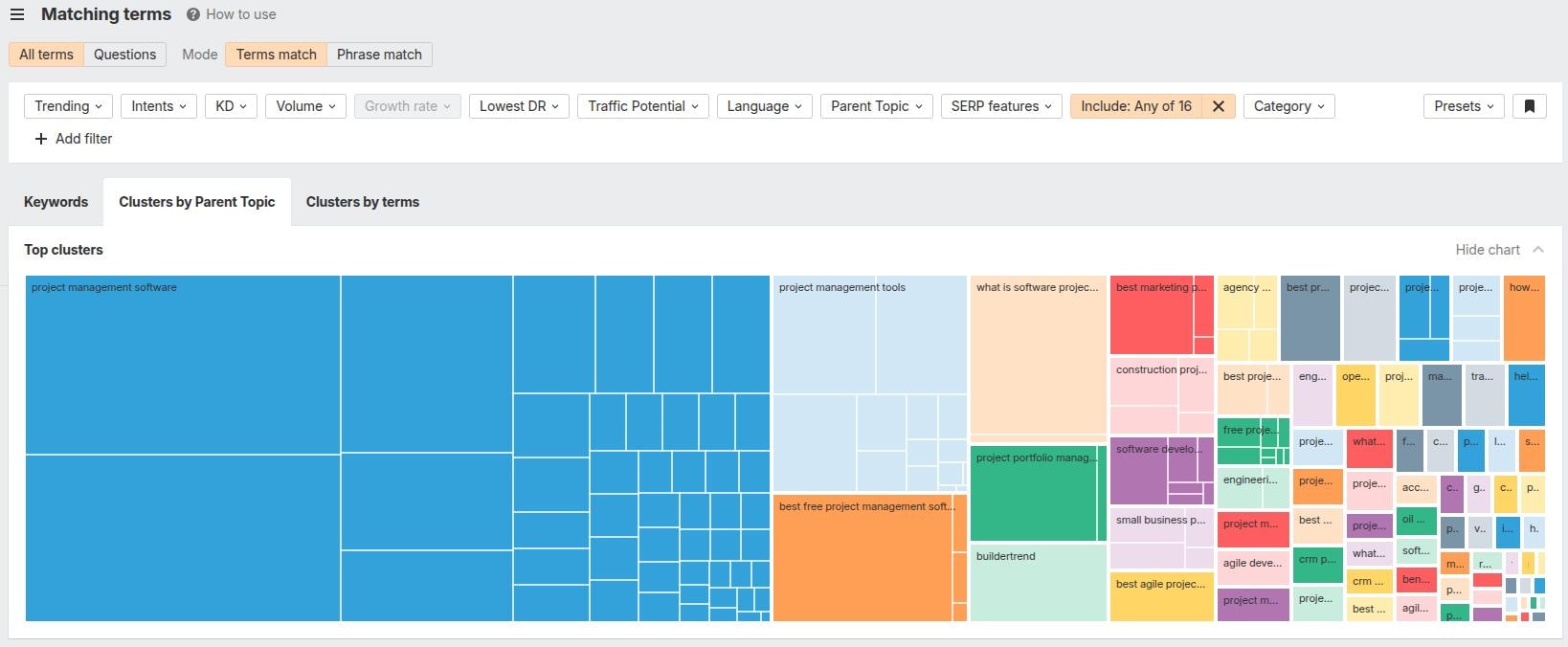
Next, you can plan content pieces by clustering keywords by parent topic. In Ahrefs, you just have to use the option next to the ‘Keywords’ list to see the following results:
While clustering and keyword research in Ahrefs, Semrush, or any other keyword tool can be tedious, Contentpen’s keyword research is much smoother.
Simply enter your target phrase and let the tool generate keywords for it.
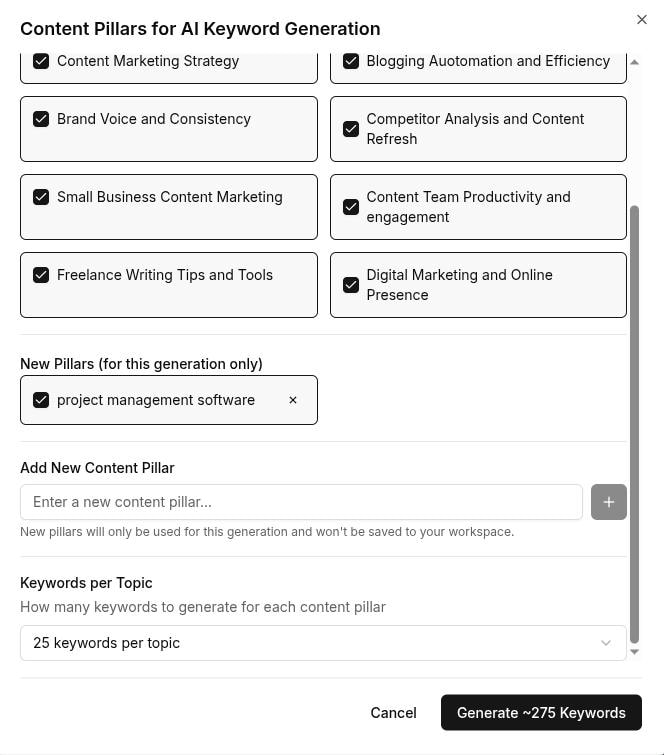
You can choose how many keywords per topic or cluster you want and let the tool find the best options from Google People Also Ask, Autocomplete, and Related search queries. It also automatically fetches KD, search volume, and CPC for each term.
Automated keyword research
Work on keywords worth writing for
Get search terms with real ranking potential, not just high volume.
Try Keyword Research for FREE →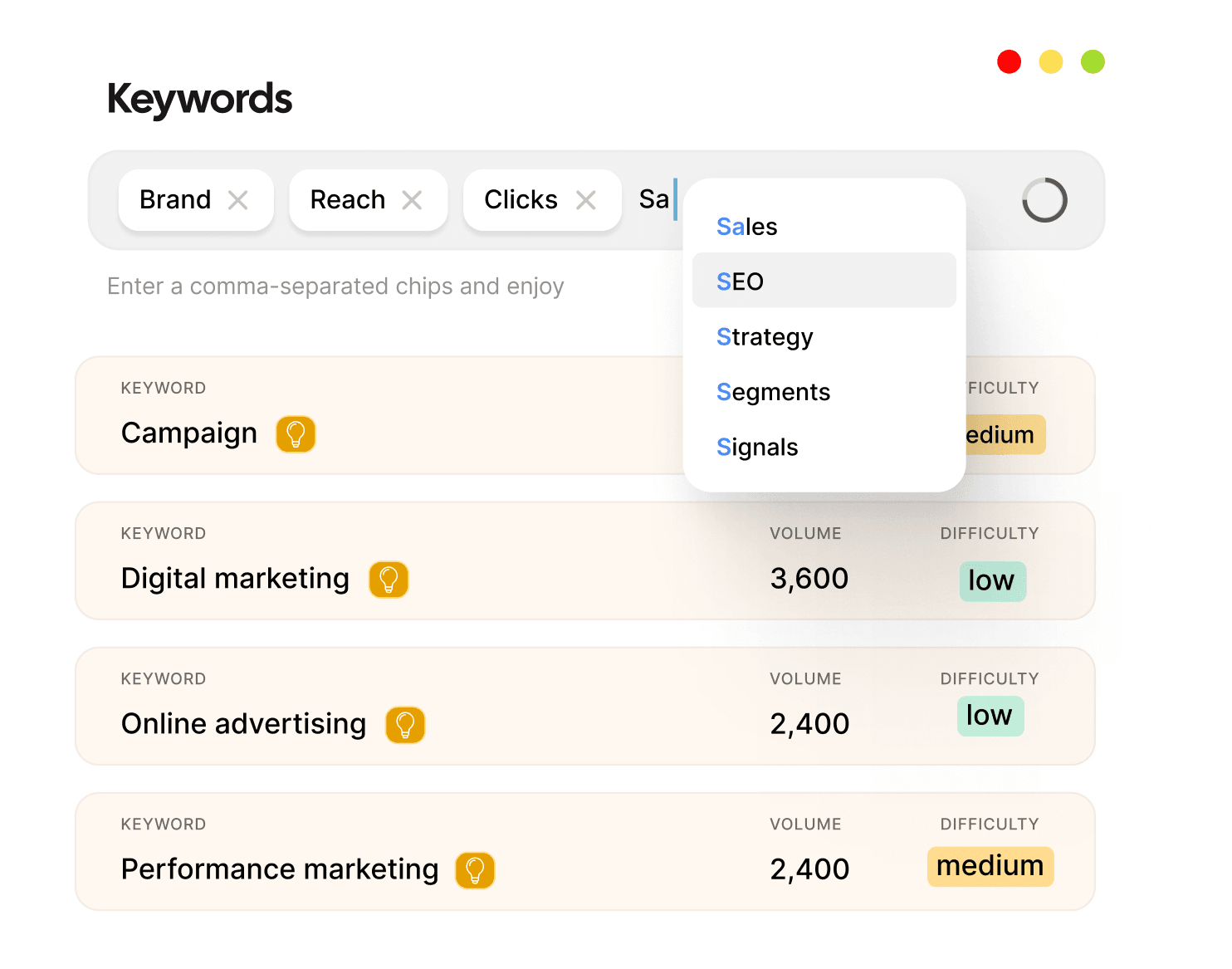
Once that’s done, you’ll see a bunch of keywords that you can organize in a new cluster.
For this example, we’ll call the new cluster “project management.”
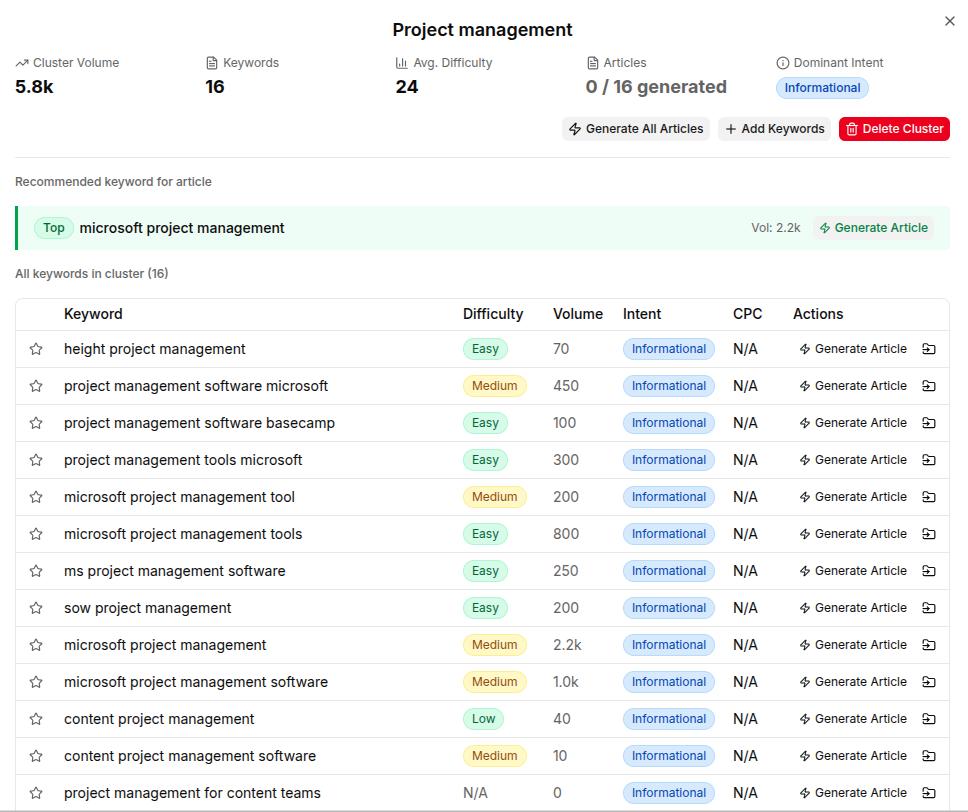
Once your cluster is ready, you can generate blogs and articles for each term according to your brand voice directly from the same interface using the ‘Generate Article’ button.
#6: Conversion rate optimization
Conversion is the most important part of SaaS marketing strategies.
You may get a lot of organic traffic from blogs and improve your brand awareness online. But if users aren’t converting, then you won’t meet your ARR/MRR targets.
The reality in SaaS is that most users who land on your blogs don’t directly convert. They likely explore some other resources before they make a decision.
A good SaaS strategy that a lot of big brands do is to provide some free templates and resources for their users to enjoy before they trust you enough to make a purchase.
A good CRO example is from HubSpot.
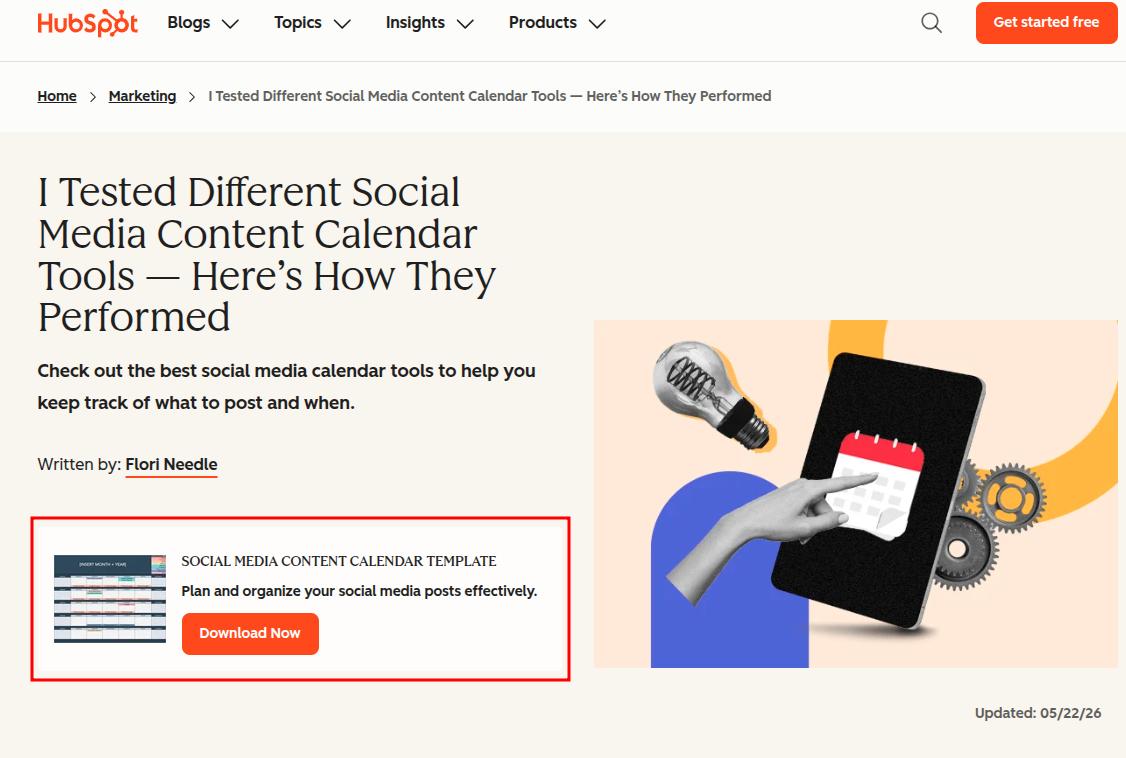
Credits: HubSpot social media content calendar tools blog.
HubSpot technically converted users from their blog to a free social media content calendar template, and then to their subscription. They gate their free resources, for example, asking people to sign up with their email before accessing them. But this is a solid SaaS strategy.
You want users in your ecosystem long before they’re your customers. Then, you can consistently keep in touch with them through the contact information received, convince free trial users to make purchases, or upsell if required.
Therefore, the typical conversion flow for a blog post changes from:
- Blog post → Sign up for product
to:
- Blog post → Free resource → Sign up for product
Sure, you can A/B test both conversion flows, since different flows suit different companies and since you can’t provide free resources for every post you make. Then, you can see what mix works better for you and your audience and stick to it.
How does UI play an important role in CRO?
Besides free resources, CRO also involves how you prepare and present your CTAs, buttons, and action blocks to the users.
Take Contentpen as an example. Our blogs have easy-to-follow, interactive buttons in articles that are not going to “pop up” on your screen or disturb your reading flow.
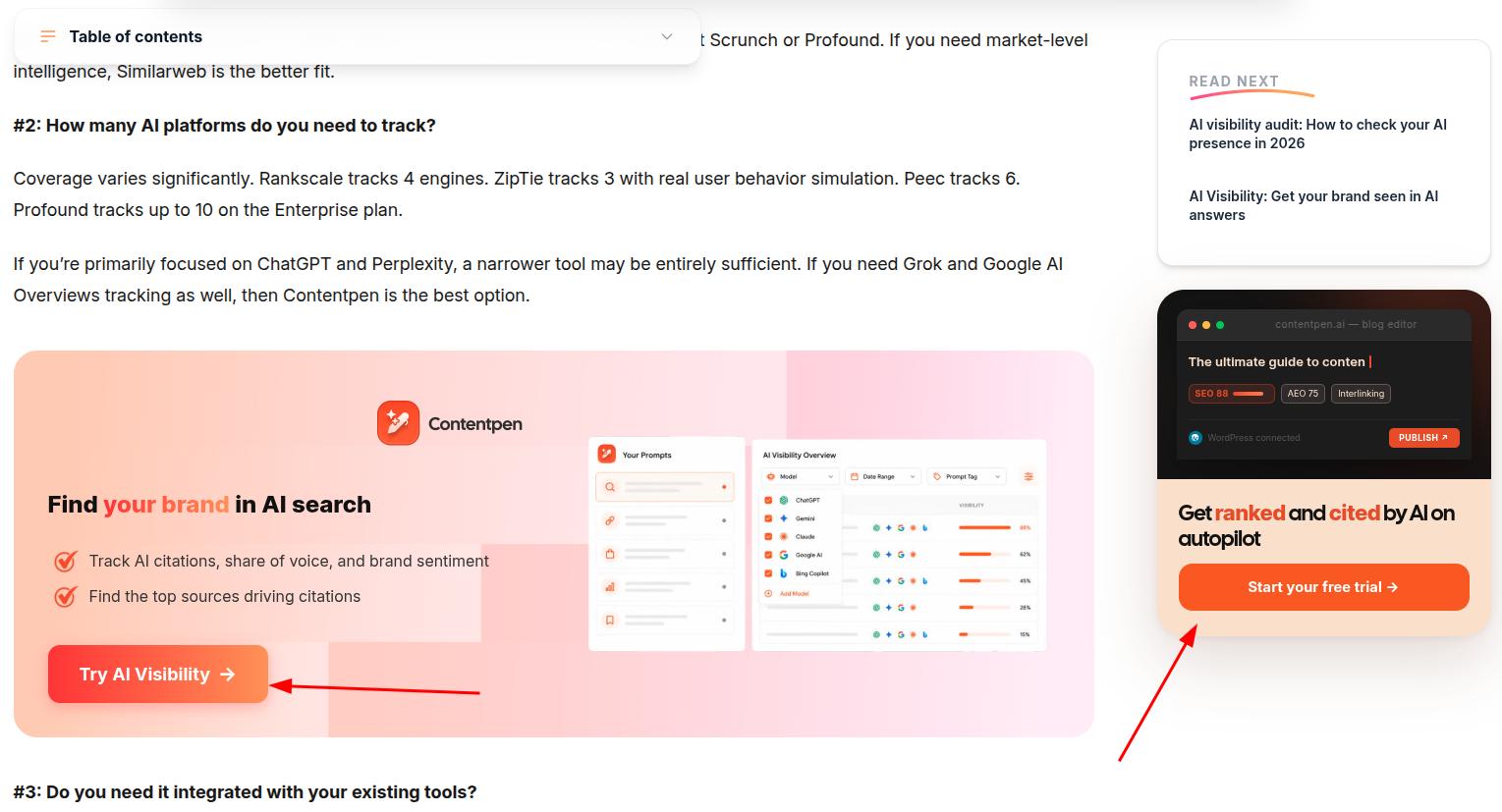
On the right-hand side, you see a live ‘Start your free trial’ button encouraging users to try out our product for free for 7 days. This block sticks throughout the scroll but doesn’t push itself out of that section.
Similarly, the ‘Table of contents’ bar stays afloat and opens on a mouse hover, guiding users to a specific section in the guide.
Lastly, the ‘Try AI Visibility’ button inside our AI visibility tools blog pushes users to give our AEO features a go without overwhelming them at any point.
There are multiple buttons on the site to guide users to an action, but neither of them makes the platform feel too “salesy” or “pushy.” This is the balance that you need to find with your SaaS product marketing as well.
#7: Content distribution
Another important thing that influences SaaS content marketing strategies is how you distribute your content.
As a bootstrap, you can try collaborating with microinfluencers with 15-20k loyal followers, relevant to your niche.
Then, try increasing your online footprint by being active in:
- Quora discussions where users are discussing brands similar to yours.
- Reddit forums and threads, answering genuine user questions and being helpful.
- Medium articles that improve brand awareness and are good for SEO.
The emphasis remains on being relevant to the platform, following their rules and regulations, and understanding how the platform algorithm works.
In our guide to Reddit SEO, we specifically stressed that the platform rewards honest, authentic discussions and transparency in marketing. You can sell, but just not outright, which is a guiding principle for anything you do off-page.
If you are not pushing content like it’s meant to be on a particular site or forum, you may not see the results you desire.
How brand consistency is important in content distribution
Distribution works like a system where each department is different from one another, but everything just fits together like a well-oiled machine.
For instance, if we’re creating social media posts for Contentpen, we’ll ensure that our carousels and posts follow the same brand colors and styles that our blogs and other channels do.
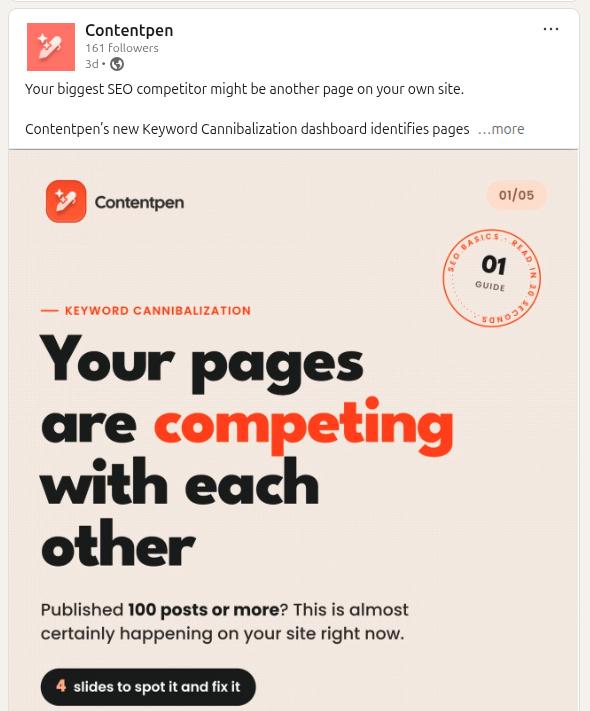
Our keyword cannibalization feature post on LinkedIn follows the same styling we do for our visuals on our blogs, feature pages, and use-case pages.
The result is instant recognition by users, as they can instantly tell who posted this carousel, imprinting the brand image in people’s minds.
#8: ROI and tracking
The best part about digital marketing is that you can track everything. And we mean EVERYTHING on your platform. This is why optimization and tracking are much easier digitally than traditional advertising or marketing channels.
For starters, you have tools like Google Analytics 4 (GA 4) and Google Search Console that tell you how much traffic you get and from where. These tools are good for free usage, but the attribution or deep analytical angles are mostly missing.
Here at Contentpen, we use Usermaven as our advanced tracking and attribution software. It not only tells you the basic metrics (daily visitors, visit duration, etc.) but also which exact sources contributed to these numbers.
We can set up form tracking to see how many leads we generated from forms or use ‘Custom Events’ to see which buttons users pressed, and what happened next.
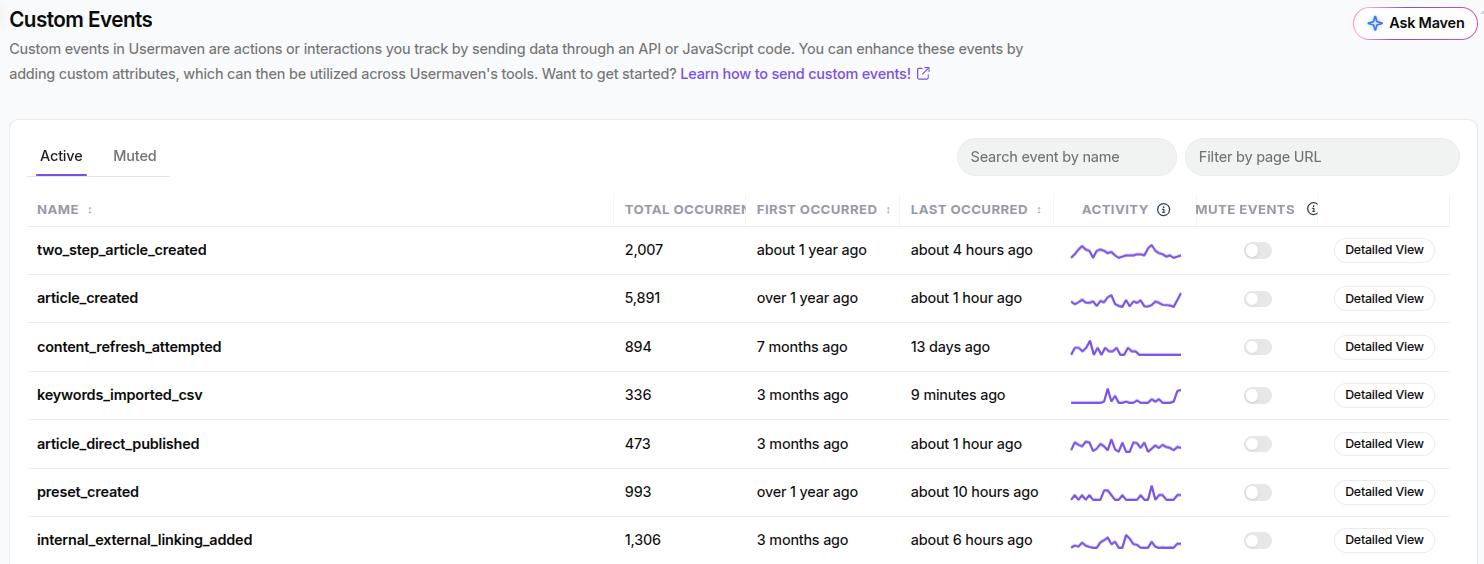
Even though mapping the customer journey is useful, we also utilize UM to see our ‘performance by attribution model.’

This tells us exactly the sources through which we got sign-ups, trial conversions, or affiliate plan sign-ups.
Once you start tracking and attributing your sources properly, you’ll understand the touchpoints leading to better conversions, helping you emphasize your SaaS content marketing efforts accordingly.
#9: Scaling your content team

Choosing between an in-house team, a SaaS content marketing agency, or some mix of both usually comes down to budget and how fast you need to scale.
In-house teams tend to understand your product and brand more deeply, since agencies split attention across several clients at once.
That said, full-time hires can be costly, given that there are benefits and other important commitments involved from the employer. In such cases, utilizing freelance writers can be a good way to increase content throughput without adding complex contracts in the mix.
Most growing SaaS companies land on a hybrid setup. They keep 2-3 in-house content managers to drive strategy while working with freelance writers or a SaaS content marketing agency to handle production volume and scale.
This mix tends to give you both the product understanding an internal team builds naturally and the extra bandwidth an agency or freelance pool can add during a busy quarter.
#10: Using AI to streamline content creation
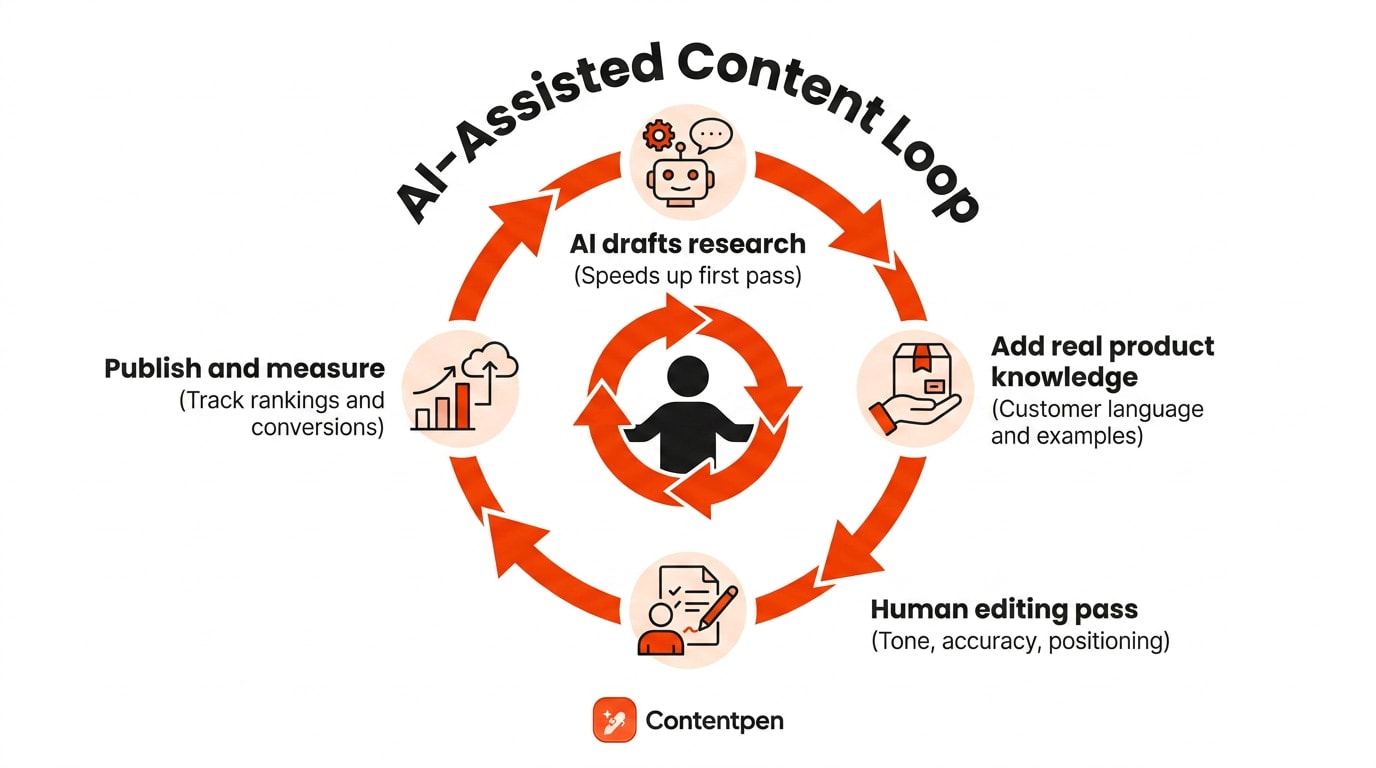
AI speeds up the slow parts of SaaS content marketing, like early research and first drafts, but it doesn’t replace the strategy, product knowledge, or original insight behind good content.
If used well, AI tools can create first drafts quickly, freeing writers to spend their time on the things a model can’t add. For example, real customer quotes, original data, or a genuinely useful example pulled from a support ticket.
Used poorly, AI just produces generic copy that reads the same as every competitor’s blog, which does nothing for rankings or trust.
A few habits keep AI-assisted content worth publishing:
- Use AI to speed up research and get a first draft on the page faster, rather than starting from a blank document every time.
- Add real product knowledge, customer language, and specific examples that only someone who actually uses the tool would know to include.
- Edit every draft for tone, accuracy, and competitive positioning before it ever gets close to a publish button.
Creating expert, authentic, and authoritative content isn’t just rewarded by Google, but it also helps your citations in AI answer engines.
Where Contentpen fits into your content workflow
Contentpen is built for AI-assisted content creation without losing the strategy and structure that make content actually rank.
The platform takes a topic idea all the way through keyword research, a detailed outline, and a full draft. The content is built with answer-first intros and headings designed to perform in both classic search results and AI answer engines like ChatGPT or Google’s AI Overviews.
Beyond drafting, Contentpen also includes competitor analysis to flag content gaps worth targeting. It also ships with a built-in content calendar and no-code webhook integrations that connect drafts to a CMS or team notification tool without manual copying and pasting.
Publish content directly to your CMS, without copy-pasting
Move from draft to live post in a single step. No hassle, no errors!
Try One-click Publishing →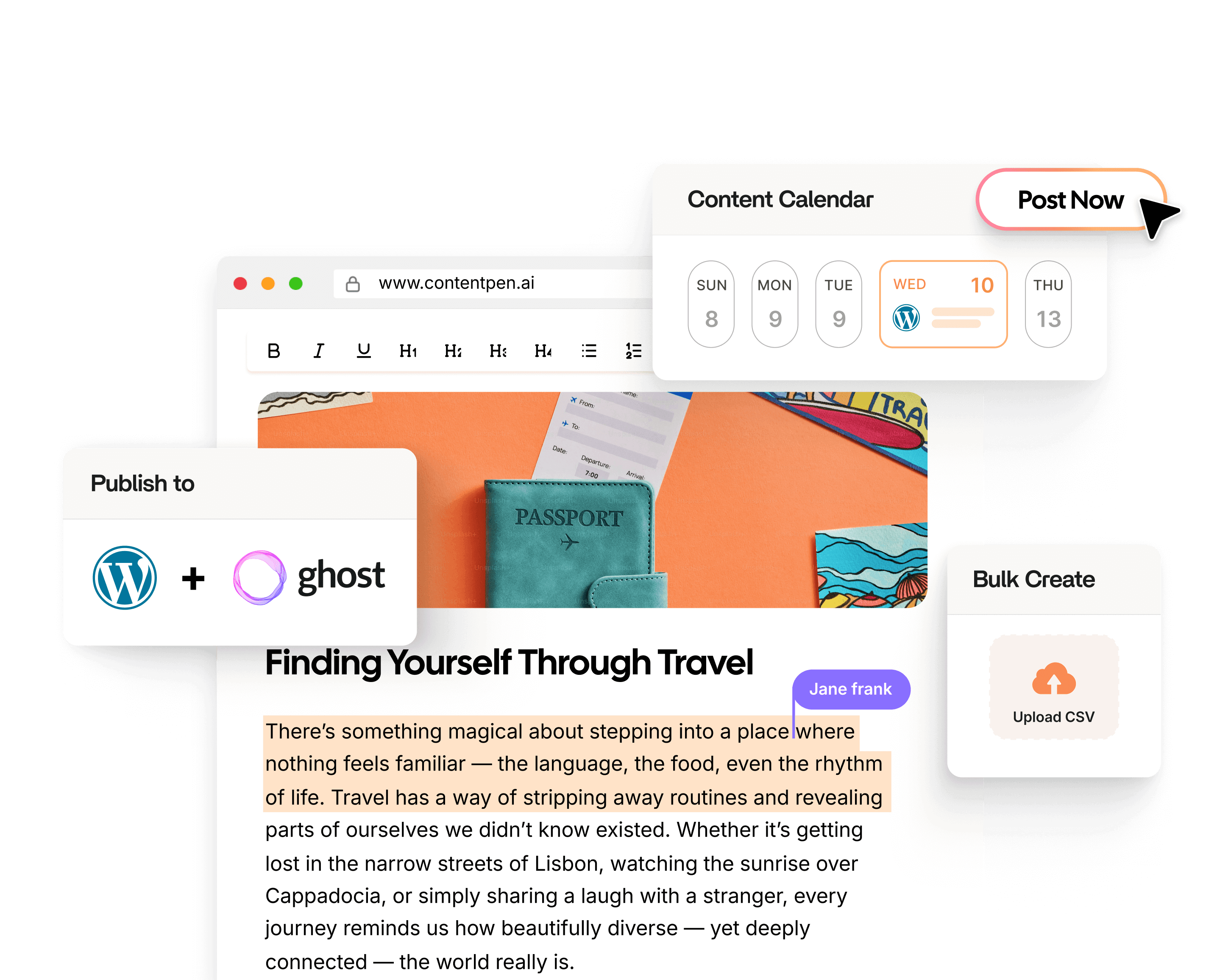
That said, none of this replaces the work of understanding your audience described earlier in this guide, since even the best tool has nothing meaningful to optimize without a solid strategy feeding it.
What are real examples of successful SaaS content marketing?

The best SaaS content marketing examples all share one trait: they pick a distinct angle and voice rather than copying a generic blog, video, or post.
Ahrefs, the leading SEO SaaS tool, built its entire strategy around solving one problem per post, always tying the fix back to its own software. It reportedly grew past $40 million in annual recurring revenue (ARR) in 2019, all without paid Google ads.
Other companies lean into approaches that feel almost risky at first glance. Dacast, an OTT streaming platform, names direct competitors inside its own comparison or alternative roundups, which builds user trust through honesty.
Let’s analyze some more brand playbooks worth studying to learn key SaaS content marketing trends in 2026.
| Brand | Core content approach | Result worth noting |
| Ahrefs | Product-tied blog posts solving one SEO problem each | Grew past $40M ARR with no paid Google ads |
| ProfitWell | Pricing page teardowns of known brands | Ranks for 55,500+ keywords |
| dacast | Naming competitors directly in comparison posts | Ranks for 106,000+ keywords |
| Hotjar | Hub-and-spoke content around “heatmaps” | Holds the top search spot for the term |
| Atlassian | One all-in-one resource page combining video, guides, and visuals | Competes for a term with 47,000 monthly searches |
To sum it up, these content marketing strategy examples show that it is okay to challenge the norm, be authentic, and honest in your analysis that people love.
They also show that adding original data, statistics, and thoughts always results in better trust and, therefore, sales for your SaaS products.
Final thoughts
Winning SaaS content marketing in 2026 starts with a clear product story, builds from the bottom of the funnel, and uses AI to move faster without losing the original insight.
Skip straight to blog volume, and you’ll end up with traffic that never converts. Skip strategy entirely, and even the best AI draft won’t rank or get cited by an AI search engine.
The path that works is boring but reliable. Use clear messaging, utilize real customer research, and establish a steady publishing habit built around formats that match how your buyers actually search.
If you’re starting from scratch, don’t try to build every content type at once. Pick one high-intent page, a use case page, or a comparison page against your closest competitor, and get that right before scaling into broader content.