 20 minutes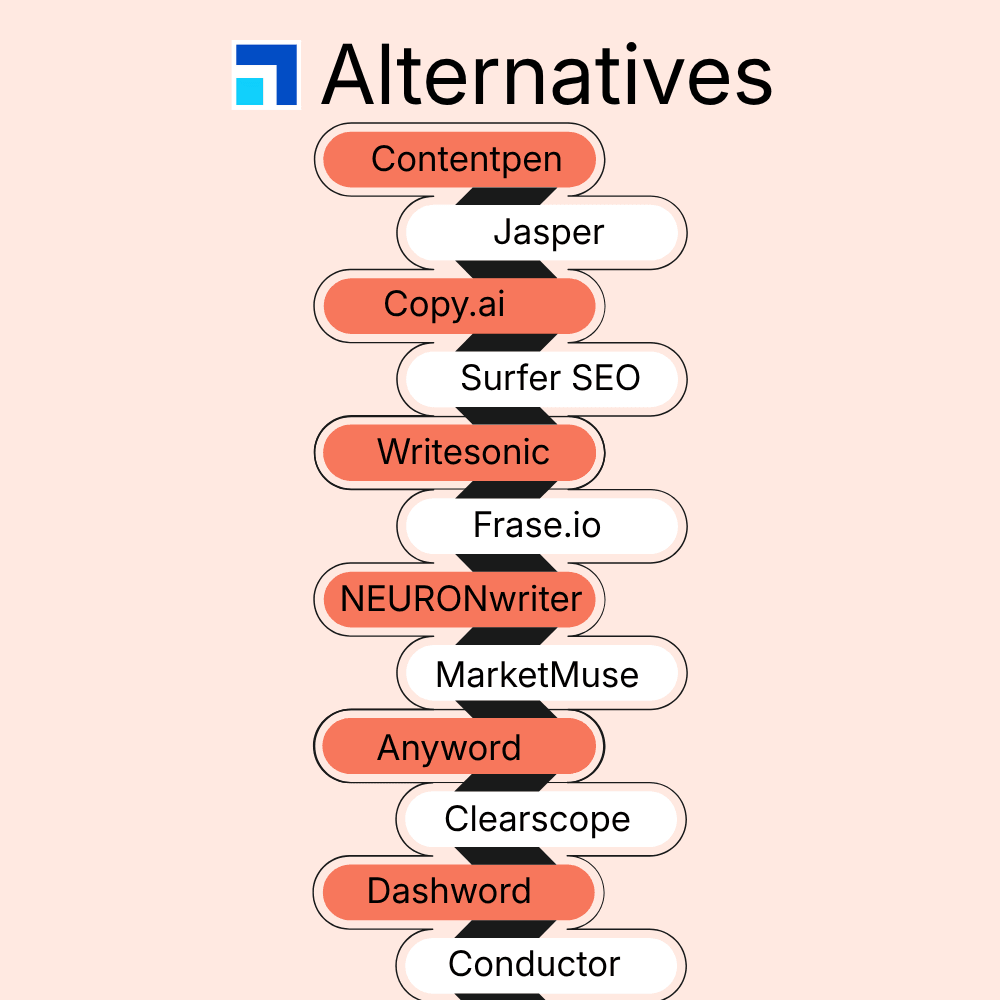
Scalenut is a capable AI SEO writer. It blends research, AI writing, and optimization in a single workflow. Yet, the AI writer falls short in some aspects, which pushes users to look for Scalenut alternatives.
This guide walks through 12 top Scalenut alternatives for 2026 that we personally tested. You will see different tools, all of which will have their own strengths and weaknesses, making them fit for a specific use case.
By the end, you’ll also see how Contentpen emerges as the best Scalenut alternative for content marketers, agencies, and enterprises.
But first, let us dive deep and learn a bit more about Scalenut.
What is Scalenut?
Scalenut is an AI‑powered platform for content planning, writing, and optimization.
It is built around Generative Engine Optimization (GEO) and Search Engine Optimization (SEO), which aims to help you rank on Google and get cited by AI systems.
The app combines research features, an AI draft writer, and an editor that scores your content as you go.
Scalenut benefits
With Scalenut as your primary content driver, you get the following features and benefits:
- Gaps/Gains: This feature allows writers to see what other SERP competitors have posted for a particular target keyword. It also enables you to add the missing angles in the content to gain a ranking boost.
- Cruise Mode: With this mode, the tool focuses on first drafts of blog posts. You provide a topic, target terms, and a rough angle, and it returns a structured article you can refine and fact‑check.
- Brand Monitor: The Brand Monitor tracks mentions of your brand by AI engines. It also provides a visibility ranking to show your share of voice in the niche and how you can improve it.
- Detect and Humanize: Scalenut allows users to convert their robotic, mundane, monotone copy into something more relatable and engaging for the audience. The feature is built into the writing workflow.
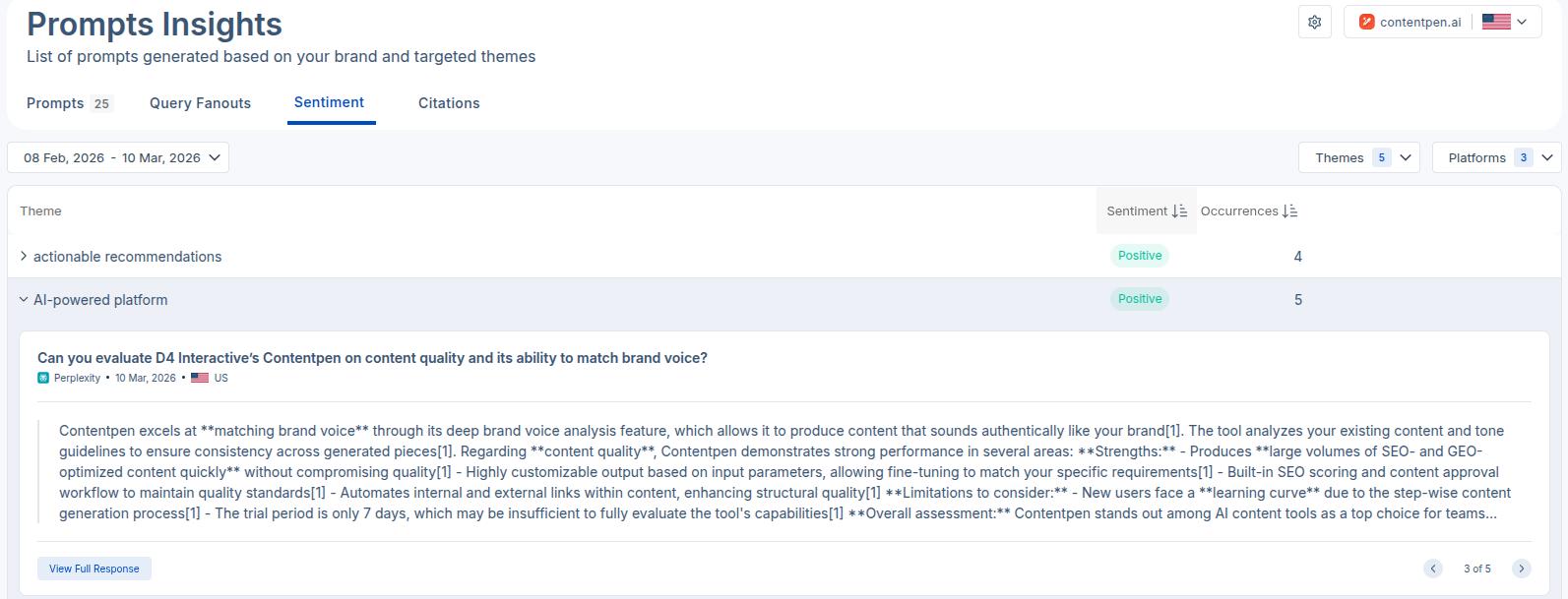
- Prompts Insights: Scalenut extracts responses from AI models based on particular prompts to show the AI sentiment of your brand. You can incorporate these insights into your content strategy for better growth.
Scalenut cons
Even with this range, many teams start to explore alternatives because of some particular limitations.
- Heavy editing on every draft: If writers spend most of their time rewriting AI output, then the tool feels like a rough starting point instead of a time saver. This is a recurrent problem with Scalenut.
- Missing visuals: Output often arrives without images, charts, or embeds, so you still need to add design elements and social proof by hand.
- Lack of cohesive brand voice controls: Agencies and larger brands want strict tone and style control with an easy-to-use interface, which Scalenut fails to provide, especially for bulk content creation.
- Pricing and limits: Even with a Scalenut free trial (7-days), users are restricted from using specific GEO features. Also, moving into higher tiers can be a stretch for small teams and freelancers, with the ‘Professional’ plan being $199/month.
- Narrower needs: Some users only need research and briefs, while others care more about social copy or on-page SEO. For focused, restricted use cases, a smaller, task‑specific tool often wins.
With these Scalenut pros and cons in mind, let’s explore the 12 best Scalenut alternatives available today.
Top 12 Scalenut alternatives worth your consideration
Below, you’ll find our list of the best Scalenut alternatives on the market, based on their features, integrations, use cases, and pricing.
1. Contentpen – Best for automated content workflows with SEO and GEO-optimization

The reason we rate Contentpen so highly is that it competes with Scalenut directly on all fronts while bringing some new features to the table.
| Feature | Contentpen | Scalenut |
| Automated internal + external linking | ✅ Yes | ❌ No |
| Multiple content planner views | ✅ List View, Kanban Board, and Calendar | ❌ Generic content planner |
| CMS integrations | ✅ WordPress, Ghost, Wix, Webflow, and Shopify | ❌ Only WordPress and Ghost |
| Strict brand voice control | ✅ Yes | ❌ Outputs can feel adrift from the customized voice |
| SEO scoring | ✅ Yes | ✅ Yes |
| Web analytics | ✅ Yes | ✅ Yes |
| Keyword planner | ✅ Yes | ✅ Yes |
| AI media library | ✅ Yes | ✅ Yes |
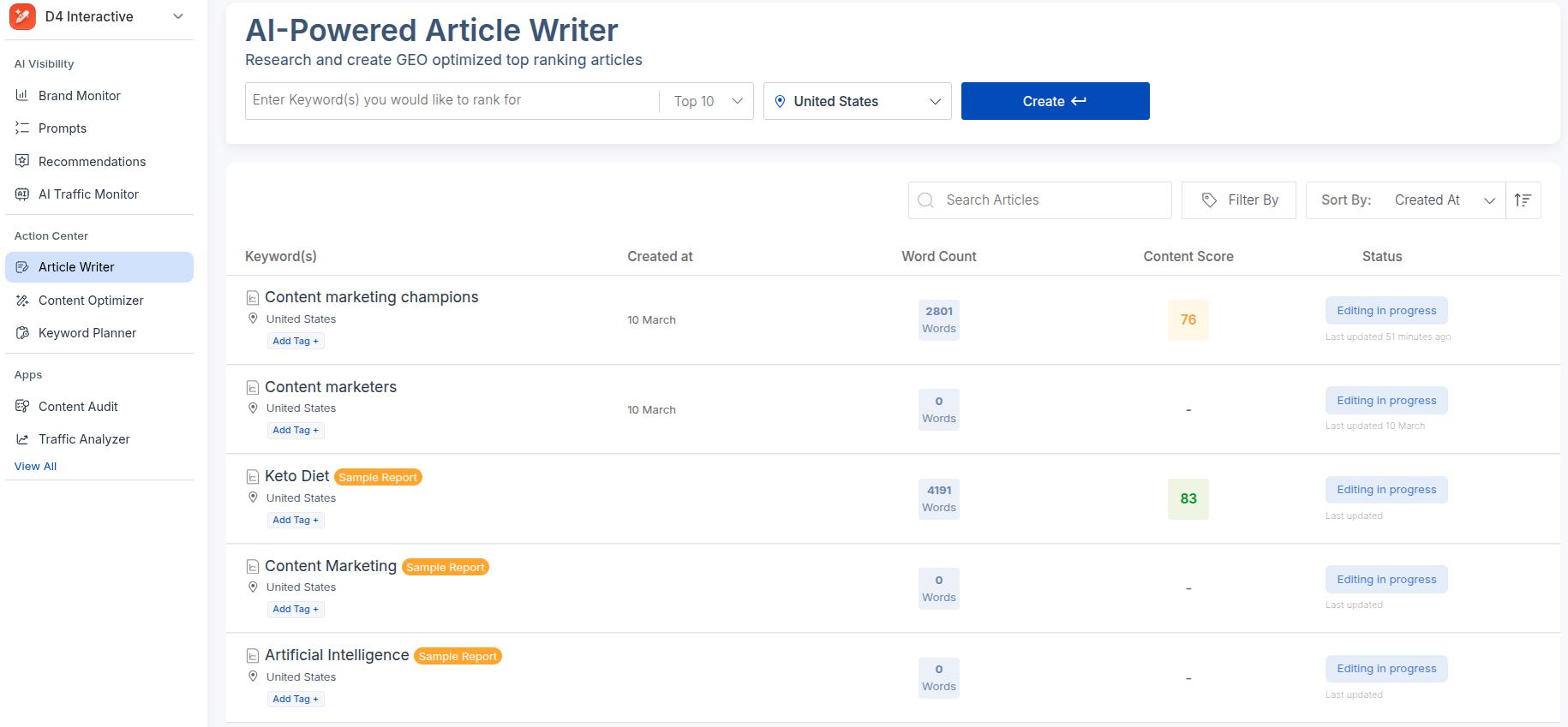
In our testing of the two tools, we found Contentpen focusing more on generating SEO and GEO optimized content with clarity, coherence, and simplicity.
Every option inside the workflow serves a clear purpose, and outputs received feel genuinely readable and conversational without the buzzwords.
Why Contentpen stands out:
- End-to-end content workflow: Unlike Scalenut, Contentpen automates the complete content workflow. You don’t need to hop on another tool to see analytics or utilize SEO ranking opportunities.
- Full access to features in free trial: Unlike Scalenut, our AI writing tool provides complete access to all features in the free trial, which allows users to deeply explore the platform before purchasing.
- Creates content that actually delivers: Unlike other Scalenut alternatives, Contentpen-generated blogs deliver consistent results that you can measure and optimize if needed without any problems.
Write content that’s built to rank, not just read
Create search-optimized blogs aligned with SEO and GEO signals, so your content performs well across search and AI-driven discovery.
Try SEO Blogging FREE →
- More control at a lower price: Contentpen starts at just $27/month, which is nearly half the price of Scalenut’s ‘Starter’ plan ($59/month) with more functionality.
Pricing:
Contentpen offers three pricing plans for its users. The options below are billed annually.
- Starter: ($27/month)
- Premium: ($55/month)
- Agency: ($139/month)
2. Jasper – Best for brand voice control and content templates

Jasper is an AI writer built for marketing teams and agencies that care about brand voice across channels. It can produce blog posts, ads, emails, and more from one shared brand knowledge.
Standout features:
- Features like ‘Brand IQ’ and ‘Content Pipelines’ let you upload style guides, tone rules, and key facts once, then keep content aligned across writers and clients.
- Collaboration tools help teams manage campaigns, group assets, share context, and review drafts in one place.
- 50+ content templates allow users to create different types of content without facing writer’s block or missing crucial deadlines.
Limitations:
- While Jasper is a powerful tool, it does not beat Scalenut in terms of Generative Engine Optimization features.
- Jasper isn’t a proper SEO tool. This is one of the few reasons why users look for a solid Jasper.ai alternative.
Pricing:
Starts at $59/seat/month (billed annually), which is costly compared to other tools on the list.
3. Copy.ai – Best for GTM-workflows
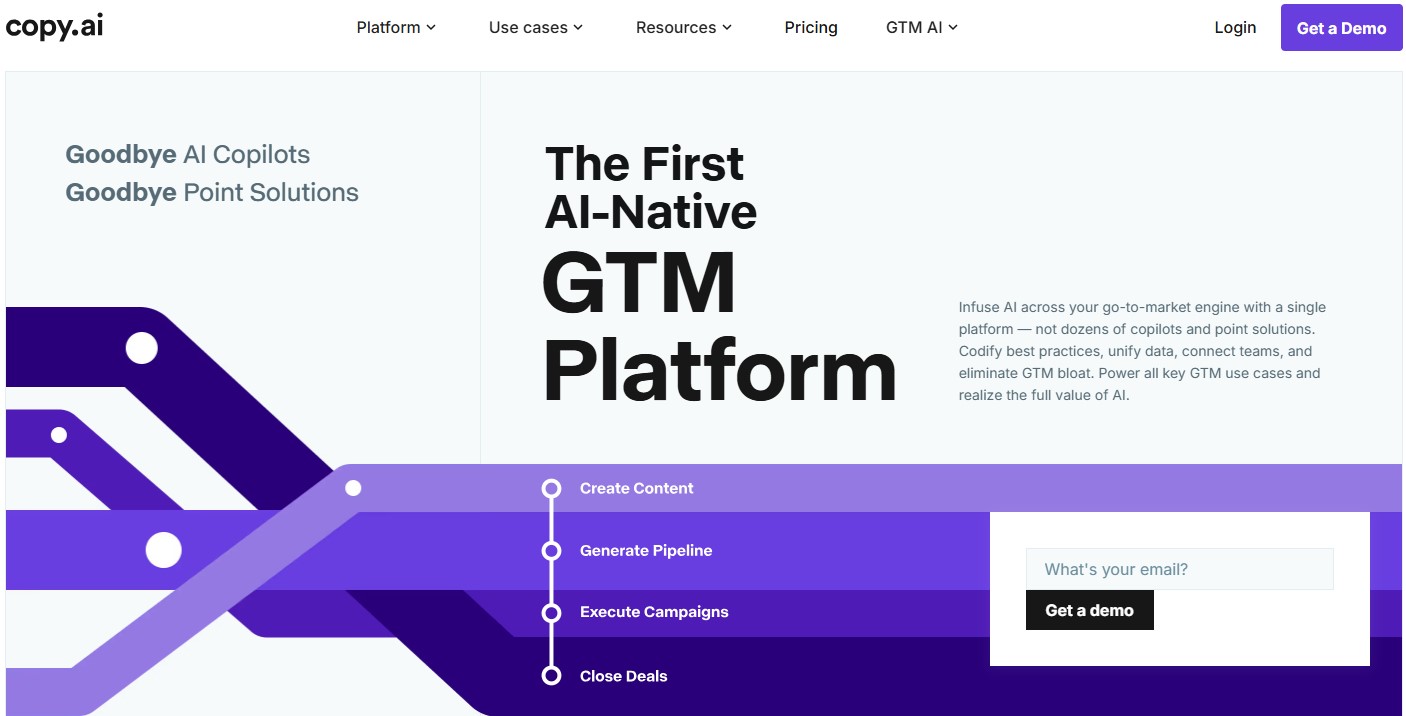
Copy.ai targets marketing teams that need many campaign assets quickly. It leans on guided flows for outbound emails, product launches, and social calendars.
Standout features:
- Instead of a blank canvas, you choose a workflow. Then, Copy.ai asks a few questions and generates a full set of related assets.
- Copy.ai provides over 90 content templates that cover a wide range of channels so you can spin up headlines, posts, and messages in minutes for rapid testing and implementation.
- AI-powered Lead Scoring helps you analyze data signals to identify promising prospects. It covers sales angles that other AI content creation tools like Scalenut simply don’t.
Limitations:
- Weaker in GEO capabilities, which can result in missed AI mentions.
- A mix of sales, marketing, content creation, forecasting, and other verticals can confuse first-time users.
Pricing:
Pricing starts at $29/month. SEO and GEO options are limited, so you might need to pair this tool up with an AI SEO optimization software.
4. Surfer SEO – Best for on-page SEO optimization
Compared to Scalenut, Surfer SEO focuses on on‑page optimization and content scoring. It plugs into your editor to show how your draft compares with competitors, providing AI-powered suggestions for better ranking.
Standout features:
- ‘AI Search Visibility’ monitoring assists marketers in analyzing their visibility in AI discovery platforms. The insights help you win buyer trust by allowing you to take control of your AI mentions.
- Surfer also offers audits and a content planner that nudges you toward related topics and quick wins.
- Powerful SEO audit feature helps identify underlying problems with your site and provides AI-powered recommendations for quick fixes.
Limitations:
- Even though Surfer SEO is a great Scalenut alternative, it falls short in terms of its long-form content creation at scale.
- Surfer SEO is one of the most expensive alternatives to Scalenut, which is why many individuals and small businesses seek Surfer SEO alternatives.
Pricing:
Pricing starts at $99/month (billed annually).
5. Writesonic – Best for overall content creation and optimization

Writesonic is a flexible AI content platform that covers blogs, ads, product copy, and more. In our experience, Writesonic suits teams that want one general tool instead of several specific ones.
Standout features:
- The interface offers many ready‑made templates: pick the use case, give a short brief, and quickly get the first draft.
- Writesonic provides GEO‑style features and SEO guidance, including keyword ideas and readability tips for long‑form content.
- Chatsonic, the built-in AI assistant, helps optimize and enhance the generated content with ease.
Limitations:
- Writesonic is one of the most expensive Scalenut alternatives on our list, which is why it is important to consider some Writesonic alternatives if budget is your concern.
- Unlike Scalenut, you cannot find the ‘Social Engagement’ features in the basic plan in Writesonic.
Pricing:
The pricing starts at $199/month.
6. Frase.io – Best for competitor analysis and brief generation
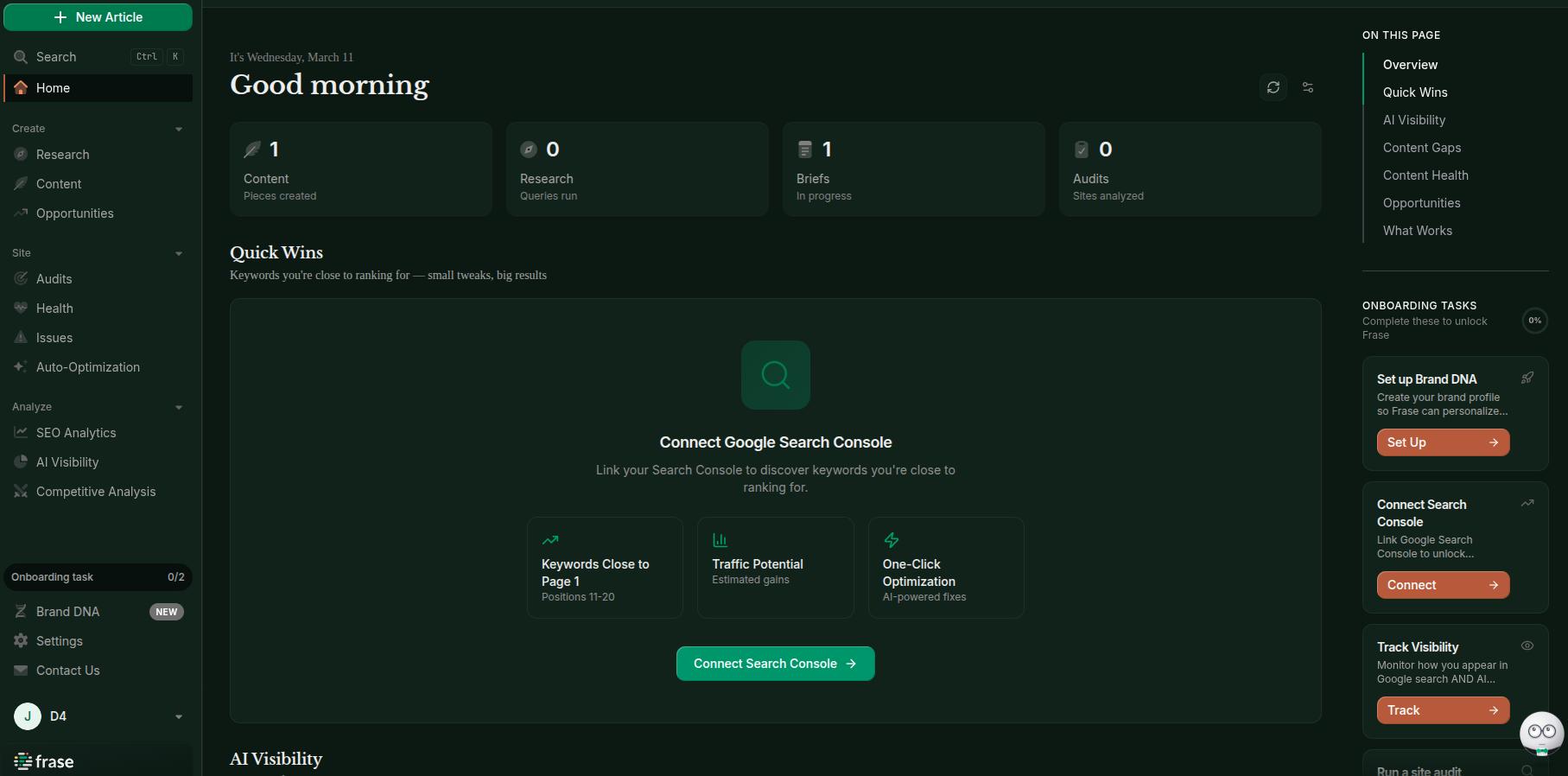
Frase.io combines SERP analysis, briefs, and AI drafting in one tool. It helps teams research and outline faster, then create drafts based on that research to create comprehensive pieces that rank and convert.
Standout features:
- The research view pulls headings, questions, and stats from top results so you can drag items into an outline with a few clicks.
- Its editor lets you write or generate text in the same space while watching an optimization score.
- Frase.io’s image generator helps you create meaningful visuals along with written content.
Limitations:
- Compared with Scalenut, Frase.io doesn’t provide a built-in humanize option.
- Frase’s integrations are also limited, compared to tools like Scalenut or Contentpen.
- Long‑form output can feel thin without strong prompts or manual rewriting,
Related read: Frase.io alternatives.
Pricing:
The pricing starts at $39/month (billed annually) in the ‘Starter’ plan, with the ‘Scale’ plan offering maximum functionality at $239/month.
7. NEURONwriter – Best for semantic SEO and content optimization
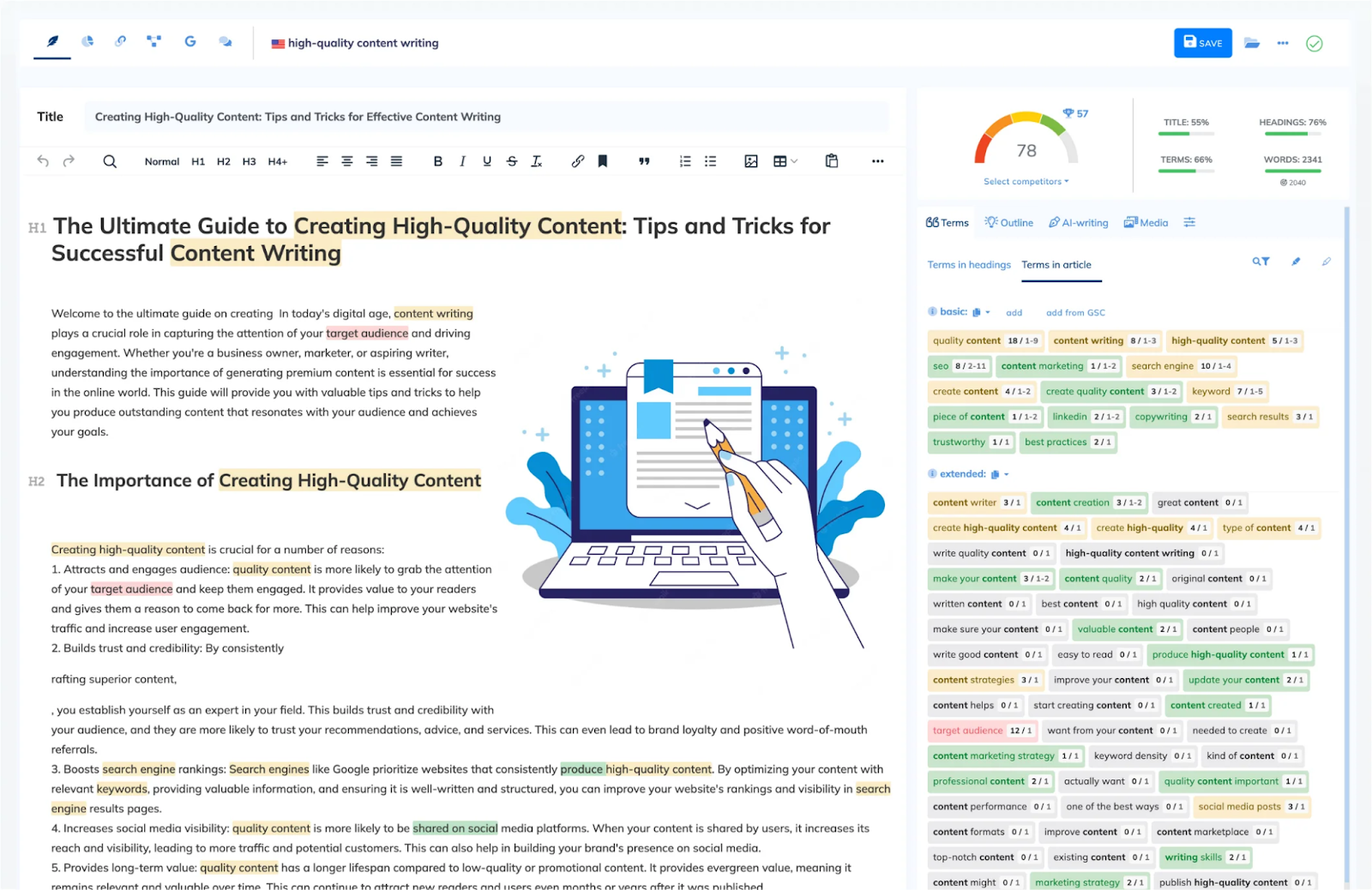
NEURONwriter sits in a sweet spot between a research tool and an AI writer. It leans heavily on semantic SEO analysis, pulling NLP terms and competitor data to help you build content that search engines can actually parse and rank.
Standout features:
- NEURONwriter’s internal linking suggestions are always contextual and relevant, allowing you to create a strong internal site structure with ease.
- The SERP analysis view breaks down competitor headings, word counts, and term usage side by side so you can spot structural gaps before you write.
- NEURONwriter allows you to rank your platform in different countries, depending on your business type and needs.
Limitations:
- The UI feels cluttered once you have several projects running. Navigating between content plans, drafts, and audits takes more clicks than it should, which slows down high-volume workflows.
- Unlike Scalenut, there is no built-in GEO or AI visibility monitoring, which is a gap worth considering if AI citation tracking matters to your strategy.
Pricing:
Pricing starts at $23/month, making it one of the more affordable alternatives on this list for teams that primarily need optimization over full content generation.
8. MarketMuse – Best for content strategy and topic authority planning

MarketMuse takes a top-down approach to content. Instead of helping you write one article at a time, it maps your entire domain’s topical authority and tells you exactly where to invest content effort for the highest return.
Standout features:
- The ‘Competitor Analysis’ feature analyzes all your rivals with one click. This gives content strategists a clearer picture of where authority gaps exist across the whole domain and how to capture an angle with ease.
- Content briefs generated by MarketMuse are genuinely detailed. They include target topics, related questions, recommended word counts, and suggested internal links.
- The personalized difficulty score is unique. It adjusts based on your domain’s existing authority, so you are not chasing the same difficulty benchmarks as a brand-new site would.
Limitations:
- MarketMuse is not built for speed. The platform feels more suited to monthly strategy sessions than production-level content publishing.
- Compared to Scalenut’s Cruise Mode, there is no fast-draft feature that takes a brief and returns a full article. You still need a separate writing tool to execute the strategy MarketMuse builds.
- The free plan is extremely restricted, with only ten queries/month, which makes it difficult to evaluate the tool properly before committing to a paid plan.
Pricing:
The free plan covers basic usage. The exact figure is not mentioned for paid plans. In general, the tool is targeted at large-scale enterprises.
9. Anyword – Best for performance-driven copy and predictive scoring

Anyword predicts how well a piece will perform with a specific audience before you publish it, rather than focusing on SEO structure. We liked its conversion-focused approach, which is unique among Scalenut alternatives.
Standout features:
- The tool rates each variation of your copy based on audience data. It gives you a tangible signal to choose between headline or CTA options without running a full A/B test.
- Anyword’s ‘Data-Driven Mode’ lets you connect existing ad performance data, so the AI learns from what has actually worked for your brand rather than generating generic output.
- The blog post wizard produces structured long-form drafts with keyword research, which covers a reasonable portion of what Scalenut’s Cruise Mode does, though with less SEO depth.
Limitations:
- The SEO capabilities are noticeably thinner compared to Scalenut. There is no SERP competitor analysis built into the writing workflow, which means you are optimizing for conversions more than rankings.
- Anyword works best for short-to-mid-length copy. Long-form blog content at scale can feel inconsistent, requiring heavier editing passes than you would ideally want.
Pricing:
Pricing starts at $39/month (billed annually) for the Starter plan.
10. Clearscope – Best for content grading and editorial team alignment

Clearscope has built a reputation as the go-to content grading tool for editorial teams. It is not trying to write content for you. It is designed to make whatever you or your writers produce rank better.
Standout features:
- The content grading system is clean and immediate. Paste or write your draft, and Clearscope highlights which NLP-relevant terms are missing, overused, or well-covered.
- Clearscope integrates directly with Google Docs, Google Search Console, and WordPress. It allows you to see web analytics directly in one place without switching tabs.
- The keyword discovery reports surface related terms and topic clusters that help writers expand thin content into comprehensive pieces. Clearscope also helps create targeted, locally focused content.
Limitations:
- Compared to other Scalenut alternatives, Clearscope is very expensive. We also believe that you don’t get the value with this tool, as you only get 20 monthly drafts at a marginally higher price than others.
- Unlike other tools on the list, there’s no unique angle to Clearscope. It isn’t an AI writer that stands out due to its GTM workflows, on-page SEO, or any other feature set.
Pricing:
Pricing starts at $129/month, with the ‘Enterprise’ plan also available to support bulk content generation and high-volume workflows.
11. Dashword – Best for teams that need fast content briefs
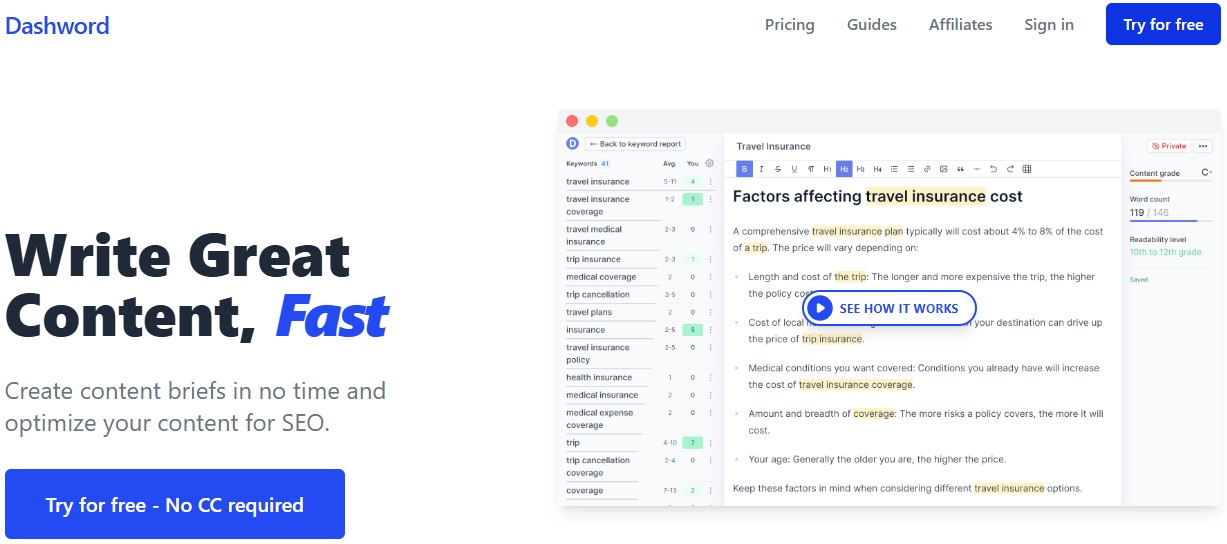
Dashword strips content optimization down to the essentials. In our testing, we appreciated Dashword’s simplistic UI. You enter a keyword, and the tool immediately returns a content brief and optimization report that you can use.
Standout features:
- The keyword rank tracker identifies low-hanging fruit to help you quickly capture a target market with ease.
- Real-time feedback makes it convenient to make the required changes as you write the content. The result is publishable content that requires the least editing and hassle.
- The simple interface means onboarding a new writer takes minutes, not days. There are no feature menus to navigate or settings to configure before someone can produce their first optimized piece.
Limitations:
- Dashword’s AI writing output is basic. Unlike Scalenut, Dashword’s generation layer feels like a supplement rather than a core feature.
- There is no brand voice control, content calendar, or GEO monitoring. For agencies managing multiple clients, the lack of organizational features quickly becomes a friction point.
Pricing:
Pricing starts at $99/month for up to 30 content reports, making it a reasonable fit for small teams with a predictable, moderate publishing workflow.
12. Conductor – Best for cross-team content intelligence
Conductor is built for enterprise marketing teams that need SEO data, content performance insights, and cross-department collaboration rolled into one platform.
Standout features:
- The Content Guidance feature surfaces keyword opportunities and content recommendations directly inside a workflow that connects to your broader site performance data.
- Conductor’s reporting layer ties content performance to business outcomes, giving marketing leaders the kind of revenue-linked visibility that justifies SEO investment at the executive level.
- The platform includes strong integrations with enterprise CMS platforms, which reduces the data silos that typically slow down large content teams.
Limitations:
- Compared to Scalenut’s self-serve setup, Conductor requires a significant onboarding investment. The platform is not something a solo marketer or small team can pick up and run.
- Pricing is not publicly listed, which is a common friction point for teams trying to evaluate it against more transparent competitors.
Pricing:
Conductor does not publish pricing publicly. You will need to contact their sales team for a custom quote.
The comparison table for the 12 best Scalenut alternatives
Below is a table for all the details we’ve discovered and discussed so far for the Scalenut alternatives.
| Tool | Ideal Use Case | Key Limitation | Starting Price | G2 Rating |
| Contentpen | Content marketers and agencies that want end-to-end automation from keyword to publication | Limited 7-day trial period | $27/month | 4.9/5 |
| Jasper | Marketing teams that need consistent, on-brand output across blogs, ads, and emails | No native SEO or GEO features without third-party integrations | $59/seat/month | 4.7/5 |
| Copy.ai | Sales and marketing teams that need multiple campaign assets generated from a single workflow | Weaker GEO capabilities | $29/month | 4.7/5 |
| Surfer SEO | Writers who want real-time feedback on drafts against competitor benchmarks | Expensive for small teams | $99/month | 4.8/5 |
| Writesonic | Teams that want one platform for blogs, ads, product copy, and basic content optimization | One of the most expensive options on the list | $199/month | 4.7/5 |
| Frase.io | Researchers and writers who need fast, data-backed outlines before drafting | No humanize feature and limited third-party integrations | $39/month | 4.6/5 |
| NEURONwriter | Freelancers and small teams that need solid on-page optimization without the enterprise price tag | Cluttered UI at scale | $23/month | 4.9/5 |
| MarketMuse | Enterprise teams building long-term authority across large content libraries | No fast-draft feature | Custom pricing | 4.6/5 |
| Anyword | Conversion-focused marketers who want data-backed copy decisions | Thin SEO capabilities and no GEO monitoring | $39/month | 4.8/5 |
| Clearscope | In-house editorial teams that need precise NLP scoring | Premium price for a tool that covers only the optimization stage of the workflow | $129/month | 4.9/5 |
| Dashword | Small teams or solo creators that need quick briefs without a learning curve | Basic AI writing output with no brand voice control | $99/month | 4.6/5 |
| Conductor | Enterprise marketing teams that need SEO data tied directly to revenue and business outcomes | Steep onboarding commitment | Custom pricing | 4.5/5 |
How to choose the right Scalenut alternative for your needs
With so many Scalenut alternatives and other SEO writing tools available in 2026, it can become difficult to choose the right tool. Feature lists blur together, and every site promises faster content and higher rankings.
But there’s a better way to select the best AI writer online. That is by matching each option to your biggest bottleneck.
- Start with your primary goal: If the top priority is organic traffic at scale, Contentpen is the best option you can choose. When the main need is brand‑consistent copy, then Jasper stands out.
- Decide the automation level: Hands‑on strategists often enjoy MarketMuse and similar platforms, whereas most content marketers enjoy Contentpen, Writesonic, and Frase.io for complete automation.
- Consider who will use the tool: Non‑technical freelancers and solo founders often do well with Copy.ai. Experienced SEO specialists may care more about Surfer SEO, Clearscope, or Contentpen.
- Set a firm budget: Always have a clear budget in your mind when evaluating tools. If budget is a concern, you can consider cost-effective options, including NEURONwriter, Anyword, and Contentpen.
Pro tip: Do not choose a tool based on features alone. Choose the one that fixes the workflow problem that hurts your results the most.
Similar to Scalenut’s free trial, most tools offer their demo versions for testing. Utilize the free versions to get a better idea of how the AI writer behaves in day-to-day writing workflows before making the final decision.
Final thoughts
Scalenut remains a solid choice for many content teams, but it is far from the best option available on the market. This is why it is necessary to review some Scalenut alternatives.
In this post, we saw the 12 best Scalenut alternatives in 2026. We learned that some tools focused on automation, while others prioritized brand voice control, research depth, or maximizing price-to-performance ratio.
Although each tool on the list had something unique to offer. Still, Contentpen emerged as the best Scalenut alternative due to its ability to match Scalenut on all fronts while also providing some additional features.