 13 minutes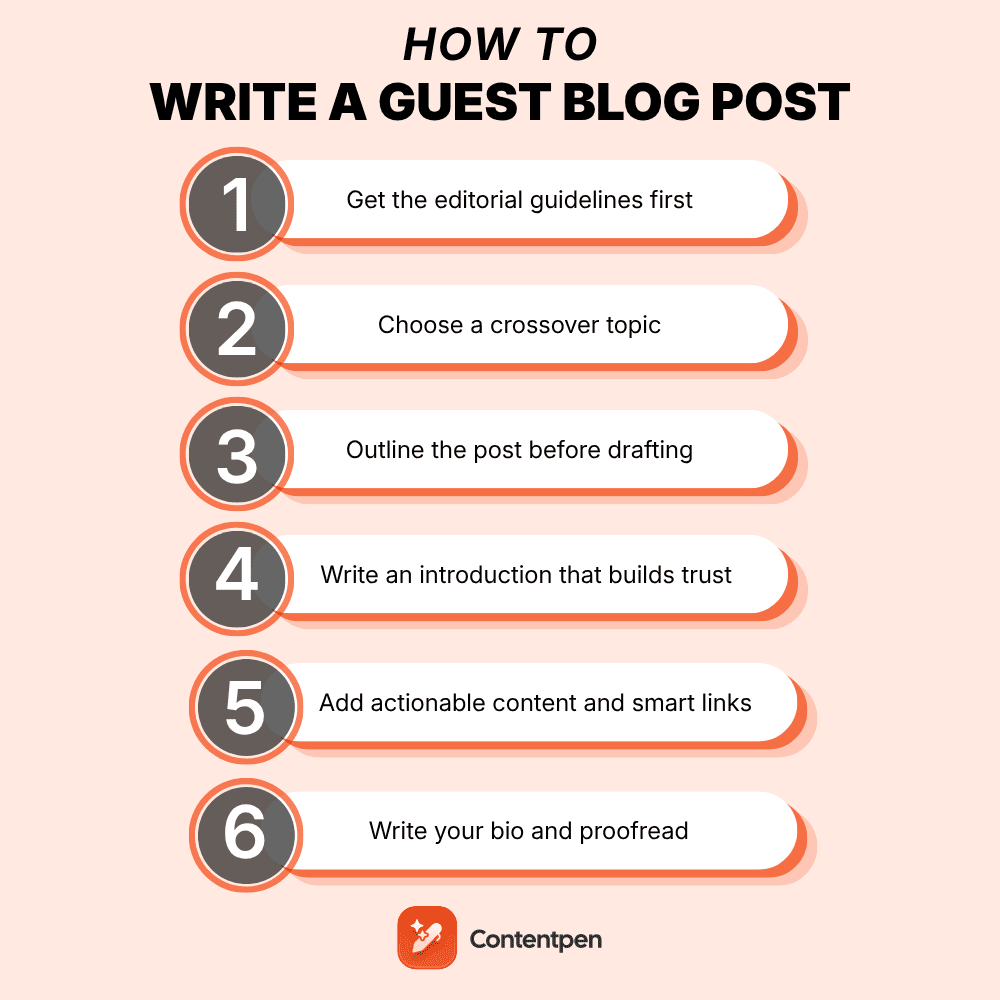
Getting a “thanks, but this isn’t a fit” reply after hours of writing is one of the most frustrating parts of guest blogging. Most rejections don’t happen because the writing is weak. They happen because the pitch was generic, or the draft ignored the publisher’s rules from the start.
Learning how to write a guest blog post that editors actually want means treating the whole process as a system.
You need to understand that you are competing against dozens of other guest posts sitting in that editor’s inbox right now. Editors skim fast, so a post that feels useful and on-brand for their site wins over one that reads like a sales page.
This guide covers how to write a guest blog post from start to finish, including finding the right sites, pitching, structuring the draft, adding links, and proofreading before you hit send.
So, let’s get to it, shall we?
Key takeaways
- Find crossover opportunities where your niche and the publisher’s audience genuinely overlap.
- Pitch with two or three specific headline ideas instead of one vague, generic request.
- Write for the publisher’s audience and follow their editorial guidelines to the letter.
- Make the post actionable and editorial, never promotional or sales-focused.
- Use tools like Contentpen to speed up research, outlining, and drafting processes across multiple pitches.
What is a guest blog post?

A guest blog post is an article you write and publish on someone else’s website instead of your own. It is usually accompanied by a short bio attached to your name to earn backlinks to your site or social profiles over time.
Guest posting lets you reach an audience you haven’t built yourself, in exchange for giving that site fresh, useful content. The arrangement works because it creates a genuine three-way benefit:
- The publisher fills their editorial calendar
- You gain traffic and a backlink
- Readers get information they wouldn’t have found otherwise
That backlink also carries brand association. When a reader already trusts the publisher, some of that trust transfers to you the moment your byline appears next to theirs.
Guest posting is still one of the strongest ways to boost your off-page SEO efforts, but only if done right.
How to find the right guest blogging opportunities
Finding the right guest blogging opportunities starts with matching audiences, not chasing the biggest blog you can find.
Look for guest posting sites where your expertise and the publisher’s readership genuinely overlap. Before pitching, spend a few minutes reading their recent posts to confirm there’s room for your angle and that you won’t just repeat what’s already been covered.
Identifying strong guest targets

Run through this quick checklist before you send a single pitch:
- Search for terms like “your niche + write for us” or “guest post guidelines” on Google to surface sites that openly accept outside contributors. Take the example of the “AI content automation + write for us” phrase that we typed into Google.
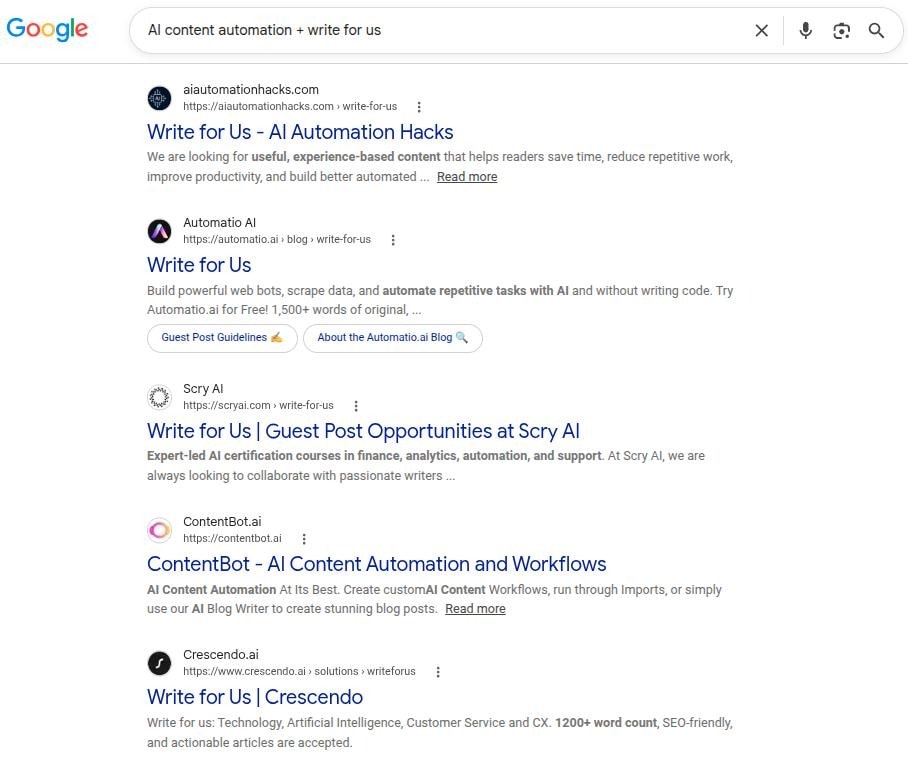
As you can see from the search results, these sites do accept guest content. However, there’s always a risk involved in link collaborations.
If a publisher’s “write for us” page feels more like a sales pitch than an editorial invitation, be cautious. Having a contributor page isn’t a red flag on its own, but if selling placements seems to be the site’s main business, it may be a private blog network (PBN).
- Review the blog’s recent posts for topic gaps your specific expertise could fill.
- Check domain authority with a trusted tool and engagement signals like comments and social shares to understand if guest posting on the site is going to be worth it or not.

Look for a site with DA higher than yours, preferably in the range of 50-60 or more. Also, check the traffic by location for the guest posting site.
For example, if you are a service-based business (HVAC, plumbing) in the United States, you should prefer US traffic since those are the people you’d naturally want to sell to.
- Check if the site advertises a price for the post. If they do ask for money to put your link up, it’s better not to indulge in this activity, since Google penalizes paid link exchange, according to the Link Spam update.
Remember, the more natural and organic the guest posting process is, the better. Sure, approval times may be significantly higher when guest blogging on actual sites, but it’s surely worth the wait.
Once you’re done with these steps, you are ready to pitch your guest post to the editor.
How to pitch a guest post that gets a yes
Landing the placement is often harder than writing the post itself, since popular blogs get more pitches than they could ever accept.
A pitch that gets a yes shows real familiarity with the host’s blog and proves to them that you understand their niche well.
Writing a clear, professional email with a specific subject line and a concise explanation of your proposed topic helps editors quickly assess whether your pitch fits their audience.
Generic spam pitches and hollow “give back to the community” messages get deleted within seconds, because editors can spot a “templated effort” from the first line.
Build rapport before you pitch
Cold pitches convert far better once the editor already recognizes your name from somewhere else. For that to happen, you should already have some published samples that either rank on Google or have won AI citations.
You can also follow this exact routine before pitching to build the rapport you need with editors:
- Spend a couple of weeks commenting thoughtfully on their recent posts.
- Reply to the hosts’ newsletter with genuine feedback.
- Engage with the publisher on LinkedIn or Instagram.
- When you eventually pitch, reference one of those specific articles by name, since it proves you actually read the site instead of mass-emailing every blog in your niche.
Spending time to learn about the hosts’ blog builds trust with the editors. You genuinely start on the right foot with them, giving you the leverage to add quality links back to your site with the least hindrances.
Write the pitch email properly

Follow this structure when drafting the email itself:
- Open with a specific line about their content. For instance, “Hey, I read about your AI visibility blog and loved how you explained the query-fan-out process.” This immediately grabs their attention.
- State your expertise in a sentence or two, backed by a real result or credential. For example, “Hey, this is Alex, founder of XYZ marketing (Forbes Unicorn Company).”
- Offer two or three headline ideas, each with one line explaining what it covers and why their readers would care.
Note: Never write the full guest post draft before you get approval on the angle. You can, however, do so if the publisher is reputable enough and you’re a beginner guest blogger with no online footprint to showcase your rapport. In that case, this could be your Hail Mary.
How to write a guest blog post step by step
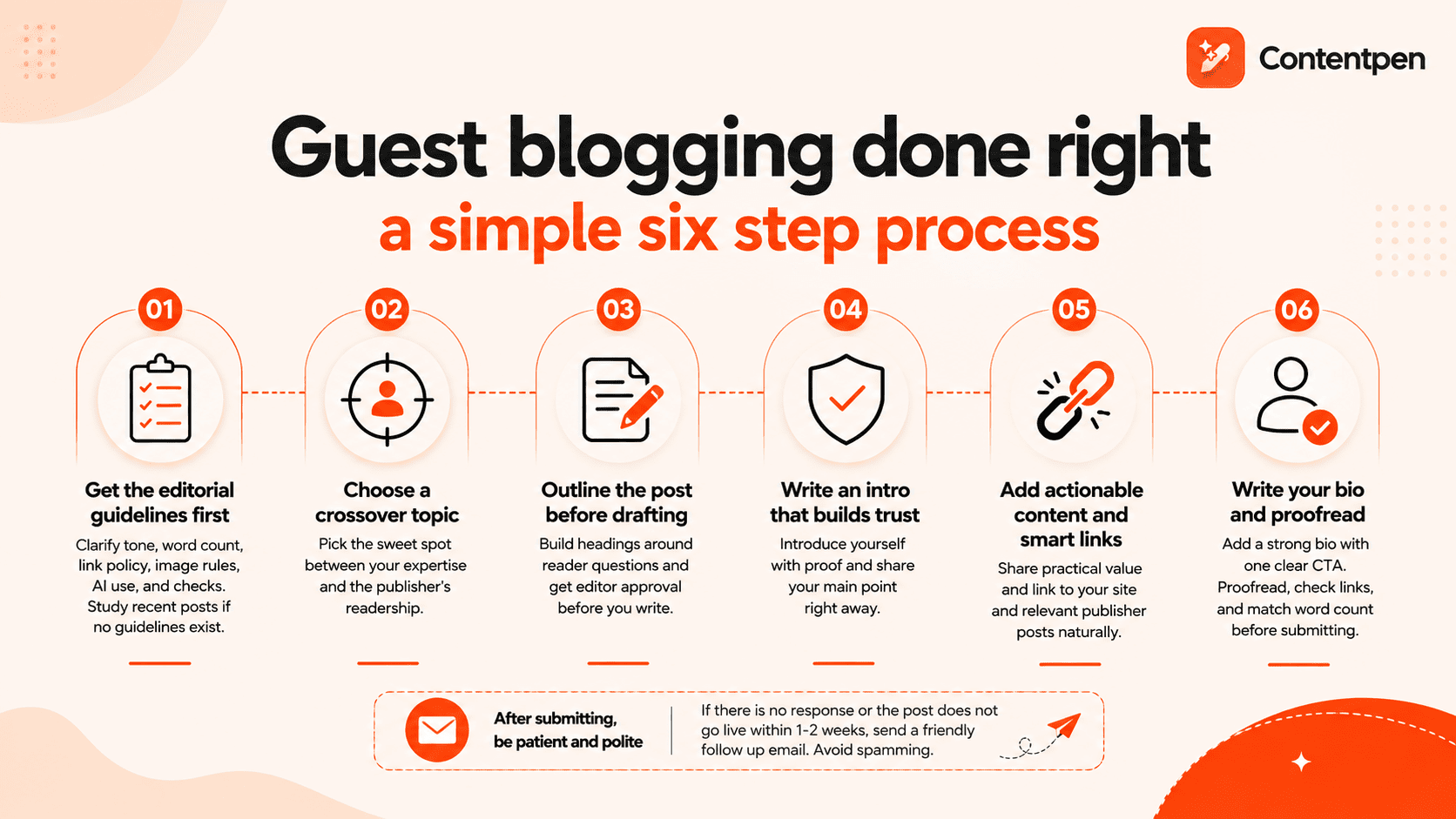
Writing a guest blog post that gets accepted follows a repeatable sequence, from research through final proofreading.
Each step below affects whether an editor publishes your draft as submitted or sends it back with a rejection, so skipping ahead usually backfires later in the process.
Step 1: Get the editorial guidelines first
Before you draft a single line, ask the publisher for the following details:
- Their preferred tone and voice.
- Expected word count.
- Link policy, including how many links are allowed and where.
- How many branded images are allowed per article.
- Rules on AI-assisted writing.
- Any plagiarism or readability checks that they look for.
If they have no formal guidelines, which is common for smaller blogs, study 5-6 recent posts to infer the voice, structure, and typical length they use instead of guessing. After a while, you will eventually see the pattern in the content they post, and all you have to do is follow it.
Step 2: Choose a crossover topic
Pick the topic sitting at the intersection of your expertise and the publisher’s readership, not just whatever ranks well for your own site.
Writing a topic that only serves the publisher’s audience might drive plenty of clicks back to your site. But those visitors won’t stick around if your own content won’t match what drew them there in the first place.
Step 3: Outline the post before drafting
Map your headings around the exact questions the publisher’s readers are typing into Google, rather than a generic list of talking points.
A tool like Contentpen can be a great help here to generate a detailed outline, tailored to your needs in minutes. It saves you from staring at a blank page while still matching the publisher’s expected structure and depth.
Once the outline is ready, get approval from the editor before proceeding to the next steps. If they’re out of office or unavailable for any reason, you may write the draft, but please be prepared to make any changes if requested later by the publisher.
Step 4: Write an introduction that builds trust fast
Introduce yourself in one sentence with a real proof point, such as “after ten years building outdoor furniture, here’s what actually holds up outside.”
Lead with your main point right away instead of a slow windup, since readers decide within a few seconds whether to keep scrolling or click away.
Keep the overall introduction of the article about 100-150 words (maximum) so that you can provide enough details to gauge the reader and also encourage them to read on.
Step 5: Add actionable content and smart links
This step matters more than any other in the entire process, since editors reject drafts here more often than anywhere else.
Always keep these rules in mind:
- Give readers concrete steps, checklists, or numbers they can use right away instead of abstract advice they’ll forget by lunch.
- Add a link to your own site early, tied to your name or brand, plus another one in your bio. Readers don’t scroll till the end, so it’s better to utilize the starting space of the blog for your own good while providing value to the publisher’s audience.
- Add links to the publisher’s existing posts, or internal links. This signals real research to the editor and also keeps your external links balanced in the article.
As a general rule of thumb, keep every sentence editorial rather than promotional, from the opening line to the final paragraph.
Step 6: Write your bio and proofread before submitting
Pair one strong trust statement with a single clear call to action, whether that’s your website, a landing page, or a free resource. Then proofread the bio several times before submitting.
Run through this final checklist before hitting send:
- Read the draft out loud once to catch awkward phrasing.
- Confirm every link works and points where it should.
- Match the word count against what the publisher requested.
- Double-check that your bio and call to action are both included.
Once you send your guest post and bio details to the publisher, wait. If you don’t get a response or your post doesn’t go live within 1-2 weeks, you can remind them again with an email.
However, if you keep spamming their email, you can blow away the chance of your collaboration. Remember that all great things take time.
How to get a guest post accepted and boost your results
Getting a guest post accepted the first time matters, but the writers who keep landing placements are the ones editors genuinely want to work with again.
Promote the piece after it goes live, tag the publisher across social platforms, and reference it in your own newsletter. Editors notice who actually helps distribute the content instead of disappearing right after publication.
Common mistakes that get guest posts rejected
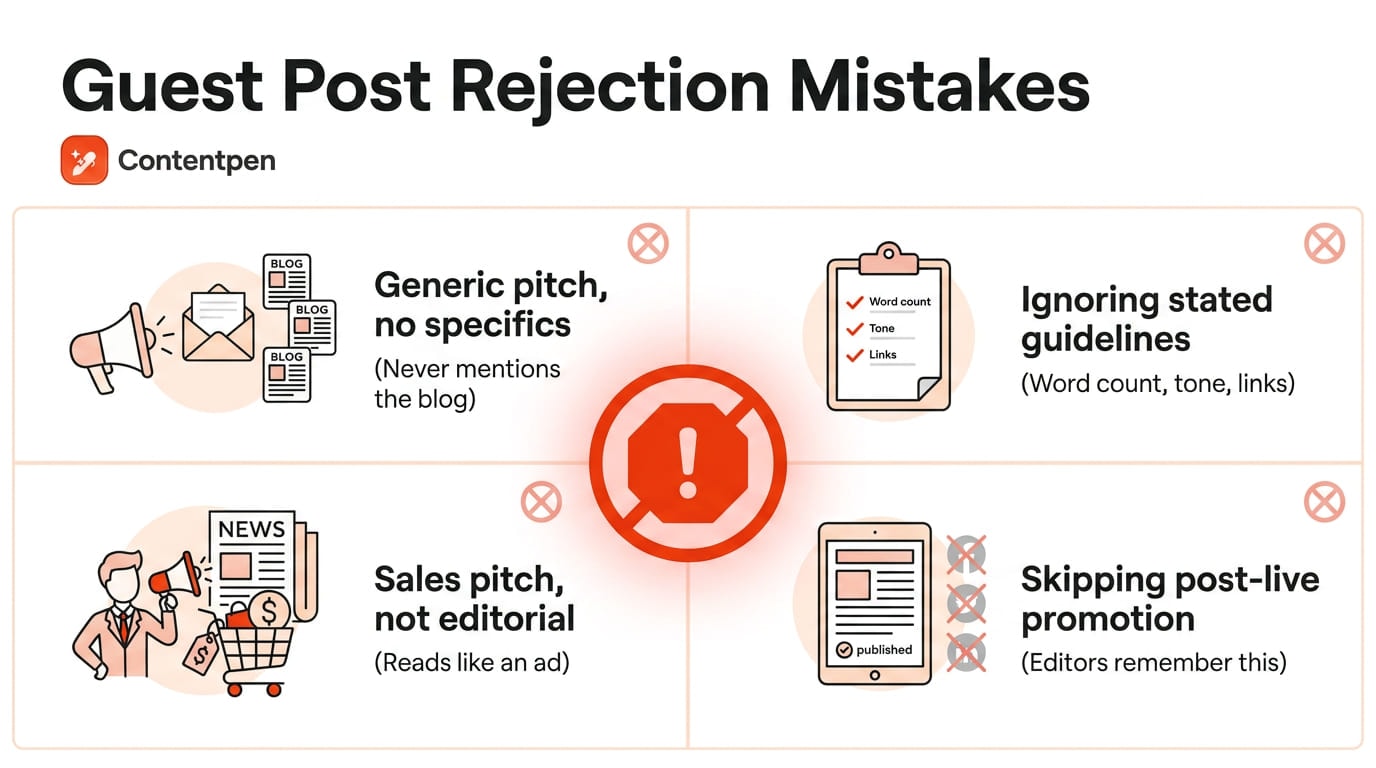
A handful of avoidable mistakes account for most of the rejections editors send out:
- Sending a generic pitch that never mentions a specific post, angle, or detail from the blog.
- Ignoring the publisher’s word count, link, or tone guidelines after they’ve already been provided.
- Turning the post into a sales pitch instead of genuinely useful, editorial content.
- Skipping promotion once the post is live, which editors remember before the next pitch arrives.
In general, ensure that your content is according to the EEAT guidelines with helpful links (besides your own), images, and video embeds where necessary.
Contentpen helps you with this process by taking you from an outline to a complete, SEO and GEO-optimized article.

From outline to publish-ready content that fills them

Structured
Consistent
SEO-aligned
Fast
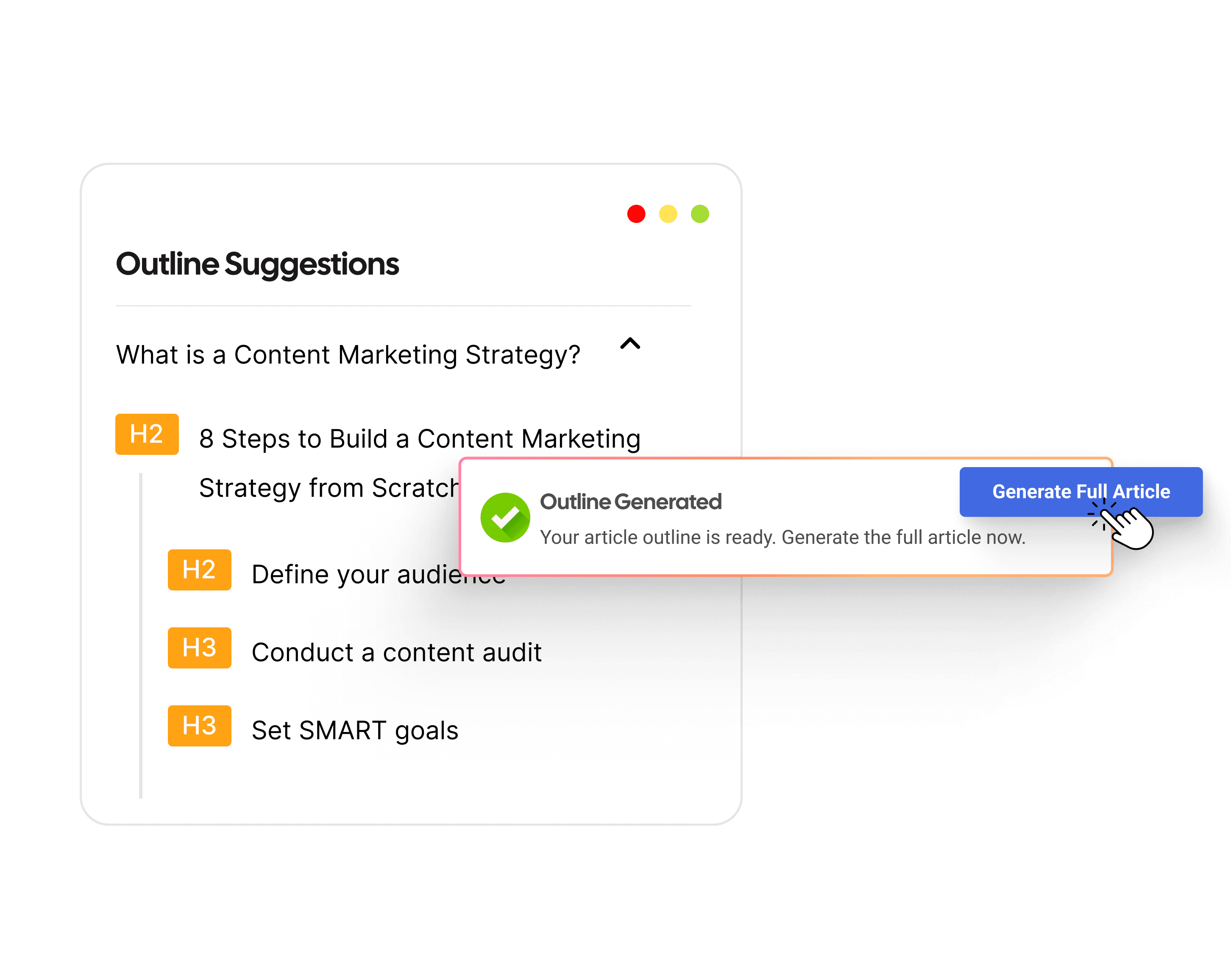
The tool also takes care of alt text for your images and ensures that everything is according to the publisher’s needs.
The takeaway
Guest blogging success comes down to research, following the publisher’s rules, and delivering real value.
Every step, from finding a crossover topic to writing a bio with one clear call to action, either builds an editor’s trust or loses it.
Platforms like Contentpen can handle the heavy lifting on research, outlining, and drafting, freeing up your time for personal outreach.
Now that you know how to write a guest blog post that fits an editor’s exact expectations, pick one site this week and send a specific, well-researched pitch. Follow it up by sending a complete, SEO-optimized guest blog post that helps you capture the right audience.
Frequently asked questions
Yes, when you target relevant, quality sites, since backlinks and audience overlap still drive real SEO and referral value. Low-quality mass guest posting on irrelevant or spammy sites has diminishing returns and can even hurt your reputation with search engines and readers.
Most guest posts run 1000 to 1,500 words, though the exact length depends entirely on the publisher’s own guidelines. Always check their submission requirements first and treat their stated minimum or maximum as the final word.
No, a website isn’t strictly required, but having one maximizes the backlink and lead-capture value of the post. Without a site, you can still direct readers to a social profile, a newsletter signup, or a portfolio page as your call to action.
It depends entirely on the publisher’s policy, so always ask before submitting an AI-assisted draft. In most cases, the editor may require you to run extra plagiarism or readability checks, regardless of how you created the content.
Search operators like “your niche + write for us” on Google surface sites that openly accept outside contributors at no cost. You can also check competitors’ backlink profiles for sites that have already published similar guest content, since that usually means they’re open to more.

Jawwad
Jawwad Ul Gohar is an SEO and GEO-focused content writer with 3+ years of experience helping SaaS brands grow through search-driven content. He has increased organic traffic for several products and platforms in the tech and AI niche. As an author at Contentpen.ai, he provides valuable insights on topics like SEO technicalities, content frameworks, integrations, and performance-driven blog strategies. Jawwad blends storytelling with data-driven content that ranks, converts, and delivers measurable growth.
View all posts by this author