 17 minutes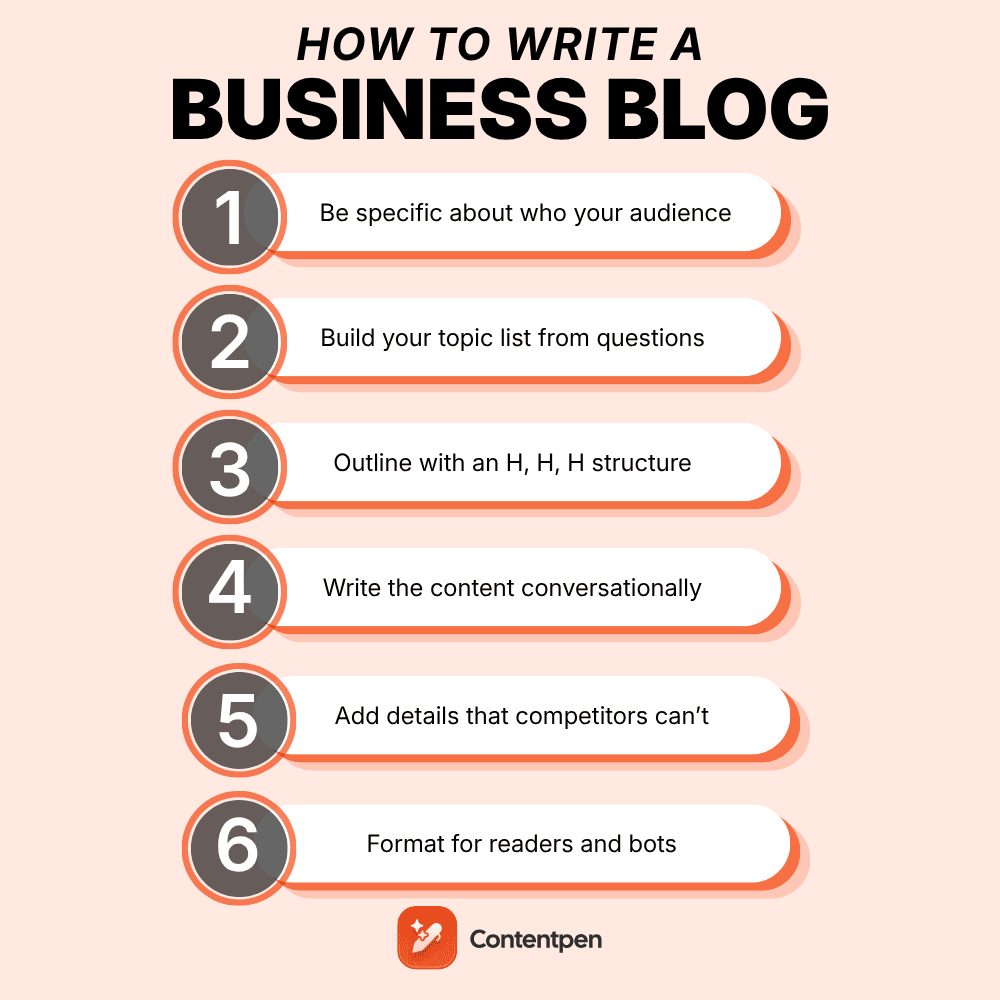
Most business owners start a blog for one reason. They want more customers. Then, three posts in, they’re stuck writing about “industry trends” because that’s what they think a business blog is supposed to sound like.
Learning how to write a business blog means treating content like a sales conversation you’re having with a stranger who hasn’t decided to trust you yet. You have to earn that trust with something useful before you ever ask for anything back.
This guide walks through what a business blog actually is, how to pick topics your future customers are already searching for, and a simple structure for writing posts. You’ll also see where a tool like Contentpen speeds up the process for your convenience.
So, let’s get into it, shall we?
Table of contents
- Key takeaways
- What is a business blog?
- What a business blog actually does for your business
- Writing a business blog step by step
- Business blog post types to know in 2026
- How to turn business blog readers into customers
- What to do after you hit publish?
- Business blog examples worth studying
- How Contentpen helps you run a business blog without a content team
- Final thoughts
- Frequently asked questions
Key takeaways
- A business blog is written to win customers for a specific company, and it succeeds or fails based on whether it answers real buyer questions.
- Build your topic list from what customers actually ask you, not from generic industry keywords.
- Use a simple Hook, Help, Handoff (H, H, H) structure for every post so it reads like advice, not a brochure.
- Match your call to action to how close the reader is to buying, instead of pitching the same thing at the end of every post.
- Treat AI tools as the first draft, then add your own numbers, opinions, and customer stories to make the post worth reading.
What is a business blog?
A business blog is a blog that a company publishes to attract, educate, and eventually convert potential customers.
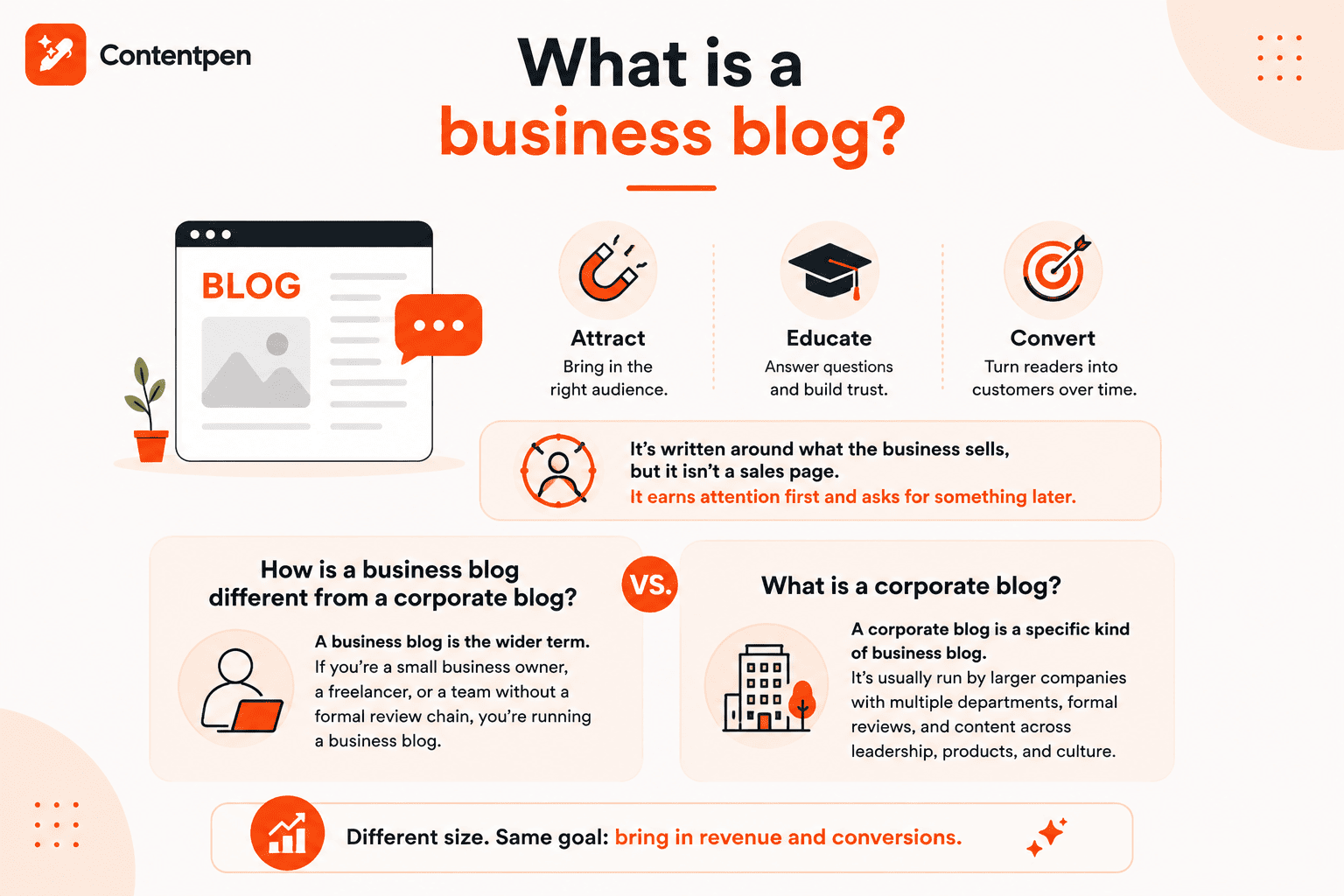
It’s written around what the business sells, but it isn’t a sales page. It earns attention first and asks for something later.
That’s a broader category than it might sound. A one-person consultancy, a local service business, and a growing SaaS startup can all run a business blog. What they have in common isn’t size or industry. It’s that the blog exists to bring in revenue and conversions.
How is a business blog different from a corporate blog?
A corporate blog is a specific kind of business blog. It is usually run by a larger company with multiple departments, a legal or brand review process, and content split across thought leadership, product education, and company culture.
A business blog is the wider term. If you’re a small business owner, a freelancer, or a team without a formal review chain, you’re running a business blog.
The main goals a business blog usually serves
Most business blogs are trying to do one or more of these things at once:
| Goal | What it looks like | Example post | Example blog |
| Get found in search | Rank for the questions your buyers type into Google | “How much does [your service] cost in [city]?” | How much does a locksmith cost in NYC? |
| Build trust before the sale | Show you know the problem better than a stranger would | “The 3 mistakes we see most often with [problem].” | 3 common plumbing mistakes to avoid today. |
| Answer questions your sales team is tired of repeating | Turn a common call question into a page you can link to | “Do you offer [specific option]?” | Do HVAC companies offer free estimates? |
| Support existing customers | Reduce support load with a clear explainer | “How to set up [feature] in under 10 minutes?” | How to set up brand knowledge in Contentpen |
A single post can accomplish more than one of these tasks at once, but knowing which goal you’re writing toward before you start keeps the post focused.
What a business blog actually does for your business
A business blog works slowly. The first few posts rarely bring in leads on their own. What they do is build a library of pages that keep working for you long after you hit publish.
Over time, that library becomes the reason a stranger finds you online and the reason an existing customer trusts your advice enough to buy the next thing you sell.
Your business blog also does something your sales page can’t. It lets a reader get to know how you think before they’ve ever spoken to you. By the time they fill out a contact form, they’ve often already decided that you’re the right fit for their needs.
That’s a very different kind of lead than one who found you cold from an ad.
Writing a business blog step by step

Business blog post writing actually comes down to six steps, and none of them require a content team to pull off.
#1: Get specific about who you’re writing for
Before you write anything, name the exact kind of customer this post is for. Not “small business owners” broadly, but something closer to “a restaurant owner who’s been putting off building a website for two years.”
The more specific the reader, the easier it becomes to write something that feels like it was written just for them. This is exactly what makes a stranger stop scrolling and start reading.
If your business serves more than one kind of customer, that’s fine. Just pick one reader per post instead of trying to speak to everyone in the same 1,000 words.
#2: Build your topic list from real customer questions
The fastest way to find business blog topics that actually convert is to stop guessing and start listening.
Go through the last few weeks of:
- Sales calls and discovery calls
- Support tickets or emails
- Reviews, both good and bad
- Questions people ask in your DMs or comments
Every recurring question in that list is a blog waiting to be written. Posts written on such query-based topics usually convert better than generic keyword-based topics because it mirrors an actual buying conversation.
Once you have a running list, run each topic through a quick search to see if people are searching for it the way you’d expect. Check what’s already ranking.
If you want a longer list of starting points, our blog post ideas guide has more prompts to pull from. It pairs well with a quick look at how to start a blog if you haven’t published your first post yet.
#3: Outline with a Hook, Help, Handoff (H, H, H) structure
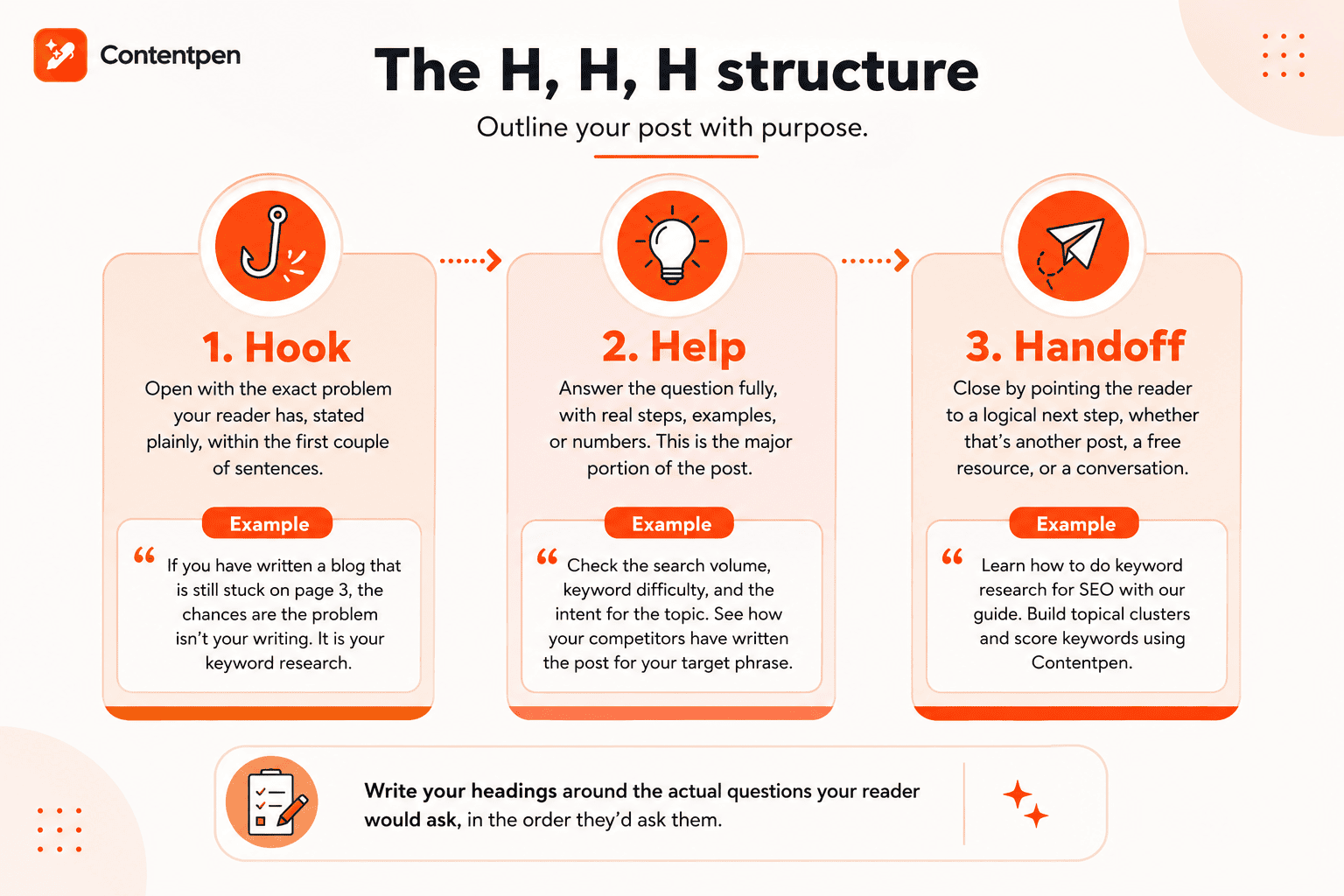
A business blog post has three real jobs, and a simple structure keeps you from losing track of any of them while writing.
- Hook: Open with the exact problem your reader has, stated plainly, within the first couple of sentences.
Example: “If you have written a blog that is still stuck on page 3, the chances are the problem isn’t your writing. It is your keyword research.”
- Help: Answer the question fully, with real steps, examples, or numbers. This is the major portion of the post, and it should be genuinely useful even if the reader never buys anything from you.
Example: “Check the search volume, keyword difficulty, and the intent for the topic. See how your competitors have written the post for your target phrase.”
- Handoff: Close by pointing the reader to a logical next step, whether that’s another post, a free resource, or a conversation with your team.
Example: “Learn how to do keyword research for SEO with our guide. Build topical clusters and score keywords using Contentpen.”
Write your headings around the actual questions a reader would ask as they move through the post, in the order they’d ask them. If you get stuck structuring a post from scratch, check out our post on how to write a blog post that covers the basics of outlining and drafting in more depth.
#4: Write it the way you’d actually explain it to a customer
The biggest tell that a business blog post was rushed or auto-generated is that it sounds like nobody. No opinion, no specific detail, just safe, general advice that could belong to any business in the category.
Picture the last time a customer asked you this exact question in person, and write the post close to how you actually answered.
If you run a bakery and someone asks why your sourdough takes three days, you probably don’t say “our proprietary process ensures optimal fermentation.” You say something like “we let the dough rest overnight twice because rushing it makes the crust chewy instead of crispy.”
That second version is the one worth publishing. It sounds like a person who actually does the work, not a brochure written to avoid saying anything specific.
#5: Add one detail a competitor’s post couldn’t copy
Generic advice is everywhere, including in whatever an AI tool would produce on the same topic with no input from you. What makes a business blog post worth reading is the detail that only you could add.
That could be a real number from your own business:
- How long does a project actually take
- What a typical client spends
- How many revisions does a project usually need
- A specific customer success story
- An honest opinion on something most posts in your industry avoid.
This is also the detail that tends to get pulled into AI-generated answers and AI Overviews, since those systems tend to favor sources with something specific to cite.
#6: Format so both people and AI search can scan it fast
Readers skim before they commit to reading, and AI answer engines do something similar when they’re deciding what to cite.
Give the direct answer to the post’s main question within the first 100 to 150 words. Then, use short paragraphs, clear subheadings, and the occasional table or numbered list to break up the rest of the text. See how to format a blog post guide for a deeper look.
Formatting isn’t just a nice-to-have for your content. It is mandatory now, especially since the rise of AI Overviews and AEO practices in the industry. A post that buries its answer under three paragraphs of fluff loses both a skimming reader and a shot at getting cited by an AI search tool.
Business blog post types to know in 2026
You don’t need to reinvent the format every time you sit down to write. A handful of post types cover almost everything a business blog needs to say.
| Post type | What is it for | Example title | Example blog |
| How-to guide | Walks a reader through solving a specific problem | “How to prep your home for a spring photo shoot” | “How to write a blog post on Shopify.” |
| Listicle | Group practical tips or options in a scannable format | “7 questions to ask before hiring a [service].” | 7 questions to ask before hiring a lawyer. |
| Customer story | Prove your work through a real result | “How we cut [client]’s [metric] in 90 days” | How we saved Go Smart Mortgage $1000+ per month. |
| Comparison post | Helps a reader choose between two real options | “[Option A] vs [Option B]: Which one fits your situation” | Contentpen vs. Jasper: Which is better for blog writing? |
| FAQ or explainer | Answers a question your sales team gets constantly | “What’s actually included in [your service]?” | What is actually included in a Carnival Cruise Line fare? |
| Opinion or take | Shares a genuine, slightly contrarian view on your industry | “Why we stopped recommending [common practice].” | Why we stopped recommending STEM OPT. |
Rotating through these formats keeps the blog from feeling repetitive. It also gives you a place to cover almost any topic from your research without forcing it into the wrong shape.
How to turn business blog readers into customers
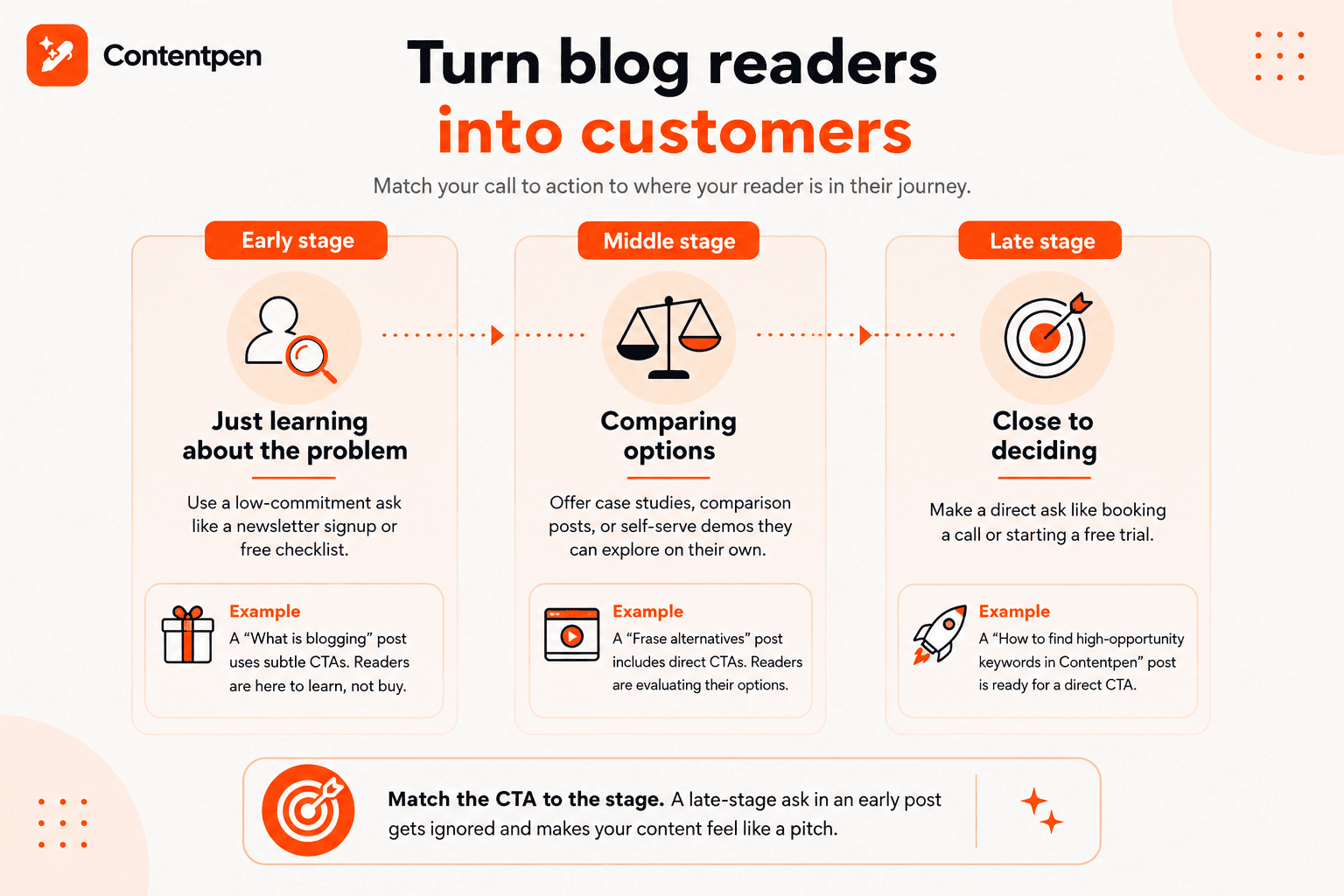
A business blog post can rank well and still bring in zero customers if the call to action doesn’t match where the reader actually is in their decision.
Someone reading an introductory “what is” style post isn’t ready to book a call yet. Someone reading a detailed comparison or pricing post usually is.
A simple way to think about it is this:
- Early-stage readers (just learning about the problem) respond better to a low-commitment ask, like subscribing to a newsletter or downloading a free checklist.
Example: A business blog like ‘What is blogging’ is a simple explainer that will use subtle calls to action, but no pushers, since the audience is only here to learn. They don’t trust you well enough for a direct action right now.
- Middle-stage readers (comparing options) respond well to a case study, a comparison post, or a demo they can watch on their own time.
Example: You can place some direct CTAs in a blog like ‘Frase alternatives’, since it will contain some head-to-head comparisons of the best AI blog writer tools, and the user is close to an action.
- Late-stage readers (close to deciding) respond to a direct ask, like booking a call or starting a free trial.
Example: A user reading a post like ‘How to find high-opportunity keywords in Contentpen’ is either already committed or about to commit to the platform. They just need a push in the right direction. Therefore, it is okay to be direct in your CTAs here.
It is important to match your CTA to the stage of the post you wrote. A late-stage ask dropped into an early-stage post usually gets ignored, and it can make the post feel like a pitch instead of help.
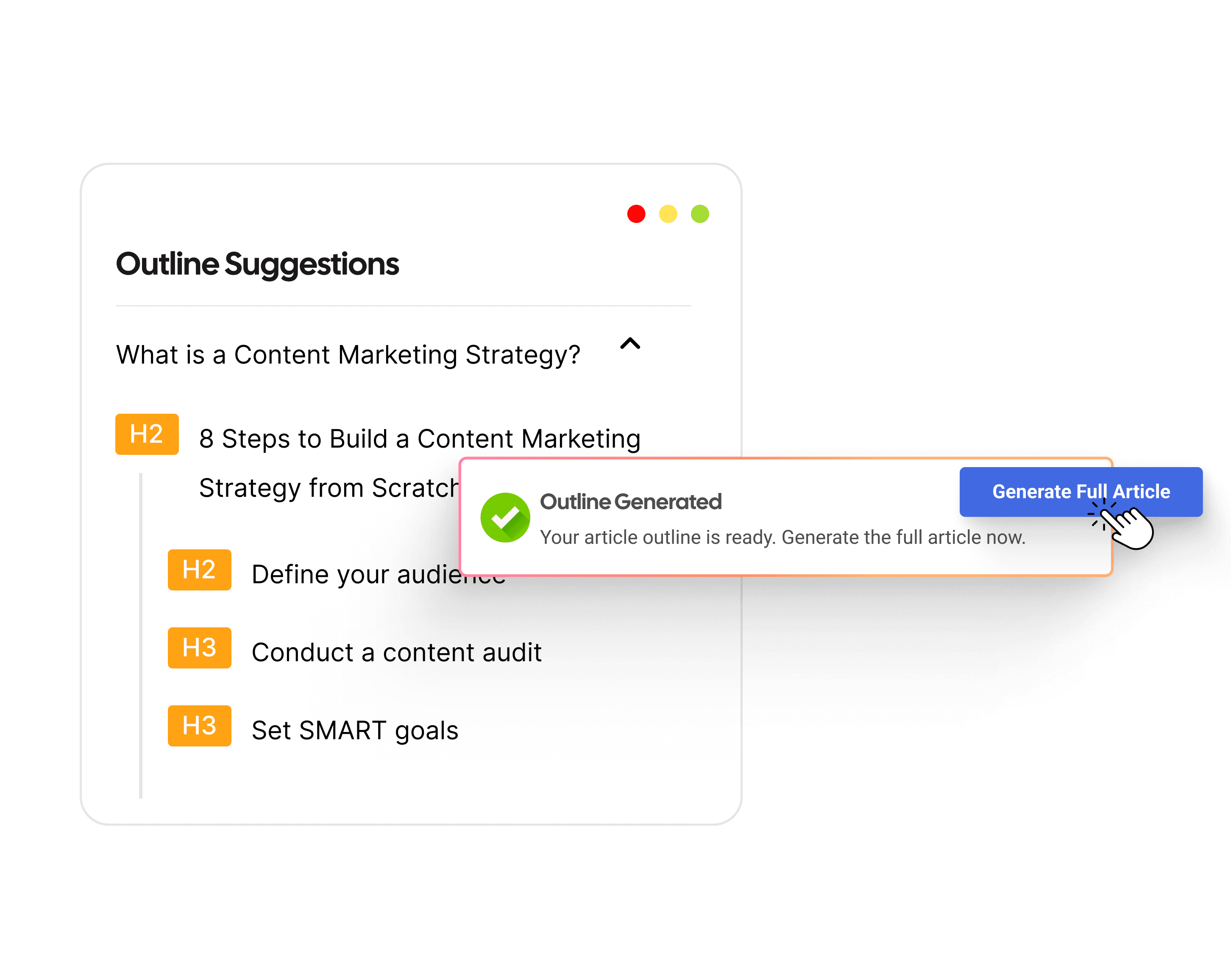
Write posts that are built to convert from the outline stage
- Get outlines structured around search intent and funnel stage
- Draft, optimize, and publish from one place

From outline to publish-ready content that fills them

Structured
Consistent
SEO-aligned
Fast
What to do after you hit publish?
Publishing is not the finish line. A great business blog post website that nobody sees doesn’t bring in a single customer.
Share it where your actual customers already spend time. That might be a relevant Facebook group, a LinkedIn post written in your own words, or an email to your existing list.
If you run ads, a strong post is also worth testing as a landing page or a retargeting touchpoint.
Give your sales and support teams a heads-up, too.
A well-written post that answers a common question is often the fastest way to close a lead who’s still on the fence. It also saves your team from typing out the same answer for the hundredth time.
Business blog content also goes out of date faster than people expect. Prices, offers, and even your own advice can shift within a year.
Therefore, it is important to set a simple reminder to revisit your best-performing posts every few months and update anything that’s gone stale.
Business blog examples worth studying
A few business blog post examples are worth studying regardless of your industry, because they solve the same problem in different ways.
#1: Buffer
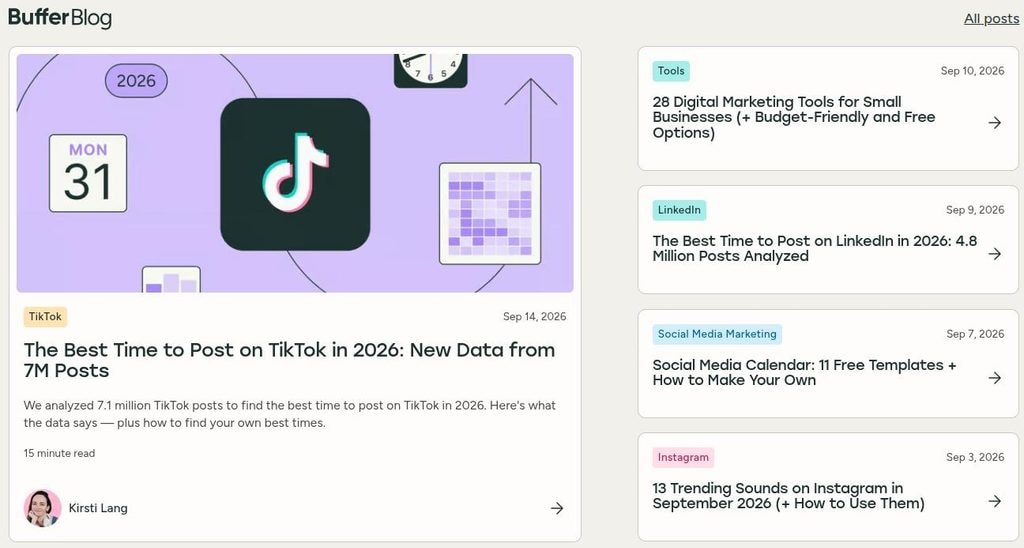
Buffer’s blog mixes practical social media advice with an unusually candid look at how the company itself operates, including its approach to remote work and transparency. It reads like a team that actually believes what it’s writing, not a brand voice reciting talking points.
#2: Beardbrand

Beardbrand, a small grooming products company, built its blog and video content around genuinely useful grooming advice long before it tried to sell anything. The content earned trust first, and the conversions followed.
#3: Mailchimp

Mailchimp’s resource content stays focused on the actual questions a small business owner has about marketing, even when the answer doesn’t point straight back to Mailchimp’s product. That restraint is part of why the content works.
What all three blogs have in common is that none of them read like they were written to hit a keyword quota. They were written with a clear audience in mind and with perfect details and formatting that readers and search engines (including AI chatbots) love to cite.
If you want a wider set of blogs to read, check out our roundup of strong blog examples that covers a broader range of styles across industries.
How Contentpen helps you run a business blog without a content team
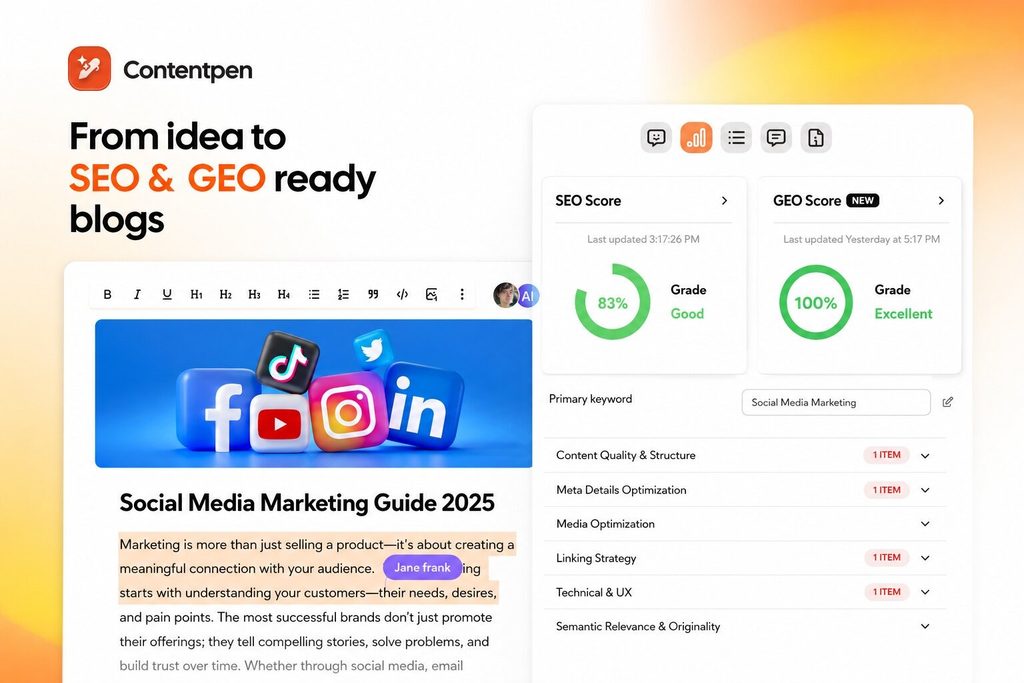
Contentpen is an AI-powered blogging system that automates finding real topics, outlining around search intent, formatting, writing, optimizing, and publishing your content. It saves your time in performing repetitive tasks, so that you can focus on the strategy part of your business.
Turning customer questions into a real content plan
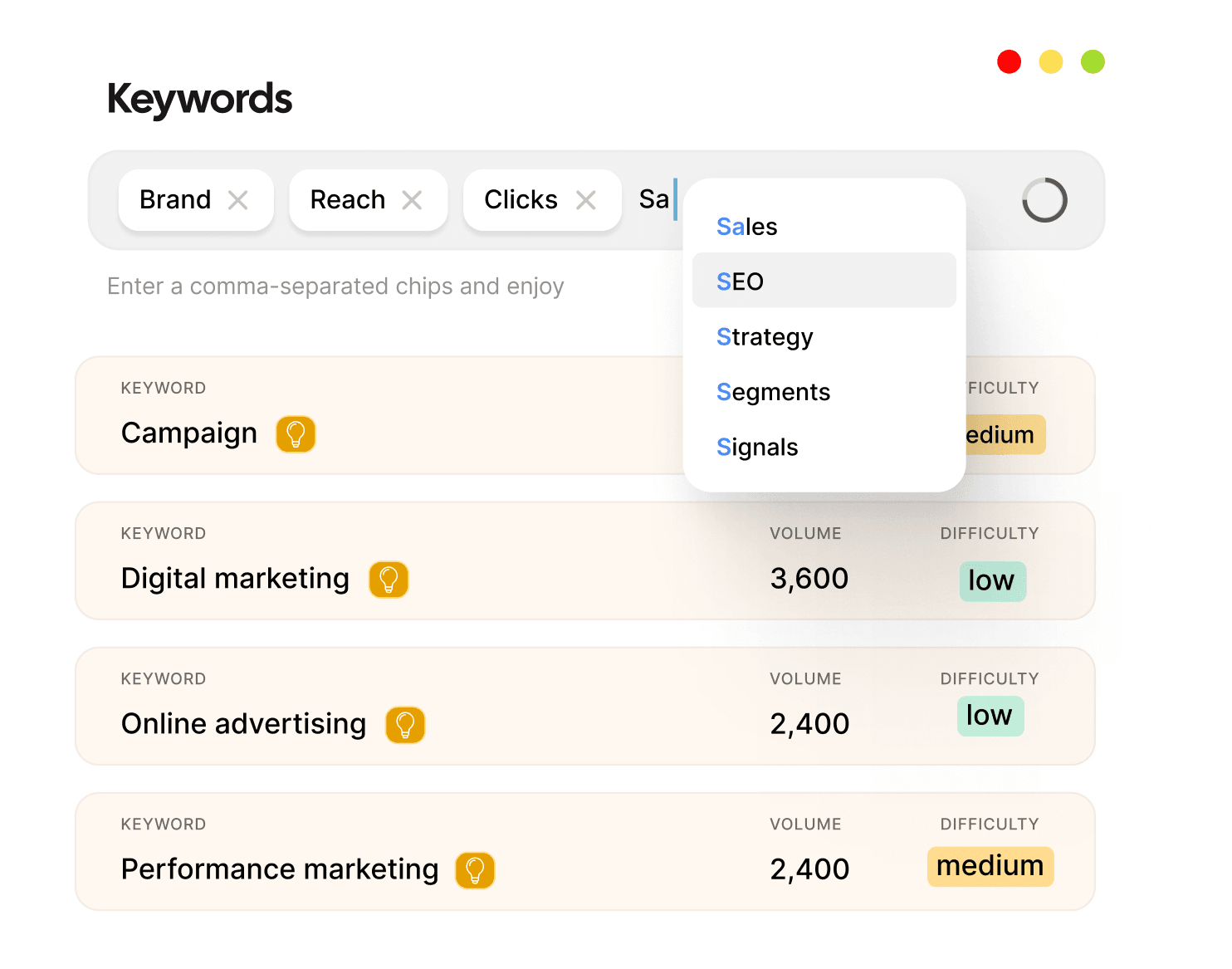
Contentpen’s keyword research pulls in search volume, difficulty, and CPC metrics for the topics you feed it. So, you can take the list of questions your customers actually ask and quickly check which ones are worth writing first. Then, compile them into clusters to create a content plan.
Create topical authority, not isolated posts that fills them
Group related content into SEO-friendly clusters
Strengthen rankings with internal relevance
SERP and gap analysis in real-time
Contentpen’s SERP and gap analysis tool helps flag content gaps before you commit to a draft. It creates outlines for you that help you outrank your competitors for more reach and visibility.
Drafting, optimizing, and publishing from one place
Once you know what to write, Contentpen can generate a full draft and then score the post for SEO and AEO readiness before it goes live.
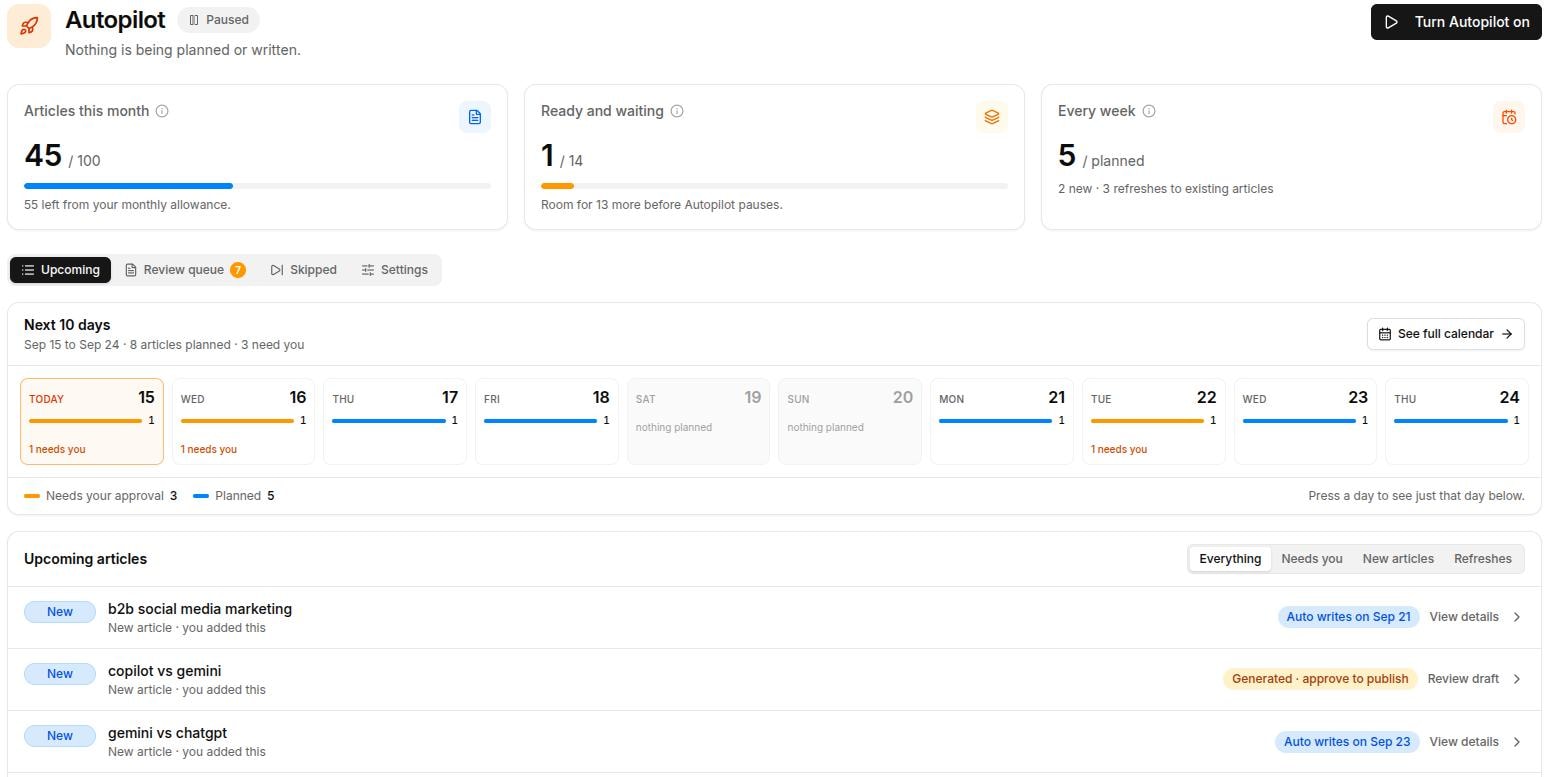
Contentpen helps businesses and enterprises achieve more with less. It collapses the entire research, outline, draft, format, and publishing process into a single-click pass. Check out our SEO autopilot for more details.
Final thoughts
A business blog is essential to answer the questions your future customers are already asking, in a voice that sounds like a real person who does the work.
Unlike corporate blogs, business blogs don’t need a big team, a formal review process, or a huge budget to work. It needs consistency, a real understanding of who you’re writing for, and at least one detail per post that only your business could add.
For the next steps, start with the questions your customers ask you every week. Pick one, write it using the Hook, Help, Handoff (H, H, H) structure we discussed earlier, and see how it performs before scaling up.
Use Contentpen to see performance post-publishing and to handle the repetitive writing, optimizing, and publishing tasks for you on autopilot.