 13 minutes
Content creation requires you to cover a topic from different angles and perspectives. This is the idea behind “your topics | multiple stories”.
When you write comprehensively about a topic, you build real depth and audience trust, which translates to better returns in the long run.
Using multiple narratives for your posts also helps boost your search engine and AI visibility as you establish yourself as an authority on the subject.
In today’s post, we’ll show you ways to incorporate multiple narratives in your writing to engage various types of audiences. By the end, you’ll also see how Contentpen fits in the picture and how you can use it today to create meaningful content.
So, let’s get started.
Table of contents
- What does “your topics | multiple stories” really mean?
- Why a single narrative is no longer enough for content success
- How to identify topics that work best across multiple stories
- Examples of topic types having multiple narrative angles
- Structural frameworks for organizing multi-story content
- Common challenges of multi-narrative content and how to overcome them
- How Contentpen helps you turn one idea into endless narratives
- The future of multi-story content belongs to strategic creators
- Frequently asked questions
What does “your topics | multiple stories” really mean?
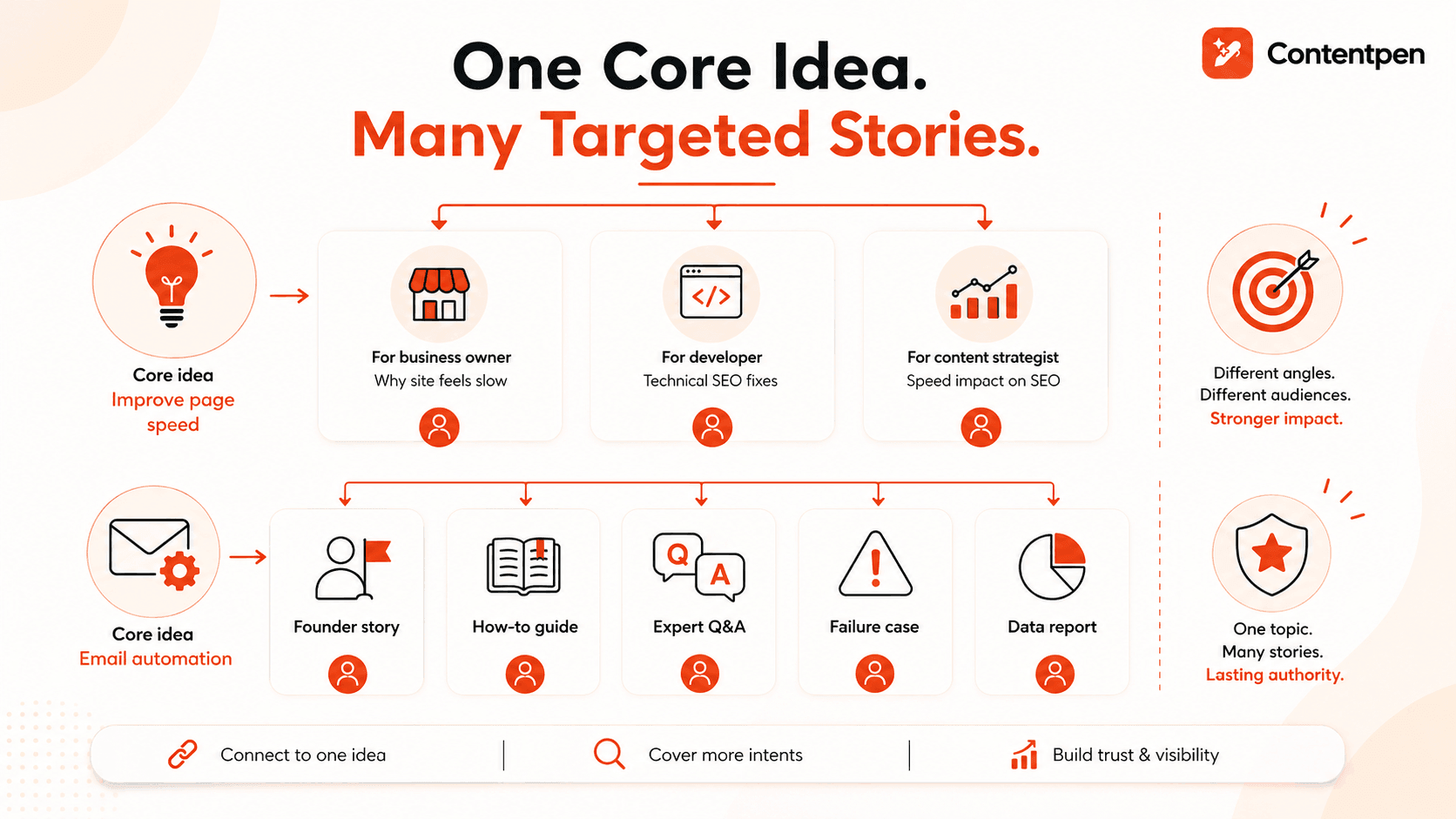
The phrase “your topics | multiple stories” describes a content approach where one core idea turns into many targeted narratives. Instead of squeezing everything into a single article, you split that idea across viewpoints, formats, and depths.
Think about a core topic like improving website page speed. One piece targets a small business owner asking why their site feels slow. Another walks a developer through technical SEO fixes like image compression and caching. A third piece of content can show tips and tricks for a content strategist to understand how speed affects rankings and bounce rate.
Same topic, three very different angles, audiences, and search intents.
For content teams, this is not just a fun writing trick. It is a strategic way to plan narrative writing topics, content ideas for storytelling, and even SEO.
Most high-performing marketers build out themes, not random one-off posts, which fits this model very well.
By writing content with this strategy, a topic like email automation might become:
- A founder story
- A practical how-to guide
- An expert Q&A session
- A failure case study
- A data-driven benchmark report
Each piece speaks to a different reader, answers a different intent, and still points back to the same idea. Over time, that cluster stands out for search engines and showcases you as the subject-expert for that topic.
Why a single narrative is no longer enough for content success
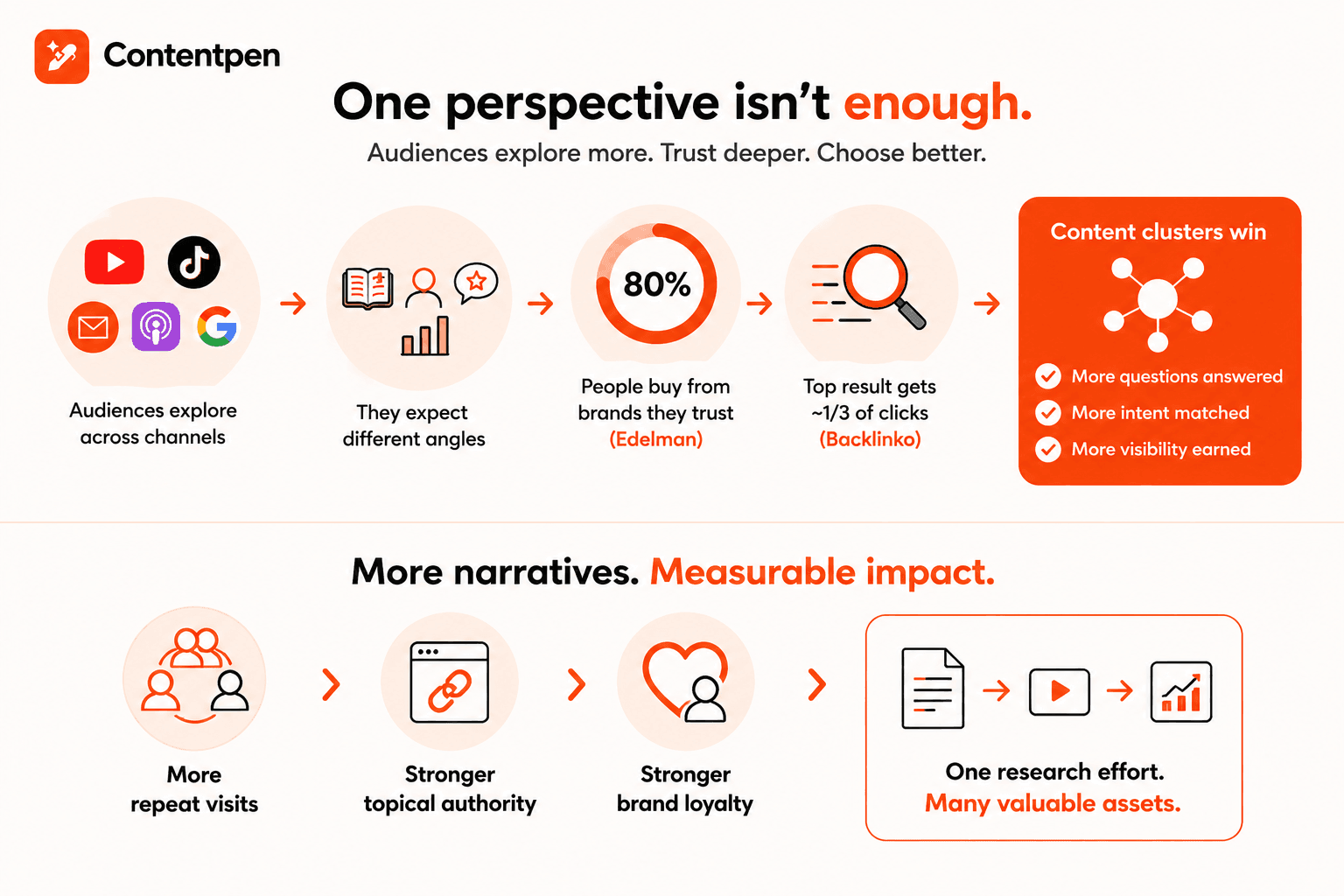
A single narrative on a topic gives one version of reality, which used to be accepted without much question. Now audiences move between YouTube, TikTok, newsletters, podcasts, and Google search results in minutes, comparing angles as they go.
If you aren’t present in most of these channels covering multiple angles for a topic, people will not consider you as their go-to source of information.
Readers expect to see beginner guides, personal accounts, expert opinions, and hard data before they trust a claim.
Studies from the Edelman Trust Barometer show that 80% of people buy from brands they trust. And that trust builds faster when content has nuance and shows more than one side of a story.
Search behavior reinforces this shift. People rarely type one head term and stop. They explore long-tail keywords for a topic as well to get to the depth of a topic.
According to Backlinko, the top organic result captures about one-third of all clicks, and that result often belongs to sites with deep, related coverage.
So a single article on remote work or AI safety struggles to rank against a site that turns that idea into content clusters. The cluster:
- Answers more questions
- Matches more intent
- Gives Google many chances to surface the brand
How multi-narrative content delivers measurable results
Multi-narrative content pays off in numbers, not just in theory.
First, it drives more repeat visits because readers know there is always another angle to explore.
Second, multiple narratives around one idea build topical authority. Internal links between beginner pieces, deep dives, and case studies help Google understand your site as a go-to on that subject. This also encourages visitors to mark you as one of their Google Preferred Sources when searching through AI Overview results.
Third, brands that show more than one perspective build stronger loyalty, since audiences see their own situation reflected somewhere in the mix.
In short, the method of incorporating multiple narratives for a single topic turns one research effort into several assets, which makes every hour of strategy and writing worth it.
How to identify topics that work best across multiple stories
Pieces of content that work share a few traits. They touch different stakeholders, get updated over time, and surface insights or angles nobody is talking about.
When you feel like you could argue about a subject from three distinct sides, you probably have a strong candidate for a topic that you can use to tell multiple stories.
Several topic families almost always support multiple narratives:
- Historical events: You can provide commentary on the lives of leaders, citizens, and individuals, and how they’ve influenced a particular thing in the past.
- Social issues: Writers can explore climate policy or housing costs that touch policymakers, families, landlords, and activists.
- Technology shifts: In 2026, you should consider writing about AI tools and technologies, such as driverless cars, which involve workers, founders, regulators, and users.
- Business dynamics: Content creators and news analysts can discuss how pricing changes affect finance, sales, customers, and partners in different ways.
Once you’ve identified topics that are worth covering over multiple stories, run it through our ACLC test:
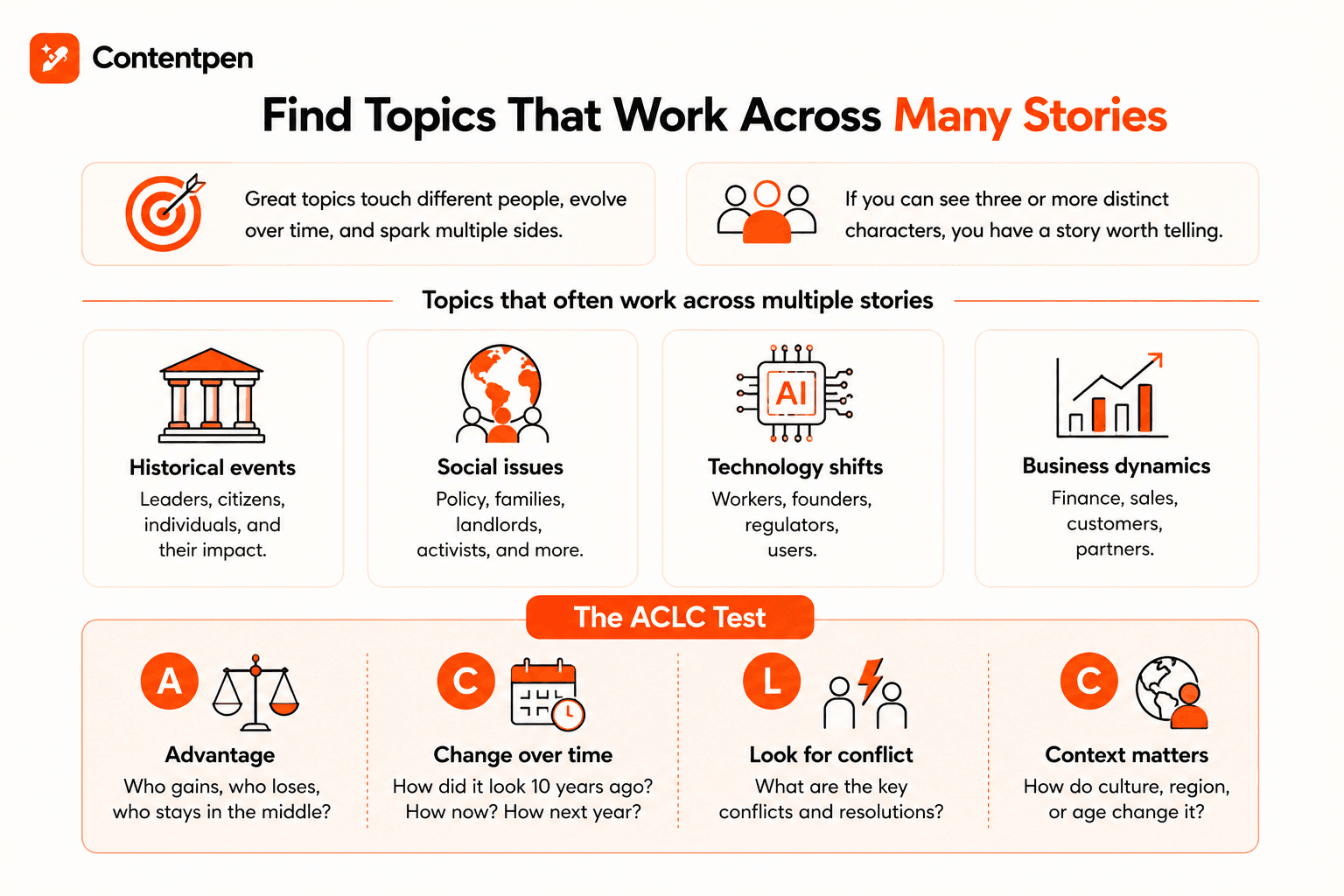
- Ask who gains, who loses, and who sits in the middle if this topic changes.
- Consider how the story looked ten years ago, how it feels now, and what might change next year.
- Look for clear conflicts and resolutions from different sides, such as buyer vs seller or citizen vs city planner.
- Check whether culture, region, or age changes how someone experiences it.
If you can quickly imagine three or more specific characters around the topic, you likely have good material for storytelling from one idea that can stretch into many narratives.
Examples of topic types having multiple narrative angles
The table below gives a fast way to spot topics that can support multiple narratives and stories for different content formats.
| Topic type | Example topic | Sample story angles |
| Historical event | Local factory closure | Worker memories, town budget impact, new startup response |
| Social issue | Urban air quality | Parent fears, doctor advice, city planner trade-offs |
| Technology and innovation | Content creation | Team adoption, SEO specialist concerns about quality control |
| Personal identity | First year in a new country | Feeling invisible, community support, long-term career change |
| Business or market shift | Move to subscription pricing | Customer pushback, finance team modeling, support team workload |
Each example can carry many more variations, including creative writing prompts, tutorials, and opinion pieces.
One such real-life example could be from Contentpen. We covered the ‘what is alt text’ topic, highlighting the basics of what it is, where it is used, etc.
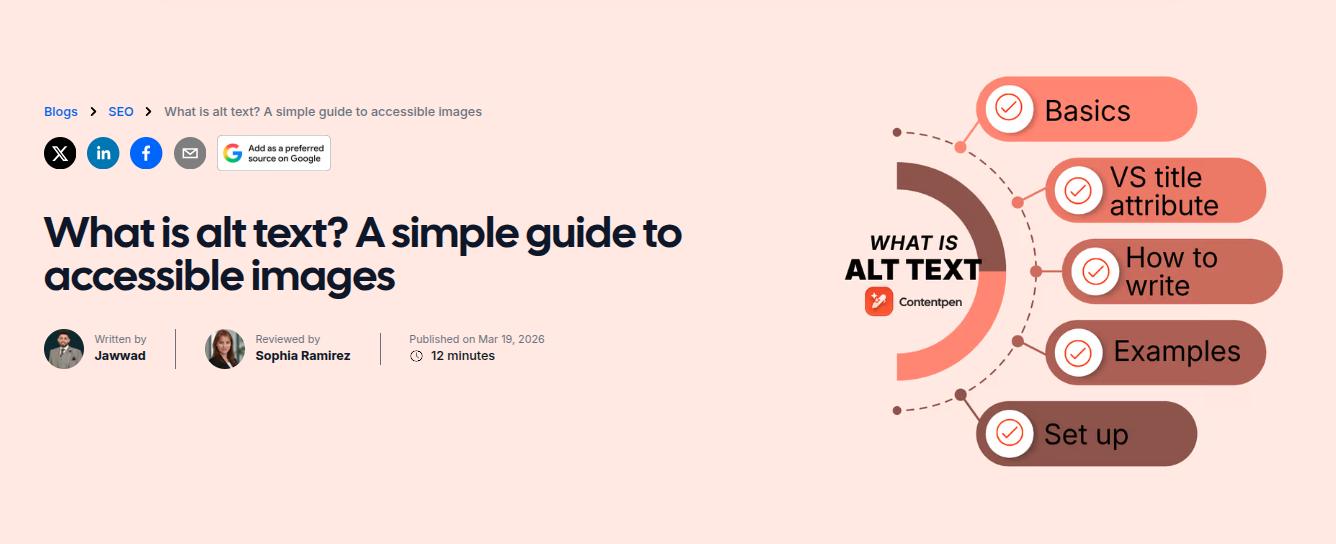
Then, we added another story on ‘how to write alt text’, followed by ‘alt text examples’ to show users how it’s actually done in real-life.
Therefore, we were able to put all our multiple angles for a single topic (alt text), which also allows us to place internal links, leading to better SEO.
Structural frameworks for organizing multi-story content
Structural frameworks give ‘your topics | multiple-story‘ projects a clear reading path so audiences do not feel lost, and they give teams a reliable method for placing each planned piece within the broader content system.
Choosing the right framework upfront is the difference between a coherent narrative cluster and a scattered pile of loosely related posts.
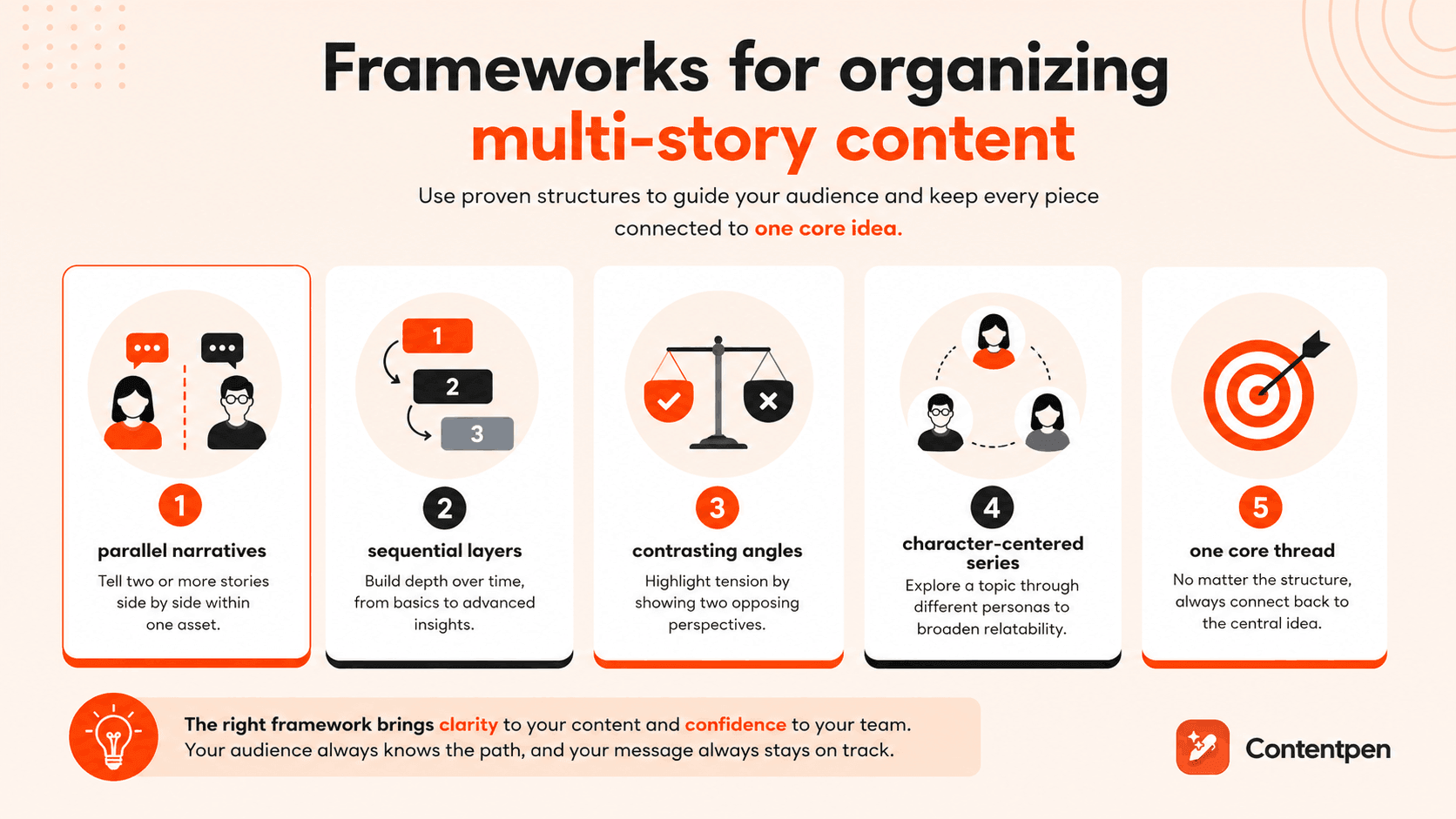
One common model is parallel narratives, where you tell two or more stories side by side inside one asset. An example is a blog post on remote work that alternates between an employee viewpoint and a manager viewpoint.
Another model is sequential layers, where each asset adds depth over time, such as a series of newsletters leading from basics to advanced practice of blog writing.
You can also use contrasting angles, where stories highlight tension, such as customer success vs customer failure with the same product.
Character-centered series focus on different personas, such as designer, engineer, and marketer inside a product team. With such pieces of content, you can connect with different types of audiences, making your writing more relatable and likeable.
The key is that every structure still points back to one core thread. Your audience should always know what idea they are exploring, even as the voices change.
A step-by-step content development framework for content teams
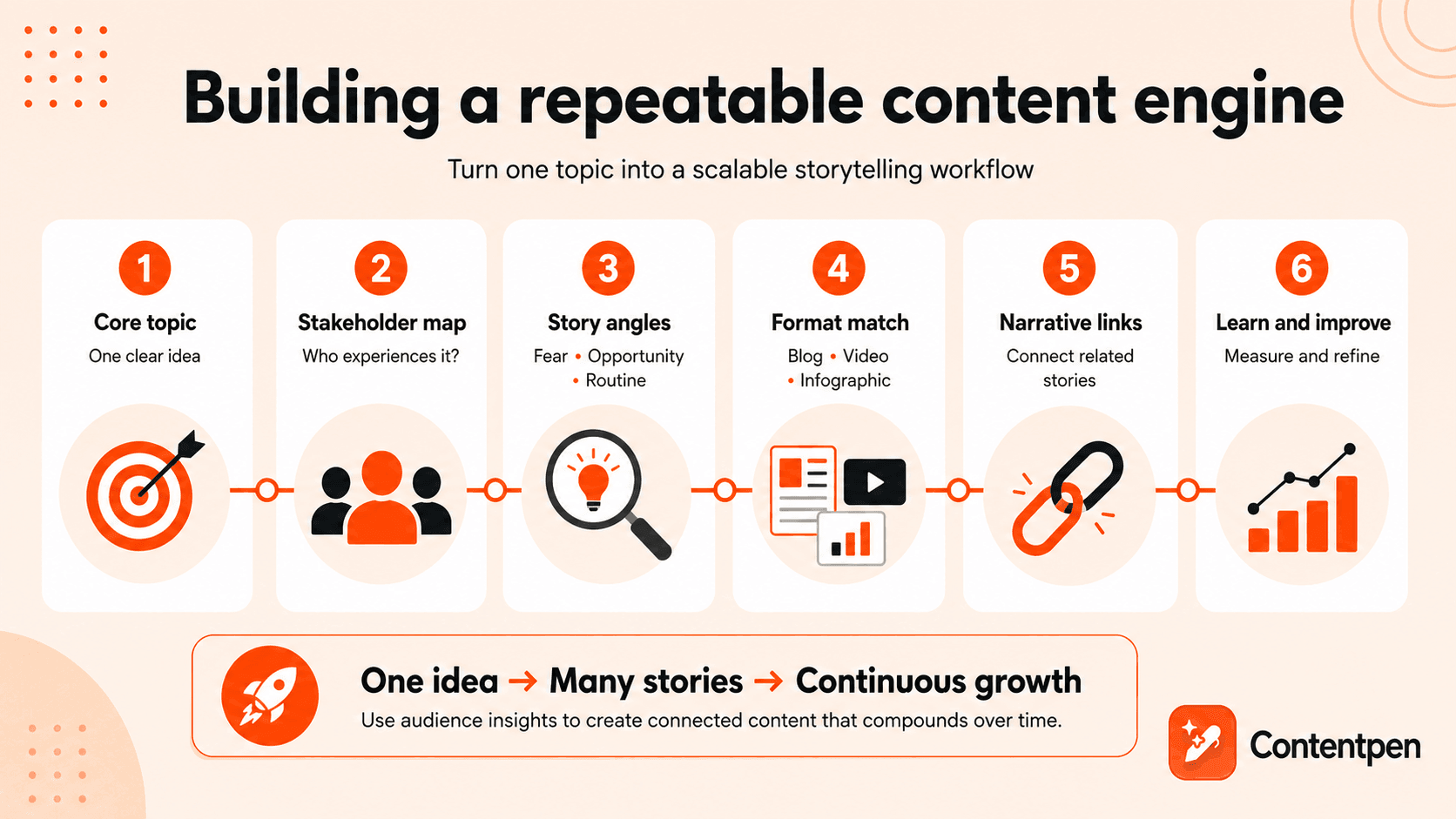
A simple workflow makes multi-story content easier to repeat and scale.
- Step 1: Define the core topic in one plain sentence that captures the main idea and audience.
- Step 2: Map the stakeholders and write out how each group touches that topic on a normal day.
- Step 3: Assign one clear angle to each stakeholder, such as fear, upside, daily routine, or long-term result.
- Step 4: Match angles to formats, using blog posts for analysis, podcasts or video for lived stories, and infographics for data.
- Step 5: Plan internal links so every article or episode points to at least two related narratives.
- Step 6: Review performance through analytics, comments, and social replies, then feed that insight into the next round of stories.
This kind of system turns one idea into a repeatable content machine that helps you bring in visitors and organic traffic consistently.
Common challenges of multi-narrative content and how to overcome them
Multi-narrative content strategy comes with a defined set of recurring obstacles. These are information overload, confirmation bias, structural fragmentation, and high resource usage.
Understanding these challenges in advance lets teams build systems that sidestep them before they derail a campaign.
#1: Suffering from information overload
Too many angles packed into one asset makes readers bail out. They may have a lot to process initially, which becomes a friction point for them in exploring more angles for a topic.
This begs the question, ‘what to do when you have too many story ideas?’
Well, the best approach for this is to keep each piece focused on one clear perspective or question, then connect related content through internal or external links (if needed) and calls to action.
A series across several posts is easier to follow than one overloaded article trying to cover everything in one place.
#2: Confirmation bias
Readers may only click stories that match their current beliefs. To reduce this, pair contrasting views in the same hub page or newsletter and invite comparison.
You might place a founder success story next to an honest breakdown of a failed launch. That mix nudges people to consider more than one side and accept your diverse narratives for a single topic.
#3: Structural fragmentation
When writers work in silos, narrative threads start to fall out. You may have the best ideas for multiple narratives, but the execution part still needs to be impeccable.
To overcome this challenge, create a short content blueprint that repeats the core topic, audience, and promise at the top of each brief. Google recommends keeping pages focused and helpful, and a shared blueprint helps teams hold that line across many stories.
#4: Resource intensity
Multi-story projects can feel heavy for lean teams. There’s a lot to write and distribute online on your website, socials, or video platforms, such as YouTube, etc.
One possible solution to this is to treat multi-story projects like campaigns instead of random ideas, and reuse research, quotes, and data across pieces.
Platforms such as Contentpen make this easier by holding topic research, outlines, and internal links in one place so you do not restart from zero every time.
How Contentpen helps you turn one idea into endless narratives
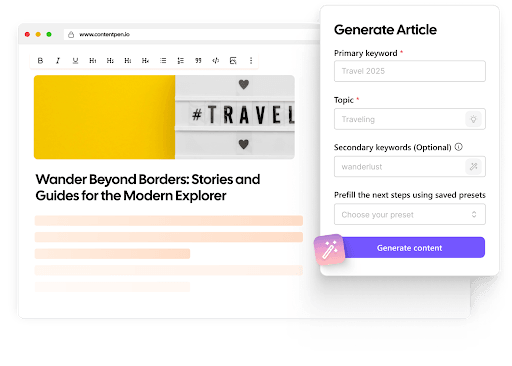
Contentpen exists to make ‘your topics | multiple stories‘ projects practical for real teams that juggle deadlines or have resource constraints. It is an end-to-end AI blog creation platform built to provide SEO and AEO-optimized long-form content at scale.
Instead of starting from scratch, you begin with one clear idea and let the platform create multiple, structured angles that perform well for both search and AI visibility.
Inside Contentpen, you can take a seed topic and quickly see content ideas for storytelling across different audience types.
The AI blog writer suggests narrative writing topics based on your brand voice and knowledge base, so you never drift away from your target audience.
The same workspace supports keyword research, content creation, editing, and publishing. Contentpen helps you design proper clusters and connects them through the interlinking tool.
For agencies and in-house teams, this means you can treat each campaign as a set of related stories, not scattered narratives.
Who benefits most from Contentpen’s multi-story capabilities?
Contentpen is helpful for the following groups of people looking to create comprehensive pieces of content at scale:
- Marketing teams and agencies can turn a single campaign idea into a queue of blog posts, thought leadership pieces, and landing pages without reinventing briefs every time.
- Solo creators and freelance writers can turn one client topic into multi-narrative articles, boosting income while keeping research time under control.
- SEO specialists can plan content clusters around strategic phrases and let Contentpen keep structure, internal linking, and brand voice consistent while they focus on search gaps.
One of the biggest advantages of Contentpen is its ability to see how your content performs after publishing with web analytics.
The future of multi-story content belongs to strategic creators
The bottom line is this: the future will favor those who plan content and provide comprehensive answers to users’ questions, not just post it.
As more digital marketing channels emerge and audiences skim harder, brands that can tell one idea in many focused ways will be more trustworthy than those who won’t.
Contentpen offers the structure and tools to build that content library without adding chaos. When you are ready to turn one idea into a set of connected narratives, you can explore Contentpen and see how it fits your workflow.

Write better blogs in less time, without sacrificing quality.
Let AI handle structure, clarity, and flow while you stay in control of the message.
Try AI blog writing →